If you’re eyeing a 2025 Nissan Ariya, or a lightly used 2023–2024 model, you’re probably wondering one thing: will this stylish electric SUV be a dependable partner or an occasional problem child? The Ariya is comfortable, quiet, and packed with tech, but reliability stories online range from “flawless so far” to “dead in the driveway with warning lights everywhere.” Let’s separate patterns from one-off horror stories so you can decide with clear eyes.
Quick takeaway
2025 Nissan Ariya reliability at a glance
Ariya reliability snapshot (based on 2023–2025 feedback
Because the Ariya is still a relatively new model (launched for 2023 in the U.S.), we don’t yet have 10-year, 150,000‑mile data. What we do have is a growing pile of owner reports from 2023 through early 2026 that all point to the same themes: excellent battery durability so far, fussy 12V batteries and warning lights for some owners, and long waits for parts when a more complex repair is needed.
What’s new for the 2025 Ariya (and why it matters for reliability)
Mechanically, the 2025 Ariya isn’t a clean-sheet redesign. It builds on the same basic platform as the 2023–2024 models, with the familiar 63‑kWh and 87‑kWh battery options and front- or all-wheel drive. That means most of what we’ve learned about reliability on 2023 and 2024 examples applies directly to 2025 cars.
- Same core battery packs and thermal management system as earlier years
- Same dual‑motor setup on e‑4ORCE AWD models
- Incremental software updates over the air and via dealer visits
- Some trim and feature reshuffling, but no single big mechanical change
From a reliability standpoint, that’s actually a good thing. Nissan has had several model years to iron out manufacturing and software bugs, while early data shows the main high-voltage components holding up well. The flip side: if a 2023–2024 Ariya has an Achilles’ heel, chances are a 2025 can share it unless Nissan has quietly updated suppliers or software in the background.
Common 2023–2025 Nissan Ariya issues owners report
Dig through owner forums and social channels, and a pattern emerges. You’ll see glowing reports from people with 20,000–55,000 trouble‑free miles, right alongside posts about being stranded by an “EV System Off” warning two days into a lease. Here are the most commonly mentioned problems across 2023–2025 Ariyas:
Most common Ariya reliability complaints
Not every Ariya will see these issues, but they’re the ones you should know about.
Weak 12V battery
- "EV System Off" or "Service EV System" messages
- No start / bricked vehicle after parking
- Multiple 12V replacements on some cars
Error messages after DC fast charging
- Car won’t go into gear
- Needs a tow and dealer visit
Slow parts and repairs
- Headlamp assemblies, control modules, sensors
- Owners report parts on backorder for weeks
- Cars can sit at dealers for a month or more
Important nuance
High-voltage battery life and range over time
If you’re looking at the Ariya as a long‑term EV, the big question is simple: will the main battery hang in there, or are you buying a ticking time bomb? Early evidence from 2023–2025 owners is encouraging.
- Drivers with 20,000–55,000 miles on 87‑kWh packs commonly report no noticeable range loss yet.
- Owners are fast‑charging on road trips and regularly charging to 100% at home without seeing obvious degradation in the first few years.
- Compared with older Leafs, Ariya’s liquid‑cooled battery and chemistry appear to be aging more gracefully so far.
You should still expect some degradation over 8–10 years, every EV loses a slice of range as the pack ages, but nothing in real‑world reports suggests the Ariya is an outlier in a bad way. In fact, it’s shaping up to be more conservative and battery‑friendly than many early EVs.
Simple habits that help the Ariya battery last
- Charging to 80–90% for daily use and saving 100% for trips.
- Avoiding frequent deep discharges below 10–15% when you can.
- Not fast‑charging back‑to‑back on hot days unless you truly need to.
The 12V battery problem: small part, big headaches
If the Ariya has a signature reliability sore spot so far, it’s the humble 12‑volt auxiliary battery. That little lead‑acid unit powers up modules, relays, and computers, if it sags, the whole car can behave like it’s possessed.
What owners are seeing
- "EV System Off" or "Service EV System" warnings at startup
- Car won’t shift into gear, even though the main battery has plenty of charge
- Errors more likely after the car sits for a day or two or after DC fast charging
- Some owners report multiple 12V failures within the first couple of years
What often fixes it
- Dealers testing and then replacing the 12V battery under warranty
- Owners proactively swapping the factory 12V battery for a higher‑quality AGM unit
- Aftermarket battery monitors to watch resting voltage at home
Why a weak 12V feels so dramatic
The good news? Once the 12V issue is properly sorted, often with a better‑spec replacement battery, many owners report months of trouble‑free driving. If you’re shopping used, this is one of the first things you should ask about.
Software, electronics, and driver-assist reliability
Modern EVs are rolling computers, and the Ariya is no exception. Compared with some tech‑heavy competitors, the Nissan’s infotainment and driver‑assist systems have been relatively drama‑free, but there are still quirks.
Electronics and tech: what to expect
From lane‑keeping to phone apps, here’s how the Ariya behaves day to day.
Infotainment & connectivity
Driver-assist systems
App & remote features
Dealer software updates matter
Repair costs, parts availability, and downtime
Reliability isn’t just about how often a car breaks, it’s about what happens when it does. On that front, the Ariya is a bit of a mixed bag.
When something breaks: what Ariya owners report
Not every repair will look like this, but these are the patterns that show up repeatedly in owner stories.
| Issue type | Typical fix | Covered under warranty?* | Owner pain point |
|---|---|---|---|
| Weak 12V battery | Replace 12V battery | Often yes in first years | Stranded vehicle; may need tow |
| Sensor / warning light | Diagnose, reprogram, or replace sensor/module | Usually | Parts occasionally on backorder |
| Lighting or trim component | Replace headlamp, exterior piece, interior trim | Usually in early years | Some owners waiting weeks for parts |
| Major EV component (rare so far) | Repair/replace inverter, motor, or pack | Typically covered under EV warranty if early failure | Potentially long waits; limited dealer EV experience in some areas |
The hidden cost: time without your car
On the plus side, the Ariya doesn’t have oil changes, timing belts, or exhaust systems to maintain. Routine costs, tires, cabin filters, brake service, are in line with other compact SUVs. It’s the rare but complex repair where the ownership experience can get bumpy.
Ariya warranty coverage: what’s actually protected
Nissan backs the Ariya with the kind of coverage you’d expect from a mainstream EV, and that matters a lot when you’re weighing reliability risk, especially on a used example.
- Basic bumper‑to‑bumper warranty: typically 3 years / 36,000 miles from original in‑service date.
- High‑voltage battery warranty: typically 8 years / 100,000 miles against defects and excessive capacity loss, transferable to subsequent owners.
- Powertrain coverage: often aligned with or slightly longer than basic warranty for EV drive components, depending on market.
Double‑check battery warranty on a used Ariya
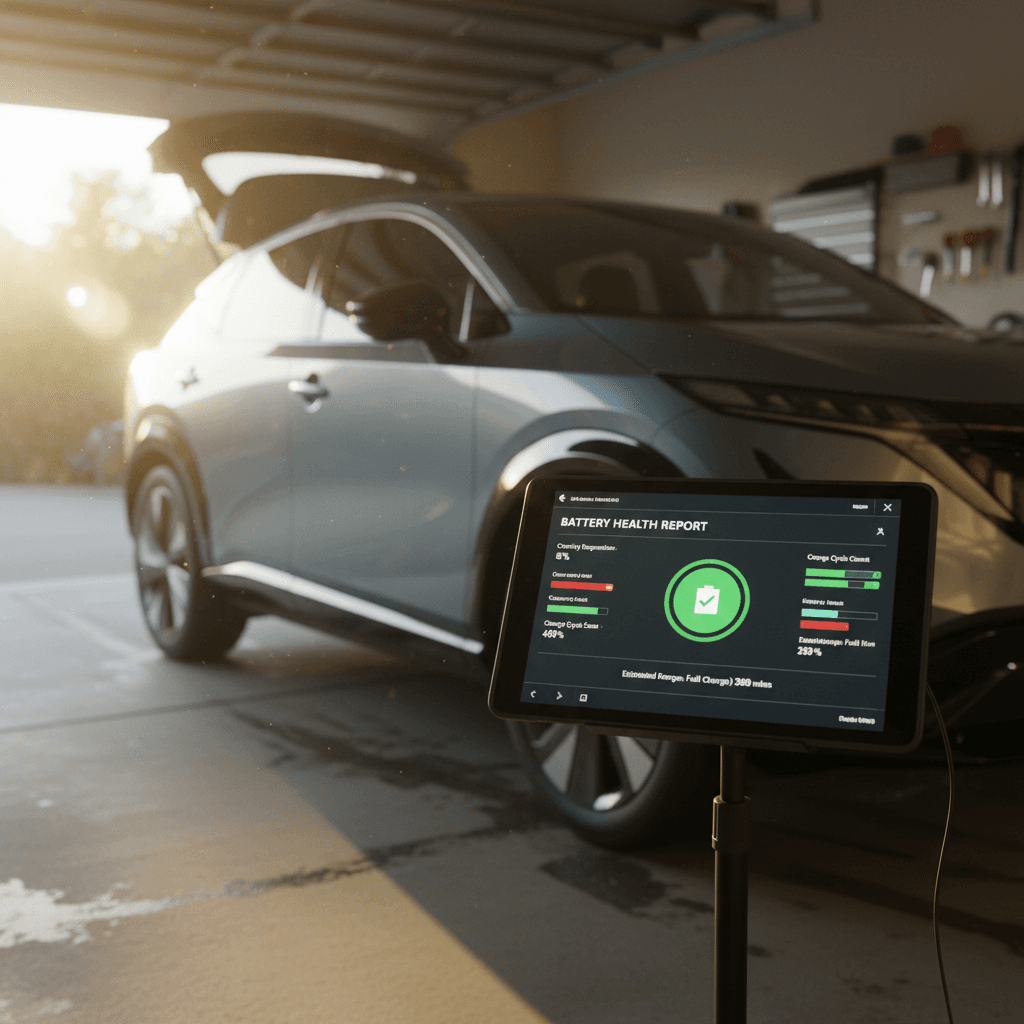
If you shop through a platform like Recharged, your car comes with a Recharged Score battery health report that independently verifies pack condition. That takes a lot of the guesswork out of relying on a warranty you hope you’ll never need.
Used Nissan Ariya reliability checklist
A clean Carfax and shiny paint don’t tell you whether an EV will be a good long‑term partner. When you’re evaluating a used Nissan Ariya, especially a 2023–2025 model, use this reliability‑focused checklist to separate the keepers from the headaches.
10 reliability checks before you buy an Ariya
1. Confirm remaining warranties
Ask for documentation on the <strong>in‑service date</strong> (when the warranty clock started). Confirm how much basic and battery warranty time and mileage are left, and get it in writing.
2. Ask about 12V battery history
Has the 12V battery ever been replaced? If yes, when and with what? A quality replacement, ideally an AGM battery, can be a good sign, not a red flag.
3. Scan for stored error codes
Have a shop or EV‑savvy seller run a scan for any <strong>stored EV system or battery‑related codes</strong>, even if no warning lights are on today.
4. Review charging behavior
During your test drive, <strong>AC charge the car</strong> briefly and, if possible, do a short DC fast charge. Watch for warning lights before, during, and right after charging.
5. Test every driver-assist feature
On a clear road, gently test lane‑keeping, adaptive cruise, and ProPILOT functions. They should behave consistently, without random disengagements or constant beeping.
6. Inspect tires and suspension wear
Uneven tire wear or a harsh, noisy ride can hint at alignment or suspension issues. Tires worn out very early may just be soft OEM rubber, but factor replacement cost into your offer.
7. Check all lighting and exterior trim
Turn on every light, including adaptive or cornering functions if equipped. Headlamps and some trim pieces have been on <strong>long backorder</strong> for some owners.
8. Verify software is up to date
Ask the seller for <strong>dealer service records</strong> showing completed software updates or recalls. Outdated software can cause weird behavior that looks like hardware failure.
9. Look for water leaks and interior squeaks
After a car wash or rain, check for moisture in the cargo area, footwells, and around the panoramic roof (if equipped). Rattles and squeaks on rough roads can drive you crazy over time.
10. Get independent battery health data
Whenever possible, rely on a <strong>formal battery health report</strong>, like the Recharged Score, to see real state‑of‑health rather than guessing from the range estimate on the dash.
Why used Ariyas can be a sweet spot
How the Ariya’s reliability compares to other EV SUVs
If you’re cross‑shopping a 2025 Ariya with competitors like the Tesla Model Y, Hyundai Ioniq 5, Kia EV6, or Ford Mustang Mach‑E, you’re probably trying to figure out where it lands on the reliability spectrum.
Where the Ariya looks strong
- Battery durability so far appears competitive, with many owners reporting zero visible degradation after tens of thousands of miles.
- Ride comfort and interior build quality are highlights; squeaks and rattles are mentioned less often than in some rivals.
- Fewer widespread software meltdowns than we’ve seen from some newer‑to‑EV brands.
Where it lags rivals
- 12V battery issues feel more common than they should on a modern EV.
- Parts availability and dealership EV expertise can trail Tesla and Hyundai/Kia in some regions.
- DC fast‑charging speeds are modest, so if you road‑trip a lot, you spend more time parked at chargers.
In plain English: the Ariya isn’t the problem child some early rumors suggested, but it’s not the bulletproof Toyota of EVs either. It sits in the middle of the pack, better than average in battery and build, average or slightly below in dealer experience and minor electrical issues.
2025 Nissan Ariya reliability: FAQ
Frequently asked questions about 2025 Nissan Ariya reliability
Bottom line: should you trust an Ariya long-term?
If you’re after an electric SUV that feels refined and relaxed rather than shouty and over‑caffeinated, the 2025 Nissan Ariya has a lot going for it: a quiet cabin, comfortable ride, and a battery that’s aging gracefully so far. Reliability isn’t perfect, 12V battery gremlins and slow parts can turn a random Tuesday into an unplanned adventure, but the underlying EV hardware looks solid, and many owners are piling on miles with nothing more than tire and brake service.
For a new or nearly new Ariya, the smart move is to leverage the warranty period: keep software current, get the 12V battery thoroughly tested, and document anything that seems odd. For a used one, be choosy, lean on independent battery health data, and don’t be afraid to walk away from a car with a sketchy history. If you want help finding a good example, Recharged can pair you with a used Ariya that’s already been through battery diagnostics, pricing analysis, and expert review, so you spend your time driving, not refreshing the service department’s voicemail.
Next step: find the right EV for you
Ready to find your next EV?
Browse Vehicles