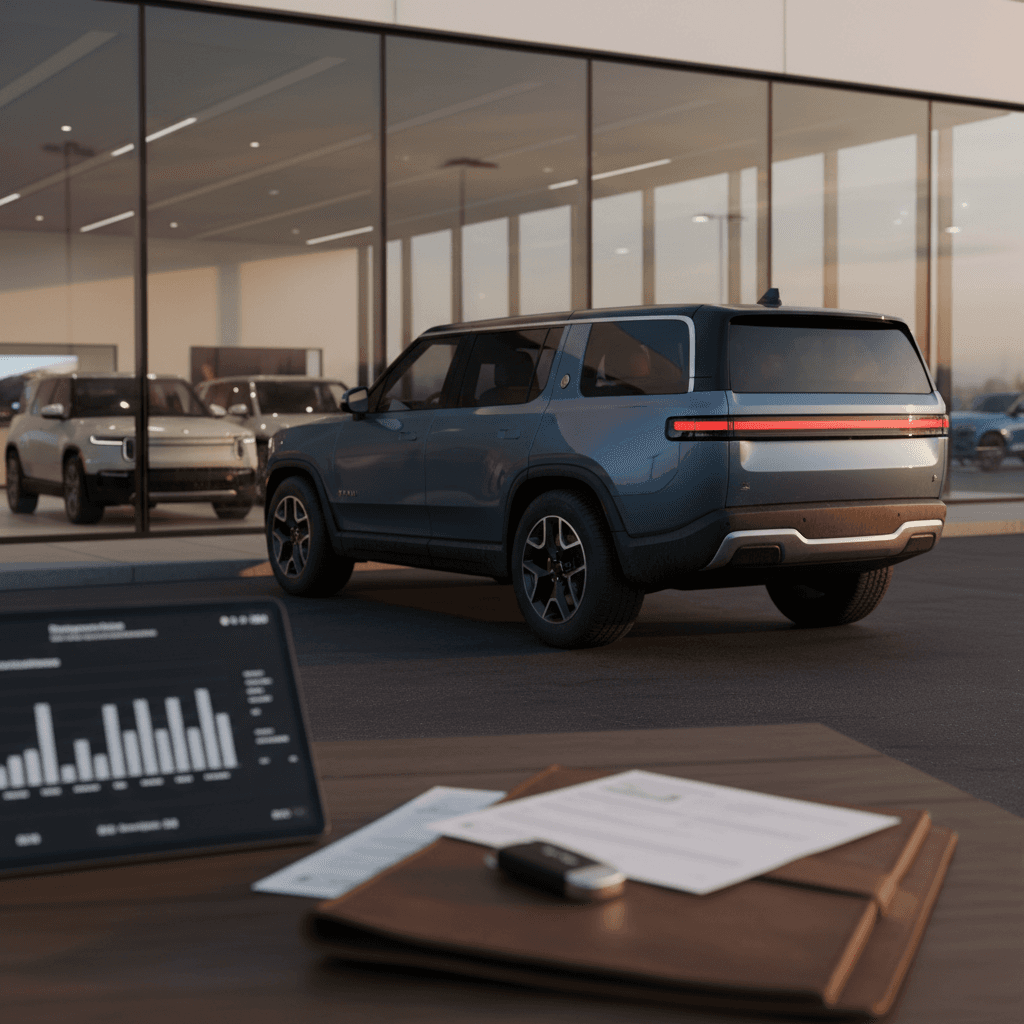
If you own a 2025 Rivian R1S, you’re sitting on one of the most desirable electric SUVs in the market, and a vehicle with a fast‑moving resale story. Understanding your 2025 Rivian R1S trade in value is the difference between leaving thousands of dollars on the table and walking away with a deal that actually reflects what your three‑row EV is worth.
Why R1S trade values feel confusing
How 2025 Rivian R1S trade-in value is really set
Every buyer, whether it’s a Rivian store, a franchise dealer, or a used‑EV marketplace, is doing the same basic math on your R1S. They start with recent retail selling prices for similar vehicles, subtract the margin they need, then adjust for condition, options, mileage, battery health, and local demand. The result is your trade offer. The trick is understanding each of those pieces so you can push the number higher.
Rivian R1S value snapshot (early 2026 used market)
Public data for 2024 R1S models shows trade‑in values mostly in the low‑$60,000s for clean, average‑mileage examples, with retail values stretching up toward $80,000 depending on options. The newer 2025s will usually sit a bit higher, but they’re following the same depreciation curve: a sharp hit in year one, then a shallower slide as the truck ages.
2025 Rivian R1S pricing and depreciation basics
To make sense of any trade offer on a 2025 R1S, you first need to know where it started. Rivian has adjusted pricing and trims several times, phasing out some lower‑priced dual‑motor variants and leaning into higher‑content models. That matters because depreciation is percentage‑based, but buyers think in hard dollars.
Common 2025 Rivian R1S configurations and pricing context
Use this as a rough baseline; exact MSRP depends on paint, wheels, interior, and packages.
| Configuration (2025 R1S) | Drivetrain | Battery pack | Original MSRP ballpark* | Early used retail range** |
|---|---|---|---|---|
| Dual Motor Large Pack | AWD | Large | Mid–high $70,000s | Mid–high $60,000s |
| Performance Dual Motor Large Pack | AWD | Large | $80,000+ | High $60,000s–low $70,000s |
| Tri Motor | AWD | Large or Max | High $80,000s–$90,000s+ | Low–mid $80,000s (very limited early data) |
| Special/limited editions | AWD | Large or Max | Varies by run | Often closer to MSRP if supply is tight |
MSRP ranges are rounded for context and will vary based on final build and regional fees.
Don’t anchor only on your window sticker
Factors that move your R1S trade-in value up or down
8 key levers that change 2025 R1S trade-in value
Some you can’t control, but several you absolutely can.
Mileage
Battery & fast charging
Accident & repair history
Service & campaign completion
Region & demand
Trim & options
Ownership story
Cosmetic condition
Quick win before you get quotes
How dealers and online buyers look at a 2025 R1S
1. They start with data, not feelings
Most buyers lean on auction data, live market listings, and appraisal tools to see what similar R1S SUVs are actually selling for, not just what they’re listed for. Because Rivian volumes are still relatively low, one or two big wholesale transactions can move their benchmarks quickly.
2. Then they price in real risk
High‑end EVs are expensive to recondition and finance. Buyers build in cushions for reconditioning, market movement, and potential battery or electronics issues. That’s why offers from traditional dealers can trail retail values by 10–20% or more, depending on how confident they feel about Rivian demand in your zip code.
Rivian’s own trade‑in tool, national online buyers, and local dealers are all tapping into the same limited pool of Rivian remarketing data. When those data points are noisy, say, a few distressed sales or heavily discounted units, automated tools can get conservative. That’s one reason Rivian owners frequently report that a generic trade estimate comes in well under what a well‑marketed private sale or EV‑focused marketplace can achieve.
Beware of “teaser” online offers
Estimating your 2025 Rivian R1S trade-in value step by step
Build a realistic 2025 R1S value range in 20 minutes
1. Identify your exact trim and options
Confirm motor configuration, battery pack, wheel size, interior, and major packages from your Rivian account or original build sheet. A Performance Dual Motor Large Pack and a standard Dual Motor won’t track the same values.
2. Pull three kinds of online numbers
Check at least one trade‑in estimator, one retail pricing guide, and live listings for similar 2025 R1S SUVs within a few hundred miles. Focus on <strong>recent transactions and days‑to‑sell</strong>, not just asking prices.
3. Adjust for mileage and condition
Compare your odometer reading and cosmetic condition to the examples you found. If your R1S is well above average mileage or needs obvious work, shade value down. If it’s exceptionally clean and low‑mile, shade it up.
4. Factor in battery health and charging behavior
If you have recent fast‑charging logs, range data, or a third‑party battery health report, use them. A clean bill of health supports the top of your value range; warning signs mean staying conservative on expectations.
5. Get at least three real offers
Use your estimate as a sanity check, then get written offers: from Rivian’s trade tool, at least one local dealer, and at least one EV‑focused marketplace. The <strong>overlap among those numbers</strong> is your true trade‑in range in today’s market.
Reality check on “what it’s worth”
How to maximize your 2025 R1S trade-in or sale price
You can’t change the market, but you can change how your R1S shows up in it. The time you invest in preparation almost always comes back in higher offers or stronger buyer interest.
- Fix obvious, inexpensive issues: windshield chips, curb rash on a wheel or two, burnt‑out bulbs, and minor interior scuffs are low‑hanging fruit.
- Have it professionally detailed: a clean, odor‑free interior and fresh exterior detail can make an R1S look newer and better‑cared‑for than competing units online.
- Gather documentation: service records, recall and campaign completion, charging history, and any battery‑health reports signal low risk to the next buyer.
- Photograph like a retailer: if you’re getting online offers or considering consignment, shoot well‑lit photos from all angles, plus close‑ups of tires, interior, and screens.
- Time it right: if you can, avoid trading during local slow periods for EV demand (for example, right after a big wave of incentives expires).
Use EV‑specialist platforms when possible
Should you trade your R1S to Rivian or sell elsewhere?
Trading your R1S to Rivian
- Pros: One‑stop process when you’re buying another Rivian, seamless paperwork, and the potential for promotional trade bonuses or loyalty incentives.
- Cons: Offers are still grounded in conservative wholesale assumptions, especially in regions where used Rivians turn slowly. You may see a bigger spread versus private‑party value.
Selling or trading through other channels
- Online car‑buying brands: Convenient and fast, but they may discount more heavily for perceived battery and technology risk.
- Traditional dealers: May undervalue EVs if they’re unfamiliar with Rivian, but trade‑in tax credits in some states can offset a lower number.
- EV‑focused marketplaces like Recharged: Built around used EVs, battery diagnostics, and nationwide demand, often the best balance between convenience and strong pricing.
Where Recharged fits in
How battery health and software updates affect R1S value
With a luxury EV like the 2025 R1S, the battery pack and software story are every bit as important as paint and leather. Dealers and sophisticated buyers want to know whether your SUV will still fast‑charge reliably and deliver its promised range several years down the road.
- State of health (SoH): A pack that still tests near its original capacity supports premium pricing; noticeable capacity loss undercuts confidence and value.
- Fast‑charging behavior: Repeatedly throttled fast‑charging, unexpected errors at DC stations, or unusual tapering are red flags. A clean fast‑charge history is a plus.
- Software version and feature set: Rivian has added capability through over‑the‑air updates. Staying current can help your R1S feel more like a 2026 truck than an early‑build 2025 in the eyes of buyers.
- Open recalls or campaigns: An active safety recall or unresolved service bulletin can freeze some buyers and lenders; having them completed keeps deals moving smoothly.
Leverage third‑party battery diagnostics
When it makes sense to trade vs keep your 2025 R1S
Ownership paths for a 2025 Rivian R1S
Trade or sell sooner (1–3 years)
You want to move into a different EV or downsize from a three‑row SUV.
You live in a market where Rivians are still commanding strong prices and supply is tight.
You’ve kept mileage low and maintenance up to date, maximizing near‑term value.
You’re worried about out‑of‑warranty exposure on expensive components over time.
Hold longer term (4–7+ years)
You like the vehicle and don’t need the equity for another purchase right away.
You’re comfortable with Rivian’s service network in your region and have had a good ownership experience.
Depreciation has already taken the steep first‑years hit, so each additional year you keep it feels cheaper on a per‑year basis.
You expect software updates and charging‑network growth to keep the R1S competitive well into its life.
Watch your warranty timeline
FAQ: 2025 Rivian R1S trade-in value
Frequently asked questions about 2025 Rivian R1S trade-in value
The 2025 Rivian R1S is still new enough, and scarce enough, that trade‑in values can swing quickly as more vehicles hit the market and Rivian adjusts pricing. Your best move is to understand how dealers and online buyers look at your truck, control the factors you can, battery health documentation, condition, and presentation, and gather multiple real offers before you make a decision. If you want help turning a complex EV into a straightforward sale, Recharged can pair your R1S with a Recharged Score Report, expert pricing guidance, and nationwide buyer reach so you can move on to the next chapter with confidence.