If you’re looking at a 2025 Chevy Silverado EV, you’re probably wondering less about 0–60 times and more about whether this thing will leave you stranded. The truck rides on GM’s new Ultium EV platform and packs huge range, but its real-world reliability is still emerging, with some encouraging signs and a few serious red flags you need to know about, especially if you’re buying used.
A quick note on timing
Overview: How reliable is the 2025 Silverado EV?
Early data suggests the 2025 Chevy Silverado EV sits in a gray area: not a disaster, but far from bulletproof. There are owners with thousands of trouble-free miles, and there are a handful of horror stories involving battery pack replacements, long parts delays, and trucks sitting at the dealer for weeks.
2025 Silverado EV reliability at a glance
What you should know before you buy
Hardware fundamentals look solid
Core components like the Ultium pack and motors appear efficient and robust in most trucks. Many owners report no major mechanical issues in the first 5,000–10,000 miles.
But outliers are ugly
A small number of early trucks have seen high-voltage battery faults, coolant issues, and long waits for replacement packs and modules.
Software & service are the wild cards
Over-the-air updates, infotainment quirks, and limited EV-trained technicians at some dealers create unpredictability, especially when something does go wrong.
If you’re comfortable being an early adopter and you have a good Chevy dealer nearby, the 2025 Silverado EV can be a compelling truck. If you prize proven long-term reliability above all else, you’ll want to tread carefully, or seriously consider buying used, inspected, and warrantied once a track record is clearer.
What we actually know so far (and what we don’t)
Reliability signals from early Silverado EVs
We don’t yet have large-scale, independent reliability data sets (like long-term Consumer Reports or J.D. Power scores) specific to the Silverado EV. Instead, we’re triangulating from three sources: • GM documentation and recalls specific to the Silverado EV • Owner reports from forums and communities • Ultium platform behavior on related vehicles like the Cadillac Lyriq and GMC Hummer EV The key point: it’s still early days. The platform is complex, and GM is still iterating on software and service procedures.
Early recalls and known issues on the Silverado EV
Even this early, the Silverado EV has already seen a handful of recalls and technical bulletins. Most are not catastrophic, but they matter for everyday reliability and safety, and they’re a reminder that this is a first-generation EV truck.
Notable Silverado EV–related recalls & issues
Key early issues affecting 2024–2025 Silverado EV models (including WT and 2025 trucks).
| Issue | Model years impacted | Symptom/Risk | Fix |
|---|---|---|---|
| Pedestrian warning sound too quiet | 2025 Silverado EV WT (small batch) | Truck may not meet minimum EV sound requirements at low speed, potentially increasing pedestrian risk. | Dealer or OTA software update to adjust sound level. |
| Seatbelt bezel issue on WT | Early 2024 Silverado EV WT | Under heavy load, incorrect seatbelt bezel could affect belt performance in a serious crash. | Dealer installs correct bezel; one-time hardware fix. |
| Module & battery pack faults (select trucks) | Primarily 2024 RST FE / early builds | High-voltage battery codes, cooling-related faults, truck becomes undriveable. | Dealer diagnosis; sometimes module replacement, sometimes full pack replacement. Downtime can be weeks. |
| Generic Ultium software & connectivity glitches | 2024–2025 Ultium vehicles, including Silverado EV | Infotainment bugs, charging communication quirks, missing or delayed OTA updates. | Software updates at dealer or over the air; may require repeat visits. |
Always check your VIN with Chevrolet or NHTSA, recall campaigns are updated frequently.
Don’t assume recalls are bad news
Battery and Ultium platform reliability
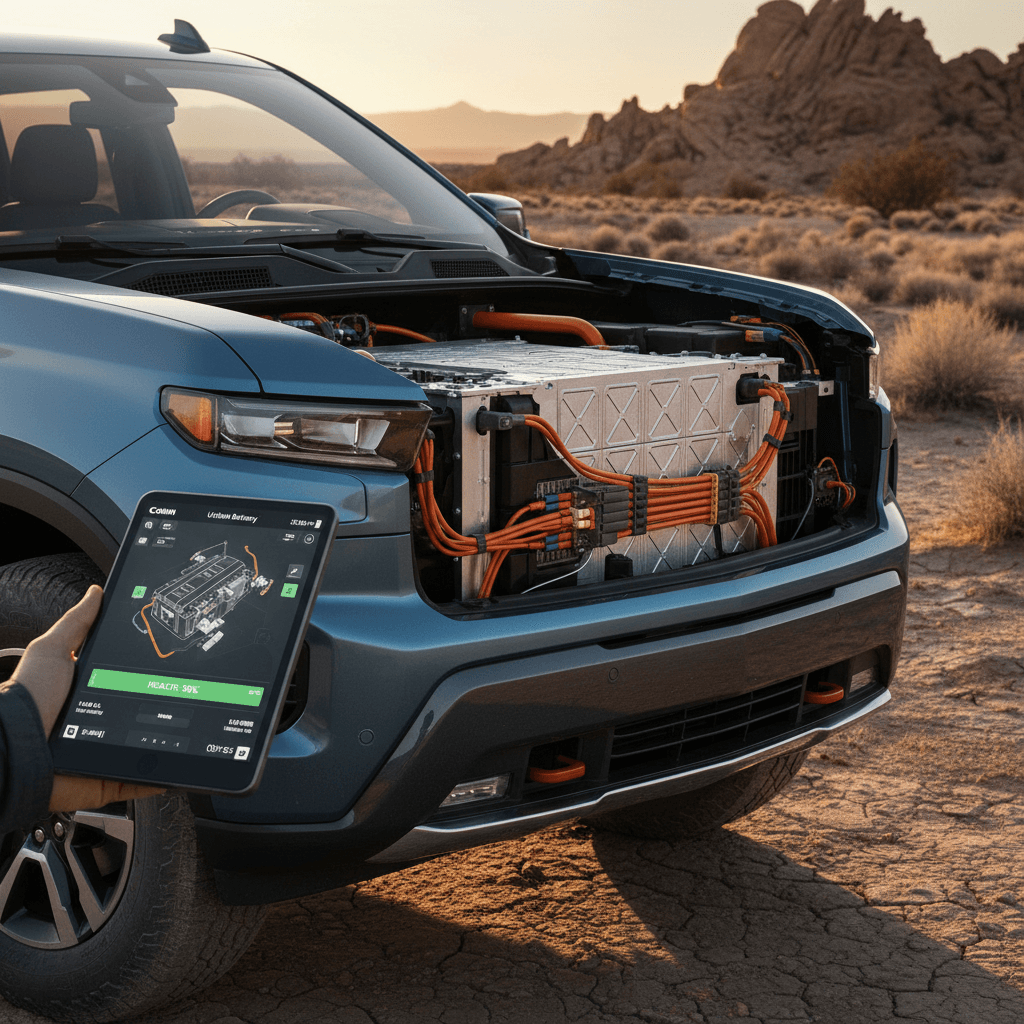
The Silverado EV’s Ultium battery pack is massive, up to the 200+ kWh range depending on configuration, and it’s the single most expensive component on the truck. The good news is that most owners are seeing stable range and very low self-discharge. The bad news is that if something goes wrong, it can be painful.
- Owners commonly report leaving the truck parked for 1–2 weeks and seeing just 0–4% state-of-charge loss, even in cold climates, which is excellent for an EV this large.
- The pack doesn’t appear to aggressively heat or cool itself when unplugged, which helps reduce vampire drain but can impact winter readiness if you don’t precondition.
- A small number of early trucks have seen lithium-ion battery faults or coolant-related failures that required full pack replacements, with downtime measured in weeks.
How to treat the Silverado EV battery well
Battery reliability positives
- Low standby drain: Owners regularly see minimal charge loss when parked for days or weeks.
- Good thermal management: Ultium packs use liquid cooling and sophisticated controls, limiting rapid degradation in normal use.
- Long warranty: GM’s battery coverage (often 8–10 years/100k+ miles, check your specific truck) shields you from most pack-level defects.
Battery reliability risks
- Complex packaging: Huge packs mean more modules, plumbing, and software, more potential failure points.
- Parts & expertise: If your pack has a problem, finding a replacement and an EV-trained tech can take weeks.
- Unproven long-term aging: We don’t yet know how Silverado EV packs look at 8–10 years with heavy towing or DC fast charging.
Software, tech features, and OTA updates
Like most modern EVs, a lot of the Silverado EV’s reliability story lives in software. Infotainment, Super Cruise, charging communication, and even pedestrian noisemakers are governed by code, and GM is still working out the kinks.
Common software & tech themes from owners
Not all of these are failures, but they affect confidence
Infotainment quirks
Some owners report loose-feeling trim, missing expected features like Apple CarPlay on certain trims, and occasional glitches that require a reboot or dealer update.
Super Cruise & subscriptions
Hands-free driving depends on an active OnStar / Super Cruise subscription. New owners sometimes think the system is broken when it simply isn’t provisioned yet.
OTA vs. dealer updates
Some updates push over the air, but others require a long dealer visit and service bulletins that not every advisor is familiar with yet.
When software undermines reliability
Real-world owner experiences: patterns emerging
Owner reports so far paint a split picture. On one side are drivers with thousands of miles and routine software updates; on the other are a small but vocal group whose trucks have spent weeks or months at the dealer waiting on high-voltage battery or module repairs.
- Several 2024–2025 RST and WT owners report no mechanical issues in the first year beyond minor cosmetic fixes and infotainment gripes.
- A few unlucky owners experienced early battery faults (sometimes linked to coolant leaks), resulting in full pack replacement requests and long waits for parts.
- Parts availability for EV-specific components, headlights, glass, trim, can be slower than on gas Silverados, leaving trucks stuck in body shops for weeks.
- Dealership experience is wildly variable: some stores now have EV-trained staff and handle updates smoothly, while others still seem to be learning on the job.
“Early adoption has its drawbacks… It’s a cool truck but what a disaster of engineering [for my particular unit].”
What this means for you
How the 2025 Silverado EV compares to other electric trucks
Reliability isn’t just about whether the Silverado EV is good or bad, it’s about how it stacks up against alternatives like the Ford F-150 Lightning, Rivian R1T, and Tesla Cybertruck. All of these are first- or second-generation EV pickups, so none are as bulletproof as a basic gas half-ton.
2025 Silverado EV vs rival EV pickups: reliability lens
High-level reliability trends across popular electric trucks as of 2025–2026.
| Model | Strengths | Known pain points | Best fit |
|---|---|---|---|
| Chevy Silverado EV | Huge range, strong towing, low standby drain, traditional truck feel. | Complex Ultium pack, long wait times for some parts, uneven dealer EV expertise, software/infotainment quirks. | Drivers who want GM’s truck DNA, long range, and plan to keep within warranty window. |
| Ford F-150 Lightning | Familiar F-150 platform, broad dealer network, simpler feature set on lower trims. | Early build quality variability, towing range hits, some high-voltage junction box issues in early runs. | Ford loyalists, fleet users, buyers prioritizing dealer coverage over bleeding-edge range. |
| Rivian R1T | Strong real-world owner satisfaction, adventure-focused design, quick updates from a software-first company. | Small service network, parts and body repair delays, some early drive-unit and suspension issues. | Buyers near Rivian service centers who value software polish and off-road capability. |
| Tesla Cybertruck | Robust fast-charge network, over-the-air updates, minimalist mechanical design. | Very new platform, panel alignment and build quality complaints, changing feature set via updates. | Tech-forward early adopters who prioritize Tesla’s ecosystem and charging over traditional truck cues. |
All of these trucks are early in their life cycle, expect teething issues across the board.
Who the Silverado EV suits best
- Already comfortable with GM trucks and dealer network.
- Want very long range and strong towing in an EV.
- Plan to keep the truck mainly within factory warranty window.
- Have a nearby Chevy dealer with proven EV service experience.
Who should be cautious
- Buyers in rural areas with no EV-certified Chevy dealer.
- Shoppers who hate any downtime or service uncertainty.
- Used buyers considering out-of-warranty trucks before long-term data exists.
- Heavy commercial users who can’t afford multi-week downtime.
Used Silverado EV reliability checklist
If you’re eyeing a used 2024–2025 Silverado EV, you’re in even dicier territory: you get a price break, but you also inherit someone else’s early-adopter experience. This is where independent battery health data and a thorough EV-focused inspection matter more than on a gas truck.
Pre-purchase checklist for a 2024–2025 Silverado EV
1. Pull a full recall & service history
Ask for a printout from a Chevy dealer showing completed and open recalls, software campaigns, and any high-voltage battery or module work. Multiple battery-related visits in the first few thousand miles are a red flag.
2. Get a true battery-health report
Range guesses on the dash aren’t enough. At Recharged, every used EV gets a Recharged Score report with verified battery health so you can see degradation and pack balance before you buy.
3. Inspect for collision or water damage
Check for uneven panel gaps, overspray, and mismatched glass dates. EVs with poorly repaired body damage can have subtle wiring and sensor issues that haunt you later.
4. Test AC and DC charging
Verify Level 2 charging at home or a public station, then test at least one DC fast charger if possible. Watch for error messages, thermal throttling, or the truck refusing to start a session.
5. Drive it in mixed conditions
On your test drive, include highway speeds and some rough pavement. Listen for clunks or wind noise, test Super Cruise (if equipped and subscribed), and monitor for warning lights or alerts.
6. Validate OTA and app connectivity
Make sure the MyChevrolet / OnStar apps connect reliably, location updates work, and the truck shows recent software update history. Vehicles stuck on very old software deserve extra scrutiny.
How Recharged can help
Warranty coverage, downtime, and repair costs
On paper, GM’s warranty coverage on the Silverado EV looks competitive. In practice, what matters is how that warranty interacts with parts availability and dealer capability.
Typical GM warranty coverage on Silverado EV (check your VIN for exact terms)
Approximate coverage for 2025 model year trucks in the U.S.
| Component | Typical coverage | What’s included | What’s not |
|---|---|---|---|
| Bumper-to-bumper | 3 years / 36,000 miles | Most electronics, interior, suspension, cameras, motors in many cases. | Wear items (tires, wiper blades), damage, some software-related quirks if not reproducible. |
| Battery & electric drive (Ultium) | 8–10 years / 100,000–150,000 miles | Defects in battery modules, pack assembly, and often drive units. | Normal degradation, abuse (e.g., deep flooding), damage from non-GM modifications. |
| Corrosion / rust | 5–6 years (varies) | Body rust-through in normal conditions. | Surface rust from chips, aftermarket add-ons, collision damage. |
Always confirm coverage in your specific warranty booklet, terms can vary by region and trim.
Where Silverado EV owners run into pain isn’t usually the cost of covered repairs, it’s the time. If your truck needs a high-voltage pack or a rare EV-specific part, it can sit for weeks waiting on logistics or an available EV technician. That’s a reliability risk even if GM ultimately pays the bill.
Plan for downtime risk
FAQ: 2025 Chevy Silverado EV reliability
Frequently asked questions about Silverado EV reliability
Bottom line: Is the 2025 Silverado EV a safe bet?
The 2025 Chevy Silverado EV is a hugely capable electric truck riding on a sophisticated new platform. On balance, early evidence suggests average reliability with above-average consequences when something goes wrong. Most owners are enjoying quiet, powerful miles; a minority are dealing with slow, frustrating repairs on trucks that are still almost new.
If you’re comfortable as an early adopter, have a trusted Chevy dealer with EV experience, and keep the truck within its factory warranty window, the 2025 Silverado EV can make sense. If you want a safer long-term bet, consider waiting for more data, or buy a used, thoroughly inspected example where early bugs have already surfaced and been fixed.
Either way, don’t treat this like a normal gas half-ton purchase. Demand battery health data, service history, and clear answers about recall status and dealer capabilities. And if you’d rather not manage all that yourself, a platform like Recharged can help you compare EV trucks, understand battery reports, arrange trade-ins and financing, and have a vetted used EV delivered to your driveway with far fewer surprises.