If you’re eyeing a 2024 Ford Mustang Mach-E, or you already own one, you’ve probably heard about quirky software, battery warnings, or the latest recalls. The good news: most 2024 Ford Mustang Mach-E problems and fixes are well understood by now, and many are more annoying than catastrophic. This guide walks you through the issues that actually show up in the real world, how to fix them, and what to watch for if you’re shopping used.
Quick note on model years
Are 2024 Mustang Mach-E models trouble-prone?
By 2024, the Mustang Mach-E was no longer a brand-new experiment. Ford had several model years of feedback and warranty data, and many of the ugly early-production issues (like poorly bonded glass or random shut‑offs from overheated contactors) were already addressed with recalls and software changes on earlier years. The 2024 models tend to land in the middle of the EV pack for reliability: serious mechanical failures are rare, but owners still report a steady drip of software quirks, charging frustration, and the occasional 12‑volt battery or door‑latch headache.
2024 Mustang Mach-E issue snapshot
Quick list: Most common 2024 Mach-E problems and symptoms
- Low or failing 12‑volt battery causing warning messages, failure to wake, or door locks that won’t respond.
- Door-latch and lock behavior tied to 12‑volt voltage or ongoing recall campaigns.
- Home charging that won’t start, stops early, or shows “waiting to charge” even when schedules are off.
- Slower‑than‑expected DC fast charging, or sessions that stop early at public stations.
- Glitchy SYNC 4 infotainment: frozen screens, Bluetooth oddities, or laggy climate controls.
- BlueCruise driver-assist dropping out more often than expected or refusing to engage.
- OTA software updates that stall, roll back, or won’t enable auto-update in the car or FordPass app.
- Isolated squeaks/rattles, wind noise from door seals, or firm ride quality on rough pavement.
How to use this guide
Problem 1: 12‑volt battery and door-lock issues
Like a lot of modern EVs, the Mach-E hides a very old‑school component: a traditional 12‑volt battery that powers the latches, computers, and wake‑up sequence. On 2024 models, Ford has refined the software that manages this low‑voltage system, but it’s still the root cause of many “weird” behaviors. In some cases, a low 12‑volt state of charge can interact with a recall‑covered issue and cause the electronic door locks not to release, or leave the vehicle unresponsive when you try to unlock or start it.
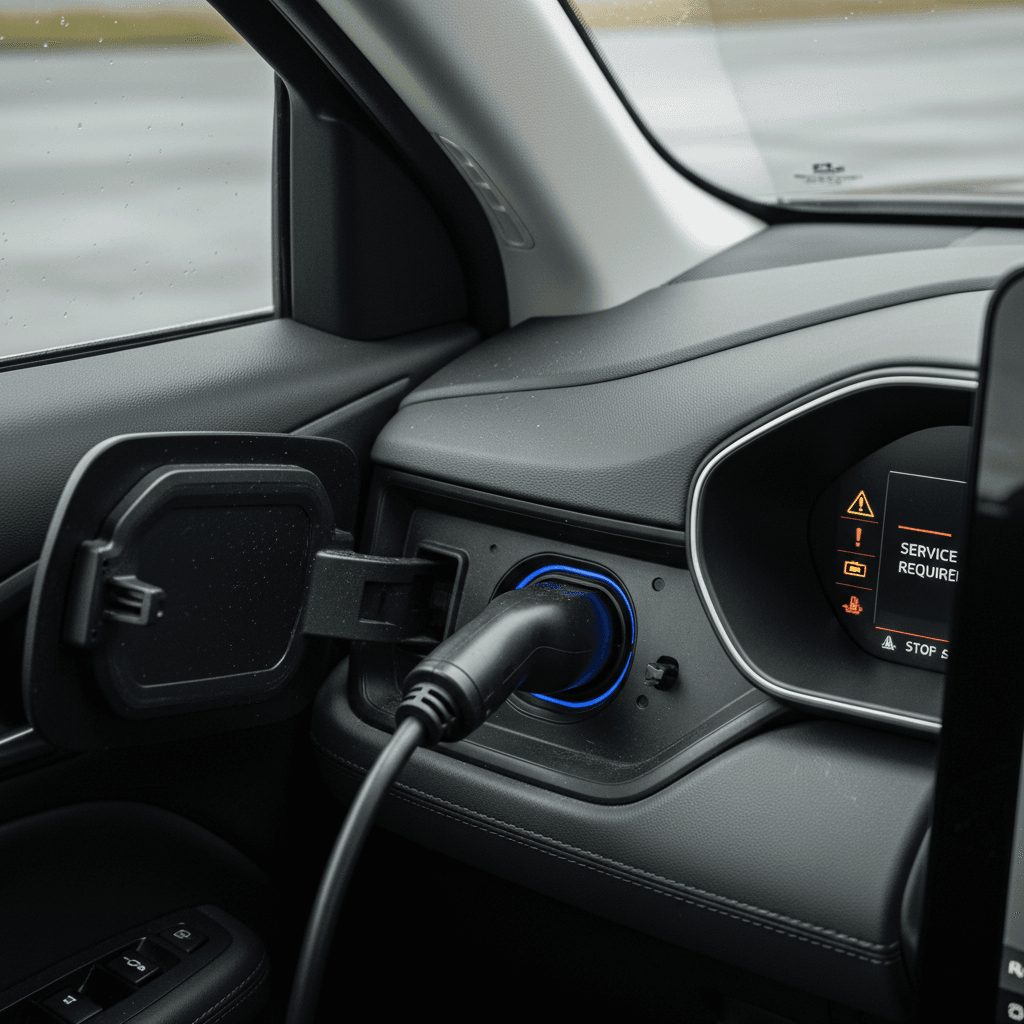
Typical 12‑volt and door-lock symptoms
- Car wakes up slowly, or not at all, when you approach with phone-as-key or fob.
- FordPass app shows a 12‑volt battery warning or low-battery alert.
- Door handles present, but doors won’t unlatch electronically, or feel “dead.”
- Interior lights and screens stay dark until you try several times.
- Vehicle behaves normally once it’s finally awake, at least for a while.
DIY checks and quick fixes for 12‑volt issues
Step-by-step: What to do if your 2024 Mach-E acts “dead”
1. Try the physical key backup
If the car won’t unlock, use the mechanical key blade hidden in your fob to access the front trunk area or door. Your owner’s manual and Ford’s support site walk through the exact steps.
2. Check for lights and screens
Once you’re in, see whether any screens or lights power up. Dim or flickering screens strongly point to a weak 12‑volt battery, even if the main traction battery shows plenty of charge.
3. Put the car on a proper charge
Plug into a Level 2 home charger (or at least a Level 1 outlet) and allow the car several hours to charge. The Mach-E uses that charging window to top off the 12‑volt battery from the high‑voltage pack.
4. Avoid repeated short drives only
If the car sits for days, then only does quick trips, the 12‑volt may never get fully replenished. Build in an occasional longer drive and charging session so the system can balance itself.
5. Have the 12‑volt battery tested correctly
If issues keep coming back, ask a Ford dealer, or an EV-savvy shop, to test the 12‑volt battery using EV‑appropriate diagnostic tools, not just a generic “cold cranking amps” tester meant for gas cars.
6. Schedule recall and TSB checks
Because several safety recalls involve door locks and low 12‑volt voltage, make sure your 2024 Mach-E is up to date on all campaigns. A dealer can check by VIN; so can an independent seller like Recharged before listing the car.
Safety note: Passengers stuck inside
Problem 2: Home and DC fast-charging problems
Most 2024 Mach-E charging complaints fall into two buckets: home charging that won’t start or keeps stopping, and DC fast‑charging on road trips that feels slower than spec. The twist is that sometimes the car is innocent and the culprit is a finicky home charger, a wiring issue, or a public station that’s having a bad day. Other times, the Mach-E’s own software, temperature management, or low 12‑volt battery is part of the story.
Home charging: “Waiting to charge” and random stops
- Car displays “Waiting to charge” at a specific time, even though you thought you turned schedules off.
- Charging starts, runs for a while, then stops with no clear explanation on the screen.
- Car charges fine at public Level 2, but not on your home wall box, or vice versa.
- GFCI or breaker trips in your panel when you plug in.
Quick fixes you can try at home
- Disable all schedules in both the car and the FordPass app. Then power‑cycle the car (full shutdown in settings) and try again.
- Test with the mobile charge cord that came with the vehicle on a known-good outlet, ideally on a different circuit.
- If your wall box lets you adjust amperage, try lowering the current and see if charging becomes stable.
- Inspect the charge port for debris, bent pins, or damage, and listen for the latch “click” when you plug in.
When to suspect the charger or house wiring
- If more than one EV has issues on the same charger, focus on the charger or the circuit, not the Mach-E.
- If a breaker trips or outlet feels hot, stop using that circuit and have an electrician inspect it.
- If your Mach-E charges normally elsewhere, document that and bring it to the electrician or installer, this proves the car is capable of charging correctly.
If you’re new to home charging, it’s worth reading an EV-specific installation guide, not just a generic electrical checklist.
DC fast charging: Slower than expected
On paper, the 2024 Mach-E can hit strong DC fast‑charging rates, especially with the extended-range battery. In practice, owners see a wide range of performance depending on battery temperature, state of charge, and the health of the particular fast charger. Climbing to a charger with a cold pack, arriving nearly full, or using a station with derated power can all make it feel like the car is “broken” when it’s really playing it safe.
Tips to get the best road-trip charging out of a 2024 Mach-E
Precondition the battery
Use the built‑in route planner or Ford’s En-Route Preconditioning feature so the Mach-E warms the battery on the way to a DC fast charger. A warm pack takes power faster.
Arrive between 10–40%
DC fast charging is quickest at lower states of charge. If you routinely plug in at 60–70%, you’ll see slower speeds and shorter peak power windows.
Avoid hopping between weak stations
If a station delivers poor speeds to several cars in a row, it’s likely the station. Move to a different site or network before assuming your Mach-E has a fault.
Watch for repeat errors at the same SOC
If the car <strong>consistently</strong> errors out at the same percentage or temperature, take screenshots and have a dealer or EV specialist run diagnostic checks on the DC fast‑charge hardware.
When charging problems are a red flag
Problem 3: SYNC 4, BlueCruise, and OTA update glitches
If there’s one area where Mach-E owners are loud online, it’s software. The SYNC 4 system, FordPass connectivity, BlueCruise driver assistance, and over‑the‑air (OTA) updates are all powerful, and occasionally flaky. By 2024, many early bugs were ironed out, but new software bundles still sometimes introduce odd behavior before the next patch cleans it up.
Common SYNC 4 and BlueCruise complaints
- Center screen freezes or lags, especially when quickly switching between navigation, music, and climate.
- Bluetooth devices disconnect, or phone-as-key works one day and sulks the next.
- BlueCruise refuses to engage on mapped roads, or drops out with “hands on wheel” alerts even when you’re attentive.
- Voice commands become unresponsive until you restart the car.
OTA update headaches
Owners of 2023–2024 Mach-E models sometimes report that OTA updates stall, roll back to an older version, or refuse to enable automatic updates in the settings. In most cases, the underlying problem is a combination of marginal 12‑volt charge, inconsistent connectivity, or a known software hiccup that Ford later patches with a newer release.
Simple “good housekeeping” steps
- Do a soft reset of the SYNC screen by holding the power and seek forward buttons together until the system reboots.
- Make sure the car gets regular cellular or Wi‑Fi access where it’s parked so updates can download cleanly.
- Keep the 12‑volt battery healthy with regular driving and charging, low voltage can block or delay updates.
- When an update is queued, avoid interrupting the car mid‑install; let it sit until you’re sure it’s finished.
When to involve a dealer or specialist
- If updates appear to install and then roll back repeatedly.
- If BlueCruise or critical safety alerts change behavior suddenly after a specific update.
- If you get warning lights for ABS, stability control, or other safety systems after an OTA push.
- If you cannot turn auto-update on in settings, even after multiple restarts.
Document the software version and behavior with photos or video, this makes it much easier for a technician to see patterns, and for a seller like Recharged to verify that an issue has been fixed before you buy.
Driver-assist is not a safety net
Problem 4: Key 2024 Mustang Mach-E safety recalls
Because the Mach-E spans several model years with shared components, many 2024 vehicles are covered by multi-year recall campaigns. Some involve door locks and the 12‑volt system; others relate to roll‑away risk, rearview camera behavior, or software that can affect braking and stability systems. The list evolves over time, so the single smartest move you can make is to run a VIN-based recall check before you buy, or once a quarter if you already own one.
Major recall themes affecting 2024 Mach-E models
Exact recall numbers change over time, but these are the big categories you’re likely to see attached to 2024 Mustang Mach-E VINs.
| Recall theme | What can happen | Typical fix | What you should do |
|---|---|---|---|
| Door locks / 12‑volt | Low 12‑volt charge can prevent electronic door unlatching, potentially trapping occupants. | Software update, possible hardware inspection, plus 12‑volt battery testing or replacement. | Confirm all door-lock recalls are closed; test interior and exterior handles on every door. |
| Roll-away / park system | In rare cases, software may not correctly secure the vehicle in Park in certain conditions. | Updated control software and/or component inspection or replacement. | On a test drive, park on a slope and verify the car stays put with Park engaged and parking brake set. |
| High-voltage battery contactors (earlier years, sometimes updated across fleet) | Under specific conditions, battery contactors can overheat and cause a loss of drive power. | Software limits, contactor inspection, or replacement depending on VIN and campaign. | Ask whether any high-voltage battery or contactor recalls apply to a 2024 you’re considering and confirm completion. |
| Rearview camera & visibility | Camera image may freeze, delay, or fail to display when reversing. | Software patch via dealer or OTA, and in some cases camera module replacement. | During an inspection, shift to reverse several times to confirm the camera activates quickly and reliably. |
Always verify open recalls with the NHTSA lookup tool or a Ford dealer before purchase.
How Recharged handles recalls
Ready to find your next EV?
Browse VehiclesProblem 5: Ride, noise, and hardware niggles
By 2024, big structural quality issues on the Mach-E were much less common, but that doesn’t mean every car is perfect. What owners most often mention now are small but real irritants: a firmer‑than‑expected ride on rough pavement, intermittent wind noise around mirrors or door seals, and the occasional interior squeak or rattle that appears as the miles add up.
Common 2024 Mach-E “little things” to listen and feel for
None of these are deal breakers on their own, but they’re great negotiation leverage on a used car.
Wind noise
Listen around 45–70 mph for whistling near the mirrors or A‑pillars. Often this is a minor seal adjustment or mirror cap alignment, but it’s worth noting.
Squeaks & rattles
Over broken pavement, note any recurring squeaks in the dash, seat tracks, or hatch area. A good technician can usually chase them down, but it takes time.
Ride comfort
The Mach-E skews more “sporty” than cushy. If you’re sensitive to firm rides, spend real time on rough streets before you commit, especially on larger wheels.
Test-drive checklist for a used 2024 Mach-E
How to diagnose issues before you panic (or visit the dealer)
The difference between a great Mach-E experience and a maddening one often comes down to how you handle the first sign of trouble. Many 2024 Mustang Mach-E problems share the same root causes: low 12‑volt charge, an incomplete software update, or a grumpy home charger. Before you assume the sky is falling, or that the car you’re about to buy is a lemon, work through a simple triage process.
Five smart steps before you book service
1. Capture the evidence
Take clear photos of any warning lights or messages, and note the outside temperature, battery percentage, and what you were doing (charging, parking, using BlueCruise, etc.).
2. Try a full vehicle shutdown and restart
Use the menu option for a <strong>complete power down</strong>, wait a few minutes, then restart. Like a computer, the Mach-E sometimes just needs a clean reboot.
3. Check both batteries
Confirm the main high‑voltage battery shows a sane state of charge, and pay attention to 12‑volt warnings in the FordPass app. If in doubt, put the car on a charger for a few hours.
4. Change one variable at a time
If you’re chasing a charging or connectivity issue, change <em>one thing</em>, different charger, different phone, different location, so you can see what actually fixes it.
5. Use a specialist when possible
Not every shop understands EV diagnostics yet. If you aren’t near a strong Ford EV dealer, consider an independent EV specialist or a seller like Recharged that can provide a <strong>diagnostic report and battery health data</strong> with the car.
Buying a used 2024 Mach-E: Which problems really matter?
If you’re buying a 2024 Mustang Mach-E used, you’re in a sweet spot: most recalls are known and fixable, but the vehicles are still young enough that major wear‑and‑tear failures are rare. The trick is to separate normal EV quirks from red‑flag issues that hint at poor care or unresolved defects.
Issues that are usually manageable
- One‑off SYNC 4 freezes that go away after a reboot or update.
- Minor wind noise or rattles that appear at specific speeds.
- A single documented 12‑volt battery replacement early in the car’s life.
- Home‑only charging issues that disappear on another charger or circuit.
These are bargaining chips, not automatic deal breakers, as long as the seller is transparent and you have a plan to address them.
Problems that deserve more caution
- Repeated incidents of the car going totally dead or locking occupants in even after recall work.
- Documented loss of drive power that isn’t clearly tied to an already‑fixed recall.
- Multiple failed or incomplete software updates that a dealer can’t sort out.
- Visible crash repairs near high‑voltage components or the charge port.
When in doubt, build the cost of deeper diagnostics, or walking away, into your buying strategy.
How Recharged de-risks a used Mach-E
FAQ: 2024 Ford Mustang Mach-E problems and fixes
Frequently asked questions about 2024 Mach-E problems
Bottom line: Is the 2024 Mustang Mach-E a good bet?
If you understand what you’re getting into, the 2024 Ford Mustang Mach-E can be a terrific EV: quick, practical, and more refined than the earliest model years. Its biggest weaknesses live in software, 12‑volt battery management, and the gray area where home chargers and public stations meet a picky car. Those are real issues, but they’re also problems you can anticipate, test for, and in many cases fix with updates, good diagnostics, and a bit of patience.
Whether you’re already living with one or hunting for a used 2024 Mach-E, focus on battery health, recall completion, and charging behavior rather than chasing ghost stories. And if you’d rather not decode all of that yourself, buying through Recharged means every car comes with a Recharged Score Report, expert EV support, and transparent history, so you can enjoy the Mach-E’s strengths without constantly looking over your shoulder for the next glitch.