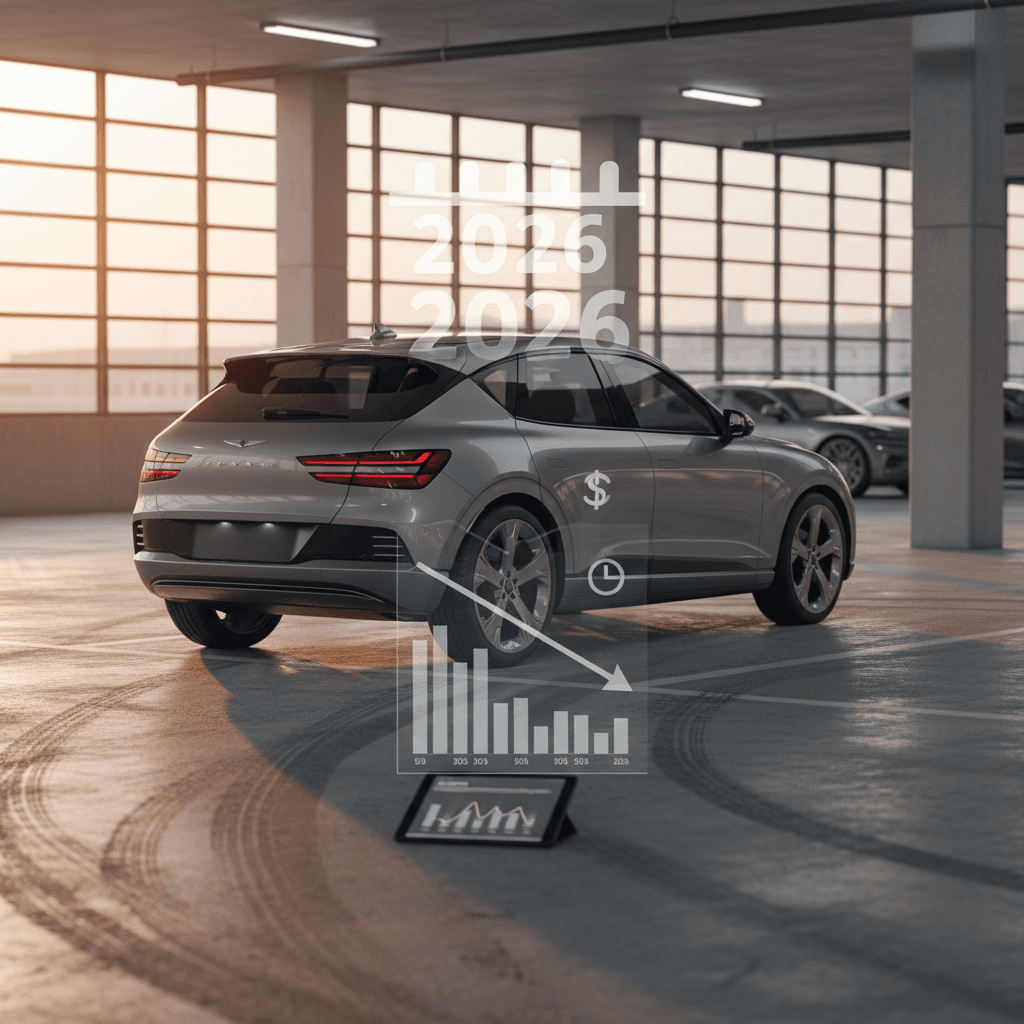
If you’re eyeing a used Genesis GV60 in 2026 (or wondering what your own GV60 is worth), depreciation is the elephant in the room. This stylish Korean luxury EV is a joy to drive, but like most premium electric crossovers, its value curve is steeper than many buyers expect. Let’s look at the real Genesis GV60 depreciation rate in 2026, how it compares to other EVs, and how to use that drop in value to your advantage.
Key context for 2026
Genesis GV60 depreciation rate in 2026: the short version
Genesis GV60 depreciation snapshot (2026, U.S. market)
Different valuation models don’t agree on the exact percentage, but most put the 5‑year Genesis GV60 depreciation rate in 2026 somewhere around 55–65% of original MSRP. In human terms, that means a GV60 that stickered around $63,000 new might realistically trade in the mid‑$20,000s after five years if miles are average and the battery checks out.
Used‑buyer silver lining
How fast does a Genesis GV60 depreciate by 2026?
Genesis launched the GV60 in the U.S. for the 2023 model year as a premium, tech‑heavy crossover riding on the same E‑GMP platform as the Hyundai Ioniq 5 and Kia EV6. Early MSRPs generally landed from the low‑$50,000s (later rear‑wheel‑drive Standard models) up into the high‑$60,000s for fully loaded Performance trims.
- Third‑party depreciation calculators peg the GV60 around 60–61% depreciation after 5 years, leaving a five‑year resale value close to $25,000 on an example originally priced in the low‑$60Ks.
- Auction and retail data show some 2‑ to 3‑year‑old GV60s already transacting in the high‑$20,000s to low‑$40,000s in 2026, depending on trim, mileage, and options.
- Compared with mainstream EV crossovers, the GV60’s curve is steeper: luxury badges, rapid tech turnover, and aggressive lease incentives all push prices down faster.
Sticker price vs. what people actually paid
3‑year vs. 5‑year Genesis GV60 depreciation in 2026
In 2026 we have meaningful real‑world data on 2‑ to 3‑year‑old GV60s, along with modeled 5‑year projections from tools that blend auction results with retail transactions. Here’s how the curve tends to look for a typical GV60 that started around $60,000–$65,000 new.
Genesis GV60 depreciation estimates (U.S., 2026)
Approximate retained value vs. original MSRP for a typical GV60, assuming average mileage and no major damage.
| Vehicle age (years) | Estimated value vs. MSRP | Dollar example on $63,000 MSRP | What that looks like in the real world |
|---|---|---|---|
| 1 year | ≈70–75% of MSRP | ≈$44,000–$47,000 | Clean 1‑year‑old examples listed in the mid‑to‑high $40Ks. |
| 3 years | ≈45–55% of MSRP | ≈$28,000–$35,000 | Most 3‑year‑old GV60s fall somewhere between high‑$20Ks and mid‑$30Ks. |
| 5 years | ≈35–45% of MSRP | ≈$22,000–$28,000 | Modeled 5‑year values cluster in the mid‑$20Ks for a well‑kept GV60. |
These are directional estimates, not guaranteed numbers for any specific vehicle.
Individual cases will be all over the map, an ultra‑low‑mile Performance trim in a hot EV market might beat these numbers, while a high‑mile fleet car with rough cosmetics may fall well below. But for planning purposes, the Genesis GV60 depreciation rate in 2026 sits firmly in “aggressive luxury EV” territory: big drop early, then a slower glide down.
What 2023–2025 Genesis GV60 values look like in 2026
Because the GV60 is still relatively young, most of the real cars you’ll see listed in 2026 are 1–3 years old. Here’s how the main model years tend to shake out on the used market, based on national listing aggregates and appraisal tools:
Typical 2026 value ranges by GV60 model year
Assuming clean history and average mileage for the age of the vehicle.
2025 Genesis GV60
Age in 2026: About 1 year
- Many still on first owners or just coming off short leases.
- Trade‑in appraisals often in the high‑$30Ks to low‑$40Ks for mid‑spec trims.
- Retail asking prices usually mid‑$40Ks and up, depending on spec.
2024 Genesis GV60
Age in 2026: About 2 years
- Plenty of volume from early adopters cycling out of leases.
- Some popular valuation tools show resale values dropping from the low‑$50Ks at launch into the high‑$20Ks and $30Ks already.
- Great hunting ground if you want a big discount off MSRP but still‑fresh tech.
2023 Genesis GV60
Age in 2026: About 3 years
- First model‑year vehicles now squarely in the deep‑depreciation zone.
- It’s not unusual to see compelling examples in the high‑$20Ks with good equipment.
- Condition, options, and battery health matter more than model year at this point.
Where the value sweet spot lives
Why the Genesis GV60 depreciates so quickly
Every EV loses value as newer, more efficient models arrive, but the GV60 stacks a few extra forces on top. Understanding those forces helps you decide whether its 2026 depreciation profile is a bug or a feature for you.
Main drivers of Genesis GV60 depreciation
Luxury‑EV price ceiling
The GV60 launched as an upmarket halo product. High MSRPs mean there’s simply farther to fall before prices intersect with what mainstream buyers are comfortable paying for a used EV.
Rapid EV tech turnover
Battery efficiency, range, charging speed, and driver‑assist suites improve almost annually. A three‑year‑old GV60 is still impressive, but the on‑paper spec race makes it look older faster than a comparable ICE luxury crossover.
Heavy lease incentives & tax credits
Genesis and its dealers have leaned on leases and manufacturer cash, plus pass‑through federal incentives, to move metal. That lowers effective new transaction prices, undercutting used values within just a year or two.
Limited brand equity vs German rivals
Genesis builds excellent cars, but its luxury‑brand equity and name recognition still trail Audi, BMW, and Mercedes. On the used market, that translates to lower willingness to pay from shoppers who buy based on badge.
Crowded EV‑crossover segment
By 2026, the GV60 is one of many premium crossovers chasing the same shopper: Tesla Model Y, BMW iX, Mercedes EQE SUV, Cadillac Lyriq, etc. Abundant options mean buyers are picky and price‑sensitive.
Range and charging perception
Real‑world range is solid, and 800‑volt fast‑charging is a plus, but some shoppers gravitate to whatever just launched with five or ten more miles of EPA range, even when it doesn’t matter in day‑to‑day use.
The risk if you’re buying brand‑new in 2026
Genesis GV60 vs. other luxury EV depreciation
The GV60 isn’t an outlier among premium EVs so much as a solid representative of a tough class. Across the market, battery‑electric vehicles and luxury models both tend to depreciate faster than mainstream gas crossovers, stack those together and you have a category that sheds value briskly in the first half‑decade.
How the GV60 compares
- Luxury EVs in general: Many high‑end EVs lose 55–70% of their value in 5 years, especially early‑generation models and those eclipsed by newer tech.
- GV60 specifically: Sitting around a modeled 5‑year loss of ~60%, its curve is steep but not catastrophic by luxury‑EV standards.
- Mainstream EVs: Some mass‑market EVs with strong brand pull (think Tesla Model 3) hold value better, but plenty of early BEVs drop just as hard, or harder.
What that means for you
- If you’re cross‑shopping used luxury EVs, the GV60 often gives you more car per dollar in 2026 than German rivals that still trade on badge power.
- If you’re comparing to a mainstream EV, expect the GV60 to be cheaper used than you’d guess from its original price tag, but also a bit riskier if market conditions change.
- As a seller, you’ll need realistic expectations; as a buyer, you can be choosy on color, trim, and options without paying a huge premium.
Don’t just compare percentage loss
In 2026, is it smarter to lease or buy a Genesis GV60?
Lease deals are a big part of the GV60 story. Genesis and captive finance partners have often used generous lease cash and EV tax‑credit pass‑throughs to boost monthly payment appeal, all while keeping residual values artificially high on paper. That dynamic matters a lot when depreciation is this sharp.
Lease vs. buy a Genesis GV60 in 2026
How depreciation and incentives shift the math.
Leasing a new GV60 in 2026
- Pros: Factory incentives and EV credits can dramatically cut your effective payment; you’re insulated if resale collapses faster than expected.
- Cons: High residuals mean you’re often paying for the steepest part of depreciation anyway, just in monthly form.
- Best for: Drivers who want the latest tech and don’t plan to keep the car beyond 3–4 years.
Buying (especially used) in 2026
- Pros: Used GV60s have already taken their big hit; you capture most of the value upside and can keep the car as long as it fits your needs.
- Cons: You own the long‑term risk: out‑of‑warranty repairs, future tech obsolescence, and any further market slide.
- Best for: Shoppers who want maximum value and are comfortable owning a 3‑ to 7‑year‑old EV if it stays reliable.
A note on purchase options at lease end
How to shop smart for a used Genesis GV60 in 2026
The upside of a steep depreciation curve is that you, the 2026 used‑car shopper, hold most of the cards. There’s real value out there, if you’re disciplined about which GV60 you choose and how you evaluate it.
Used GV60 buying checklist for 2026
1. Target the right age & trim
For most buyers, a 2‑ to 3‑year‑old Advanced or Performance trim hits the sweet spot. You get more features than the base Standard model and still pay far less than the original buyer did.
2. Scrutinize battery health
Battery condition is the single biggest swing factor in EV value. Look for documentation of charging habits and range, and prioritize vehicles with independent battery‑health data rather than just dash‑estimated range.
3. Verify fast‑charging behavior
On your test drive, observe how the GV60 charges at a DC fast station if possible. Healthy packs should ramp up quickly and maintain strong kilowatt rates; severely throttled charging can hint at issues or heavy abuse.
4. Check warranty status
Genesis offers a long battery warranty, but bumper‑to‑bumper coverage expires sooner. In 2026, many early GV60s will be leaving or have just left basic coverage. Factor this into your budget and price expectations.
5. Compare against current incentives
Because new GV60s and rival EVs may be heavily incentivized in 2026, always compare your used‑car deal against what a subsidized new lease or purchase would cost you per month.
6. Use transparent pricing data
Lean on multiple appraisal sources, not just a dealer’s number. Platforms like Recharged aggregate real‑world transactions so you can see how your target GV60 stacks up on price for age, trim, and mileage.
How Recharged can help in 2026
Ready to find your next EV?
Browse VehiclesBattery health, the Recharged Score, and protecting your GV60’s value
With gas cars, depreciation is mostly about miles, model reputation, and cosmetic condition. With EVs like the GV60, battery health sits right at the center of the value equation. Two identical‑looking GV60s can differ by thousands of dollars in real‑world worth, depending on how their packs have aged.
For current GV60 owners
- Be gentle with fast charging: Occasional 350‑kW blasts are fine, but living on DC fast charging can hurt pack health and future value.
- Avoid baking the pack: Whenever possible, park in shade or a garage and avoid letting the car sit at 100% state‑of‑charge for long periods.
- Document everything: Keep records of services, software updates, and any high‑voltage system work. This paper trail reassures the next owner.
For GV60 shoppers on Recharged
- Recharged Score battery diagnostics: We use specialized tools and data to quantify pack health beyond what the gauge on the dash says.
- Transparent pricing: Depreciation forecasts and real‑world transaction data are baked into the price, so you can see how a listing compares to broader GV60 trends.
- Expert guidance: Our EV specialists can walk you through what a specific GV60’s health report and ownership costs mean for your situation.
Battery health is your anti‑depreciation lever
FAQ: Genesis GV60 depreciation and resale value in 2026
Common questions about GV60 depreciation in 2026
Bottom line on Genesis GV60 depreciation in 2026
By 2026, the story on the Genesis GV60 depreciation rate is pretty clear: this is a fast‑depreciating luxury EV that punishes early adopters but richly rewards savvy second owners. Expect a roughly 25–30% drop in the first year and something on the order of 55–65% by year five, with big variations based on incentives, mileage, and, most of all, battery health.
If you’re thinking of buying new, go in with open eyes and a realistic time horizon. If you’re shopping used, the GV60 is one of the sharpest ways to step into a genuinely premium EV experience for mainstream money, as long as you vet the battery, check pricing against current market data, and choose your example carefully.
Recharged was built for exactly this moment in the EV market. Every GV60 we list comes with a Recharged Score Report, fair‑market pricing, and EV‑savvy support from the first search to delivery. In a world where depreciation can feel like a moving target, having that level of transparency turns a risky‑looking luxury EV into a smart, informed purchase.