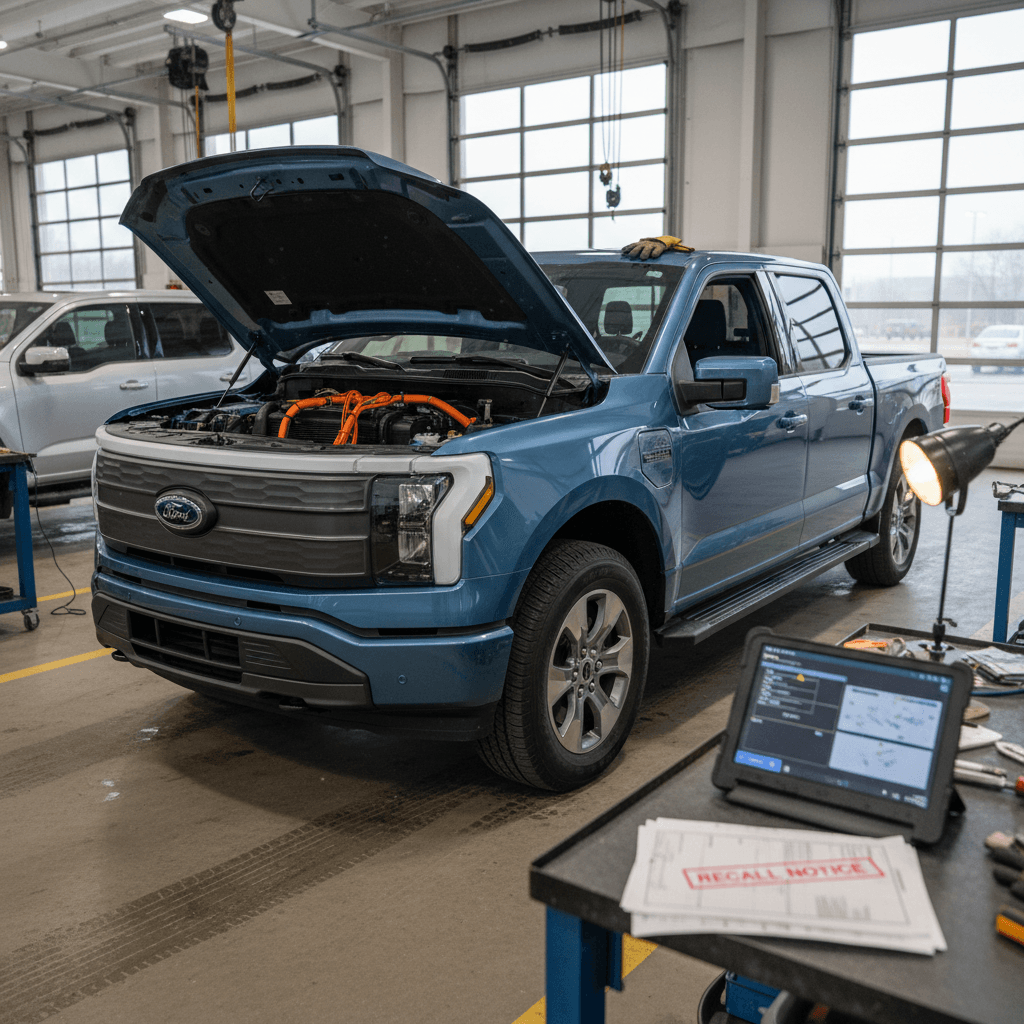
If you own or are shopping for a 2023 Ford F-150 Lightning, you’ve probably heard about recalls: battery fires, software bugs, a rollaway risk. The headlines are loud, but what you really need is a clean, up‑to‑date 2023 Ford F-150 Lightning recalls list in plain English, what each recall does, how serious it is, and what it means for you as an owner or used‑truck buyer.
Model-year scope
Overview: Why 2023 F-150 Lightning recalls matter
The 2023 Lightning sits right in the messy middle of Ford’s EV learning curve. It’s an impressive, brutally quick truck, but it’s also an over‑the‑air software experiment bolted to 9,000 pounds of pickup. Recalls are the paper trail of that learning process. Reading them tells you where Ford stumbled, and how they fixed it.
What the recalls tell you
- Battery: A tiny subset of 2023 trucks had serious cell defects; Ford replaced those packs entirely.
- Software: Several campaigns address glitches in SYNC, charging logic, park modules, and safety systems.
- Hardware: Light bar cracks and some suspension hardware need old‑fashioned parts and wrenches.
What they don’t mean
- They don’t mean every Lightning is a ticking time bomb.
- They don’t mean you should avoid the truck altogether, especially if recalls are completed.
- They do mean you need to verify recall status, especially on a used truck.
The key is not panic; it’s paperwork.
2023 F-150 Lightning recalls at a glance
Quick 2023 F-150 Lightning recalls list
This is a high‑level 2023 Ford F-150 Lightning recalls list. We’ll unpack each one in detail in the sections that follow.
Major 2023 F-150 Lightning recalls and campaigns
Key safety and compliance actions that affect many 2023 Lightnings, plus one very small but serious battery recall.
| Campaign | Issue | Main Risk | Fix Type | Applies to 2023 Lightning? |
|---|---|---|---|---|
| 23S15 (Safety recall) | High-voltage battery cell manufacturing defect | Thermal runaway and vehicle fire | Full HV battery pack replacement | Yes – 18 trucks built with specific cells |
| Battery module safety CSP (23B57 and related) | Battery module fault behavior | Vehicle disabled if a module faults | Software update and selective module replacement | Yes – many 2023 builds, CSP not always labeled as recall |
| 23C38 (Compliance recall) | Fault in SYNC OTA update 6.3.0 | ESC off & other safety features not defaulting correctly | Dealer software reflash / updated OTA | Yes – 2022–2023 with specific software load |
| 23S30 (Safety recall) | Rear light bar lamp micro‑cracks / failure | Reduced rear visibility, increased crash risk | Replace rear light bar assembly | Yes – primarily Lariat & Platinum |
| IPM / rollaway recall (late 2025) | Integrated park module may not fully engage Park | Rollaway if parking pawl doesn’t lock | Park module software update | Yes – certain 2022–2026 trucks, including 2023 |
| Upper control arm / hardware (safety recall & CSP) | Suspension hardware torque or component quality | Noise, alignment change, in rare cases loss of control | Inspect and replace components | Yes – subsets of 2023 trucks |
Always confirm exact coverage for your VIN on Ford’s recall site or NHTSA.gov, campaign numbers can expand over time.
Recall list vs your VIN
High-voltage battery fire recall (23S15)
You may remember the viral video: an F-150 Lightning in a Ford holding lot caught fire during charging. That incident ultimately turned into Safety Recall 23S15 for a very small batch of 2023 battery packs built with defective cells.
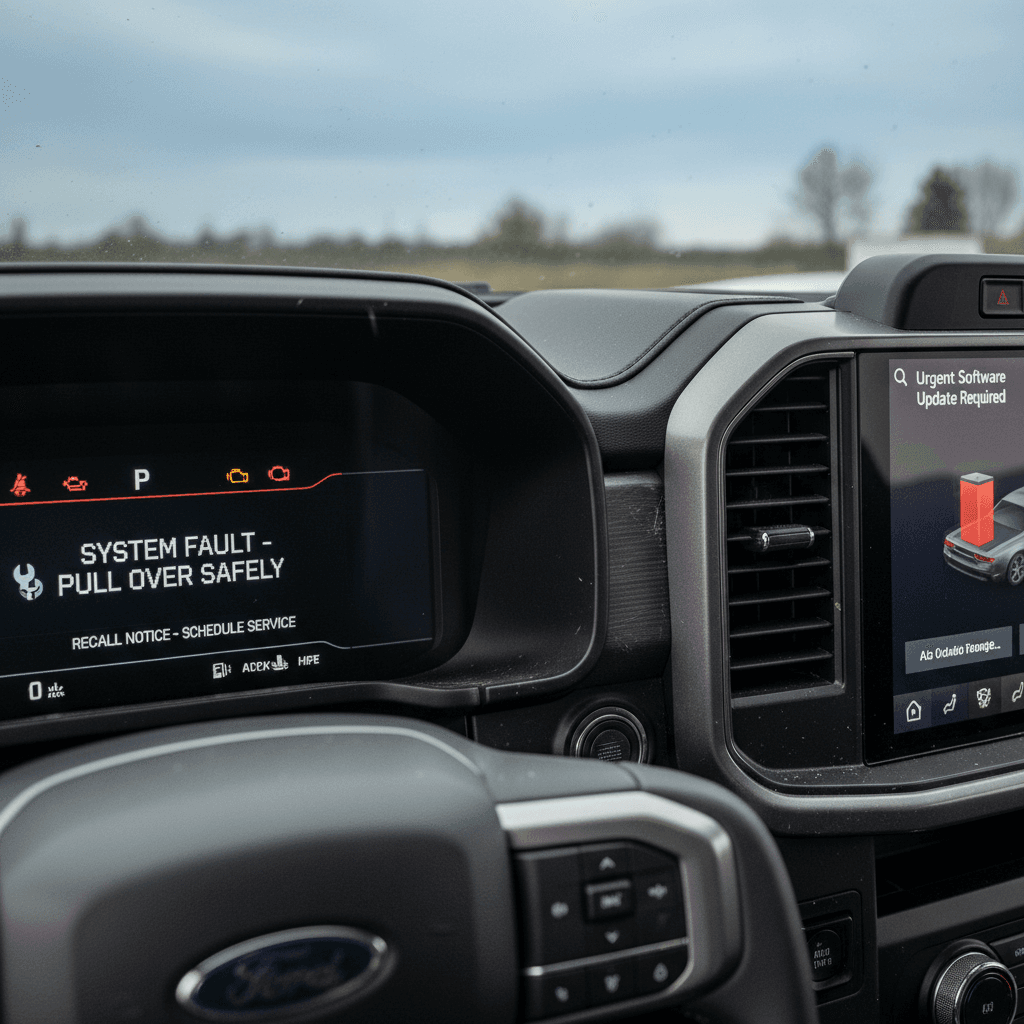
- What’s wrong: A defect in certain high‑voltage battery cells can cause an internal short, overheating, and in the worst case a thermal runaway event, what normal people call “a battery fire.”
- How many trucks: 18 2023 F‑150 Lightning BEVs sold in the U.S. built with cells from a specific lot. It’s microscopic volume, but the consequences are severe enough to justify a safety recall.
- Symptoms: Many affected packs show diagnostic trouble codes long before they reach the dramatic stage, reduced performance, warning lights, or the truck refusing to charge normally.
- The fix: Ford replaces the entire HV battery pack with one built to the corrected spec. You don’t get a band‑aid; you get a new pack under warranty.
If your VIN is in 23S15
For a used‑truck buyer, this recall is paradoxical. On one hand, the words “battery fire” clear a room. On the other hand, if the work is complete, you’re looking at a Lightning with a brand‑new pack installed by Ford. That can be a quietly excellent deal if the price reflects the truck’s reputation, not its present reality.
Battery module safety campaigns vs recalls
Separate from the tiny 23S15 fire recall, Ford has been running broader Customer Satisfaction Programs (CSPs) around battery modules and the Battery Energy Control Module (BECM). Owners see them in FordPass with cryptic names like 23B57 or “High voltage battery module replacement and/or BECM software update.”
What these campaigns do
- Update BECM software so that a single module fault doesn’t brick the truck far from home.
- In a small percentage of trucks, replace one or more battery modules showing early‑life issues.
- Improve fault‑handling logic so the truck can enter a limited‑operation mode instead of dying dramatically at the worst time.
Why they matter but aren’t “recalls”
- CSPs are proactive quality campaigns, not always tied to a formal safety defect.
- Dealers are encouraged to complete them, especially before sale, but they’re not handled quite as urgently as safety recalls.
- For you, they’re still free work that makes the truck less likely to strand you and more attractive on the used market.
Used‑buyer angle
SYNC/OTA software recall (23C38)
The Lightning is as much smartphone as truck, and that means over‑the‑air updates can occasionally do what smartphones do: break things. Compliance Recall 23C38 is Ford’s attempt to clean up one of those missteps.
- The problem: An over‑the‑air update, internal version 6.3.0 with SYNC software 1.9.4, could, in certain circumstances, leave safety systems like Electronic Stability Control (ESC) or other driver‑assistance features not behaving as required by regulations.
- Who’s affected: Selected 2022–2023 F‑150 Lightnings that successfully installed that specific OTA build before Ford paused the rollout.
- Real‑world risk: In normal driving, many owners never noticed anything. The concern is edge cases: emergency maneuvers where ESC or warning chimes might not behave exactly as required.
- The fix: Dealers apply an updated software package via wired programming; in some cases Ford also pushes a corrected OTA build. The goal is to restore all safety systems to full, compliant operation.
How to spot this one
Rear light bar lamps recall (23S30)
Every Lightning owner knows that full‑width rear light bar, it’s a signature styling element. Less obvious is that early versions on 2022–2023 Lariat and Platinum trucks tended to develop micro‑cracks and intermittent failures, which led to Safety Recall 23S30.
- What fails: The outer sections of the rear light bar can crack or lose internal contact, leading to partial or total loss of illumination.
- Why it’s a safety recall: Diminished rear lighting makes your truck harder to see at night or in bad weather, especially given the Lightning’s width and mass.
- What Ford does: Dealers replace the entire rear light bar assembly with a revised unit. It’s not a five‑minute bulb swap; it’s a proper parts‑and‑labor job, covered by Ford.
Good news for buyers
Integrated park module rollaway recall
Late in 2025, Ford announced a broad recall covering more than 270,000 vehicles, including 2022–2026 F-150 Lightning BEVs, for a fault in the integrated park module (IPM). This one is simple to describe and terrifying to imagine: you think the truck is in Park, but the parking mechanism doesn’t fully engage.
- The defect: Under certain conditions, the transmission park system may not fully lock, even though the shifter and cluster show Park selected.
- The risk: If the parking pawl doesn’t engage and the parking brake isn’t applied, the truck can roll away. On a 9,000‑pound EV truck, that’s not a theoretical concern.
- The fix: A software update to the park module that changes how it verifies engagement and can automatically apply the electronic parking brake in suspicious situations.
- Owner inconvenience: Most trucks receive this as a quick dealer flash; Ford is rolling out broader OTA coverage, but early waves are in‑shop only.
How to live with it until fixed
Suspension and hardware-related updates
Alongside the big, headline‑grabbing campaigns, 2023 Lightnings have also seen lower‑drama but still important hardware campaigns. They don’t trend on social media, but they do matter for how the truck steers, rides, and lasts.
Common 2023 Lightning hardware fixes
These may appear as recalls, Customer Satisfaction Programs, or technical service bulletins (TSBs), depending on build and market.
Upper control arm / ball joint
Front air dam & aero pieces
12V and accessory modules
TSB vs recall vs CSP
How to check if your 2023 Lightning has open recalls
Because campaigns evolve, the only way to know if a specific truck is in the clear is to run its 17‑digit VIN through official tools. The good news: you can do this for free in a couple of minutes before you ever step into a dealership.
Step‑by‑step: check recall status on a 2023 Lightning
1. Grab the full VIN
You’ll find it on the lower driver‑side windshield, on the door jamb sticker, in the title/registration, or inside the listing details if you’re shopping online.
2. Use Ford’s recall lookup
Go to Ford’s official recall lookup site, enter the VIN, and review any <strong>open recalls or CSPs</strong>. Print or screenshot this page for your records.
3. Cross‑check on NHTSA.gov
On NHTSA’s website, plug in the same VIN. This ensures you catch any newly reported campaigns that might not yet be obvious in the owner portal.
4. Ask the seller for service records
Request dealership invoices or a FordPass screenshot showing completed recall work, especially for <strong>23S15, 23S30, 23C38</strong> and the IPM rollaway recall.
5. Confirm "no open recalls" on the work order
When you pick up the truck from a dealer, new or used, ask them to print a <strong>OASIS</strong> or similar report showing no open safety recalls as of that date.
6. Keep FordPass and OTA updates active
In your own truck, leave <strong>over‑the‑air updates</strong> enabled and check FordPass regularly. Many Lightning fixes arrive as software, not physical parts.
Shopping online?
Buying a used 2023 F-150 Lightning: recall checklist
Recalls don’t automatically make a truck a bad buy. In the used market, they’re often leverage: documented past problems that someone else already paid, in time, if not money, to fix. The trick is telling the sorted trucks from the science projects.
Green‑flag recall history
- 23S15 battery recall completed with pack replacement (and paperwork to prove it).
- 23S30 light bar recall completed; truck has updated rear light bar with no cracking.
- 23C38 and other SYNC/ESC software recalls done; truck runs the current software stack without dealer‑only alerts.
- IPM rollaway recall done; parking brake logic updated.
Yellow‑flag scenarios
- Multiple open recalls showing in Ford’s system that the seller can’t explain.
- Long gaps in service history on an early‑build truck that clearly lived through the busy 2023–2024 recall window.
- Seller “never uses OTA updates” and hasn’t visited a dealer since delivery.
- The truck drives fine, but the dash shows warning lights the seller waves off as “software stuff.”
Hard red flags
If you’d rather not play recall detective on your own, this is exactly where a curated used‑EV marketplace earns its fee. At Recharged, every Lightning listing includes a Recharged Score report, verified battery health, and expert guidance on open recalls, so you’re not flipping between browser tabs decoding Ford campaign codes on your phone in a parking lot.
FAQ: 2023 Ford F-150 Lightning recalls
Frequently asked questions about 2023 Lightning recalls
Bottom line: Should these recalls stop you from buying?
The 2023 Ford F-150 Lightning is both a milestone and a science experiment, and its recall history reads exactly like that: a mix of genuine safety scares, fixable software misfires, and grubby, old‑school hardware problems. Taken in isolation, some of the campaign names, "battery fire," "rollaway", sound apocalyptic. Taken with the fixes, they look more like what they are: the growing pains of building a cutting‑edge electric pickup at Detroit scale.
If you’re shopping used, the smart play isn’t to flee from recall history, it’s to use it. A 2023 Lightning with a replaced pack, updated BECM software, completed light‑bar and IPM recalls, and clean service records is a far better bet than a seemingly perfect, low‑mileage truck whose software is frozen in 2023 and whose owner never opened a FordPass notification.
That’s where a transparent marketplace like Recharged helps. Every truck comes with a Recharged Score report, verified battery health diagnostics, and expert EV support, so you can see at a glance whether a particular 2023 Lightning has had its recall moment, and moved past it. The recalls are real, but so are the fixes. Learn the difference, and you can buy the truck for what it is today, not for what it scared people with two years ago.