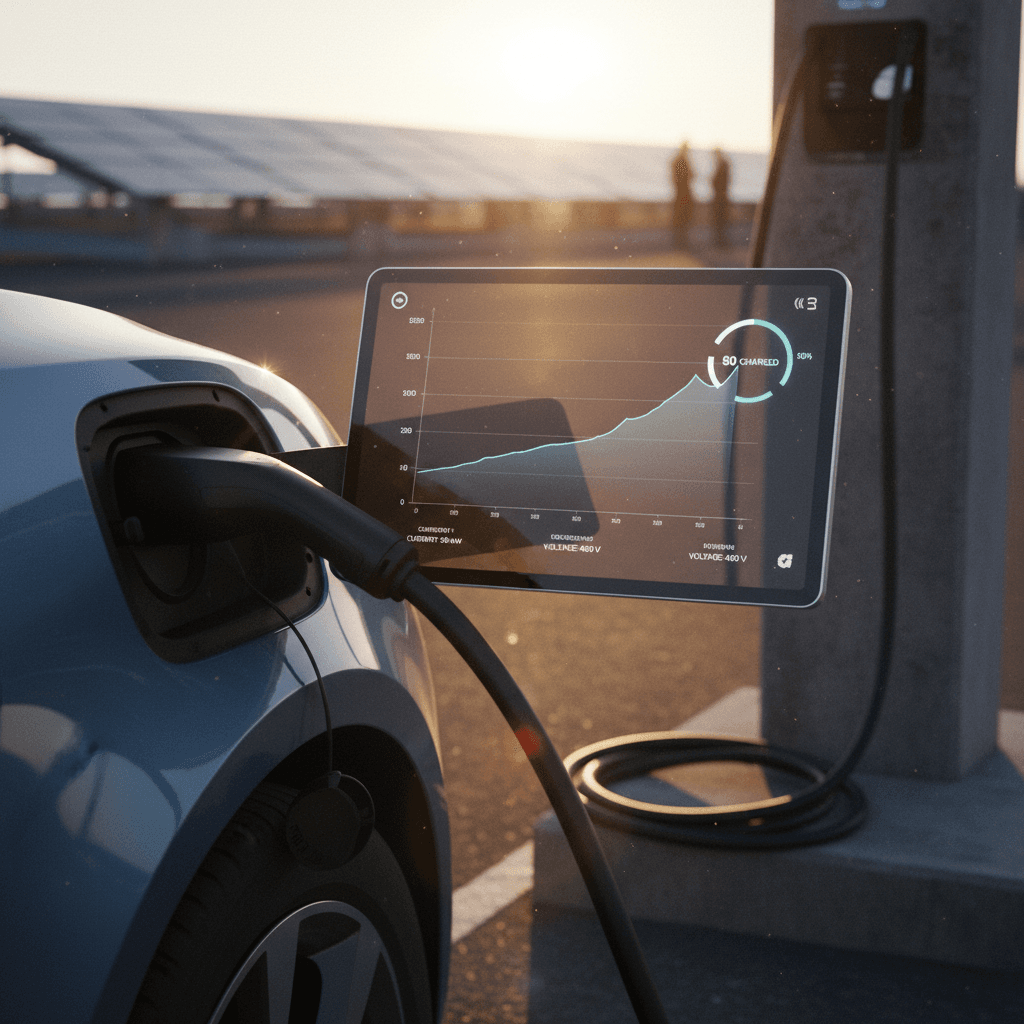
If you’ve ever watched a DC fast charger race from 10% to 60% and then crawl from 80% to 100%, you’ve already seen the EV charging curve in action. Many drivers ask, “Why does EV charging slow down at 80 percent, and is something wrong with my car or the charger?” The good news is that it’s almost always normal, and understanding why it happens can save you time and protect your battery.
Quick answer
What You’re Noticing at 80% (and Why It Feels So Slow)
On a modern fast charger, a typical charging session looks something like this:
- You plug in around 10–20% state of charge (SoC). The charger quickly ramps up to a high power number, maybe 120 kW, 150 kW, or even more.
- Between roughly 20% and 60–70%, the power stays near that peak or slightly below it. You’re adding miles very quickly.
- Somewhere between 60% and 80%, the power number on the screen starts to drop, sometimes sharply.
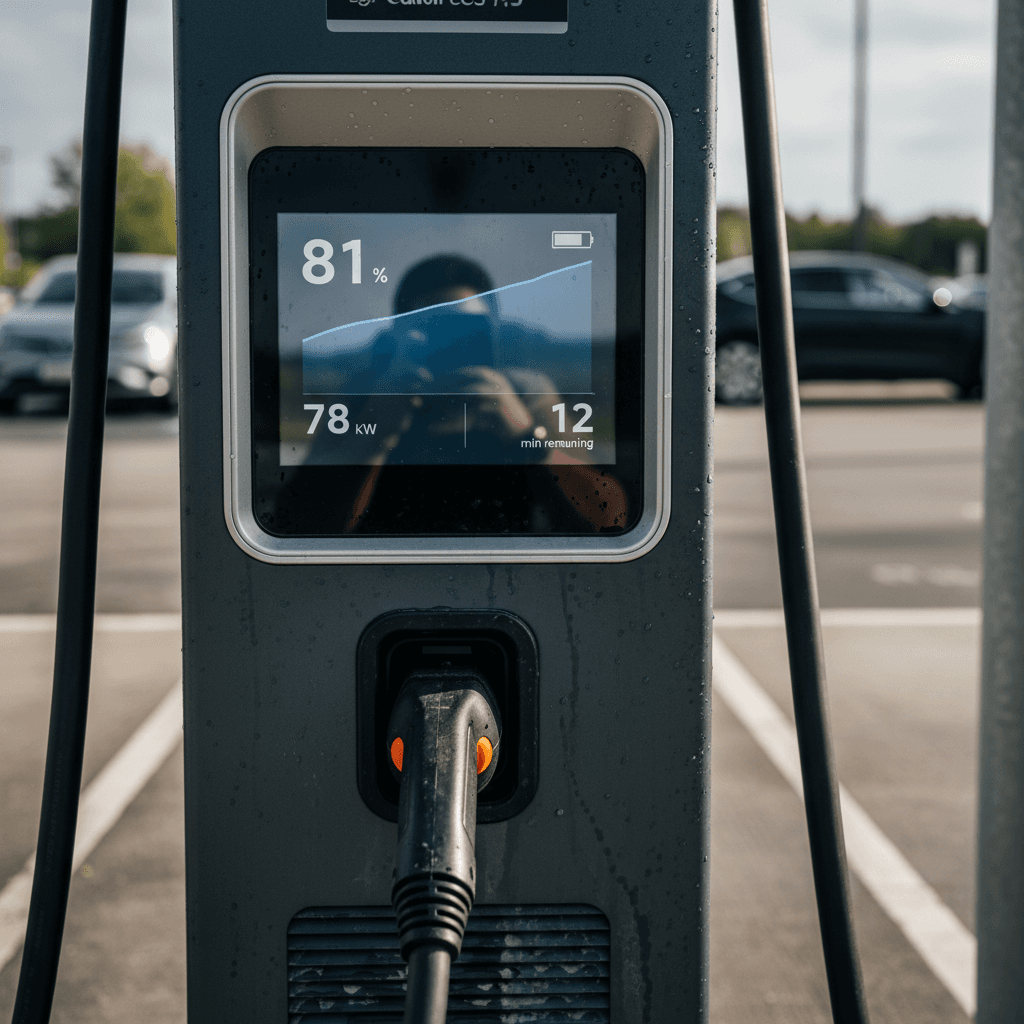
- Above about 80%, charging can feel painfully slow. You might only see 20–40 kW on a charger capable of 150 kW or more.
If you’re new to EVs, that can feel like something is broken. In reality, this is how nearly every lithium‑ion EV battery is designed to behave. The car, not the charger, is calling the shots, and once you understand the logic behind it, you can use it to your advantage.
How EV Charging Actually Works: Constant Current and Constant Voltage
Behind the scenes, your EV follows a charging profile often described as CC/CV, constant current followed by constant voltage.
The Two Phases of Fast Charging
Once you see these phases, the 80% slowdown finally makes sense.
Phase 1: Constant Current (CC)
In the early part of a DC fast‑charging session, your EV accepts as much current (amps) as its hardware and the charger will allow, within safe limits. Power (kW) stays high and relatively flat.
- Typically from ~10% to 50–70% SoC
- Fastest miles‑per‑minute of the whole session
- This is where the advertised “up to 150 kW” or “up to 350 kW” really shows up
Phase 2: Constant Voltage (CV)
As the battery fills, its voltage rises. To prevent cells from exceeding their safe max voltage, the BMS holds voltage roughly constant and reduces current. That causes charging power (kW) to taper down.
- Often begins somewhere between 60% and 80% SoC
- Charging slows the closer you get to 100%
- This taper is what you’re feeling at 80%
You can think of this like filling a glass with water from a powerful faucet. At first you can turn the faucet wide open. As the glass nears the brim, you instinctively turn it down to avoid splashing. Your EV is doing the same thing, just with electrons instead of water.
The Real Reasons Charging Slows Down Around 80%
There isn’t a single magic switch at exactly 80%. Instead, several physics and engineering limits are all converging in that neighborhood. Different cars hit the brakes earlier or later, but the reasons are similar.
Key drivers of the 80% slowdown
1. Voltage limits and cell safety
Each lithium‑ion cell in your pack has a safe voltage window. As the battery fills up, cell voltage rises. Near full charge, even a small increase in energy can push cells out of their comfort zone. To prevent over‑voltage and the risk of damage, your BMS lowers current, and therefore power, once SoC climbs past the mid‑range.
2. Heat management
Fast charging generates heat. Higher SoC levels are more sensitive to temperature, and heat is one of the main drivers of long‑term battery wear. Your EV will taper charging to keep battery temperatures in a safe band, particularly if the pack is already warm from highway driving or previous fast‑charge stops.
3. Cell balancing
Your battery pack is made up of hundreds or thousands of cells. They don’t all charge at exactly the same rate. As you approach full, the BMS slows charging to give lower‑voltage cells time to “catch up,” a process called <strong>cell balancing</strong>. That careful balancing is critical for pack longevity and safety, but it takes time.
4. Diminishing efficiency
Charging is most efficient at lower states of charge. As you climb toward 100%, more of the energy you’re drawing from the charger is lost as heat and overhead. Slowing down helps maintain reasonable efficiency rather than wasting power trying to cram those last few percent in quickly.
5. Automaker strategy
Manufacturers tune charging curves differently. Some performance‑oriented or long‑range EVs hold high power a bit longer; others start tapering earlier to prioritize battery life. Software updates can also adjust these limits over time. Your owner’s manual and in‑car displays often recommend 80% as the everyday fast‑charge target for this reason.
Nothing’s “wrong” with your charger
Why 80% Became the EV Charging Sweet Spot
With all this in mind, it’s easy to see why automakers, charging networks, and experienced drivers talk so much about charging “to 80%.” It isn’t a hard rule, but it’s a very practical guideline, especially on road trips and at busy public chargers.
How long does the “last 20%” really take?
Use 80% as your default, not your ceiling
What This Means for Road Trips and Public Fast Charging
On the open road, understanding the 80% slowdown can turn a frustrating wait into a much smoother trip. The goal usually isn’t to cram in every possible mile at each stop, it’s to minimize total travel time while keeping the battery happy.
Plan for more, shorter stops
Because your car charges fastest at lower states of charge, it’s often quicker to:
- Arrive at a fast charger around 10–20%
- Charge only to about 60–80%
- Drive on and repeat as needed
Instead of one long push from 10% to 100%, two shorter sessions that both stay mostly in the “fast” part of the curve can shave meaningful time off your trip.
Be a good charging neighbor
Once your battery has tapered and you’re only gaining a few miles every several minutes, you’re getting less value from that fast‑charger slot. If others are waiting, unplugging at 80% is an easy way to keep the station flowing.
That’s not just courtesy, it’s a practical response to how EVs charge. Many networks even send a notification when you’ve reached your set target or when power drops significantly.
Pro move for long drives
Home Charging vs. Fast Charging: How the Curve Differs
So far, we’ve mostly been talking about DC fast charging, where power levels are high enough that tapering is very noticeable. At home, using Level 1 or Level 2 AC charging, the experience is a bit different.
Charging curves at home vs. DC fast
Same battery physics, very different feel.
Home & workplace (AC)
- Lower power (typically 1–11 kW)
- Charging is slow enough that taper is less dramatic in day‑to‑day use
- You’re usually plugged in for many hours, so whether the last 20% is a bit slower rarely matters
- Great for overnight charging to 80–100% when you’re not in a hurry
Public fast charging (DC)
- High power (50–350+ kW)
- Taper stands out: big numbers early, much smaller numbers after ~70–80%
- Session time really matters, especially on road trips or when chargers are busy
- Best used as a quick top‑up rather than a full fill to 100% when possible
Why 100% is fine at home (most of the time)
Does Slowing Down at 80% Really Protect Battery Health?
Battery engineers lose sleep so you don’t have to. Their marching orders are simple but strict: deliver good range and fast charging today without sacrificing too much capacity 8–12 years down the line. The 80% slowdown is one of their main tools to hit that target.
- Spending lots of time at very high state of charge (near 100%) tends to age lithium‑ion cells faster.
- Spending lots of time at very low state of charge (near 0%) can also stress the pack.
- High temperatures and repeated high‑power fast‑charging events add additional wear.
By tapering charge power around 70–80%, your EV reduces heat and avoids pushing cells right up against their voltage ceiling for long periods. Many automakers now recommend, and even default to, daily charge limits around 70–80%, and some offer battery warranties that assume you’ll follow those guidelines.
When to avoid 100%
How to Read and Use Your Car’s Charging Curve
Every EV has its own unique charging curve. Some 800‑volt models hold high power closer to 70%; others on 400‑volt architectures taper earlier. You don’t need to memorize graphs, but getting familiar with your car’s behavior pays dividends.
Simple ways to learn your EV’s charging curve
1. Watch the power number once or twice
On your next DC fast‑charge stop, pay attention to the kW number on the charger or in your car’s display as SoC climbs. Note roughly where it peaks and where it starts to drop significantly.
2. Use trip‑planning apps
Many route‑planning apps and in‑car navigation systems now factor in your vehicle’s typical charging curve and recommend ideal arrival and departure SoC targets. Let them do the math; you just follow the prompts.
3. Set a smart charge limit
In your car’s settings, choose a daily charge limit around 70–80% if your driving habits allow. You can temporarily raise it to 90–100% for road trips or special situations.
4. Track time, not just percent
Instead of obsessing over squeezing in one more percent, look at remaining time to target SoC. Often, you’ll see that the last few percent add very little usable range but eat up a lot of time.
Used EV Shopping: What the 80% Rule Means for You
If you’re considering a used EV, the way the previous owner charged it, especially how often they fast‑charged to 100%, can influence long‑term battery health. You can’t see their habits directly, but you can see their effects in the pack’s actual capacity and behavior.
This is where tools like the Recharged Score come in. Every EV sold through Recharged includes a battery health report that looks beyond simple odometer readings. Our diagnostics help you understand how much capacity the pack still has and how it’s likely to perform over time, regardless of whether the previous owner loved fast charging or mostly plugged in at home.
Why this matters for buyers
If you already own an EV and plan to sell or trade it in later, whether privately or through a service like Recharged, following good charging habits today can pay off in tomorrow’s resale value.
FAQ: Why EV Charging Slows Down at High State of Charge
Frequently Asked Questions
Bottom Line: Smart Habits Beat Watching the Last 20%
When you understand why EV charging slows down at 80 percent, it stops being a mystery, and starts becoming a tool you can use. The slowdown is a sign that your car is taking care of its battery, not a sign that something’s broken. On the road, that usually means unplugging around 70–80%, planning more, but shorter, stops, and saving 100% charges for the days you truly need the range.
Whether you’re driving your first EV or comparing used models, paying attention to charging behavior is one of the best ways to protect both your time and your investment. And if you’re shopping the used market, a trusted battery health report, like the Recharged Score that comes with every EV we sell, turns the invisible world of charging curves and past habits into clear, confident decision‑making.