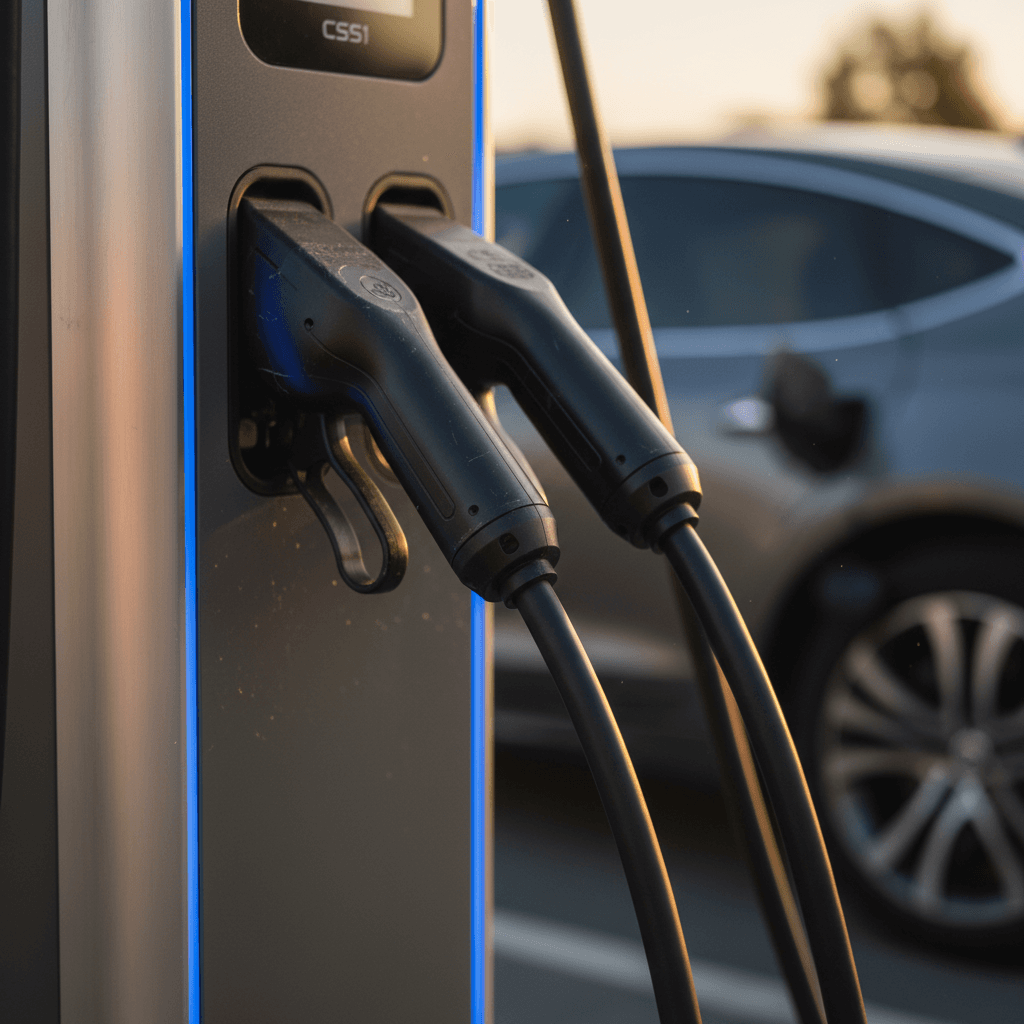
If you’ve spent any time around public DC fast chargers, you’ve seen a bulky plug labeled CCS. So what is a CCS charging connector, and does it matter for the EV you drive or plan to buy? In this guide, we’ll break down CCS in plain language, how it works, how fast it can charge, how it compares with Tesla’s NACS plug, and what all of this means for today’s EV shoppers, especially if you’re considering a used electric vehicle.
Quick definition
What is a CCS charging connector? The short version
CCS stands for Combined Charging System. It’s a global standard for EV charging hardware and communication between the car and the charger. A CCS connector is the physical plug you insert into your EV for DC fast charging. In North America this plug is called CCS1; in Europe and much of the rest of the world it’s CCS2.
- It combines AC and DC charging in one inlet on the car, slow/Level 2 and DC fast charging share the same opening.
- It’s used by most non‑Tesla EVs sold over the last decade, including models from BMW, Hyundai, Kia, Volkswagen, Ford, GM, and many others.
- CCS chargers today commonly deliver up to 350 kW of power, with newer hardware pushing higher in specific conditions.
Think of CCS as the “USB‑C” ofEVs (for now)
How a CCS connector actually works
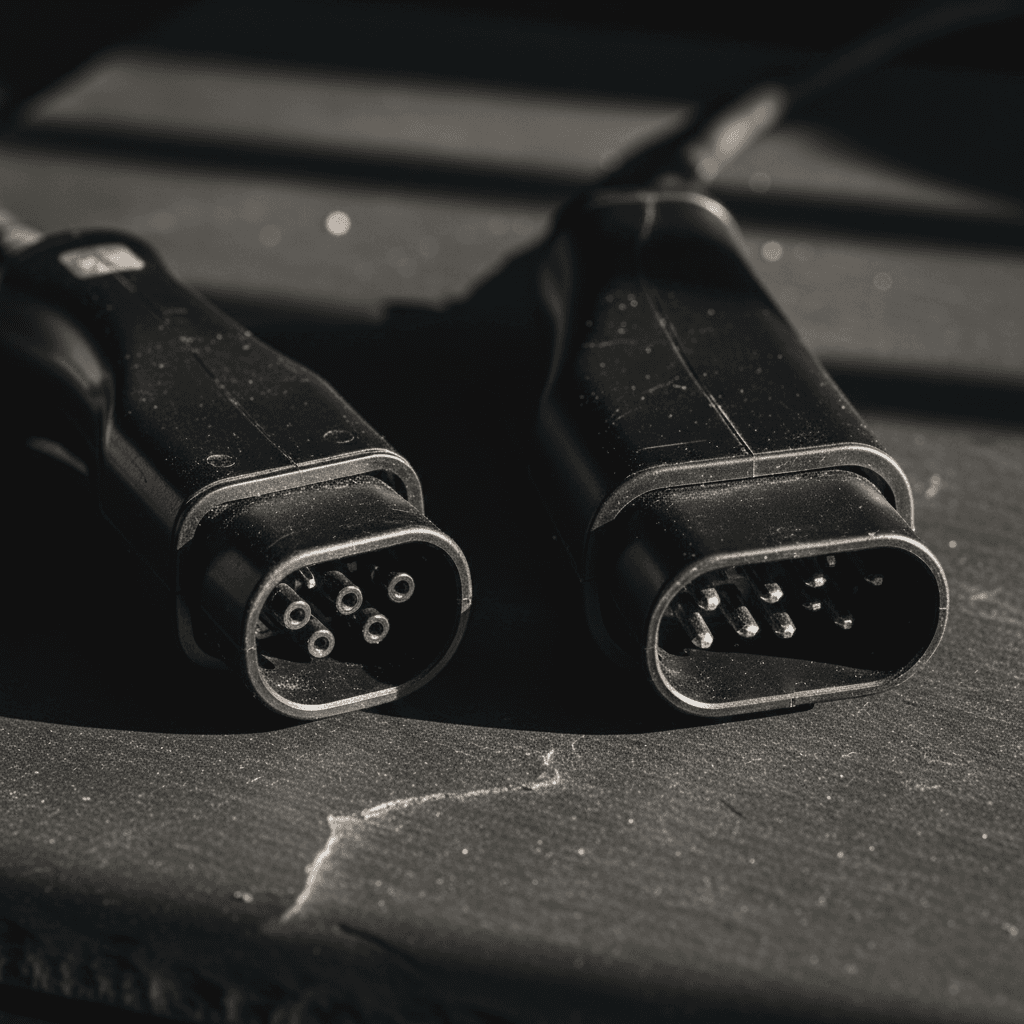
The easiest way to understand CCS is to picture it as a standard AC port with two extra muscles for DC fast charging. On the car, you see a single, tall oval‑shaped inlet. The upper section is the familiar AC connector, J1772 in North America or Type 2 in Europe. The two large pins at the bottom are for high‑power DC charging.
Anatomy of a CCS connector
What’s actually hiding inside that bulky plug?
AC portion (upper half)
The top half of a CCS inlet is a standard AC connector:
- CCS1: SAE J1772 Type 1 (North America)
- CCS2: Type 2 / Mennekes (Europe and others)
- Handles Level 1/Level 2 AC charging at home or slower public stations.
DC portion (lower pins)
The bottom two pins are for DC fast charging:
- Large diameter pins carry high current directly to the battery pack.
- Bypasses the onboard AC charger for much higher power.
- Supported by sophisticated communication so the car and station can adjust current and voltage safely.
When you fast‑charge with CCS, the station converts AC from the grid to DC and sends it straight into your battery. The car and charger constantly talk to each other over communication pins to manage voltage, current, temperature, and safety. If anything looks off, both sides reduce power or stop the session.
Why CCS plugs feel heavy
CCS1 vs CCS2: what’s the difference?
You’ll hear people throw around CCS1 and CCS2 as if they’re interchangeable. They’re closely related but not the same connector. Both follow the same Combined Charging System standard, but they’re designed around different legacy AC plugs and regional power systems.
CCS1 vs CCS2 at a glance
Both versions support high‑power DC fast charging; the big differences are shape, AC capability, and where they’re used.
| Feature | CCS1 (Combo 1) | CCS2 (Combo 2) |
|---|---|---|
| Base AC plug | SAE J1772 Type 1 | Type 2 (Mennekes) |
| Typical regions | North America, South Korea | Europe, UK, Australia, much of Asia |
| AC capability | Single‑phase, up to ~19.2 kW with the right circuit | Single‑phase or three‑phase, up to ~43 kW at capable sites |
| DC fast charging | Typically up to 350 kW (with advanced cooling, even higher in some trials) | Similarly up to 350 kW+, with newer hardware targeting 500+ kW |
| Backward compatibility | Works with J1772 AC stations via the upper part of the inlet | Works with Type 2 AC stations via the upper part of the inlet |
Most U.S. EV drivers will only encounter CCS1, but CCS2 dominates Europe and many other regions.
Regional rule of thumb
How fast can CCS charge? Power levels explained
On paper, CCS can deliver eye‑watering power levels. In real life, your charging speed will depend on your car, the charger, battery temperature, and how full your pack already is. But it’s worth understanding the rough limits.
CCS charging capability
Remember, those numbers are theoretical maxima. Your EV has its own DC fast‑charging curve, usually starting high when the battery is low, then tapering as it fills to protect long‑term battery health. A compact hatchback with a 50 kWh pack might max out at 100 kW; a big SUV with an 800‑V architecture could briefly touch 250–350 kW or more.
How to estimate your real‑world speed
Where you’ll find CCS chargers today
Even as Tesla’s NACS plug gains traction, CCS remains everywhere, especially across the big nationwide DC fast‑charging networks that serve non‑Tesla drivers.
Typical places you’ll see CCS connectors
If you’re road‑tripping in a non‑Tesla EV today, these are your go‑to options.
Dedicated fast‑charging hubs
Locations built around multiple high‑power DC stalls, usually along interstates and busy corridors.
- Electrify America, EVgo, ChargePoint DC fast hubs, and regional providers.
- Often co‑located with restrooms and food options.
Retail parking lots
Many big‑box stores, supermarkets, and shopping centers host CCS fast chargers.
- Charge while you shop.
- Power levels vary widely, always check in the app.
Highways & travel centers
Truck stops and travel plazas increasingly host multi‑standard fast‑charging plazas.
- CCS plus CHAdeMO (legacy) and, increasingly, NACS.
- Designed for quick in‑and‑out road‑trip stops.
Most non‑Tesla DC sites in the U.S. today still revolve around CCS. As more automakers adopt NACS, networks are adding NACS cables, but they’re not ripping out CCS, there are simply too many CCS‑only vehicles on the road.
Good news for current CCS drivers
CCS vs. NACS vs. CHAdeMO: connector comparison
CCS isn’t the only game in town. In North America you’ll also see Tesla’s NACS connector (sometimes still called the Tesla plug) and, less often, CHAdeMO on older Japanese EVs. Here’s how they stack up conceptually.
CCS (Combined Charging System)
- Who uses it: Most legacy non‑Tesla EVs, Hyundai, Kia, VW, Ford, GM, BMW, Mercedes‑Benz, and others.
- Strengths: Widely deployed DC fast‑charging standard with high power and open governance.
- Weaknesses: Bulkier connector; more complex plug design than NACS.
NACS (North American Charging Standard)
- Who uses it: Tesla today; many major automakers plan to ship NACS‑port EVs in North America from 2025 onward.
- Strengths: Compact, easy‑to‑handle plug; deep integration with Tesla’s Supercharger network.
- Weaknesses: Transition period requires adapters and dual‑standard infrastructure.
CHAdeMO, once the dominant DC fast‑charging standard for early Nissan LEAFs and a few other models, is now fading fast in North America. New sites are rarely built with CHAdeMO‑only posts, and many future‑proofed corridors prioritize CCS and NACS instead.
Don’t confuse connector with network
Adapters, compatibility, and safety rules
Because we’re in a transition period, especially in North America, adapters are hot topics. You might use an adapter to charge a CCS car at a NACS site (like a Supercharger) or, in some cases, a NACS‑port car at CCS stations. But there are limits and safety considerations you should respect.
Using CCS and NACS adapters safely
1. Prefer automaker‑approved adapters
Automaker‑supplied or officially licensed adapters are tested for high‑power DC use and usually carry safety certifications. They’re your safest bet for regular fast charging.
2. Avoid DIY high‑power adapters
Homemade or off‑brand high‑current adapters can overheat or fail under sustained 200–500 amp loads. Many charging networks explicitly ban these on their DC fast chargers.
3. Understand power limits
Some adapters cap maximum power well below what the charger or your car supports. Even if the station advertises 350 kW, your adapter might limit you to 150 kW or less.
4. Know which direction you’re adapting
A CCS‑port car needs a different solution than a NACS‑port car. Make sure the adapter direction matches your situation (e.g., NACS‑to‑CCS1 vs CCS1‑to‑NACS).
5. Follow network rules
Major networks often allow only automaker‑made, UL‑listed adapters. If you use unapproved hardware, they can stop the session or revoke access under their terms of service.
6. Inspect for wear and heat
If an adapter or plug feels unusually hot, shows discoloration, or fits loosely, stop using it and contact the manufacturer or your automaker.
Never use extension cords for DC fast charging
What CCS means when you’re buying a used EV
If you’re shopping for a used EV in 2026, understanding CCS isn’t just a technical curiosity, it affects how and where you’ll fast‑charge, how future‑proof your car feels, and whether you’ll want an adapter down the road. This is exactly the kind of nuance Recharged bakes into every Recharged Score and battery‑health report we provide with our vehicles.
Key CCS questions for used‑EV shoppers
Ask these before you commit to a car with a CCS port.
1. What fast‑charging options are near you?
Open your favorite charging app and filter by CCS fast chargers around your home, workplace, and common road‑trip routes.
- Plenty of CCS nearby? Great, you’re well served today.
- Mostly Superchargers (NACS) with few CCS sites? Factor in adapter availability and cost.
2. How does this model charge on CCS?
Not all CCS cars charge equally.
- Check the model’s peak DC rate (e.g., 100 kW vs 230 kW).
- Look for real‑world tests showing 10–80% times.
- Recharged’s listings summarize this so you’re not guessing.
3. Does it fit your travel pattern?
If you mostly charge at home and use fast charging a few times a year, CCS availability is rarely a deal‑breaker.
- Frequent road‑tripper? Map out CCS corridors on your main routes.
- Consider whether an automaker‑approved NACS adapter is available or promised.
4. What’s the long‑term outlook?
CCS support will be around for years, but the ecosystem is evolving.
- Many brands plan NACS ports on future models, not existing ones.
- That makes a well‑priced used CCS vehicle a value play, especially if it includes or supports a NACS adapter.
How Recharged helps you de‑risk CCS decisions
Visualizing CCS connectors
CCS charging connector FAQs
CCS connector: common questions answered
Key takeaways on CCS connectors
The CCS charging connector is one of the backbone technologies of modern EV charging, especially for non‑Tesla models. It bundles everyday AC charging and high‑power DC fast charging into a single inlet on your car, supports power levels up to hundreds of kilowatts, and underpins much of today’s public DC infrastructure.
As the industry shifts toward NACS, CCS will coexist for many years. If you own or are shopping for a CCS‑equipped EV, your priority should be understanding how quickly your specific model charges, what CCS coverage looks like where you drive, and whether a high‑quality adapter can unlock NACS networks for you.
If you’re evaluating a used EV, Recharged can help you make sense of all this. Every vehicle we list comes with a transparent Recharged Score Report so you can see battery health, realistic range, and fast‑charging behavior before you buy. Pair that with EV‑specialist support, flexible financing, and nationwide delivery, and you’ll head into your next CCS, or NACS, EV with confidence.