If you’re trying to make sense of West Virginia used EV incentives in 2026, you’ve probably noticed a lot of outdated articles still talking about federal tax credits and old state programs. The landscape changed sharply after September 30, 2025, and West Virginia has never been a big “cash-on-the-hood” EV state to begin with. This guide cuts through the noise so you know exactly what incentives are gone, what’s still available, and how to keep your total cost of a used electric vehicle as low as possible.
First, a quick reality check
Overview: West Virginia used EV incentives in 2026
West Virginia EV cost snapshot for 2026
In other words, 2026 is less about a big headline tax credit and more about stacking smaller savings and negotiating a good deal on the car itself. You still need to budget for title tax, plate fees, and West Virginia’s extra EV fee, but a smart purchase price and a cheap-to-run EV can outweigh the lack of a big rebate over a few years of ownership.
Watch for outdated information
Did West Virginia ever have its own EV tax credit?
West Virginia has a long history of alternative-fuel vehicle policy, but most of it was built around natural gas and propane rather than battery EVs. The state created an alternative-fuel motor vehicle tax credit years ago that could be worth several thousand dollars, and for a time some battery EVs qualified in practice. That program effectively ended more than a decade ago, and more recent legislative reports discuss it largely in the past tense.
There’s also been a separate credit for alternative-fuel refueling infrastructure in West Virginia state law, not to be confused with the federal EV charger tax credit, but again, the focus was more on natural gas and propane fueling. For a used EV buyer in 2026, neither of these historic credits is something you can count on when you walk into a dealership.
Why WV looks “quiet” on EV purchase incentives
What happened to the federal used clean vehicle credit?
From 2023 through most of 2025, many West Virginia drivers could use the federal Used Clean Vehicle Credit (Internal Revenue Code Section 25E). It offered up to $4,000 off a qualifying used EV, subject to price caps, income limits, and other rules. Beginning in 2024, many dealers, including EV specialists like Recharged, could even apply that credit at the point of sale, lowering your out‑of‑pocket price instead of making you wait for tax season.
That whole regime changed when federal lawmakers passed the One Big Beautiful Bill Act. Among other things, it accelerated the sunset of clean-vehicle incentives. As of deliveries after September 30, 2025, the headline federal credits, both for new and used EVs, no longer apply. That means there is no federal used EV tax credit available for a car you buy and take delivery in 2026, whether you live in West Virginia or any other state.
Bottom line on federal incentives in 2026
West Virginia cost factors: taxes, fees and registration for used EVs
Motor vehicle title privilege tax
West Virginia charges a 5% motor vehicle title privilege tax when you title a vehicle with the DMV. That applies whether the car is gas, hybrid, or fully electric. It functions like a sales tax, but it’s collected at the time you title the vehicle rather than at the dealership cash register.
On a $20,000 used EV, that 5% tax adds about $1,000 to your out‑the‑door cost, plus a $10 title fee and normal registration charges.
Extra annual EV and hybrid fees
Like many states, West Virginia has imposed extra registration fees on electric and some hybrid vehicles. The idea is to replace gas‑tax revenue that EVs don’t pay. For a fully electric vehicle, expect an extra charge in the low‑hundreds of dollars per year on top of normal registration; hybrids are typically assessed a smaller surcharge.
This doesn’t kill the value proposition, EVs are still far cheaper to fuel per mile, but it’s a cost you should bake into your long‑term budget.
Key cost elements for a used EV titled in West Virginia
These are the recurring money factors to think about alongside the purchase price of the vehicle itself.
| Cost item | How it works for a used EV in WV | What to plan for |
|---|---|---|
| Title privilege tax | 5% of the vehicle’s value, collected when you first title the vehicle in West Virginia | Adds roughly $1,000 on a $20,000 used EV |
| Registration & plates | Standard WV registration fees similar to gas cars | Budget for typical registration cost plus any local add‑ons |
| EV / hybrid surcharge | Extra annual fee on battery EVs and some plug‑in hybrids to replace gas tax | Think in terms of a few hundred dollars per year for a full EV |
| Insurance | EVs can be slightly higher or lower than similar gas cars depending on model and carrier | Shop around, different insurers rate EVs very differently |
| Charging costs | Depends on your electric rate and mix of home vs public charging | In coal‑heavy WV, electricity is still usually cheaper per mile than gasoline |
Numbers are approximate and may change with future legislation, always confirm with the WV DMV and your local county office before you buy.
Use “total cost of ownership,” not just sticker price
Utility and charging incentives that still exist in West Virginia
The most reliable West Virginia–specific incentives in 2026 aren’t for the car itself, but for the charging hardware and electricity you’ll use to run it. That’s where local utilities come in.
Where West Virginia used EV owners can still find incentives
Small rebates and smart-rate programs can add up over the life of the car.
Home Level 2 charger rebates
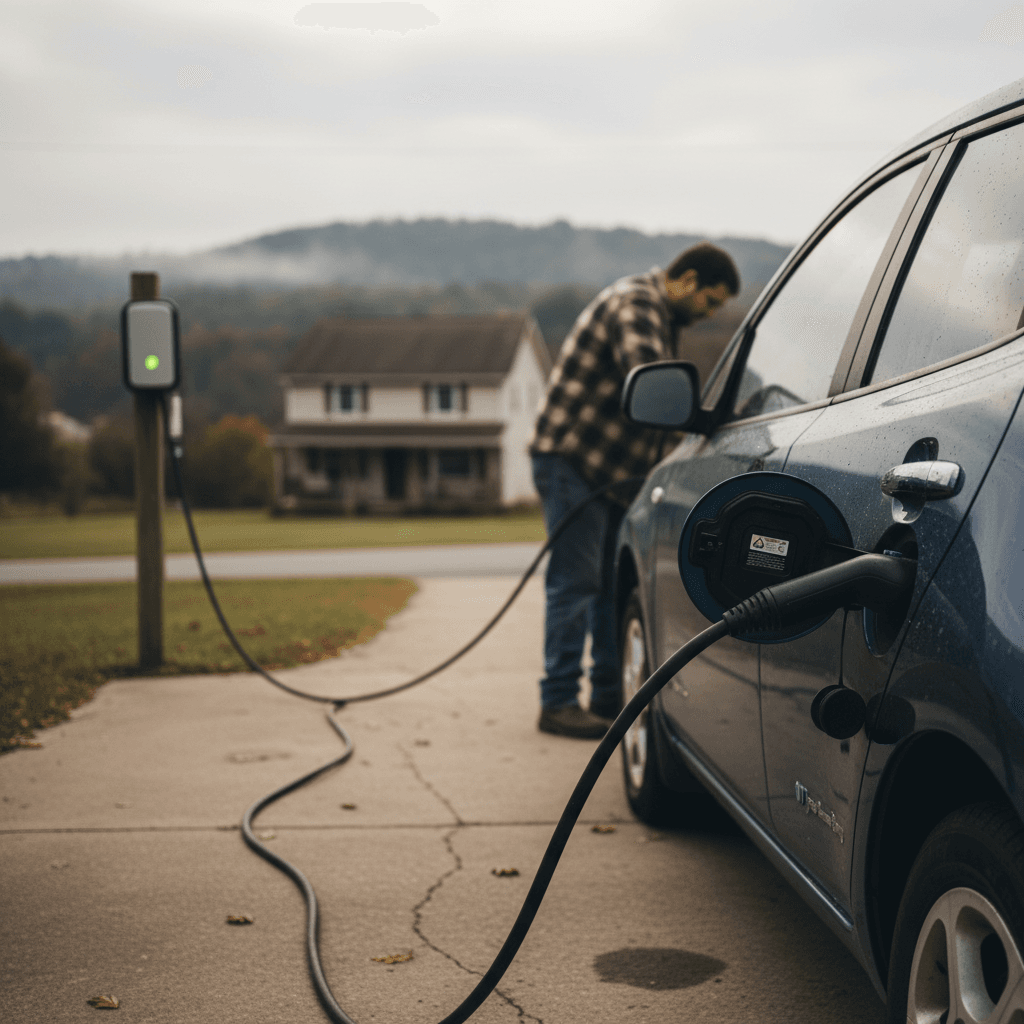
Appalachian Power’s TakeCharge WV program offers a residential rebate (around $300) when you install a qualifying Level 2 home charger, subject to program rules and funding.
That won’t make or break a purchase, but it can significantly cut the cost of upgrading from a slow 120‑volt plug.
Off-peak charging rates
Some utilities in and around West Virginia experiment with time-of-use electric rates, making overnight charging cheaper than daytime use.
Even modest off‑peak discounts can save a heavy commuter hundreds of dollars over a few years versus filling up with gasoline.
Public charging build-out
Federal NEVI highway funding has pushed more DC fast chargers onto interstates that touch West Virginia. You may not get a rebate for using them, but competition between networks is starting to show up as promos and lower per‑kWh prices.
For rural drivers, that’s as valuable as a one‑time rebate.
Check utility program fine print
Manufacturer and dealer discounts on used EVs
With federal tax credits gone after September 30, 2025, automakers and dealers have had to do more heavy lifting to keep EVs moving off lots. That’s actually an opportunity if you’re shopping for a used electric vehicle in West Virginia in 2026.
- Automakers are leaning on subvented financing and lease cash for new EVs, which indirectly pushes more recent off-lease EVs into the used market at good prices.
- Many franchise dealers are still “pricing in” the old federal tax credits by showing large apparent discounts on late-2024 and 2025 EVs, even though the government money is gone.
- Independent EV-focused retailers like Recharged compete primarily on transparent pricing, verified battery health, and simplicity rather than chasing expired tax programs.
Treat “dealer incentives” like any other discount
Practical ways to lower your used EV cost in West Virginia
7 levers you can still pull in 2026
1. Target models with healthy depreciation
Used EVs like early Chevrolet Bolt EVs, Nissan Leafs, and first‑generation Hyundai/Kia models often sell far below their original MSRP, especially in low-EV states like West Virginia. That depreciation is effectively your “rebate.”
2. Prioritize battery health over odometer
A ten‑year‑old EV with a strong battery can be a better value than a newer pack that’s been fast‑charged hard. A <strong>battery health report</strong>, like the Recharged Score you get on every car bought through Recharged, tells you much more than a simple mileage number.
3. Plan your title tax and fees up front
Use the 5% title privilege tax, extra EV surcharge, and registration fees to build a true, out‑the‑door price before you fall in love with a specific car. That prevents “sticker shock” at the DMV.
4. Use utility rebates for your home charger
If you buy a Level 2 charger, line up your paperwork for programs like Appalachian Power’s TakeCharge WV before installation. The difference between a full-price $700 install and a rebated one can cover your first year of electricity.
5. Choose the right battery size for your driving
There’s no reason to pay for a 300‑mile pack if you mostly drive 40 miles a day around Charleston or Morgantown. A smaller, cheaper pack with slower degradation can be a better economic fit.
6. Shop finance offers, not just rates
In a post‑credit world, lenders and retailers sometimes use <strong>rate buydowns or cashback at signing</strong> to move EV inventory. Compare total interest paid and any up‑front cash, not just the advertised APR.
7. Look beyond state lines (but run the math)
Because West Virginia has so little EV inventory, you may find better selection in neighboring states. Just remember that when you bring the car home, WV’s 5% title tax still applies to what you paid, and delivery costs can eat into any price advantage.
Why low-EV states can be a bargain
How Recharged helps West Virginia drivers shop smarter for used EVs
Even without big 2026 tax credits, you still have leverage as a buyer, especially if you focus on transparency and long‑term costs rather than just a monthly payment. That’s exactly the gap Recharged is built to fill.
What Recharged brings to West Virginia used EV buyers
Transparency and battery insight matter more in a post-credit world.
Verified battery health (Recharged Score)
Every vehicle on the Recharged platform comes with a Recharged Score Report that includes detailed battery diagnostics, pack health, and realistic range expectations.
That makes it much easier to compare a used EV against a gas car in total cost terms.
Fair market pricing
Recharged benchmarks each vehicle against the wider used‑EV market instead of trying to bake in expired tax credits or confusing fine print.
In a state without direct incentives, fair pricing is your primary “rebate.”
Digital buying and delivery
Recharged offers a fully digital retail experience, plus nationwide delivery and an Experience Center in Richmond, VA. That gives West Virginia shoppers access to a much larger pool of vetted used EVs than local lots can provide.
Ready to find your next EV?
Browse VehiclesOn top of that, Recharged can help you navigate financing options, value your trade‑in, or even get an instant offer if you’re moving out of an older gas vehicle. In a world without simple tax‑credit answers, having a specialist in your corner is one of the most valuable incentives you can get.
West Virginia used EV incentives FAQ (2026)
Frequently asked questions about West Virginia used EV incentives in 2026
Key takeaways for West Virginia used EV incentives in 2026
- There is no active West Virginia state tax credit or rebate for buying a used EV in 2026, and the historic alternative-fuel credits are legacy programs, not something today’s buyers can count on.
- The federal Used Clean Vehicle Credit ended for deliveries after September 30, 2025, so 2026 purchases are not eligible, despite what older blog posts and some advertisements still suggest.
- You should budget for West Virginia’s 5% title privilege tax, normal registration costs, and an extra annual EV fee when comparing a used EV to a gas car.
- The most meaningful remaining incentives are utility rebates and rate programs (like Appalachian Power’s TakeCharge WV) plus manufacturer and dealer discounts built into the price.
- In a post-credit world, your best “incentives” are smart shopping and transparency: focus on battery health, fair pricing, and total cost of ownership over 3–7 years.
- Specialist platforms like Recharged help West Virginia shoppers by providing verified battery diagnostics, fair‑market pricing, financing and trade‑in support, and delivery from larger EV markets.
Incentive headlines may have faded by 2026, but that doesn’t mean a used EV can’t be a smart financial move in West Virginia. The equation has simply shifted from chasing tax forms to buying the right car at the right price, with the right information. If you line up your numbers on taxes, fees, charging costs, and battery health, and use partners who specialize in EVs rather than treating them as oddballs on the lot, you can still come out ahead, even without a state or federal check in your mailbox.