If you drive an electric vehicle in the Mountain State, you’ve probably wondered whether West Virginia EV HOV lane rules give you any special perks, like solo access to carpool lanes during rush hour. The short answer in 2026: **West Virginia does not currently offer special HOV-lane privileges just because your car is electric**. But there are a few important nuances worth understanding, especially after recent federal changes to HOV rules.
Key takeaway up front
Overview: How West Virginia EV HOV Lane Rules Work Today
Start with the big picture: **West Virginia has very limited HOV infrastructure**, and the state’s transportation priorities have focused more on freight movement, safety, and basic capacity than on dedicated carpool lanes. Unlike neighbors such as Virginia or Maryland, West Virginia does not operate a network of urban HOV or HOT (High-Occupancy Toll) lanes where special clean-vehicle rules would typically apply.
- On most West Virginia interstates and highways, there are **no signed HOV-only lanes** at all.
- Where multiple lanes exist, they are generally **general-purpose lanes** open to all motor vehicles that meet normal rules (registration, insurance, speed limits, etc.).
- Because there are no active HOV corridors, **there is no separate EV decal, plate, or sticker program** tied to HOV access.
Don’t assume Virginia’s rules apply
Does West Virginia Give Solo HOV Access to EVs?
In states with mature HOV systems, electric vehicles sometimes get **solo-occupant access** as a way to reward low-emission driving. That’s the classic “EV in the carpool lane with only one person” perk. West Virginia drivers often ask if something similar exists here.
West Virginia EV HOV Access at a Glance
What solo EV drivers can and can’t do in 2026
What EVs CAN do
- Use all regular lanes like any other car
- Carpool legally in any lane when you meet posted occupancy rules
- Benefit from federal and state EV incentives unrelated to HOV
What EVs CANNOT do
- Use special carpool/HOV lanes solo, because none are designated today
- Skip normal occupancy rules based on being electric
- Rely on a WV “clean fuel" plate or HOV decal (no such program)
So if you’re wondering, “Do West Virginia EV HOV lane rules let me drive solo in a carpool lane?”, the practical answer right now is **no, because there are effectively no carpool-only lanes to begin with**. You follow the same lane rules in your EV as you would in a gasoline or diesel vehicle.
How the Federal HOV Law Changed in Late 2025
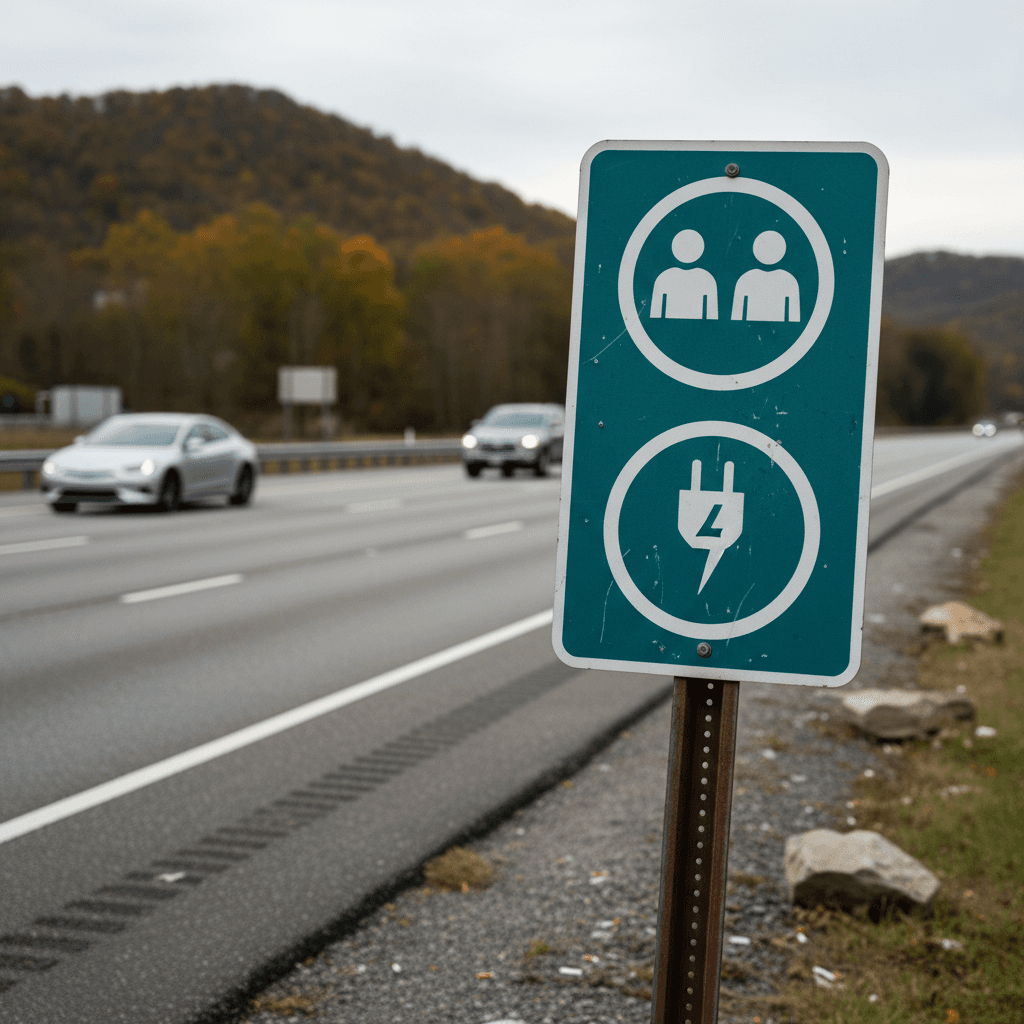
A lot of the confusion around HOV rules in 2026 comes from a **federal policy change at the end of September 2025**. For years, federal law gave states the option to let certain alternative-fuel vehicles, like EVs and plug-in hybrids, use HOV lanes without meeting minimum occupancy, as long as the state chose to opt in and manage the program.
That federal authorization **expired around October 1, 2025** without renewal. States that had built entire programs on it, California, Virginia, Maryland and others, were suddenly forced to **end or sharply restrict solo HOV access** for EVs and plug-in hybrids. Many agencies announced that, going forward, EVs would need to meet the posted occupancy rules just like any other vehicle, or pay regular tolls on HOT lanes.
What this means for West Virginia
Where HOV-Style Rules Could Matter in West Virginia
Even though West Virginia doesn’t have active HOV lanes today, it’s still worth understanding where HOV-style rules **could** show up in the future, or affect you if you’re crossing state lines. There are three main contexts to keep an eye on:
Where HOV-Style Questions Might Come Up for WV Drivers
Scenarios where you might hear about HOV or EV-lane rules as a West Virginia driver.
| Scenario | What It Is | Relevance to WV EV Drivers |
|---|---|---|
| Crossing into Virginia or Maryland | Urban interstates with signed HOV or HOT lanes, plus historic clean-fuel plate systems | You must follow that state’s posted rules; most EV-specific HOV perks there have ended or been curtailed since late 2025. |
| Future WV capacity projects | If congestion grows around Charleston, Morgantown, or on key corridors, WV could eventually consider HOV/HOT lanes. | If West Virginia ever creates HOV lanes, lawmakers could decide whether EVs get solo access, but that would require new, explicit state policy. |
| Special event or work-zone restrictions | Occasional temporary lane restrictions for construction or events. | These apply to all vehicles; being electric doesn’t grant exemptions. |
None of these scenarios currently create special HOV access for EVs registered in West Virginia, but they’re worth tracking if your commute crosses state borders.
Simple rule of thumb when you leave WV
Checklist: What WV EV Drivers Actually Need to Do
Given how much noise there’s been around EV incentives, plate programs, and HOV access, it helps to strip things back to a simple, practical checklist. For an EV owner who lives in West Virginia and mostly drives within the state, the lane-use rules are straightforward.
West Virginia EV HOV Rules: Practical Checklist
1. Treat every lane as a general-purpose lane
On WV interstates and highways, use left and right lanes the same way you would in a gas car: pass on the left, cruise and exit on the right. There is no “EV lane” or active HOV lane to worry about.
2. Ignore talk of decals or special plates for HOV
West Virginia does not currently have a clean-fuel plate, decal, or sticker that changes your HOV or lane-use rights. If someone references one, they’re probably talking about another state’s program.
3. Watch for HOV signs at state borders
If your commute takes you into Virginia, Maryland, Pennsylvania, or Ohio, **read the signs at the border and on the highway**. Any HOV or Express lane rules that exist there are based on that state’s law, not West Virginia’s.
4. Pay attention to work-zone lane restrictions
Temporary lane closures and truck-restriction zones apply to EVs just like to any other vehicle. HOV doesn’t come into play, but fines for speeding in work zones can be steep.
5. Focus on charging and route planning, not HOV perks
In West Virginia, the real EV advantage is cost per mile and access to growing charging corridors, not HOV access. Spend your energy planning charging stops and home charging instead of hunting for an HOV program that doesn’t exist.
Good news for used EV buyers
HOV vs. Toll Lanes vs. EV Corridors: Don’t Mix Them Up
Another reason EV drivers get confused is that a bunch of similar-sounding ideas get lumped together: **HOV lanes, HOT or Express lanes, and federal alternative fuel corridors**. They’re related to traffic management and EVs, but they are not the same thing, and they work differently in West Virginia.
HOV & HOT lanes
- Purpose: Move more people per lane by rewarding carpooling or charging tolls.
- Rules: Usually require 2–3 occupants; some states used to give EVs exemptions.
- WV status: No active HOV or HOT lanes where EV-specific rules apply in 2026.
EV Alternative Fuel Corridors
- Purpose: Federal designation that corridors like I-79 or I-77 have or will have sufficient EV charging.
- Rules: No special lane or occupancy rights, just better access to chargers.
- WV status: Several interstates are designated for EV charging build-out, which helps long-distance travel more than commuting.
Why corridors matter more than HOV in WV
Buying a Used EV in West Virginia With Commuting in Mind
If you’re shopping for a used EV in West Virginia or nearby, you don’t need to game West Virginia EV HOV lane rules, because again, there are effectively no HOV perks to game. Instead, what matters for your commute are **range, battery health, charging access, and total cost of ownership**.
Commuter Priorities That Matter More Than HOV Access in WV
How to choose a used EV that actually works for your daily drive
Range & efficiency
Make sure the car comfortably covers your **round-trip commute plus errands** with a buffer, especially in winter, when Appalachian temperatures can cut range.
Battery health
Battery degradation matters more than any theoretical HOV perk. A healthy pack preserves range and resale value over time.
Home & corridor charging
Check whether you can install Level 2 at home and what rapid charging exists along your most common routes.
This is exactly where a marketplace like Recharged is built to help. Every used EV listed includes a **Recharged Score Report** that verifies battery health, explains fast-charging performance, and compares fair market pricing. Instead of hoping an HOV sticker saves you a few minutes in traffic, you can choose a car that reliably does your full commute for years without unpleasant surprises.
Consider total commute cost, not just time
FAQ: West Virginia EV HOV Lane Rules
Frequently Asked Questions About West Virginia EV HOV Rules
Bottom Line for West Virginia EV Drivers
If you were hoping West Virginia EV HOV lane rules would let you sail past traffic alone in a dedicated carpool lane, that’s simply not how the state is set up today. **There are no meaningful HOV perks tied to driving electric in West Virginia**, and the big 2025 federal policy change mostly disrupted states that had gone all‑in on EV HOV access. For WV drivers, lane rules in 2026 are simple: drive your EV like any other car, obey posted speed and occupancy limits, and treat every open lane as a general‑purpose lane unless signs clearly say otherwise.
Where West Virginia is moving faster is in **EV charging corridors and the used EV market**. That’s where drivers see tangible benefits in lower operating costs and more flexible long-distance travel. If you’re weighing a used EV for a Charleston, Huntington, or Morgantown commute, your smartest play is to focus on **battery health, real-world range, and charging convenience**. That’s exactly what Recharged was built to make transparent, so you can skip the HOV myths and find an electric car that fits your life, your roads, and your budget.