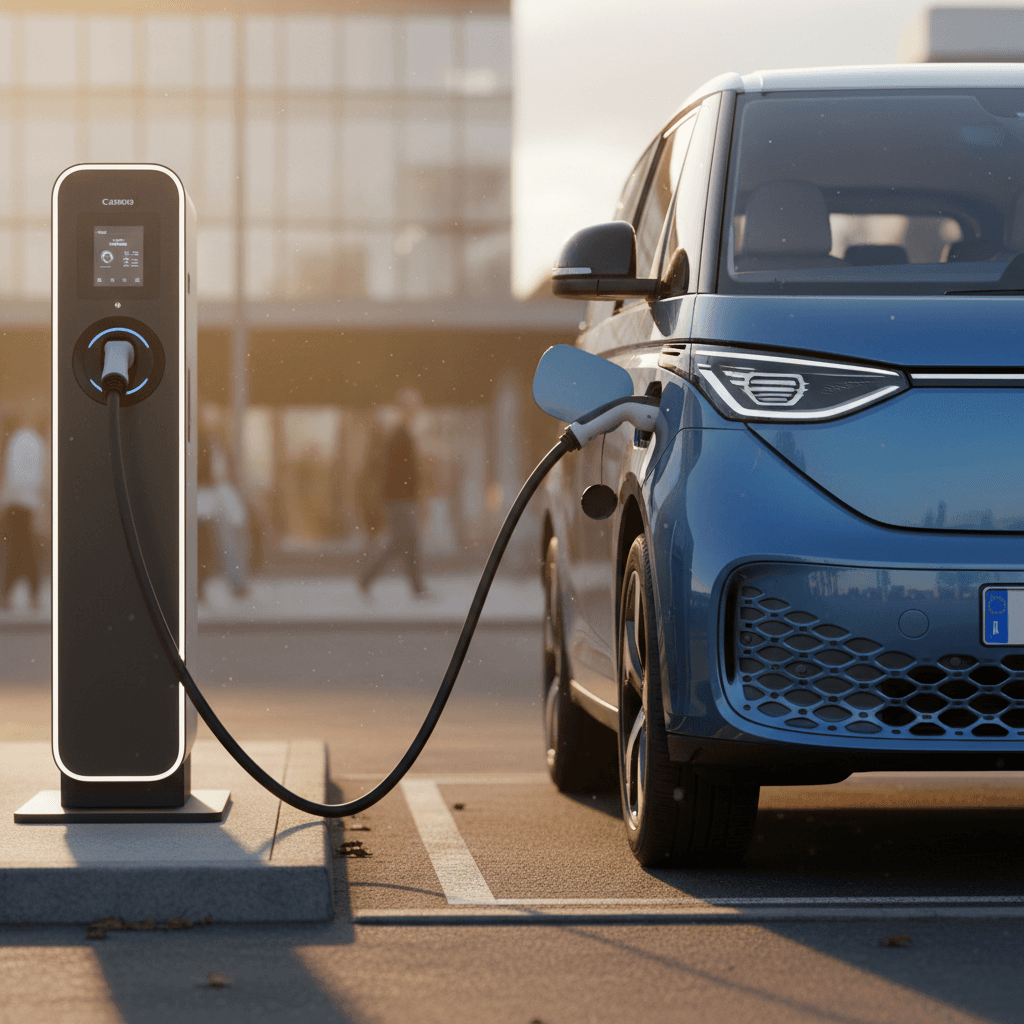
The VW ID. Buzz is a rolling nostalgia bomb: a surf shack on wheels with a lithium-ion heart. But once the Instagram filters wear off, there’s a serious question lurking underneath the two-tone paint: is the VW ID. Buzz actually a good road trip vehicle for your family, or just a charming city runabout with a short leash?
What this road trip review covers
VW ID. Buzz road trip at a glance
Key VW ID. Buzz road trip numbers (U.S. models)
Big caveat: 234 miles isn’t 234 road-trip miles
Range and efficiency on the open road
On paper, the VW ID. Buzz’s range is merely adequate. Most U.S. three-row Buzz trims are rated around 231–234 miles of EPA range. That’s at the low end for large family EVs, and it’s the first thing you feel when you stretch the Buzz’s legs on an interstate.
What you can realistically expect
- Summer highway driving (70–75 mph): many owners report 2.1–2.4 mi/kWh, which translates to roughly 180–200 miles between charges if you run the 91 kWh pack from ~10% to 80%.
- Fully loaded with kids and gear: figure closer to 170–190 miles usable before you’re nervous about the next charger.
- City and mixed driving: you can see mid‑200s in mild weather; that’s not what you’ll get during long interstate hauls.
What shrinks your range
- Speed: above 70 mph, the Buzz is fighting a barn door aerodynamically; drag rises and range drops fast.
- Roof boxes, bike racks, cargo pods: anything you hang off this fridge-shaped van is a range tax.
- Cold weather: winter temps cut both efficiency and available battery capacity, so 30–40% losses aren’t unusual on bad days.
- Big elevation changes: long climbs hurt more than the regen on descents can fully repay.
Range planning rule of thumb
Charging stops: how much do they slow you down?
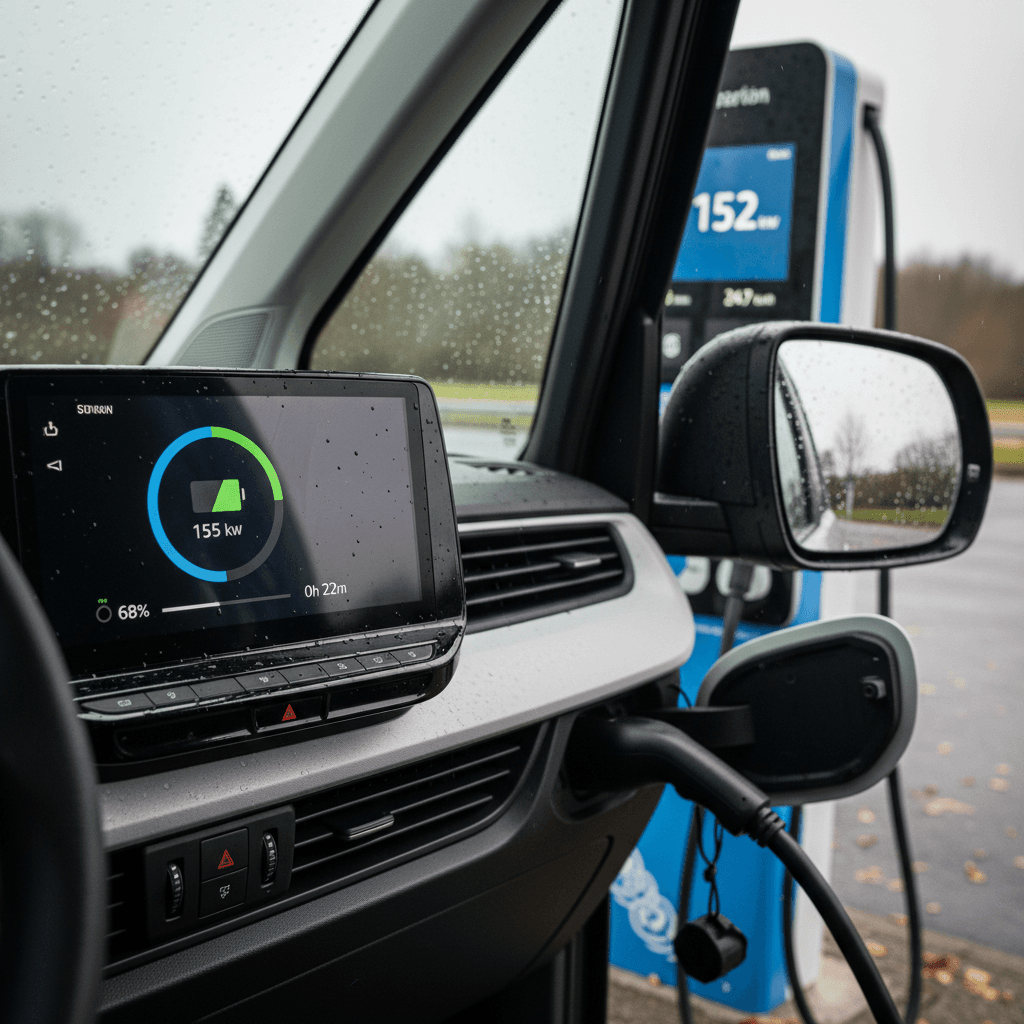
The other half of any EV road trip story is charging. The ID. Buzz carries a large ~91 kWh battery and supports up to 200 kW DC fast charging on compatible stations. In ideal conditions, VW claims 10–80% in roughly 26 minutes, and independent tests have seen 15–80% in about 25 minutes with an average around 120–130 kW.
Typical VW ID. Buzz charging times by level
Approximate times from low state of charge to a useful road-trip charge, assuming a healthy battery.
| Charging type | Power | Typical use case | Approx. time |
|---|---|---|---|
| Level 1 (120V) | ~1.2 kW | Emergency top-ups only | 2–3 days for near empty to full |
| Level 2 (240V) | Up to 11 kW | Home / destination charging | 7–9 hours from low to full |
| DC Fast (CCS) | Up to 170–200 kW | Highway road trips | ~25–30 min from 10–80% |
| Beyond 80% (DC) | Tapers under 50 kW | Only if you must stretch to next charger | Another 15–25 min to go from 80–100% |
Real-world times vary with temperature, charger quality, and how full the station is.
In practice, owners report going from roughly 10–80% in the mid‑20 minute range on a good CCS unit. The last 20% is slow and not road-trip efficient; keep your charging sessions short and frequent instead of waiting for every last electron.
Not all fast chargers are equal
- Expect to stop every 150–190 miles when cruising at true highway speeds.
- Plan on 20–30 minutes per stop, which aligns pretty well with bathroom breaks, diaper changes, and snack runs.
- If your route is dense with CCS fast chargers (and, with the right adapter, some Tesla Superchargers), the Buzz’s charging curve is perfectly acceptable for family road trips.
- If you’re heading into charging deserts, a 234‑mile EPA rating will feel tight compared with something like a Rivian R1S or Kia EV9.
Comfort, space, and family friendliness
Where the VW ID. Buzz absolutely earns its retro‑hero status is in how it treats the people inside. This is a big, tall, square van, and nearly all of that box is usable cabin or cargo space. Unlike some three‑row SUVs where the last row is a penance, the Buzz’s third row is genuinely habitable for kids and even smaller adults on shorter stints.
What makes the ID. Buzz a pleasant long‑distance companion
The intangibles that matter after hour four on the interstate.
Lounge-like seating
Kid-approved third row
Serious cargo volume
A note on the rear-seat recall
Road-trip comfort isn’t just about legroom. It’s about small stuff: cubbies for toys, real cupholders, USB ports where kids can reach them, and a flat floor that lets people move around at rest stops without shin‑bashing gymnastics. The ID. Buzz scores well here; it feels purpose‑built for long days with small humans and large dogs.
Highway manners and driving experience
On the move, the VW ID. Buzz drives like what it is: an electric city bus that’s been handed a passport. The steering is light, the suspension is tuned for comfort, and the instant torque from the rear‑mounted motor makes urban traffic almost fun. On the highway, the tune is more mixed.
What works well at 70 mph
- Calm, electric powertrain: no engine noise, just a smooth, quiet shove up to typical American highway speeds.
- Stable, planted feel: the heavy battery in the floor keeps the tall body from feeling tippy in normal lane changes.
- Driver assistance: adaptive cruise and lane‑keeping make the tedium of long interstate stretches easier, especially in traffic.
What you’ll notice on longer drives
- Wind and road noise: the big frontal area and slab sides mean more wind hiss than in a sleek crossover; it’s not loud, but you’ll raise your voice a bit.
- Crosswinds: a strong side gust will remind you that you’re driving a big box, not a wind‑tunnel sculpture.
- Soft suspension: comfy most of the time, but can get a little floaty and underdamped on undulating pavement.
The vibe matters more than the stopwatch
Winter road trips and weather factors
Cold weather is the Buzz’s least favorite road‑trip partner. In independent winter testing, the ID. Buzz’s fast‑charging performance dropped versus warm‑weather claims, and real‑world range shrank accordingly. That’s par for the EV course, but when you start with modest range, the impact feels larger.
- Expect more frequent stops in freezing temps; plan for 30–40% less effective range on especially cold, windy days.
- The Buzz supports battery pre‑conditioning, which lets you warm the pack before a DC fast charge. Use it religiously in winter to keep those 10–80% sessions near the 25–30 minute mark.
- Snow grip is competent with the right tires, but this is not an off-road van; ground clearance and approach angles are more mall parking lot than mountain pass.
- Cabin heating draws a meaningful chunk of power on very cold days, so seat heaters and steering wheel heat are more efficient ways to stay warm.
Winter road-trip hack
ID. Buzz vs other three-row EVs for road trips
By American standards, the ID. Buzz is not a cheap family car. Early U.S. pricing landed around the low‑$60K mark, and its EPA range lags behind newer electric three‑row rivals. Yet many families will still be drawn to the Buzz’s charm and packaging. Here’s how it stacks up against key players.
VW ID. Buzz vs rival three-row EVs (road-trip lens)
High-level comparison focused on road-trip priorities, not full spec sheets.
| Model | Approx. starting price (new) | EPA max range | Seating character | Road-trip strengths | Road-trip drawbacks |
|---|---|---|---|---|---|
| VW ID. Buzz | ~$61K | ≈234 miles | 6–7 seats, roomy boxy interior | Fantastic space, kid-friendly, easy to pack, nostalgic charm | Shorter range, more wind noise, CCS-only fast charging |
| Kia EV9 | Mid–$50Ks | Up to ~300 miles | Three-row SUV | Longer range, very fast charging, robust highway manners | Less cargo vertical space, more conventional feel |
| Hyundai Ioniq 9 | Around $60K | Up to mid‑300s est. | Three-row SUV | Excellent range and tech, strong efficiency | Less character, harder to find used early on |
| Rivian R1S | High‑$70Ks+ | Up to ~400+ miles | Adventure SUV | Massive range, off-road capable, strong charging | Expensive, third row tighter, cargo more compromised |
| Mercedes EQS SUV | $100K+ | Up to ~400 miles | Luxury SUV | Ultra-comfortable, quiet, very long legs | Price, optional third row is cramped for adults |
Specs and pricing vary by trim; think of this as directional guidance rather than a buyer’s guide spreadsheet.
Where the Buzz really fits
Ownership reality: used ID. Buzz and battery health
Because the ID. Buzz is a relatively new arrival in the U.S., most examples you’ll see in the next few years will be lightly used, ex‑demo, or off‑lease vans. That’s good news for early depreciation, but it also means you want hard data on how the big battery and high‑voltage systems are aging before you aim it at the horizon.
What to check before buying a used ID. Buzz for road trips
You’re trusting this van with your family and your vacation; get clinical before you get sentimental.
Battery health & DC history
Recalls and software updates
Fast-charging behavior
Usage history
How Recharged can help
Ready to find your next EV?
Browse VehiclesHow to plan a smooth road trip in an ID. Buzz
Step-by-step: planning your VW ID. Buzz road trip
1. Know your realistic range
Take a weekend shakedown trip at your typical highway speed, fully loaded. Note your mi/kWh and usable miles between 10% and 80%. Use that number, not the brochure, when planning longer routes.
2. Map chargers before you book hotels
Use tools like A Better Routeplanner (ABRP), PlugShare, and your navigation to plot DC fast chargers roughly every 120–180 miles. Favor sites with multiple stalls and recent positive check-ins.
3. Aim for 10–70% or 10–80% swings
The ID. Buzz charges quickest at lower states of charge. Stop when you’re around 10–20%, unplug when you’re 70–80%, and drive to the next fast charger. It’s faster overall than chasing 100%.
4. Stack breaks with charging
Plan meals, bathroom stops, and kid playtime around charging sessions. A 25-minute DC charge feels like an eternity if you’re staring at the SOC screen; it feels short if you’re wrangling toddlers and sandwiches.
5. Prepare a charging backup plan
For every critical stop, have a Plan B charger a reasonable distance away. Apps can show nearby networks, voltage, and recent user photos so you’re not surprised by an out-of-service station.
6. Pack smart for the Buzz
Use soft bags instead of hard suitcases to take advantage of the Buzz’s tall cargo hold. Keep charging cables, adapters, and cleaning wipes in an easily accessible bin near the rear hatch.
Don’t ignore home charging
FAQ: VW ID. Buzz road trip questions answered
Common VW ID. Buzz road trip questions
Should you road trip a VW ID. Buzz? Final verdict
The VW ID. Buzz is not the rationalist’s perfect road-trip EV. The numbers favor sleeker, longer‑legged crossovers and big‑battery SUVs that can erase states between charges. What the Buzz offers instead is a kind of laid‑back competence: adequate range, respectable DC fast‑charging, and a cabin that makes 400 miles feel like a series of gentle hops instead of a march.
If your idea of a successful family road trip is minimizing stops, you’ll be happier in something like a Kia EV9 or Rivian R1S. But if you like the notion of meandering, of every 170‑mile stretch ending with snacks, coffee, and kids climbing in and out of a bright, cheerful van, the ID. Buzz is deeply appealing. It’s less a long‑range missile and more a travel companion.
And when you’re shopping for one, new or used, don’t let the romance of the two‑tone paint blind you to the practicalities. You want proof that the battery is healthy, that software and recalls are handled, and that its real‑world range matches your map. That’s exactly what the Recharged Score and our EV‑specialist support are built for, so your next great family story isn’t about a broken charger on the side of I‑70, but about the time the kids fell asleep under that enormous glass roof as the sun went down.