If you’re eyeing a quirky, city-friendly EV, the question inevitably comes up: how fast does the Fiat 500e depreciate? The short answer is that the 500e is one of the quickest‑depreciating electric cars sold in the U.S. That’s bad news if you paid full MSRP new, but potentially very good news if you’re shopping the used market today.
Two different 500e stories
Fiat 500e depreciation at a glance
Typical Fiat 500e depreciation snapshot (older U.S. models)
Compared with mainstream EVs like the Nissan Leaf, Chevrolet Bolt EV, or Tesla Model 3, the Fiat 500e usually sits near the bottom of the resale charts. It was sold in small numbers, mostly in California and Oregon, originally as a so‑called "compliance car" to meet emissions rules rather than as Fiat’s long‑term EV flagship. That history still shapes how the market values these cars today.
Why the Fiat 500e tends to depreciate quickly
Four big reasons the Fiat 500e drops in value
Understanding these helps you predict which cars will be better deals, and which to avoid.
Short real‑world range
The original U.S. Fiat 500e was always a short‑range city EV. On paper, range hovered around 80–90 miles, and real‑world numbers can be lower with age and cold weather.
As newer EVs arrived offering 200–300+ miles, the 500e started to look dated quickly, and used buyers priced it accordingly.
Limited sales footprint
Fiat sold the 500e mainly in California and a few other ZEV states. That means low brand recognition for this EV in much of the country and a very thin dealer footprint.
When there are fewer local buyers and fewer dealers that know the product, resale values suffer.
Brand and service perception
Fiat’s U.S. presence has been modest, and some shoppers worry about parts, service, and long‑term support. Even if those fears are overblown, perception alone drags prices down.
Compliance‑car legacy
Models built mainly to meet regulations rather than dominate the marketplace often depreciate faster. The 500e falls squarely in that bucket for its first generation.
In contrast, EVs engineered as global, flagship models, like Tesla’s lineup, typically hold value better.
Depreciation is model‑year specific
How much value a Fiat 500e loses over time
Exact depreciation curves vary by region, incentives and mileage, but when you look at older U.S. Fiat 500e hatchbacks, a pattern emerges: they shed value aggressively in the first 3–5 years, then level off into “cheap city car” territory.
Illustrative Fiat 500e value curve (older U.S. hatchbacks)
Approximate resale behavior based on typical transaction patterns, assuming average mileage and condition. These are directional examples, not guaranteed prices.
| Ownership stage | Vehicle age | What typically happens to value | What you’re likely to see in the market |
|---|---|---|---|
| Brand‑new | 0–1 years | Steep initial drop from MSRP, especially once incentives are applied. | Early off‑lease or demo cars already discounted thousands vs. window sticker. |
| Early used | 2–3 years | Many 500e models have already lost a large chunk of value as newer, longer‑range EVs arrive. | Prices often well below half of original MSRP, even with relatively low miles. |
| Main depreciation zone | 4–6 years | Cars move firmly into budget‑EV territory; depreciation slows because price floor is near. | Plenty of listings clustered in the low‑teens or even under $10k, depending on miles and region. |
| High‑mileage used | 7–10+ years | Age, miles and battery wear start to matter more than the calendar; prices flatten out. | Some older 500e examples trade for economy‑car money, especially with higher mileage or weaker batteries. |
Use this as a ballpark guide, then check current listings and tools like the Recharged Score Report for vehicle‑specific numbers.
Remember incentives and tax credits
Key factors that change Fiat 500e resale value
Mileage, usage and wear
- Odometer reading: A 40,000‑mile 500e will almost always command more than a 90,000‑mile one, but the price gap shrinks once both are firmly in budget territory.
- City vs. highway duty: Stop‑and‑go urban miles aren’t as punishing mechanically as highway commutes, but lots of DC fast‑charging can accelerate battery stress.
- Cosmetic condition: Clean interiors and straight body panels still matter. A well‑cared‑for 500e is easier to sell and usually worth the extra cash.
Market, trim and equipment
- Region: Used EVs are more popular, and sometimes pricier, in EV‑savvy coastal markets than in areas where public charging is sparse.
- Options and features: Heated seats, upgraded audio, and driver‑assistance features can nudge value up, though on a budget EV ceiling is limited.
- Seasonality: EV interest often spikes when fuel prices rise and cools a bit when gas is cheap, which can move prices around the margins.
Look at price per mile of range
Battery health: how much does it matter?
For any used EV, depreciation isn’t just about the badge on the hood, it’s about how much usable battery capacity is left. On a short‑range car like the Fiat 500e, every lost kilowatt‑hour hurts more because you’re starting from a smaller battery pack to begin with.
- If a healthy 500e originally delivered around 80–90 miles of range, a car now managing only 55–60 miles will feel dramatically more limited in daily use.
- City‑only drivers who log 20–30 miles a day may happily accept that tradeoff in exchange for a low purchase price.
- Commuters who need freeway speeds and a buffer for weather will see poor battery health as a deal‑breaker, which pushes those weaker‑battery cars further down in value.
How Recharged addresses battery uncertainty
Ready to find your next EV?
Browse Vehicles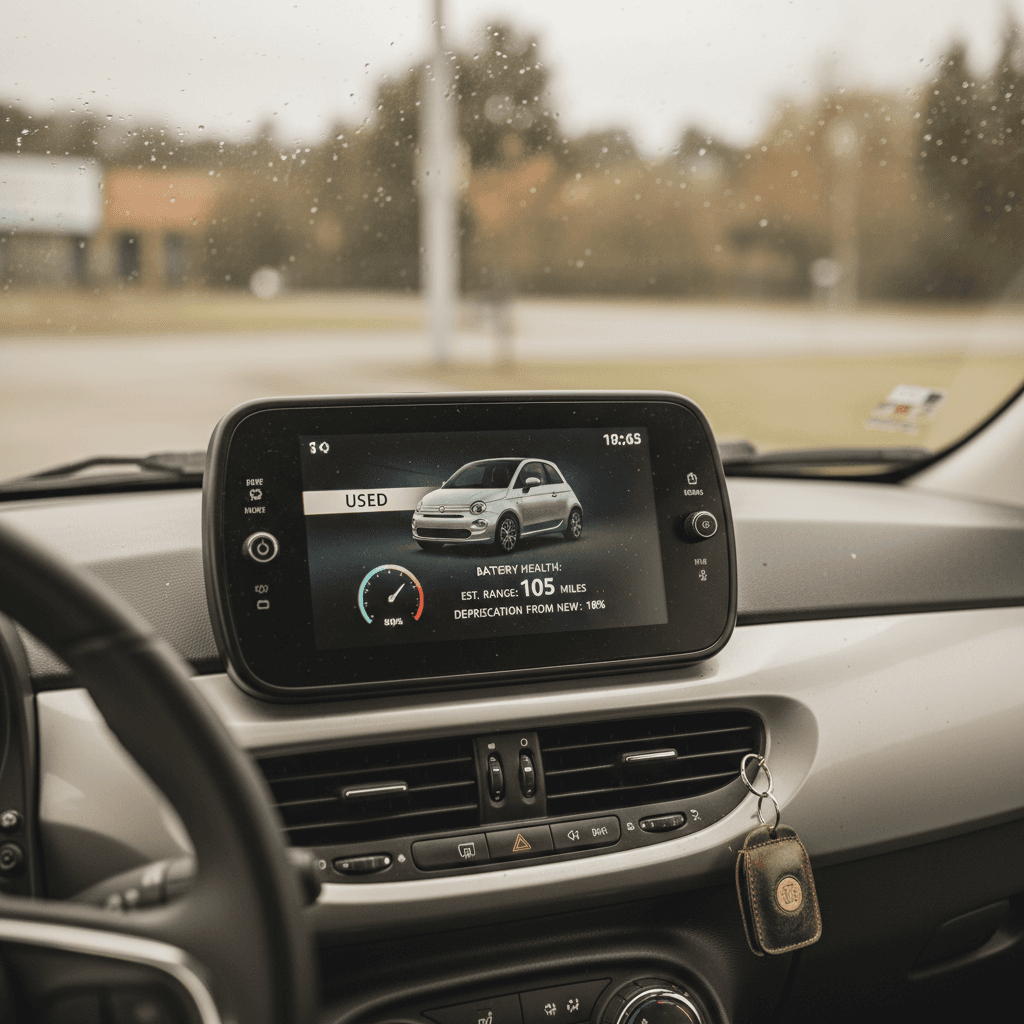
Using depreciation to your advantage as a buyer
The fact that the Fiat 500e depreciates faster than many rivals doesn’t automatically make it a bad car. It just means the second or third owner gets a bargain, especially if their use case lines up with what the 500e does best: short trips, city errands, and low annual mileage.
Where the Fiat 500e’s heavy depreciation works in your favor
In the right scenario, it can be one of the best used‑EV values on the market.
Low entry price
Because earlier owners absorbed so much depreciation, you can often get into a 500e for economy‑car money while enjoying EV smoothness and low running costs.
Cheap second car
The 500e makes sense as a second household vehicle: school runs, errands, and commuting within a modest radius of home, leaving the longer‑range vehicle for trips.
Green city runabout
If you live in a dense urban area, the 500e’s compact footprint, quick acceleration and zero tailpipe emissions can be more valuable than highway range you’ll rarely use.
Leverage depreciation in negotiation
What depreciation means if you currently own a 500e
If you already own a Fiat 500e, depreciation is more than an interesting chart; it’s part of your total cost of ownership and your exit strategy. You can’t change what the broader market thinks of the car, but you can control how your specific car is perceived when it’s time to sell or trade.
Maximizing what your 500e is worth
- Stay on top of maintenance: Keep service records organized (especially high‑voltage system checks) and fix dash lights promptly. Documentation reassures the next owner.
- Protect the interior and exterior: Small EVs lead hard city lives. Clean, presentable cosmetics stand out in a sea of curb‑rashed wheels and door dings.
- Monitor battery health: If you have access to a reputable EV diagnostic, a battery health report can back up your asking price and reduce haggling.
Choosing the right way to sell
- Trade‑in vs. private sale: A private party may pay more, but expects detailed documentation and may be more cautious about an older EV.
- Specialized EV marketplace: Platforms like Recharged focus on used EVs, verify battery health, and can match your 500e with the right kind of buyer.
- Consignment or instant offer: If convenience matters most, structured programs can handle pricing, marketing, and paperwork for you.
How Recharged can help current owners
Checklist: buying a used Fiat 500e smartly
Pre‑purchase checklist for a used Fiat 500e
1. Confirm your real‑world range needs
Add up a typical day’s driving, including side trips and seasonal weather. If you routinely need more than 50–60 miles with no chance to plug in, a highly depreciated 500e may not be the right tool for the job.
2. Compare price to similar EVs
Look at other used EVs in your region, Leaf, Bolt, i3, etc. If a 500e is priced close to cars with double the range, depreciation is not fully baked in yet and you may have negotiating room.
3. Get a battery health snapshot
Ask for documentation or shop from a seller that provides third‑party diagnostics. On Recharged, the <strong>Recharged Score</strong> gives you an at‑a‑glance look at pack health, fast‑charge history, and expected range.
4. Check charging history and usage pattern
Cars that lived on DC fast chargers may show more battery stress than those mostly charged at home Level 2. Ask how the previous owner typically charged and how often the car sat at 100%.
5. Inspect for city‑life damage
Because many 500e models live in urban cores, look closely for scraped wheels, bumper scuffs, and parking‑lot dings. Cosmetic issues aren’t fatal, but they’re leverage on price and affect resale later.
6. Evaluate resale and exit options
Even at a low purchase price, think ahead: How easy will this car be to sell locally in a few years? Check how many similar 500e listings exist in your area and how quickly they seem to move.
FAQ: Fiat 500e depreciation and resale
Common questions about Fiat 500e depreciation
Bottom line on Fiat 500e depreciation
The Fiat 500e is a textbook example of how quickly early, short‑range EVs can depreciate. For original buyers who paid close to sticker, that stings. For used‑car shoppers in 2026 and beyond, it creates an opportunity: you can step into a fun, city‑friendly electric runabout for far less than its original MSRP, as long as your expectations match its capabilities.
If you’re evaluating a 500e, or any used EV, don’t just look at the asking price. Focus on real‑world range, verified battery health, and your own daily driving pattern. Tools like the Recharged Score Report, EV‑savvy financing, and nationwide delivery can take a lot of the guesswork out of the process, so depreciation becomes a lever you pull on purpose instead of a surprise you discover later.