If you’re considering a Volvo XC40 Recharge or already own one, you’ve probably seen claims like “10–80% in 28 minutes” and wondered what that looks like in the real world. This Volvo XC40 Recharge charging speed test breaks down how fast it actually charges at DC fast chargers and at home, how the different battery versions compare, and what you should expect on a daily commute or a long‑distance road trip.
Model years matter
XC40 Recharge charging overview
Headline Volvo XC40 Recharge charging stats
Across model years, the XC40 Recharge supports DC fast charging via CCS today, with Volvo committed to adopting the Tesla/NACS connector in North America in the near future. That means you can charge quickly on most major public fast‑charging networks now and expect even more flexibility later.
- AC charging: Type 2/SAE J1772 inlet for Level 1 (120 V) and Level 2 (240 V) charging, with an 11–11.2 kW onboard charger depending on model year.
- DC fast charging: CCS port with peak rates from about 130 kW on earlier single‑motor cars up to roughly 205 kW on newer large‑battery variants.
- Battery sizes: roughly 69 kWh usable on standard‑range trims and ~79–82 kWh on extended‑range and twin‑motor versions, depending on year.
Why 10–80% matters
Battery variants and what they mean for speed
When you run a charging speed test on a Volvo XC40 Recharge, you have to know which battery and drivetrain you’re dealing with. Charging speed isn’t just about the station’s kW number on the sign; it’s also capped by the car’s hardware and software.
XC40 Recharge battery & charging variants (simplified)
The exact numbers vary slightly by year and market, but this framework will get you close in North America.
Standard‑range single‑motor (69 kWh pack)
- Usable capacity: ~66 kWh
- Drivetrain: Single‑motor RWD (2024+)
- Peak DC fast charge: ~130–136 kW
- Typical 10–80% DC time: ~25–30 minutes in good conditions
- Onboard AC charger: 11 kW
Extended‑range & Twin Motor (≈79–82 kWh pack)
- Usable capacity: around 75–79 kWh depending on trim/year
- Drivetrain: Single‑motor extended range RWD or Twin Motor AWD
- Peak DC fast charge: up to ~200–205 kW
- Quoted 10–80% DC time: ~28 minutes in ideal conditions
- Onboard AC charger: ~11 kW (7–8 hr 0–100% on a robust Level 2)
Older AWD‑only models are slower to charge
DC fast charging speed test results
Let’s translate Volvo’s specs into something you can actually use on a road trip. Below we’ll focus on a typical 10–80% DC fast charging session for the updated XC40 Recharge with the larger ~82 kWh pack, then touch on the smaller‑battery version and earlier cars.
XC40 Recharge DC fast charging: lab vs. real world
Approximate 10–80% results on a healthy battery and a capable DC fast charger.
| Variant | Battery (usable) | Peak DC kW (ideal) | Average DC kW (10–80%) | Claimed 10–80% | Realistic 10–80% on road |
|---|---|---|---|---|---|
| Single‑motor extended range (RWD, large pack) | ≈79 kWh | ~200–205 kW | ~115–130 kW | ≈28 min | 30–35 min |
| Twin Motor AWD (updated 82 kWh pack) | ≈79–82 kWh | ~200–205 kW | ~110–125 kW | ≈28–30 min | 32–38 min |
| Standard‑range single‑motor (69 kWh pack) | ≈66 kWh | ~130–136 kW | ~100–115 kW | ≈25–28 min | 27–33 min |
| Older AWD models (smaller pack) | mid‑70s kWh | 150 kW or less | 70–90 kW | ≈32–37 min | 35–45 min |
Numbers are rounded; actual times depend on temperature, station quality, and how full neighboring stalls are.
What’s “average kW” and why it matters
Typical XC40 Recharge fast‑charge curve (large pack)
- 10–30%: Car ramps quickly toward peak; often 160–200 kW if the battery is warm.
- 30–60%: Sweet spot for road trips; expect 130–170 kW in good conditions.
- 60–80%: Taper begins; power might fall toward 80–110 kW.
- 80–100%: Strong taper to protect the battery; power can drop into the 30–60 kW range or even lower.
What that means in miles per minute
Volvo’s larger‑pack XC40 Recharge delivers real‑world highway efficiency around the low‑to‑mid‑3 mi/kWh range for many drivers. Roughly speaking:
- At 150 kW: You’re adding on the order of 7–8 miles of highway range per minute of charging.
- At 100 kW: Think 5–6 miles per minute.
- At 50 kW: More like 3 miles per minute.
That’s why staying in the 10–60% (or 10–70%) window on road trips is usually most time‑efficient.
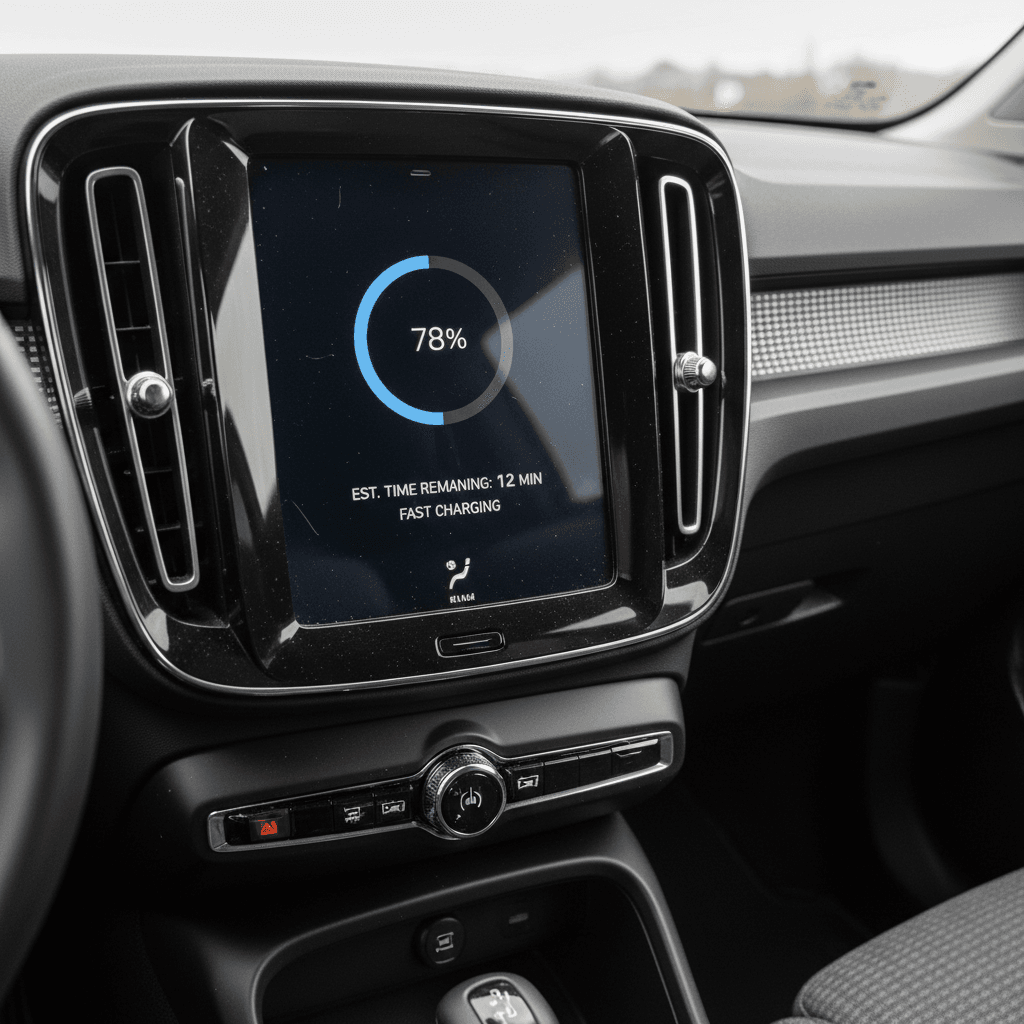
How to run your own charging speed test
Home and Level 2 charging times
Fast charging gets headlines, but most XC40 Recharge owners do the bulk of their charging at home on Level 2 (240 V). Volvo equips the car with an ~11 kW onboard charger, which is plenty to fill even the larger battery overnight if your electrical circuit can support 40–48 amps.
XC40 Recharge home and Level 2 charging estimates
Approximate times from a low state of charge to full using AC charging at home or work.
| Charger type | Circuit / charger rating | Approx. AC power | Standard‑range pack (≈66 kWh) 10–100% | Extended‑range pack (≈79–82 kWh) 10–100% |
|---|---|---|---|---|
| Level 1 (120 V outlet) | 12 A (1.4 kW) | ~1.3–1.4 kW | 30+ hours (emergency use only) | 36+ hours (emergency use only) |
| Level 2 (240 V) | 24 A (NEMA 14‑30) | ~5.7 kW | ~11–12 hours | ~13–14 hours |
| Level 2 (240 V) | 32 A wallbox | ~7.7 kW | ~8.5–9.5 hours | ~10–11 hours |
| Level 2 (240 V) | 40–48 A wallbox | 9.6–11 kW | ~7–8 hours | ~8–9 hours |
Assumes healthy battery, moderate temperatures, and little climate use while charging.
Good news: overnight is easy
If you’re apartment‑based or still living on Level 1, the XC40 Recharge is usable but not ideal. One reviewer managed roughly 5 miles of range per hour on 120 V, which is enough to add 60–70 miles in a long overnight session but not what you want if you’re driving a lot every day. Stepping up to even a modest 240 V setup dramatically improves the ownership experience.
Factors that slow down your XC40 Recharge charging
If your XC40 Recharge charging speed test doesn’t match the glossy brochure, you’re not alone. Like every modern EV, the Volvo’s battery management system will dial charging power up or down based on a long list of conditions. Understanding those factors helps you separate a bad charger from normal behavior – and it keeps you from blaming the car when the infrastructure is the real culprit.
Why your charging session might be slower than expected
Most “slow charge” complaints trace back to one or more of these issues.
Battery temperature
The XC40 Recharge, like other EVs, prefers a warm battery. In cold weather, the pack may start well below its ideal temperature. Until it warms up, the car will cap power, cutting peak kW substantially.
Preconditioning via Google Maps navigation to a fast charger helps, but in sub‑freezing conditions you still shouldn’t expect headline speeds right away.
State of charge (SoC)
Charging is fastest at low to mid SoC. If you plug in at 50–60% instead of 10–20%, you’ll see a lower peak and a shorter time at high power.
Above 80%, all modern EVs, including the XC40 Recharge, taper hard to protect the battery, so 80–100% can feel painfully slow on DC fast charging.
Station limitations
Many CCS stations are labeled “150 kW” or “350 kW,” but that’s the maximum per cabinet, not always per stall. Shared cabinets, grid limits, or throttling due to heat and maintenance can all cut your actual rate.
A weak station can make any EV look bad, so always try a different site or brand before assuming your car has a problem.
Protecting battery health vs. chasing peak kW
Charging strategy for daily driving and road trips
Once you understand how the XC40 Recharge charges, you can build a strategy that minimizes time at plugs and maximizes time on the road. That means using home charging as your baseline and treating DC fast chargers as quick top‑ups, not full refuels.
XC40 Recharge charging strategy cheat sheet
1. Daily driving: live between 20–80%
For battery longevity and convenience, aim to leave home between 70–90% and arrive back above 20%. There’s no need to charge to 100% every night unless you consistently use most of the pack.
2. Use scheduled charging for cheap rates
If your utility offers time‑of‑use pricing, schedule the XC40 Recharge to start charging when rates are lowest. You’ll pay less per kWh and still wake up to a full or nearly full battery.
3. Road trips: hop between 10–60%
On long drives, time is usually minimized by adding smaller, faster charges. Navigate to a fast charger around 10–20%, unplug around 60–70%, and let the car precondition on the way to the next stop.
4. Plan around reliable networks
Volvo bundles public‑charging partnerships, but in North America you’ll likely lean on big networks like Electrify America, EVgo, and eventually NACS‑equipped Superchargers. Use multiple apps to check station status before you arrive.
5. Avoid DC fast charging when it’s not needed
An occasional road‑trip DC session is fine. But if you have home or workplace Level 2, using DC fast charging as your primary source of energy will add unnecessary stress to the pack over time.
6. Test a new station before a long stop
If you plug in and see very low power (e.g., 20–30 kW on a 150 kW charger) in mild weather, stop the session and try another stall or location. It’s faster to move early than to sit on a bad plug for 40 minutes.
Buying a used XC40 Recharge: what to look for in charging performance
On the used market, “Volvo XC40 Recharge” now covers several powertrain and battery configurations with meaningfully different charging behavior. If you’re shopping pre‑owned, you don’t just want a nice interior, you want confidence that the battery is healthy and still fast‑charging near its original spec.
Questions to ask the seller
- Which model year and trim is it? A 2021 AWD will charge differently than a 2025 single‑motor extended range.
- How is the battery health? Ask for any diagnostic reports or service records related to the high‑voltage pack.
- Has it fast‑charged heavily? Occasional road‑trip use is fine; constant DC fast charging is harder on the battery.
- Any charging issues or software updates? Verify that recalls or updated charging software have been applied.
How Recharged helps you de‑risk this
When you buy an XC40 Recharge through Recharged, every vehicle comes with a Recharged Score Report that includes verified battery health and a transparent look at past usage patterns where data is available.
Our EV specialists can walk you through what that means in practical terms, how fast you should expect the car to charge, how much range you’ll have on your commute, and whether a given example is a good fit for your charging situation at home.
We also offer financing, trade‑in options, and nationwide delivery, so you can shop for the right used EV without spending weekends at dealerships.
Consider your charging reality, not just specs
Frequently asked questions: XC40 Recharge charging speed
XC40 Recharge charging speed FAQ
Key takeaways
The Volvo XC40 Recharge is not the raw fastest‑charging EV on the market, but the updated models deliver genuinely competitive real‑world charging performance: roughly 30–35 minutes for a 10–80% DC top‑up and easy overnight home charging even with the larger battery pack. As with every EV, the difference between a good experience and a frustrating one usually comes down to understanding how charging works, picking solid infrastructure, and matching the car to your daily life.
If you’re cross‑shopping XC40 Recharge variants, or comparing it with other used EVs, Recharged can help you read between the lines of spec sheets. Our Recharged Score puts battery health and charging behavior front and center, and our EV‑specialist team can help you weigh charging speed, range, and total cost of ownership so you end up in an electric SUV that fits your real charging reality, not just the marketing claims.