If you’re considering a Volvo EX90, or eyeing one on the used market, you’re probably wondering how it really performs at a fast charger. Official specs promise up to 250 kW DC charging and about 30 minutes from 10–80%, but real-world charging speed tests tell a more nuanced story. This guide walks through what independent tests have found, how the EX90’s charging curve behaves, and what that means for your daily driving and road trips.
Key takeaway
Volvo EX90 charging speed overview
Volvo EX90 charging numbers at a glance
Under the skin, the EX90 uses a large 111 kWh battery pack (about 107 kWh usable) on a 400‑volt system. That pack supports DC fast charging up to 250 kW and AC charging up to 11 kW. Volvo’s support documentation and dealer guides align on a headline claim of roughly 30 minutes to go from 10–80% on a high‑power DC charger, and around 10–15 hours to fully replenish on a typical home Level 2 setup, depending on your circuit amperage.
Know your station
Lab vs. real-world Volvo EX90 charging tests
Automakers publish optimistic best‑case figures; independent charging speed tests reveal how an EV behaves in the wild. For the EX90, outlets that have had early access to the three-row SUV have begun sharing hard numbers from instrumented road tests and DC fast‑charge sessions.
Factory numbers vs. independent tests
How the EX90’s claimed charging performance compares with real-world results
Volvo’s own estimates
- 10–80% in ~30 minutes on a 200–250 kW DC fast charger.
- Charging curve optimized so that dropping from a 250 kW to a 150 kW station adds only about 5 extra minutes for 10–80%.
- Home charging: roughly 10 hours from empty at 11 kW (48A, 240V).
Independent test data
- One detailed test measured a 10–90% DC fast charge in 43 minutes, with an average rate of ~127 kW across that session.
- That’s slower than the 250 kW headline, but in line with other large luxury EV SUVs.
- Highway range test: about 250 miles at 75 mph for a Twin Motor Performance EX90, implying that each 10–80% session can realistically add ~200 miles of highway range.
Why your EX90 may charge slower than the brochure
DC fast charging: 10–80% and 10–90% tests
When shoppers search for a Volvo EX90 charging speed test, they’re usually trying to answer two questions: how long will I be stuck at the charger, and how much range will I get per stop? To translate the EX90’s specs into real‑world behavior, it helps to look at specific state‑of‑charge (SoC) windows.
Volvo EX90 DC fast-charging times by power level
Approximate charging times for a single fast‑charge session, assuming a healthy battery, mild temperatures, and proper preconditioning.
| Station power | SoC window | Approx. time | What it means on a trip |
|---|---|---|---|
| 250 kW DC | 10–80% | ~30 minutes | Best case at a high‑power charger; ideal for highway road trips. |
| 200 kW DC | 10–80% | ~32 minutes | Barely slower than 250 kW because the pack can’t sit at peak for long. |
| 50 kW DC | 10–80% | ~95 minutes | Fine for a long meal stop, but not efficient for quick hops. |
| High‑power DC | 10–90% | ~43 minutes | Observed in independent testing; useful if you need extra buffer. |
| High‑power DC | 20–80% | ~28–30 minutes | Common on‑trip strategy; skipping the slowest top and bottom of the curve. |
These values are based on Volvo’s support data combined with independent charging speed tests; your times will vary by conditions, charger quality, and vehicle configuration.
The important nuance is that while the EX90 can briefly spike toward 250 kW, it spends much of a session below that figure. That’s why the observed 10–90% test averaged only about 127 kW. Charging slows significantly once you pass roughly 60–70% SoC, so it’s usually more time‑efficient on a road trip to charge between about 10–70% or 20–80% and drive, rather than trying to push to 100%.
Trip-planning rule of thumb
Volvo EX90 charging curve: what happens after 30%?
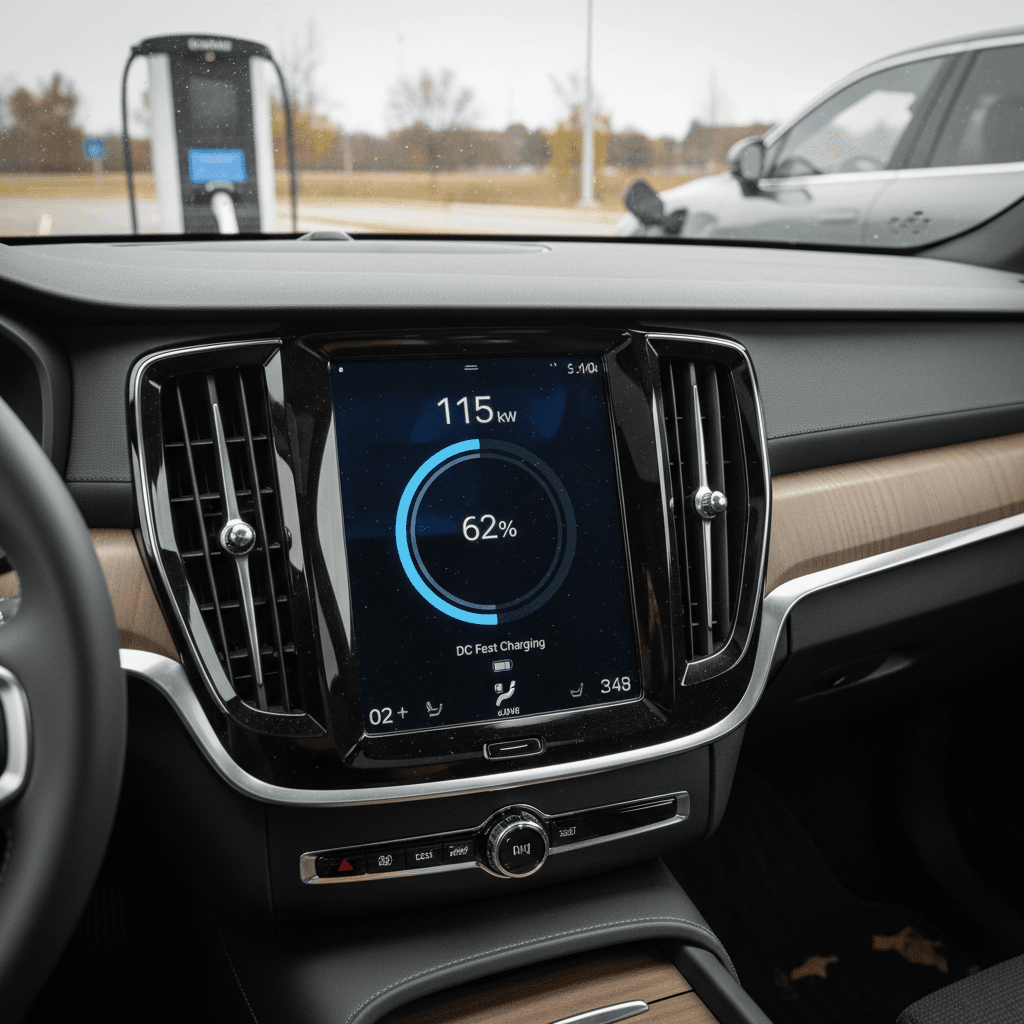
Volvo’s own support documentation notes that the EX90’s battery charges fastest when it’s at a low state of charge. After around 30% SoC, the system gradually tapers the charging power to protect the pack and manage heat. By the time you climb past 80%, it’s normal to see power drop well below 100 kW, even on a 250 kW charger.
0–30%: maximum attack
- The pack can accept close to its 250 kW peak for short bursts when it’s warm and nearly empty.
- This is where you gain miles the fastest, measured in dozens of miles of range every 5–10 minutes.
- If you arrive nearly empty and the car preconditioned the battery on the way to the station, you’ll see the highest numbers here.
30–100%: smart tapering
- Beyond ~30%, the control software starts stepping power down to preserve long‑term battery health.
- The rate typically hovers in the low‑to‑mid triple digits through the mid‑SoC range, then falls under 100 kW as you approach 80–90%.
- From 90–100%, power can look painfully slow. That’s why most road‑trippers stop around 70–80% unless they absolutely need the extra buffer.
The upside of tapering
Home and Level 2 charging performance
Most EX90 charging happens at home, not on a road trip. On AC power, the SUV uses an 11 kW onboard charger (48A on a 240V circuit) and a standard Type 2 / J1772‑style connector, depending on your region and adapter. Here, the battery’s sheer size matters more than peak power numbers.
Volvo EX90 Level 2 charging times by amperage
Approximate 0–100% home‑charging times for a Volvo EX90, assuming a 107 kWh usable battery and typical North American voltage.
| Circuit / setting | Approx. power | 0–100% time | Best use case |
|---|---|---|---|
| 48A, 240V hardwired | ~11 kW | ~10 hours | Ideal for daily drivers and heavy mileage households. |
| 32A, 240V | ~7.7 kW | ~15 hours | Common for existing 40A circuits in older homes. |
| 16A, 240V | ~3.8 kW | ~29 hours | Works for light‑use households, plug‑in dryer circuits. |
| 120V Level 1 | ~1.4 kW | 50+ hours | Emergency only; fine for topping off a few miles overnight. |
If you regularly arrive home with 20–40% on the battery, you’ll usually be back at 80–100% before morning on a 32A or 48A circuit.
NACS adapter and Superchargers
For everyday ownership, a properly sized Level 2 setup is almost more important than DC fast‑charge peak numbers. If you typically drive 30–50 miles a day, a 32A circuit paired with smart scheduling will quietly refill the EX90 overnight, while a 48A setup gives more headroom for unexpected weekend trips or multi‑driver households.
Five factors that slow down EX90 charging in the real world
- Battery temperature that’s too cold or too hot, especially in winter, when a cold pack resists taking power until it warms up.
- Charger limitations: many “150 kW” or “350 kW” pedestals share power between stalls, so your EX90 may never see the signposted maximum.
- High state of charge when you plug in; starting at 50% instead of 10–20% drastically slows the first part of the session.
- Repeated fast-charging back-to-back on a long day of driving, which can heat‑soak the pack and trigger thermal limits.
- Software, navigation, or preconditioning not being used, so the car arrives at the charger without the battery warmed to its ideal zone.
Don’t blame the car too quickly
800-volt upgrade: what it means for future EX90s
Volvo has already confirmed that it’s migrating its flagship EVs from a 400‑volt architecture, the system used by today’s EX90, to a faster, more efficient 800‑volt platform. The ES90 sedan debuts this tech, and updated EX90 variants are slated to follow, promising shorter DC fast‑charge times and higher peak power, potentially up to the 350 kW range at compatible stations.
Current EX90 (400V architecture)
- Peak DC fast‑charging power: up to 250 kW.
- Claimed 10–80% time: around 30 minutes with a preconditioned battery.
- Independent test: 10–90% in 43 minutes, ~127 kW average.
- Comparable in practice to rivals like the BMW iX and Rivian R1S.
Future EX90 (800V architecture)
- Expected peak DC power: up to 350 kW at suitable chargers.
- Targeted 10–80% times closer to 20 minutes under ideal conditions.
- Improved efficiency and lighter drivetrain components derived from the ES90 sedan.
- Better thermal management to sustain higher charge rates longer.
What this means if you’re shopping used
Charging strategy checklist for EX90 owners
Optimize your Volvo EX90 charging in 7 steps
1. Set up robust home Level 2
Aim for a 32A or 48A, 240V circuit and a quality wallbox. That lets you refill a large share of the EX90’s pack overnight. If you’re buying used, verify whether the previous owner already installed a suitable charger.
2. Use navigation for DC fast charging
Always set the charger as your destination in Google Maps or the native nav so the EX90 can precondition the battery. Arriving with a warm pack is the difference between seeing triple‑digit kW or crawling along at under 60 kW.
3. Target 10–70% or 20–80% on trips
On road trips, don’t chase 100%. Repeatedly charging in the mid‑SoC band is faster overall and easier on the battery than pushing to a full charge at every stop.
4. Prefer high-power, reputable networks
Use apps and in‑car search to find 200–350 kW sites from well‑maintained networks. Poorly maintained stations often under‑deliver on power or drop sessions.
5. Watch live kW readings
During your own Volvo EX90 charging speed test, keep an eye on the live power figure. Big drops that don’t match the SoC curve often point to a station issue, not the car.
6. Adjust expectations in extreme weather
In freezing or very hot conditions, build extra time into your charging plan. Try to arrive at fast chargers after a stretch of driving so the pack isn’t stone‑cold.
7. Track battery health over time
If you buy or sell a used EX90, pay attention to how charging behavior changes. Tools like Recharged’s <strong>battery health diagnostics</strong> and Score Report can quantify pack condition and help you price or shop with confidence.
Volvo EX90 charging speed test FAQ
Frequently asked questions about Volvo EX90 charging
Should you buy a used Volvo EX90 for its charging performance?
From a charging‑speed perspective, the Volvo EX90 lands solidly in the middle of the luxury EV SUV pack. It doesn’t deliver the headline‑grabbing 10–80% in 18 minutes promised by the latest 800‑volt flagships, but real‑world testing shows that its 30–40 minute fast‑charge stops and robust home‑charging capability make it a practical long‑distance family hauler. The conservative charging curve is a hidden strength if you’re shopping used, because it prioritizes long‑term battery health over chasing every last kilowatt today.
If you’re considering a used EX90, focus on how its charging behavior aligns with your lifestyle. Do you have reliable 240V access at home? How often will you fast‑charge on the road? At Recharged, every EV we sell comes with a Recharged Score Report that includes verified battery health, pricing backed by market data, and expert guidance on home‑charging setup and road‑trip planning. That way, you’re not just buying an impressive spec sheet, you’re getting an electric SUV whose charging performance has been tested, understood, and matched to the way you actually drive.