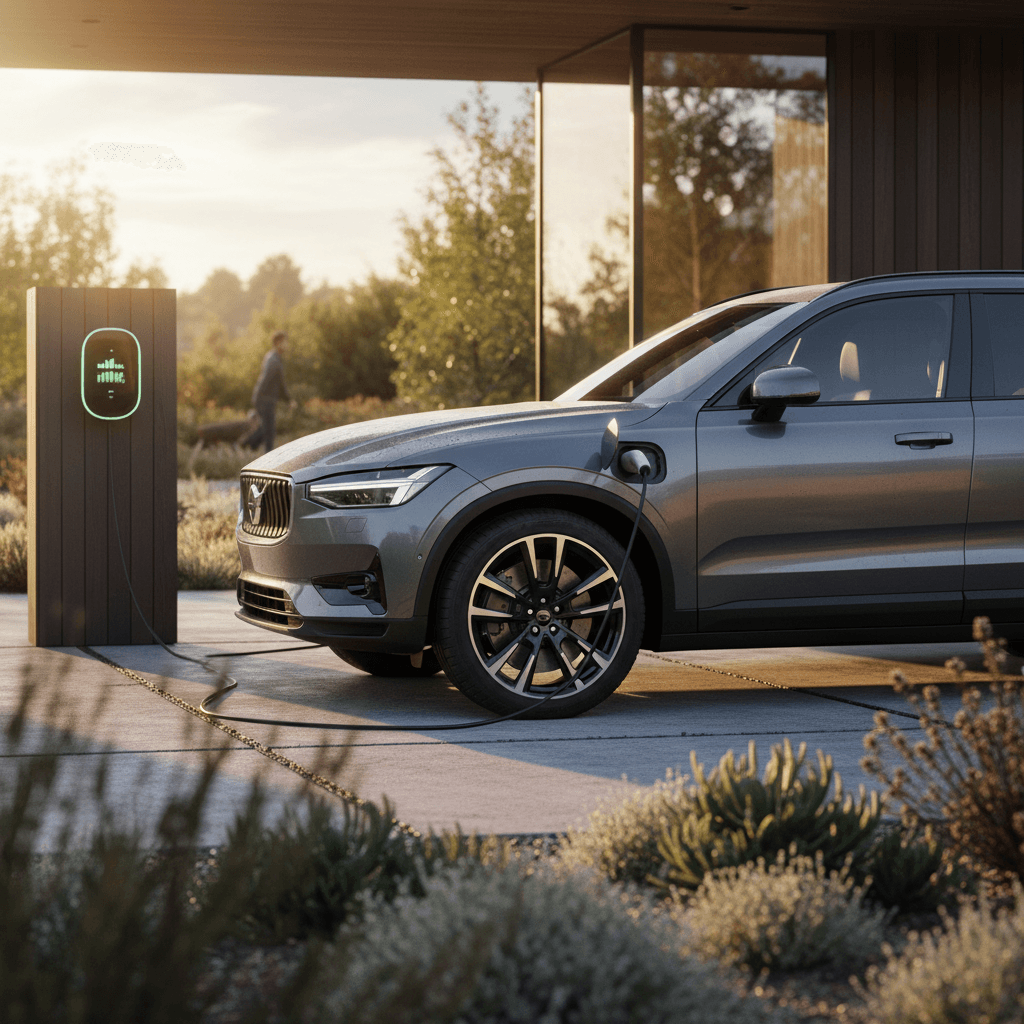
If you’re eyeing a Volvo EX90, or already have one, the big question isn’t just range. It’s **how much it actually costs per mile to charge** in the real world. With a 7‑seat luxury SUV and a 100+ kWh battery, the numbers can look intimidating until you break them down.
Quick answer
How much does a Volvo EX90 cost per mile to charge?
To pin down Volvo EX90 charging cost per mile, you need three pieces of data: 1. How efficient the EX90 is (kWh per 100 miles) 2. How much you pay per kWh of electricity 3. How you drive (climate, speed, load) Let’s start with reasonable, current numbers and build from there.
Volvo EX90 cost per mile: headline estimates
The simple formula
Cost per mile ≈ (kWh per 100 miles ÷ 100) × electricity price per kWh.Volvo EX90 efficiency: kWh per 100 miles
U.S. Volvo EX90s use a large **111 kWh battery (about 107 kWh usable)** and dual motors. Official EPA data for early model years points to an energy use figure around **39 kWh/100 miles** for some trims. Real owners commonly report averages in the low‑ to mid‑30s kWh/100 miles in moderate weather, and significantly higher in cold conditions.
Real-world Volvo EX90 efficiency estimates
Approximate energy consumption in different conditions for dual‑motor EX90s.
| Scenario | Typical kWh/100 miles | Notes |
|---|---|---|
| Mild weather, mixed driving | 30–33 | Suburban + highway, no roof box, light load |
| Highway 70–75 mph, mild temps | 34–38 | Speed and aero drag push consumption up |
| Cold weather (below freezing) | 38–45+ | Cabin heat and battery conditioning hit efficiency |
| Towing or fully loaded road trip | 45–55+ | Big aero penalty plus weight |
These are practical planning numbers, not guarantees, your driving, wheels, and weather can move you up or down this scale.
EPA vs your driveway
Home charging: Volvo EX90 cost per mile
Home charging is where the Volvo EX90 shines on cost per mile. It’s usually the cheapest way to “fuel” any EV, especially a large one.
Typical U.S. home electricity prices in 2025–2026
Use your own rate for precise math, but these ballpark figures work for planning.
National average
~17¢/kWh residential in 2025, based on recent EIA data and nationwide averages.
Lower-cost states
Many central and southern states still sit in the 11–15¢/kWh range.
Higher-cost states
Coastal states and Hawaii can reach 25–40+¢/kWh, especially in older, congested grids.
Now plug in a realistic EX90 consumption number. Let’s use **33 kWh/100 miles** as a reasonable mixed-driving average for a dual‑motor EX90.
Volvo EX90 home charging cost per mile
Estimated cost per mile at different residential electricity prices using 33 kWh/100 miles.
| Home electricity price (¢/kWh) | Cost per kWh ($) | Cost per 100 miles | Cost per mile |
|---|---|---|---|
| 12¢ | $0.12 | 33 × 0.12 = $3.96 | $0.040/mi |
| 17¢ (U.S. avg) | $0.17 | 33 × 0.17 = $5.61 | $0.056/mi |
| 25¢ | $0.25 | 33 × 0.25 = $8.25 | $0.083/mi |
| 30¢ | $0.30 | 33 × 0.30 = $9.90 | $0.099/mi |
If your EX90 runs closer to 30 or 36 kWh/100 miles, your numbers will land slightly below or above these values.
Rule of thumb for home charging
Public DC fast charging cost per mile
Fast charging is all about convenience and time, not absolute lowest cost. Networks price DC charging much higher than residential electricity to cover hardware, demand charges, and operations.
Pricing varies by provider and state, but recent U.S. rates on major DC fast‑charging networks commonly sit in the **$0.40–$0.60 per kWh** range, with some markets above that during peak hours. Tesla Superchargers opened to non‑Tesla EVs via adapters or NACS ports often price in a similar band.
EX90 cost per mile on DC fast charging
Using 33 kWh/100 miles and typical 2025–2026 public fast‑charging prices.
| Fast-charging price ($/kWh) | Cost per 100 miles | Cost per mile |
|---|---|---|
| $0.40 | 33 × 0.40 = $13.20 | $0.13/mi |
| $0.50 | 33 × 0.50 = $16.50 | $0.17/mi |
| $0.60 | 33 × 0.60 = $19.80 | $0.20/mi |
If you road‑trip heavily in cold weather at 75 mph, assume 36–40 kWh/100 miles instead; that pushes per‑mile costs slightly higher.
Road‑trip reality check
Sample monthly and annual charging costs
Translating cents per mile into real money is where things get interesting. Let’s assume a typical American driving pattern of **15,000 miles per year** and mostly home charging with a bit of DC fast charging mixed in.
Scenario 1: Mostly home charging, average rates
Assumptions:
- 90% of miles on home Level 2 at 17¢/kWh
- 10% on DC fast at $0.50/kWh
- Efficiency: 33 kWh/100 miles overall
Home miles: 13,500 × $0.056 ≈ $756/year
DC miles: 1,500 × $0.17 ≈ $255/year
Total: ≈ $1,010 per year in electricity, or about $84/month.
Scenario 2: Apartment dweller, heavy fast charging
Assumptions:
- 20% home/garage charging at 25¢/kWh
- 80% DC fast at $0.50/kWh
- Efficiency: 35 kWh/100 miles (more highway, less efficient)
Home miles: 3,000 × ~$0.088 ≈ $264/year
DC miles: 12,000 × ~$0.18 ≈ $2,160/year
Total: ≈ $2,400 per year, or about $200/month.
Where most EX90 owners will land
What changes your EX90 charging cost per mile?
Key factors that move your cost per mile up or down
The EX90 is a big, efficient vehicle, but physics still applies.
Climate & cabin heat
Cold weather is the single biggest efficiency killer for large EVs. Below‑freezing temps can push the EX90 from low‑30s into the 40+ kWh/100 mile range, especially on short trips where the cabin and battery never fully warm up.
Speed & driving style
Above ~65 mph, aero drag ramps up quickly. Cruising at 75–80 mph in a tall SUV will noticeably raise your kWh per mile and therefore cost per mile. Smooth acceleration and using regen wisely help cushion the impact.
Weight, passengers & cargo
Fill all seven seats, add luggage or a hitch rack, and your EX90 works harder. The difference isn’t huge on flat city driving, but on hilly highway trips it adds up.
Roof boxes & bike racks
Roof cargo boxes and upright bikes can be silent range killers. The aero penalty translates directly into higher kWh per mile, and higher cost per mile, at highway speeds.
Charging schedule & rates
If your utility offers time‑of‑use or EV plans, charging overnight at off‑peak rates can slash your per‑mile cost by 30–50% compared with daytime rates.
AC vs DC mix
The more you can lean on home Level 2 charging, the lower your average cost per mile will be over the life of the vehicle.
How Volvo EX90 cost per mile compares to gas SUVs
To understand whether those EX90 numbers are good or bad, you have to compare them to something tangible, like a similarly sized gasoline SUV.
Fuel cost: EX90 vs comparable gas SUV
Approximate comparison using early‑2026 U.S. gasoline prices and typical large SUV mpg.
| Vehicle type | Assumed efficiency | Energy price | Fuel cost per mile |
|---|---|---|---|
| Volvo EX90 (home charging) | 33 kWh/100 miles | $0.17/kWh | ≈ $0.056/mi |
| Volvo EX90 (mostly DC fast) | 33 kWh/100 miles | $0.50/kWh | ≈ $0.17/mi |
| Gas 3‑row SUV (19 mpg combined) | 19 mpg | $3.50/gal | ≈ $0.18/mi |
| Gas 3‑row SUV (19 mpg, $4.25/gal) | 19 mpg | $4.25/gal | ≈ $0.22/mi |
Gas prices and electricity rates vary widely by state; use this as a directional comparison, not a precise budget tool.
Where the EX90 really pays off
Tips to lower your Volvo EX90 charging costs
Practical ways to cut your EX90 cost per mile
1. Use off‑peak or EV‑specific rates
Call your utility or check its website for EV or time‑of‑use plans. Scheduling overnight charging can drop your per‑kWh cost dramatically, especially in high‑cost states.
2. Precondition while plugged in
Use the Volvo app to pre‑heat or pre‑cool the EX90 while it’s still connected to your charger. That energy comes from the grid, not your battery, reducing on‑road consumption, especially in winter.
3. Keep highway speeds reasonable
If you routinely drive at 78–80 mph, try dropping to 70–72 mph. On a big SUV like the EX90, that can cut kWh per mile enough to noticeably lower your long‑trip energy bill.
4. Ditch unnecessary roof cargo
Remove roof boxes and racks when you’re not using them. They’re a hidden drag on both range and cost per mile, particularly above 60 mph.
5. Favor home Level 2 over DC fast
Think of DC fast charging as a road‑trip tool, not your default. Every mile you charge at home instead of at 50¢/kWh is money back in your pocket.
6. Track efficiency in the app
Monitor your lifetime and trip‑level kWh/100 mile numbers in the Volvo interface. Small habits, like eco drive modes and smoother braking, add up over thousands of miles.
Don’t undersize your home charging
Charging costs and shopping for a used Volvo EX90
If you’re considering a used Volvo EX90, understanding charging cost per mile is only half the equation. The other half is how much usable battery capacity the car still has after a few years on the road, because that affects both range and how often you need to plug in.
Why battery health matters for cost per mile
So far, there’s no indication the EX90’s pack is unusually fragile, but any high‑capacity battery will lose some usable energy over time. As usable kWh shrinks, you’ll recharge more often for the same miles, and you may lean on public fast charging more frequently, nudging your cost per mile up.
How Recharged helps on used EX90s
Every EV sold through Recharged includes a Recharged Score Report with verified battery health, real‑world efficiency data where available, and fair‑market pricing. For a Volvo EX90, that means you can see how the pack is aging before you buy, and estimate your likely cost per mile instead of guessing.
Our EV‑specialist team can also walk you through local electricity rates, home charging options, and whether a particular EX90 fits your budget and driving profile.
Volvo EX90 charging cost per mile: FAQ
Frequently asked questions about Volvo EX90 charging costs
Bottom line: is the Volvo EX90 cheap to run?
For a 3‑row luxury SUV with serious weight, power, and safety tech, the **Volvo EX90 is impressively affordable to run on electricity**. If you have consistent access to home Level 2 charging, you’re likely looking at 5–8 cents per mile in energy costs, often half or less than a comparable gasoline SUV. Even for drivers who rely heavily on public DC fast charging, the EX90’s cost per mile generally tracks with or slightly under a gas counterpart.
The real swing variables are your **local electricity price**, your **driving mix**, and how often you rely on fast chargers. Get those assumptions right, and the math becomes straightforward. And if you’re exploring a used Volvo EX90, working with a seller that can document battery health, like Recharged with its Recharged Score and EV‑specialist support, turns an intimidating spreadsheet into a predictable ownership story.