If you’re considering a Volvo EX90, or thinking ahead to resale, one of your biggest questions is probably, “What is **normal Volvo EX90 battery degradation per year**, and how much range will I lose over time?” The short answer: so far there’s **no sign of abnormal EX90 battery fade**, and its big CATL NMC pack is tracking very close to modern EV norms.
Key takeaway up front
Volvo EX90 battery degradation overview
The EX90 is a large, three‑row electric SUV that launched in 2024, built on Volvo’s SPA‑II platform and sharing much of its hardware with the Polestar 3. Its traction battery is a **liquid‑cooled NMC pack from CATL** with a gross capacity of about 111 kWh. That chemistry and cooling strategy put it squarely in line with other modern long‑range EVs from Hyundai, Kia, Mercedes, and Volkswagen, cars that, in large fleet studies, typically lose about **1–3% capacity per year** under normal use.
- How **similar NMC packs** behave in other EVs over 5–10 years.
- Volvo’s own **battery warranty and thermal management strategy**.
- Early owner reports, which show **no widespread EX90‑specific degradation issue**, most concerns so far are about software and phantom drain, not the pack wearing out.
Normal EV battery degradation pattern (modern liquid‑cooled packs)
How fast do Volvo EX90 batteries degrade per year?
Because there is not yet a massive sample of 8‑year‑old EX90s on the road, any per‑year number has to be **inferred from broader EV data plus what we know about the EX90’s design**. The good news: everything about the EX90’s pack, chemistry, cooling, warranty, points to **“normal” modern EV behavior**, not a risky outlier.
Reasonable expectation (typical use)
- Year 1: Up to ~4–5% capacity loss is common across many EVs.
- Years 2–5: About 1.5–2.5% per year for a daily‑driven EX90 that’s not abused with heat or constant fast charging.
- Years 6–8: Often closer to ~1–2% per year as the curve flattens.
Over an 8‑year span, that works out to roughly **15–20% total capacity loss** for a typical owner, still well above Volvo’s 70% warranty floor.
Conservative expectation (hard use)
- Lots of DC fast charging, towing, and hot‑climate use can push toward the upper end of normal.
- In those conditions, you might see **2–3% per year** after the initial drop.
- That still typically translates to around **75–80% capacity** after 8 years, which is right where Volvo’s warranty threshold sits.
The key point: there is **no evidence** that EX90 packs are degrading faster than this envelope so far.
Don’t confuse energy loss with degradation
Factors that speed up or slow down EX90 battery degradation
Even with the same vehicle and pack, **two EX90 owners can see very different degradation per year**. The gap usually comes down to how the car is charged, where it lives, and how hard it’s driven or tows. Here are the big levers you control.
What really affects Volvo EX90 battery degradation per year
Four habits that matter more than you might think
Fast‑charging habits
DC fast charging is great for road trips but stressful on any EV battery.
- Frequent 200–250 kW sessions to high states of charge add heat and wear.
- Using fast chargers occasionally won’t ruin the pack; living on them might.
- Best practice: fast‑charge mainly for trips, and unplug or move once you hit ~60–80%.
Daily charge limits
Like other modern EVs, the EX90 app encourages you to stay below 100% for daily driving.
- Keeping your “everyday” limit around 80–90% is a healthy compromise.
- Regularly charging to 100% and letting it sit full in the heat will accelerate wear.
- For long trips, topping to 100% just before departure is fine.
Heat and climate
High temperature is enemy number one for lithium‑ion chemistry.
- Parking in hot, direct sun with a full battery is harder on the pack.
- Garaging the EX90 or using shade when possible helps long‑term health.
- Very cold weather hurts range temporarily but doesn’t inherently speed permanent degradation.
Weight, towing & driving style
The EX90 is a heavy three‑row SUV, and many are used for family hauling or towing.
- Hard acceleration, high sustained speeds, and towing at or near max weight all raise pack temperatures.
- The battery and cooling system are designed for this, but **constant** extreme use will move you toward the higher end of “normal” degradation.
Simple rule of thumb
Volvo EX90 battery warranty and what it implies
On recent U.S.‑spec Volvo EX90 models, the high‑voltage battery is covered for **8 years or 100,000 miles (whichever comes first)**, with a guarantee that the pack will retain at least **70% of its original capacity** within that window. If it falls below that threshold under normal use, Volvo will repair or replace the pack under warranty.
Volvo EX90 battery warranty basics (U.S.)
What Volvo’s high‑voltage battery coverage tells you about expected degradation.
| Item | Coverage |
|---|---|
| Duration | 8 years from in‑service date |
| Mileage limit | 100,000 miles |
| Capacity guarantee | At least 70% of original usable capacity |
| Trigger for warranty repair | Battery state of health (SoH) measured below 70% during coverage period |
| What’s not covered | Damage from abuse, improper modifications, or non‑approved repairs |
Always verify terms for your specific model year and market, but these numbers are a good rule of thumb.
Automakers don’t choose these numbers at random. Designing an expensive flagship like the EX90 around a **70% / 8‑year / 100,000‑mile promise** signals that Volvo expects **most owners to stay comfortably above that line** in normal use. In practice, that usually means an internal target closer to the **80–85% capacity** range at the end of the warranty for the average driver.
What this means for you
Real‑world behavior: phantom drain vs degradation
Early EX90 owners have reported a different battery‑related frustration: **phantom drain**. Because the EX90 is a highly connected, software‑heavy vehicle, initial software builds kept many control units awake while parked, leading some drivers to see around **3% battery loss per 24 hours** just sitting. Later updates have improved this, but a small amount of standby loss is normal for any connected EV.
Drain isn’t the same as degradation
How to tell drain from real degradation
1. Look at long‑term range, not a single day
Battery health is about how many miles you can drive at a given SoC over months and years. A bad day of weather or a long parked interval tells you almost nothing about true degradation.
2. Track similar trips over time
Compare the same commute or weekend route every 6–12 months at similar temperatures. If your EX90 used to arrive with 45% and now arrives with 40% under similar conditions, that’s a more reliable sign of actual wear.
3. Use proper battery diagnostics
A professional scan tool or a service like the Recharged Score battery health diagnostics reads detailed pack data, voltage spread, usable energy, internal resistance, not just what the dash happens to show that morning.
4. Don’t rely on winter range as a health metric
Cold weather can temporarily chop range by 20–40% in many EVs. Range bouncing back in spring is a sign the pack is fine, not failing.
How Volvo EX90 degradation compares to other EVs
Large studies of thousands of EVs, from compact hatchbacks to big SUVs, tend to land in a surprisingly tight band: **roughly 1.5–2.5% average capacity loss per year** over many years of mixed use, with a steeper initial drop then a long, shallow slope. Independent fleet data and recent meta‑analyses point to long‑term averages around **1.8–2.3% per year** for modern liquid‑cooled packs.
Where the EX90 fits
- Uses a high‑energy‑density NMC pack from a major supplier (CATL), like many premium EVs.
- Has sophisticated liquid cooling and preconditioning to keep temperatures in a healthy window.
- Shows no pattern of traction‑battery failures or sudden capacity loss in early production years.
Nothing in the EX90’s design suggests it will degrade materially faster than peers like the BMW iX, Mercedes EQE SUV, or Kia EV9.
What might be slightly different
- The EX90 is heavy and often optioned with big wheels; owners who drive fast or tow frequently may see a bit more heat‑related wear.
- Software issues like phantom drain can make the pack feel worse than it is, because you see more energy use while parked.
- Because the model is new, we simply don’t have 10‑year case studies yet; early data still looks comfortably within normal EV patterns.
Think in terms of usable range
How to slow battery degradation in your Volvo EX90
You can’t stop lithium‑ion aging, but you can **meaningfully influence where you land within the “normal” band** of Volvo EX90 battery degradation per year. The following habits are low‑effort and high‑impact.
7 habits to keep your EX90 battery healthier for longer
1. Set a sane daily charge limit
Use the Volvo app to cap daily charging around **80–90%** instead of 100%. Raise it to full only before road trips.
2. Avoid sitting at 0% or 100% for long
It’s fine to hit 0% occasionally, and to charge to 100% for trips. Just avoid leaving the car empty or completely full for days at a time, especially in hot weather.
3. Use DC fast charging thoughtfully
Fast‑charge when you need to, but try not to live on 200–250 kW stations. For daily use, a Level 2 home charger is kinder to the pack and usually cheaper per kWh.
4. Keep your EX90 cool when possible
In hot climates, prioritize shaded or covered parking. If you must leave it outside in summer, a lower charge limit (say 70–80%) is gentler on the cells.
5. Enable software updates
Volvo continues to refine thermal management, charging behavior, and sleep modes via OTA updates. Keeping the car updated can reduce phantom drain and unnecessary pack stress.
6. Moderate repeated full‑power launches
The EX90’s torque is addictive, but repeated full‑throttle launches when the pack is hot add stress. Occasional fun is fine; “launch mode every stoplight” is harder on everything.
7. Schedule charging for off‑peak hours
Many utilities in the U.S. offer cheaper overnight rates. Scheduled charging that ends near your departure time keeps costs lower and reduces time spent at high SoC.
Checking battery health on a used Volvo EX90
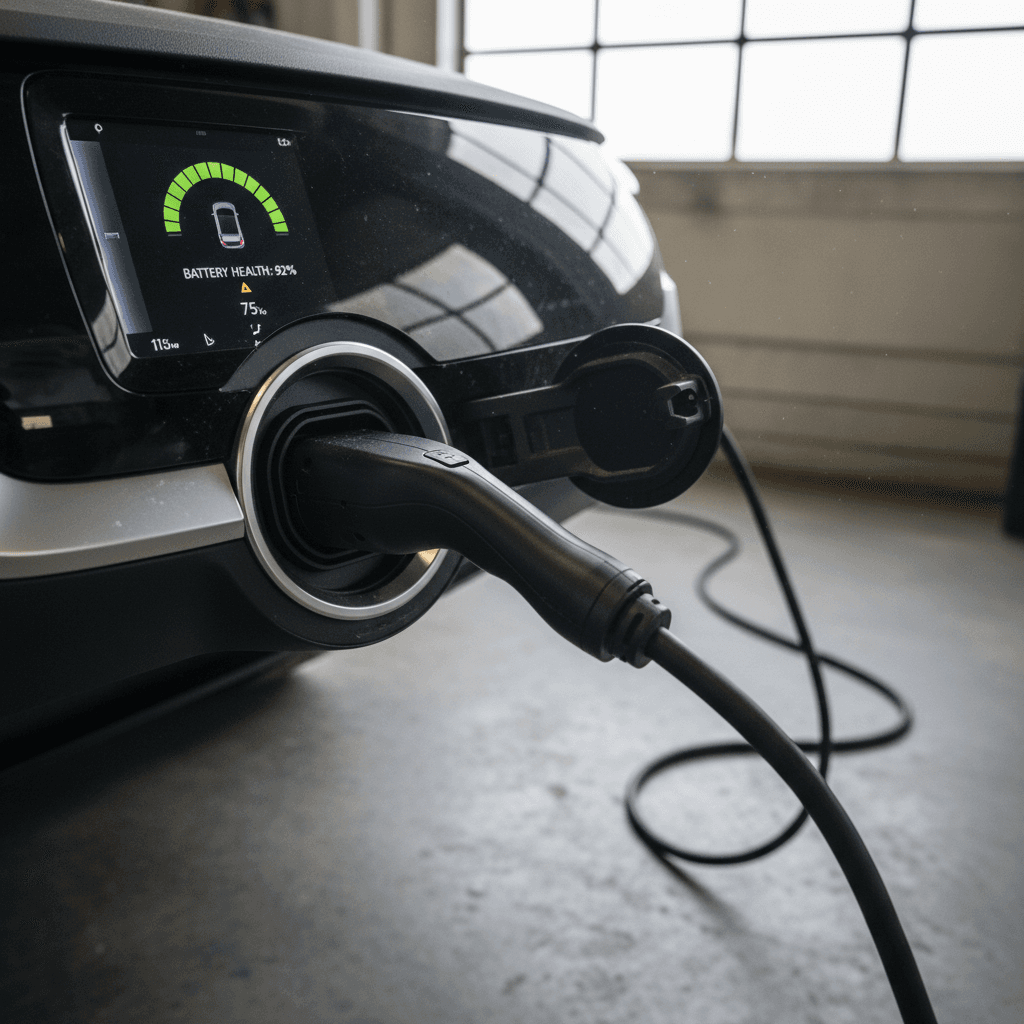
If you’re shopping used, the question isn’t just “what’s normal on paper?”, it’s **“what’s the battery health of this specific EX90?”** Because early owners may have very different driving and charging habits, pack condition can vary more than the odometer suggests.
Smart ways to evaluate EX90 battery health before you buy
Don’t guess, verify.
1. Ask for battery health documentation
Some sellers, including Recharged, provide a battery health report with data directly from the pack, not just the dash. Recharged’s Score Report includes verified state of health, usage patterns, and fair‑market pricing adjusted for battery condition.
2. Compare range on a known route
On a test drive, reset trip data and drive a 15–20‑mile loop at mixed speeds. Compare the % used to what a new EX90 would typically use for the same trip. Large unexplained gaps can warrant a deeper diagnostic.
3. Get a professional EV inspection
A technician with EX90 experience can scan for battery fault codes, cell imbalance, or prior pack work. If you’re buying long‑distance, a digital retailer like Recharged that bakes this into their process can save you a lot of uncertainty.
Red flags on a used EX90
FAQ: Volvo EX90 battery degradation per year
Common questions about Volvo EX90 battery life
Bottom line on Volvo EX90 battery life
Putting it all together, the Volvo EX90’s big CATL NMC pack behaves like a modern, well‑engineered EV battery should. **Normal Volvo EX90 battery degradation per year** will likely settle in the same 1.5–2.5% band we see across other long‑range EVs, with a slightly faster early drop and an extended period of slow, predictable decline. Volvo’s 8‑year/100,000‑mile, 70%‑capacity warranty backs that up, and early real‑world experience doesn’t show any EX90‑specific red flags.
Your driving and charging habits still matter. Keeping daily charge limits reasonable, leaning on Level 2 instead of constant DC fast charging, and avoiding extreme heat all make it more likely you’ll see only modest range loss over many years. And if you’re buying used, working with a seller that provides a **transparent battery health report, like Recharged’s Score Report, can turn “I hope this pack is good” into a confident, data‑backed decision. That’s ultimately what makes a premium EV like the EX90 feel like a smart long‑term bet, not a rolling question mark.