If you’re eyeing a roof box, bike rack, or even a rooftop tent for your Volvo EX30, the first spec you need to understand is the roof rack weight limit. Get it wrong, and you risk damaging the car, your accessories, or worse, stability on the road. This guide breaks down the Volvo EX30 roof rack weight limit in plain English so you know exactly what you can safely carry.
Official EX30 roof rack limit
Volvo EX30 roof rack weight limit: the short answer
On all currently published Volvo EX30 specifications, the maximum roof load is 75 kg, which equals about 165 lb. That figure appears in Volvo’s own support and specification materials for the EX30 and applies across trims. It’s sometimes called the “maximum roof load” or “maximum roof loading,” and it is a dynamic limit, that is, it applies while the car is being driven.
- Maximum roof load (EX30): 75 kg / 165 lb
- Limit includes: roof bars + attachments (box, bike racks, baskets) + cargo inside or on them
- Applies while driving, at all speeds, on public roads
- You must also stay within the car’s overall payload and axle limits
Don’t confuse bar rating with car rating
Dynamic vs static roof load on the EX30
Most owners bump into a second concept once they start looking at rooftop tents or big boxes: dynamic vs static roof load. Volvo only publishes the dynamic figure for the EX30, but understanding the difference will help you use that 75 kg intelligently.
Dynamic vs static roof load: what it means for your EX30
Why 75 kg isn’t the whole story for parked vs driving use
Dynamic roof load
This is the official 75 kg (165 lb) EX30 roof load limit you see in Volvo documentation.
- Applies while driving
- Includes bars, accessories, and cargo
- Protects against handling issues and structural stress
Static roof load
Static load is the weight the roof can support when the car is parked.
- Typically much higher than dynamic
- Relevant for rooftop tents and parked use
- Volvo doesn't publish a static number for the EX30, so you must stay conservative
Rule of thumb for static load
How much can you really put on an EX30 roof rack?
Because the 75 kg / 165 lb limit includes everything above the sheet metal, you have to work backwards from the accessories you’re using. Here’s a realistic breakdown using common Volvo and Thule-style components for the EX30.
Example Volvo EX30 roof load calculations
Approximate weights to illustrate how quickly you can reach 75 kg / 165 lb.
| Setup | Component weights (approx.) | Total roof load | Within 75 kg limit? |
|---|---|---|---|
| Medium roof box + crossbars | Bars: 5 kg; Box: 19–23 kg; Cargo: 30 kg | 54–58 kg | ✅ Yes, plenty of headroom |
| Large roof box + family luggage | Bars: 5 kg; Box: 23–31 kg; Cargo: 40 kg | 68–76 kg | ⚠️ Very close or slightly over |
| Two bikes on roof + crossbars | Bars: 5 kg; 2 x carriers: 4–6 kg; 2 x bikes: 30 kg | 39–41 kg | ✅ Well under limit |
| Kayak + carrier + crossbars | Bars: 5 kg; Carrier: 5 kg; Kayak: 25 kg | 35 kg | ✅ Under limit |
Always check the actual weight of your bars, boxes, and carriers before loading.
Never ignore the cargo weight in a roof box
Volvo EX30 roof box and bike rack examples
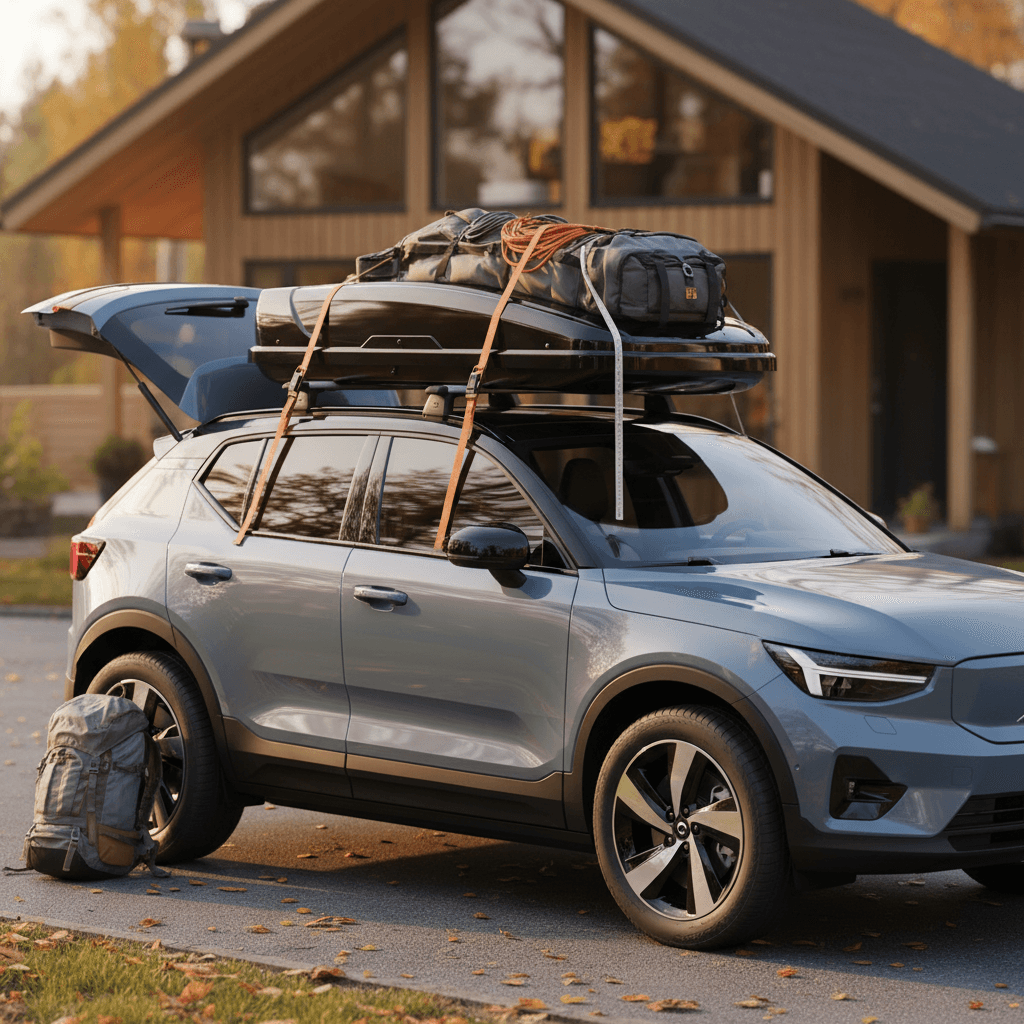
Volvo sells several OEM roof boxes and compatible carriers for the EX30, and aftermarket brands like Thule follow similar numbers. They’re typically designed to work within the EX30’s 75 kg roof load, but it’s still your job to add up the math.
Common Volvo EX30 roof setups
How real-world accessory combinations fit under the 75 kg limit
OEM Travel 400 roof box
A Volvo-branded box around 400 L in volume often weighs roughly 19–23 kg empty and carries up to 75 kg of its own load.
On an EX30, you can’t actually use the full 75 kg box rating because the car’s roof limit is 75 kg total. Subtract bars and box weight, and you’re usually left with 30–45 kg of usable cargo headroom.
Two bikes + carriers
A realistic two-bike setup looks like this:
- Crossbars: ~5 kg
- Two upright bike racks: 4–6 kg
- Two bikes: 24–32 kg total
That keeps you around 35–43 kg, well inside the EX30’s rating.
Kayak or cargo basket
Kayak on J-style carriers or a low-profile cargo basket usually totals around 30–45 kg loaded.
That’s safe territory for the EX30 as long as you don’t stack heavy extras like fuel cans or tools on top.
Use the car’s door label as your second check
Can the Volvo EX30 use a rooftop tent?
Rooftop tents are one of the hottest accessory questions for the EX30 right now. The short version: it’s possible in principle, but you’re operating in a gray area because Volvo does not publish a static roof load spec for the EX30.
What the numbers suggest
- Dynamic limit is 75 kg / 165 lb while driving.
- Many compact rooftop tents weigh 45–65 kg empty.
- Add crossbars (about 5–7 kg) and bedding or gear, and you’re likely brushing up against or exceeding 75 kg while moving.
That’s why most rooftop-tent owners on compact EVs focus on the lightest possible tent and very minimal extra gear on the roof.
Why static matters here
- Static capacity (parked) is usually a multiple of dynamic capacity on SUVs.
- Once parked, weight from people inside the tent is largely treated as static.
- Still, without an official Volvo static spec, you’re taking responsibility for the risk.
If you pursue a rooftop tent on an EX30, stay as light as humanly possible and check insurance and local regulations before drilling or modifying anything.
What Volvo does and doesn’t say
Loading your EX30 roof rack safely: step-by-step
Step-by-step: calculating safe roof load on a Volvo EX30
1. Confirm the 75 kg / 165 lb limit in your manual
Open your EX30 owner’s manual or online Volvo support and confirm the maximum roof load is listed at 75 kg. Specs can change with model years, so always double‑check before buying gear.
2. Weigh or look up every component
Find the weight of your <strong>crossbars, feet, carriers, and box or tent</strong>. Use manufacturer specs or a scale. Don’t guess, accessory weights add up fast on a 75 kg limit.
3. Subtract accessory weight from 75 kg
Take 75 kg and subtract the combined weight of your bars and attachments. Whatever remains is your <strong>usable cargo allowance</strong> for that setup.
4. Pack light and low
Use the roof for <strong>bulky but relatively light items</strong>: skis, camping gear, duffels, stroller, etc. Keep dense items such as tools, water, or heavy coolers inside the cabin or trunk for better stability.
5. Distribute weight evenly and secure it
Center the load between the bars and left‑to‑right on the vehicle. Use all straps, tensioners, and built‑in tie‑downs recommended by the box or carrier manufacturer so nothing shifts under braking or crosswinds.
6. Adjust driving style
With any load on the roof, reduce speeds, increase following distance, and be cautious in crosswinds. The EX30 is tall and light for its footprint; a heavy roof load can noticeably change how it feels on the highway.
When in doubt, leave margin
How roof load affects range, noise, and comfort
The Volvo EX30 is a small, efficient EV, and you’ll feel, and hear, it when you put a big box or bikes on top. Even if you’re under the 75 kg limit, you’re trading some range and refinement for extra cargo space.
What to expect when you load the EX30 roof
From highway whine to extra charging stops
Reduced range
Roof boxes and racks increase drag. Owners typically report 10–20% range loss with a medium to large roof box at highway speeds. The effect is usually smaller around town.
More wind noise
Even well‑designed bars and boxes add some wind rush or whistling, especially above 55–65 mph. Fairing designs and careful bar placement can help, but some added noise is unavoidable.
Different handling feel
A fully loaded roof raises the EX30’s center of gravity. Expect more body roll in quick maneuvers and slightly longer stopping distances. That’s another reason to stay comfortably under the 75 kg cap.
Plan charging stops around rooftop cargo
Buying a used EX30? Roof rack and roof load checks
If you’re shopping for a used Volvo EX30, there are a few roof‑specific items worth checking, especially if the previous owner used roof boxes, bike racks, or a tent. This is where a platform like Recharged, which specializes in used EVs, can help you avoid surprises.
Used Volvo EX30 roof and rack checklist
1. Inspect factory mounting points
Check the EX30’s roof for <strong>anchor points</strong> or covers where the OEM bars mount. Look for stripped threads, missing plugs, or evidence of over‑tightening.
2. Check for dents, ripples, or stress marks
Stand back and sight down the roof panel under good light. Subtle ripples or dents around the bar mounting zones may indicate <strong>overloaded or improperly installed</strong> racks.
3. Ask how the roof was used
A seller who regularly carried a heavy box or rooftop tent should be able to describe their setup. Ask about total weights, brands, and whether they followed the 75 kg limit.
4. Confirm accessories are appropriate
If the car comes with a box or racks, verify they’re correctly sized and mounted for the EX30. Over‑wide bars or improvised fits are a red flag.
5. Review total payload habits
A fully loaded EX30 with passengers, luggage, and a loaded roof box can approach its <strong>gross vehicle weight rating</strong>. Ask about typical trip loads and towing, if any.
6. Lean on third‑party inspection data
With a used EV marketplace like <strong>Recharged</strong>, you get a <strong>Recharged Score report</strong> that focuses on battery health and overall condition. Pair that with a visual roof inspection for a fuller picture of how the car was used.
If you plan to regularly use the EX30’s roof rack for gear or road trips, consider working with a retailer that understands EV‑specific usage patterns. Recharged can help you compare used EX30s, discuss how cargo habits affect range and wear, and even arrange nationwide delivery once you’ve found the right car.
FAQ: Volvo EX30 roof rack weight limit
Frequently asked questions about the Volvo EX30 roof rack limit
Key takeaways for Volvo EX30 owners
The Volvo EX30’s 75 kg / 165 lb roof rack weight limit is enough for a medium roof box, a couple of bikes, or a kayak setup, but it leaves very little room for overpacking or heavy rooftop tents. The safest strategy is simple: choose light accessories, add up every kilo on the roof, and treat 75 kg as a ceiling you stay well under, not a number you aim to hit.
If you’re considering a Volvo EX30, new or used, as your adventure EV, factor your roof‑rack plans into the buying process. At Recharged, every used EV comes with a Recharged Score battery health report, fair‑market pricing, and expert guidance on how cargo, charging, and daily use affect the car long‑term. That way, you’re not just buying an EX30 that can carry your gear, you’re buying one that’ll keep doing it confidently for years.