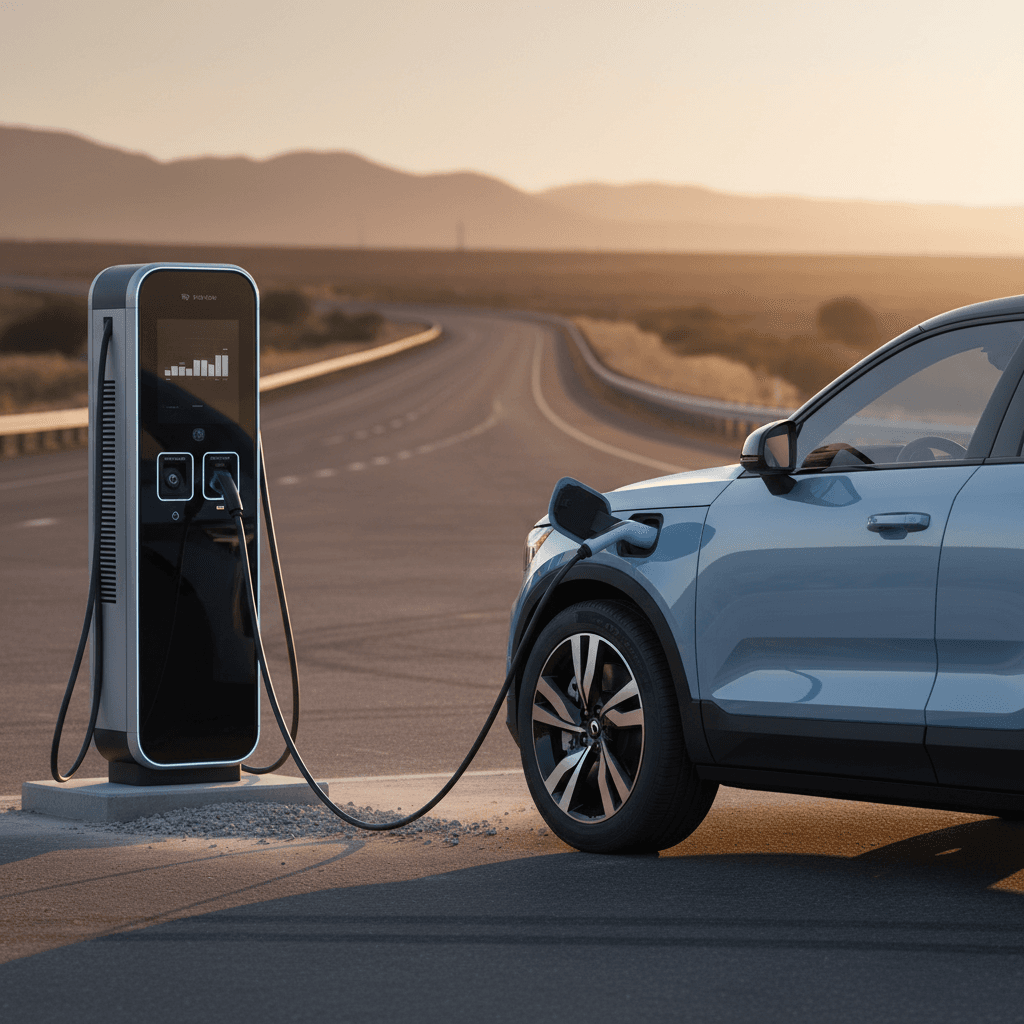
If you’re looking at a Volvo EX30, you’ve probably seen the headline claim: around 25–30 minutes from 10–80% on a DC fast charger. That sounds great, but what does it look like in real life, at home, on a road trip, and a few years down the road if you buy a used EX30? This Volvo EX30 charging speed guide breaks down the numbers in plain English so you can plan daily driving, weekend getaways, and cross-country runs with confidence.
At-a-glance EX30 charging speeds
Volvo EX30 charging basics: batteries, chargers & connectors
Before you worry about minutes and kilowatts, it helps to know which EX30 battery and charger combo you’re dealing with. Volvo offers the EX30 with two main battery sizes and a standard onboard AC charger that tops out around 11 kW on AC power. That AC limit becomes your ceiling for home and workplace charging speeds, no matter how beefy the wall box is.
Volvo EX30 battery & charging hardware overview
Key battery and charging specs that affect how fast your EX30 can charge.
| Variant | Usable battery (approx.) | Chemistry | Onboard AC charger | Max DC fast charge (peak) |
|---|---|---|---|---|
| Single Motor Standard Range | ~49–51 kWh | LFP in many markets | Up to 11 kW AC | Up to ~134 kW DC |
| Single Motor Extended Range | ~64–69 kWh | NMC | Up to 11 kW AC | Up to ~150–153 kW DC |
| Twin Motor Performance | ~64–69 kWh | NMC | Up to 11 kW AC | Up to ~150–153 kW DC |
Numbers are rounded and can vary slightly by model year and market.
Know your variant
What plugs into what? EX30 connector basics
Understanding plugs helps you pick the right public stations and home setup.
In North America
The EX30 uses a CCS1 DC fast-charging port and a J1772-compatible AC inlet. As NACS (Tesla-style) ports roll out, you’ll see more EX30s using adapters or shipping with NACS directly, but today most U.S. cars are CCS.
Public DC fast charging
Look for stations labeled CCS (Electrify America, EVgo, ChargePoint DC, some Tesla sites with CCS support). Power ratings of 150–350 kW are ideal, even though the EX30 itself peaks around 150 kW.
Home & workplace charging
At home you’ll plug into Level 1 (120V) or Level 2 (240V) AC. The EX30’s onboard 11 kW charger converts AC to DC for the battery; you’ll rarely see the full 11 kW in U.S. homes, but 7–9 kW is common with the right circuit.
Official Volvo EX30 charging times and what they mean
Volvo publishes detailed charging tables in the EX30 owner’s manual and support docs, and they all share a key pattern: charging slows down as the battery fills up. The advertised DC numbers are usually based on going from about 10–80% state of charge (SoC) on a capable fast charger with a warm battery.
Headline Volvo EX30 charging figures
Why 10–80% matters
Real-world DC fast charging speeds: 10–80%
In testing and owner reports, a healthy EX30 on a good 150 kW+ charger usually lands near Volvo’s claims: about 25–30 minutes from 10–80%. The fine print: you only see peak power for a short slice of the session, and cold weather or a weak charger can stretch that window noticeably.
Typical EX30 DC charging curve
- 10–30%: Ramp quickly toward ~130–150 kW on a capable charger with a warm battery.
- 30–60%: Power gradually tapers into the 80–110 kW range.
- 60–80%: Expect 50–80 kW as the pack fills and the car protects longevity.
- 80–100%: Power may drop well under 40–50 kW; this part of the curve is slow and least efficient for road‑trip time.
Approximate time by charge window
- 10–50%: ~15–18 minutes on a strong 150 kW+ charger.
- 20–80%: ~25–30 minutes in warm weather on high‑power hardware.
- 30–90%: ~35–45 minutes; extra minutes above 80% give smaller range gains.
- 10–100%: Often 50+ minutes; usually not worth it unless you’re starting the day or have no charger ahead.
These are planning numbers, not promises. Site power sharing, weather, and battery health can swing timing by several minutes.
Don’t judge by kilowatts alone
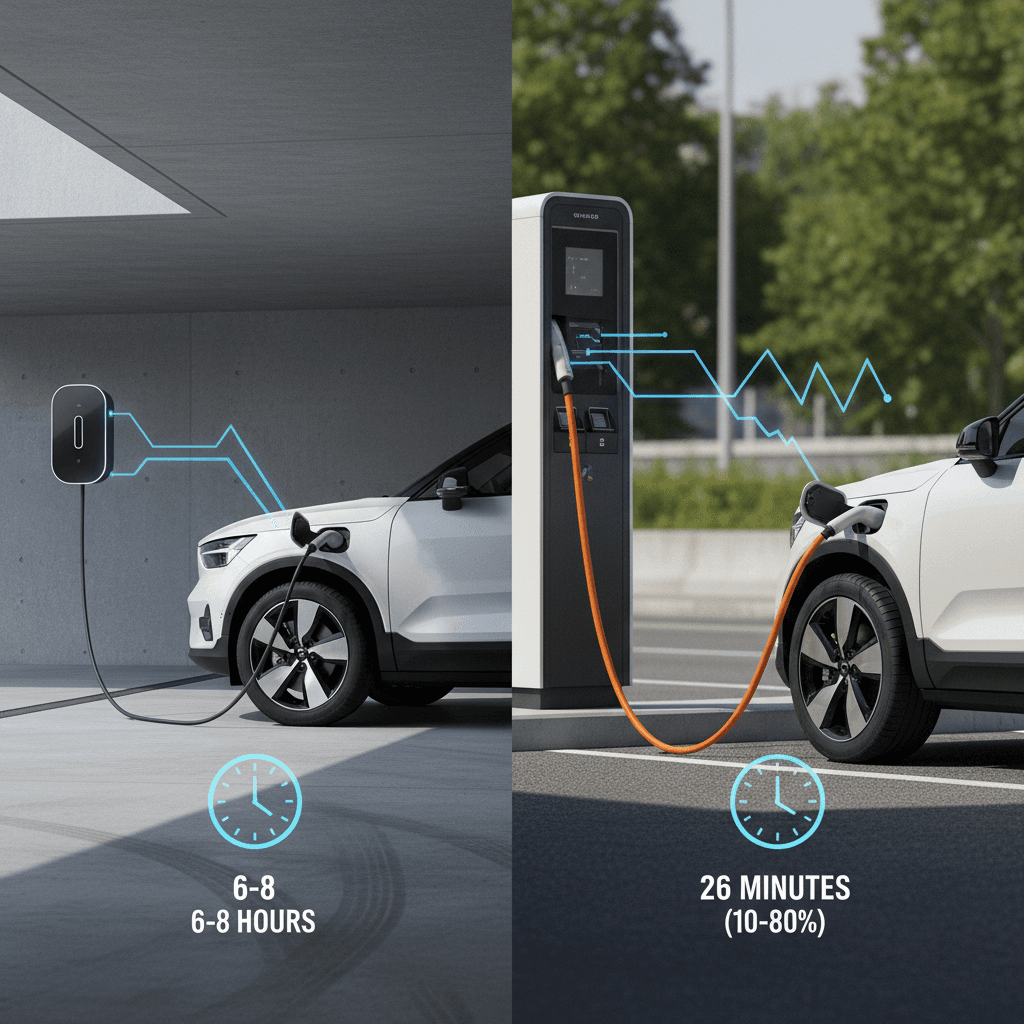
Home charging your Volvo EX30: Level 1 vs. Level 2
If you own or are eyeing a Volvo EX30, most of your charging will happen at home or work. That’s where understanding the difference between Level 1 (120V) and Level 2 (240V) really matters. The car doesn’t care where the electrons come from, it only sees voltage and amps.
How long does the EX30 take to charge at home?
Planning numbers for a roughly 64–69 kWh EX30 in the U.S.
Level 1 – 120V household outlet
- Power: ~1.2–1.4 kW (15A circuit)
- Rate: roughly 3–4 miles of range per hour of charging.
- Full 10–90% fill: easily 30+ hours; best for low‑mileage drivers or emergency top‑ups.
You can live with Level 1 for short commutes, but most EX30 owners quickly want something faster.
Level 2 – 240V home charger
- Power: 7.2–9.6 kW typical on a 40–50A circuit in U.S. homes.
- Rate: roughly 25–35 miles of range per hour.
- 10–90% overnight: roughly 6–8 hours, easily done between dinner and your morning commute.
The EX30’s 11 kW onboard charger is the ceiling; you won’t go faster than that on AC, even if the wall box is rated higher.
Right-size your home setup
Quick checklist for a good EX30 home-charging experience
1. Confirm panel capacity
Have an electrician verify that your service panel can support a new 40–50A 240V circuit without overloading. In older homes, this is the step owners often skip.
2. Plan the parking spot
Mount the charger so the cable easily reaches the EX30’s charging port without straining or crossing walkways. A 20–25 ft cable is a good target.
3. Use scheduled charging
Set the EX30 or your home charger to start during off‑peak hours where possible. It’s easier on the grid and usually cheaper on your bill.
4. Avoid constant 100% at home
For daily use, set a target around 70–85%. Save 100% home charges for road‑trip mornings or rare days when you truly need maximum range.
How long should you plan for on a road trip?
The EX30’s compact footprint and modest battery make it quick to refill but also give it less absolute range than bigger SUVs. On a highway run, you’ll usually stop a bit more often but for shorter bursts than someone in a large‑battery EV.
Illustrative road-trip pattern
- Start the day at ~90–100% after an overnight Level 2 charge.
- Drive 150–190 miles depending on speed, weather, and wheel/tire setup.
- Fast-charge from roughly 15–70% in 20–25 minutes while you use the restroom and grab food.
- Repeat; the EX30’s 10–80% window in ~25–30 minutes keeps breaks manageable if you plan around that sweet spot.
Time budgeting rules of thumb
- Per 2–3 hours of driving: expect ~25–30 minutes of DC charging.
- For a 500‑mile day: plan on one long overnight charge + 2 meaningful DC stops.
- Above 80%: only stay if your next fast charger is truly far away, the minutes are rarely worth it.
If you’re shopping used, a Recharged EX30 listing includes a Recharged Score with battery health details so you can tell whether an older pack will still hit these road-trip targets.
Use apps to aim for 10–70%
7 factors that slow your EX30’s charging speed
If your EX30 never seems to hit those glossy brochure numbers, you’re not alone. DC fast-charging speed is a three‑way negotiation between your car, charger hardware, and conditions. Here are the main culprits when sessions drag on.
- Cold battery: In winter, the EX30 may limit power heavily until the pack warms up. Use preconditioning if your route planner supports it, or drive 15–20 minutes before fast charging.
- Weak or shared chargers: A “150 kW” pedestal may be split between two cars or limited by the site’s upstream power, especially at busy highway locations.
- High state of charge: Plugging in at 60–70% instead of 10–20% lands you on the slow part of the charging curve from the start.
- Outdated software: Volvo has pushed OTA updates that tweak charging behavior. If you’re buying used, make sure the car is on current software.
- Battery health: A heavily fast‑charged or high‑mileage EX30 might pull slightly less power or taper earlier to protect an aging pack.
- Accessory loads: Cabin heat, A/C, and other draws eat into what’s available for the battery, especially at low power sites.
- Charging settings: Check that you haven’t limited DC power or set a low charge cap (like 70%) that ends the session early.
Beware cold-soak DC stops
Battery health: how often to DC fast charge an EX30
Any modern EV, including the EX30, is designed to handle regular DC fast charging, but your habits still matter over 8–10 years of ownership. The quickest way to preserve range is to use DC fast charging strategically and let Level 2 handle the grind of daily life.
Battery-friendly EX30 charging habits
- Use Level 2 at home for the majority of energy you add to the pack.
- Set a daily charge target around 70–85% instead of 100%.
- Reserve 100% charges for road‑trip mornings or rare days when you’re range‑constrained.
- On DC, try to arrive below ~25% and unplug before 80–85% whenever possible.
What this means for used EX30 shoppers
Two EX30s with identical odometer readings can age very differently depending on how they were charged. One that lived on a home Level 2 and rarely saw 100% will usually have a healthier pack than one fast‑charged to 100% multiple times a week.
Every EX30 listed on Recharged comes with a Recharged Score Report that includes battery diagnostics. That makes it easier to spot cars that still charge close to factory speeds, and to pay accordingly.
Charging-speed checklist for current and future EX30 owners
EX30 charging-speed checklist
1. Confirm your battery and hardware
Check whether your EX30 is standard- or extended‑range and verify your onboard AC charger spec. That frames realistic expectations for both home and DC charging.
2. Set smart charge limits
Use the car’s settings to keep daily charging in the 70–85% range. Raise the limit to 90–100% only before long drives.
3. Optimize your DC stops
Plan to arrive near 10–20% and leave around 70–80% on road trips. This keeps you in the EX30’s fastest charging zone and avoids wasting time chasing the last few percent.
4. Upgrade from Level 1 if needed
If you’re logging more than ~30 miles a day, a 240V Level 2 solution is worth it. It lets you easily recover a full day’s driving during an overnight charge.
5. Keep software current
Make sure your EX30 has the latest Volvo software for charging behavior and bug fixes. When shopping used, ask the seller or retailer to confirm updates.
6. Use data when buying used
Instead of guessing, look for a used EX30 with documented battery health. Recharged’s <strong>Recharged Score</strong> is built to surface that information up front.
Volvo EX30 charging speed FAQ
Frequently asked Volvo EX30 charging questions
Bottom line: is the EX30 fast enough for you?
If you think of the Volvo EX30 as a compact SUV with a compact battery, its charging story makes sense. It’s not the absolute quickest DC fast‑charging EV on the market, but being able to go 10–80% in roughly 25–30 minutes and fully reload overnight on Level 2 puts it right in the sweet spot for daily driving and realistic road trips.
Where the EX30 really shines is predictability: you can plan around a 150‑kW‑class peak, fast mid‑pack charging, and modest but manageable highway range. If you’re buying new, that means building your home‑charging setup and road‑trip expectations around those numbers. If you’re shopping used, it means looking closely at battery health and charging history, and that’s exactly what Recharged’s Recharged Score is built to surface so you know how fast your specific EX30 is likely to charge for years to come.