If you’re eyeing a Volvo C40 Recharge, or already own one, the first thing you’ll want to know is simple: how fast does it really charge? Official brochures promise 10–80% in under half an hour, but real-world charging speed tests tell a more nuanced story, especially if you’re using public DC fast chargers or shopping the used market.
Why charging speed tests matter
Overview: How fast does the Volvo C40 Recharge really charge?
Headline charging stats for Volvo C40 Recharge
In independent lab-style tests, the single-motor C40 Recharge with the smaller pack typically adds 10–80% in roughly 26–32 minutes on a strong DC fast charger. The dual-motor (Twin) / extended-range cars with the 82 kWh pack tend to land around 28–30 minutes in ideal conditions, thanks to higher peak power and a flatter charging curve. Real-world sessions in cold weather or on lower-power chargers can push those numbers closer to 40 minutes.
Quick takeaway
Battery and charging specs by C40 Recharge variant
The name “C40 Recharge” covers several mechanical setups and at least two major battery generations. That matters because your exact variant determines both peak charging speed and how long the pack can hold that power.
Volvo C40 Recharge battery & charging specs (high level)
Key charging-relevant specs across popular C40 Recharge variants. Values are rounded and focus on what matters for owners and used shoppers.
| Variant | Approx. usable battery | Official peak DC power | Typical 10–80% DC time (ideal) | Onboard AC charger |
|---|---|---|---|---|
| Single Motor (early years, ~2022–2023) | ≈67 kWh | Up to 150 kW | ≈30–32 min | 11 kW AC (3‑phase capable) |
| Twin Motor / AWD (early years) | ≈75 kWh | ≈150–155 kW | ≈35–40 min | 11 kW AC |
| Single Motor Extended Range (updated pack) | ≈79 kWh | Up to 200–205 kW | ≈28–30 min | 11 kW AC |
| Twin Motor with 82 kWh pack (2024+) | ≈79 kWh | Up to 200–205 kW | ≈28–30 min | 11 kW AC |
Exact specs can vary slightly by market and model year, but this captures the patterns that influence charging speed.
Check your exact model year
DC fast charging speed test: 10–80% in the real world
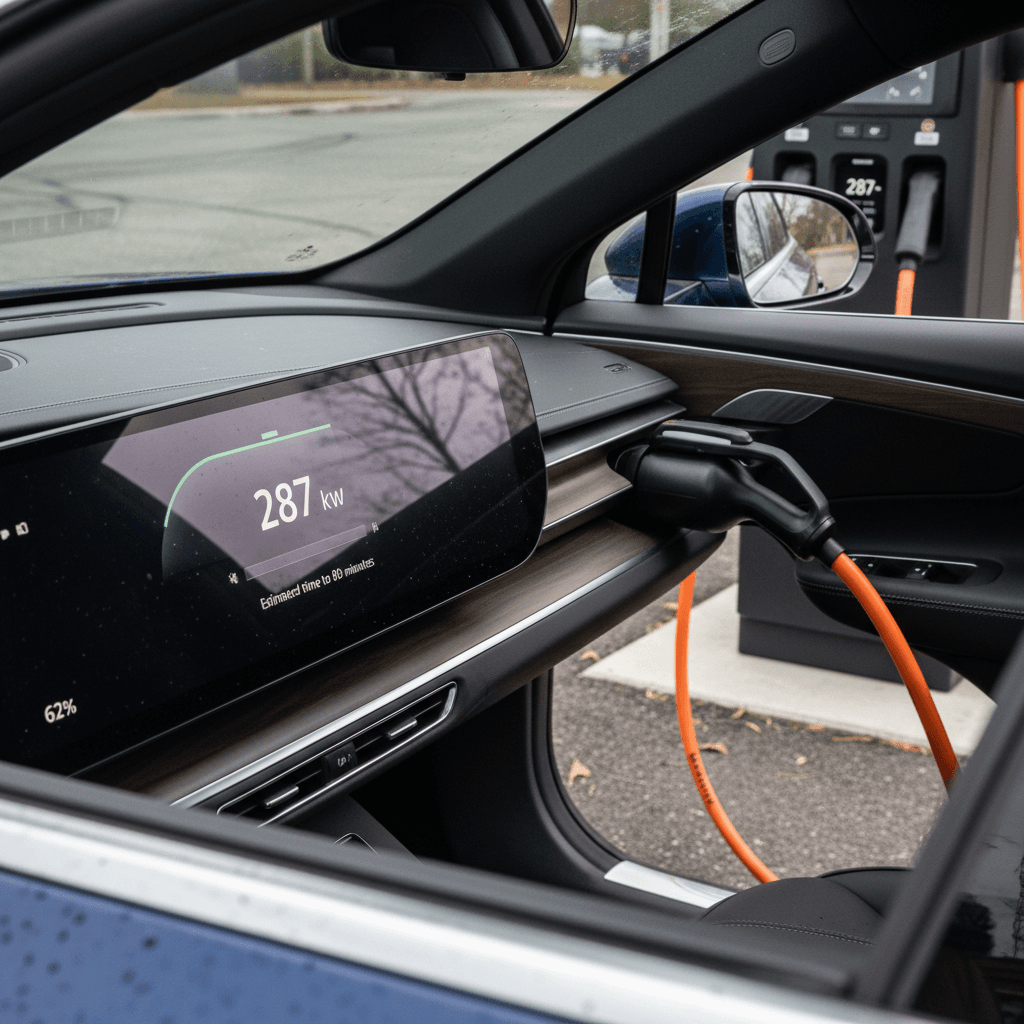
Let’s translate the brochure numbers into something more like what you’ll experience on a road trip. Here’s a realistic DC fast charging scenario for a C40 Recharge Twin with the newer 82 kWh pack, starting at low state-of-charge and plugged into a capable 200 kW CCS station.
Example DC fast charging session: C40 Recharge Twin (82 kWh pack)
1. Arrive at 10% with a warm battery
You’ve just driven 60–80 highway miles, so the pack is warm and ready for high power. This is ideal; a cold-soaked pack will charge slower even on a big charger.
2. Plug into a 200 kW CCS charger
The C40 Recharge uses the CCS standard in North America and Europe. To hit its best speeds, the charger needs to support at least 175–200 kW on your stall, not just on paper for the whole site.
3. 10–40%: High power ramp and peak
From ~10–40%, you can expect the car to climb quickly towards its peak, around 180–200 kW on the newest pack under perfect conditions, or around 130–150 kW on earlier packs. This is when you add miles the fastest.
4. 40–60%: Holding strong but starting to taper
Between roughly 40–60%, the C40 tends to hold a healthy 120–160 kW depending on variant and conditions. You’re still gaining range quickly, but the curve is starting to roll over.
5. 60–80%: Noticeable taper
Above ~60%, DC power steps down, often into the 70–110 kW range, then lower as you approach 80%. This is normal; battery longevity demands a taper as the pack fills.
6. Overall 10–80% time: ~28–32 minutes
In ideal conditions, expect about half an hour from 10–80%. Add 5–10 minutes if it’s cold, the charger is shared, or the station tops out around 100–125 kW in reality.
Don’t chase 100% on DC
Understanding the C40 Recharge DC charging curve
Every EV has a characteristic charging curve, how power (kW) rises and falls as the battery fills. The Volvo C40 Recharge’s curve is relatively conservative at the top end but decently strong in the middle, which is good news if you plan your stops smartly.
How the C40’s charging curve typically behaves
Different parts of the state-of-charge window deliver very different speeds.
0–20%: Ramp-up zone
From a very low state-of-charge, the car will quickly ramp up towards peak power, assuming the pack is warm. In winter, the C40 may linger at lower kW until the battery reaches a healthier temperature.
20–60%: Sweet spot
Here, the C40 Recharge spends much of its time around 120–180 kW on the newer packs and 100–140 kW on older ones. This band gives you the best miles-per-minute and is where you want to do most of your DC charging.
60–100%: Taper zone
Past ~60%, power steadily declines to double-digit kW by the time you get near 90–100%. This is intentional to protect the battery. It’s fine for occasional full charges, but not efficient on road trips.
Road-trip strategy
AC home charging: how long for a full charge?
The C40 Recharge’s 11 kW onboard AC charger is more than enough for overnight home charging, as long as your electrical setup can support it. In North America that usually means a 40–48A Level 2 EVSE on a 240 V circuit; in Europe it can also take full advantage of 3‑phase power.
Typical home charging times for Volvo C40 Recharge
Approximate 0–100% charging times under good conditions. Real-world daily use rarely requires a full charge from empty.
| Setup | Power | Single Motor (~67 kWh usable) | Twin / 82 kWh pack (~79 kWh usable) |
|---|---|---|---|
| Standard household outlet (Level 1, US) | 1.4 kW (120 V, 12 A) | ~40–45 hours | ~45–50 hours |
| Basic 240 V Level 2 (16 A) | ≈3.8 kW | ~18–20 hours | ~22–24 hours |
| Typical home Level 2 (32 A) | ≈7.7 kW | ~9–10 hours | ~11–12 hours |
| Max AC capability (48 A / 3‑phase 16 A) | Up to 11 kW | ~6.5–7.5 hours | ~8–9 hours |
If you plug in every night and charge to 70–90%, you’ll almost never see these full 0–100% numbers in practice.
For most owners, 32 A is enough
5 factors that slow down your C40’s charging speed
If your first “charging speed test” doesn’t match what you’ve seen on YouTube, it’s usually not the car’s fault. The Volvo C40 Recharge is fairly transparent and predictable, but it’s sensitive to a handful of conditions that can slash your kW.
- Battery temperature: A cold-soaked pack (after sitting outside in winter) will pull far less power at first. Use preconditioning via navigation to a fast charger when possible, or drive 20–30 minutes before your DC session.
- Charger limitations: Many stations advertise “up to 150 kW” but share that power across two stalls or step down due to site constraints. If you’re stuck around 70–90 kW at low state-of-charge, the bottleneck may be the charger, not the C40.
- High state-of-charge: Plugging in at 60–70% and then complaining about slow DC is a common mistake. The C40’s curve is designed to taper hard above about 60%.
- Parallel loads: Cabin heating, seat heaters, and battery conditioning all consume power. Especially in cold weather, a chunk of the energy from the plug is going to warming the pack and cabin, not just filling the battery.
- Battery health and BMS limits: On higher‑mileage cars with some degradation, the battery management system may subtly adjust how aggressively it allows fast charge power. This isn’t usually dramatic, but on a used C40 it’s one more reason to look closely at a verified battery health report.
Winter charging reality check
Used Volvo C40 Recharge: what charging data reveals
The C40 Recharge hasn’t been on the market as long as some rivals, but there are already meaningful differences between early and updated cars, not just in range, but in how confidently they hold high DC power. That makes charging performance an important data point if you’re shopping used.
1. Earlier C40s: good, but not headline-fast
First‑generation C40 Recharge models with the smaller battery typically max out around 130–155 kW and taper more aggressively at higher state-of-charge. That’s still perfectly serviceable, but if you road-trip frequently, it’s worth knowing you won’t see the same 200 kW peaks touted by the latest spec sheets.
2. Updated 82 kWh cars: stronger mid-band
The facelifted C40 Recharge with the 82 kWh pack and revised powertrains unlocks higher peaks (around 200 kW) and a more robust plateau in the 20–60% window. In practice, that shaves a few minutes off a 10–80% session and gives you more miles in the same stop.
Where Recharged fits in
Home vs public charging: smart strategy for C40 owners
The fastest charging session is the one you don’t have to think about. The Volvo C40 Recharge is clearly optimized around overnight Level 2 charging at home or at work, with DC fast charging reserved for road trips and occasional top‑ups.
Where the C40 Recharge really shines
Play to the car’s strengths and fast charging is just a safety net, not a daily habit.
Daily life: home / workplace
- Set a daily charge limit around 70–80% to protect long‑term battery health.
- Use scheduled charging to take advantage of off‑peak electricity rates where available.
- Most owners only need 2–4 hours per night on Level 2 to cover daily driving.
Road trips: DC fast charging
- Plan stops around the 20–70% window to stay in the C40’s high‑power band.
- Favor well‑reviewed 150–350 kW sites; some older 50 kW chargers will be the real bottleneck.
- Use the car’s navigation or apps like PlugShare to avoid broken or throttled stations.
Used buyer bonus
FAQ: Volvo C40 Recharge charging speed & best practices
Frequently asked questions about C40 Recharge charging speed
Bottom line: Is the Volvo C40 Recharge a fast charger?
Taken as a whole, the Volvo C40 Recharge is a respectably quick, if not headline‑grabbing, fast charger. The newer 82 kWh variants in particular deliver genuinely useful 10–80% times in the ~30‑minute range, while earlier cars are only a few minutes behind in typical conditions. Where many owners go wrong is expecting peak numbers at high state-of-charge, or underestimating the impact of cold weather and mediocre public chargers.
If you mostly charge at home and use DC fast charging for road trips, the C40 Recharge’s charging performance will feel more than adequate, and worlds better than gas‑station downtime once you get into the plug‑in rhythm. And if you’re considering a used C40 Recharge, pairing these charging speed expectations with a verified battery health report like the Recharged Score gives you a much clearer picture of how the car will fit your lifestyle over the long haul.