If you’re comparing electric SUVs, you’ve probably noticed that Volkswagen ID.4 insurance rates by age can swing hundreds of dollars a year. A 22‑year‑old ID.4 driver might pay nearly double what a 45‑year‑old pays for the same coverage, even with similar mileage. Understanding why that happens, and what you can control, can shave real money off your total cost of ownership.
A quick word on numbers
Why Volkswagen ID.4 insurance varies so much by age
Age is one of the strongest predictors insurers use when pricing a Volkswagen ID.4 policy. It’s not personal; it’s math. Statistically, younger drivers file more claims, cause more at‑fault accidents, and drive more miles at night. Older drivers tend to have more experience, more stable routines, and often better credit, all of which lower risk in an actuary’s eyes.
- Teen and early‑20s drivers are priced as high‑risk, especially in an SUV with modern tech and higher repair costs like the ID.4.
- Drivers in their 30s to 50s usually land in the sweet spot: longer clean records, established credit, and more rate competition from insurers.
- Drivers 60+ may still enjoy lower rates, but premiums can creep up again in their 70s and 80s as insurers factor in slower reaction times and medical claim severity.
With the ID.4 specifically, age interacts with EV‑specific traits. This is a heavy, battery‑dense SUV with advanced driver‑assist, crash‑avoidance tech, and a high MSRP when new. For a 19‑year‑old, that’s a pricey bundle of risk. For a 45‑year‑old with a long clean record, insurers see the same vehicle as a relatively safe, well‑equipped family EV.
High-level view of Volkswagen ID.4 insurance costs
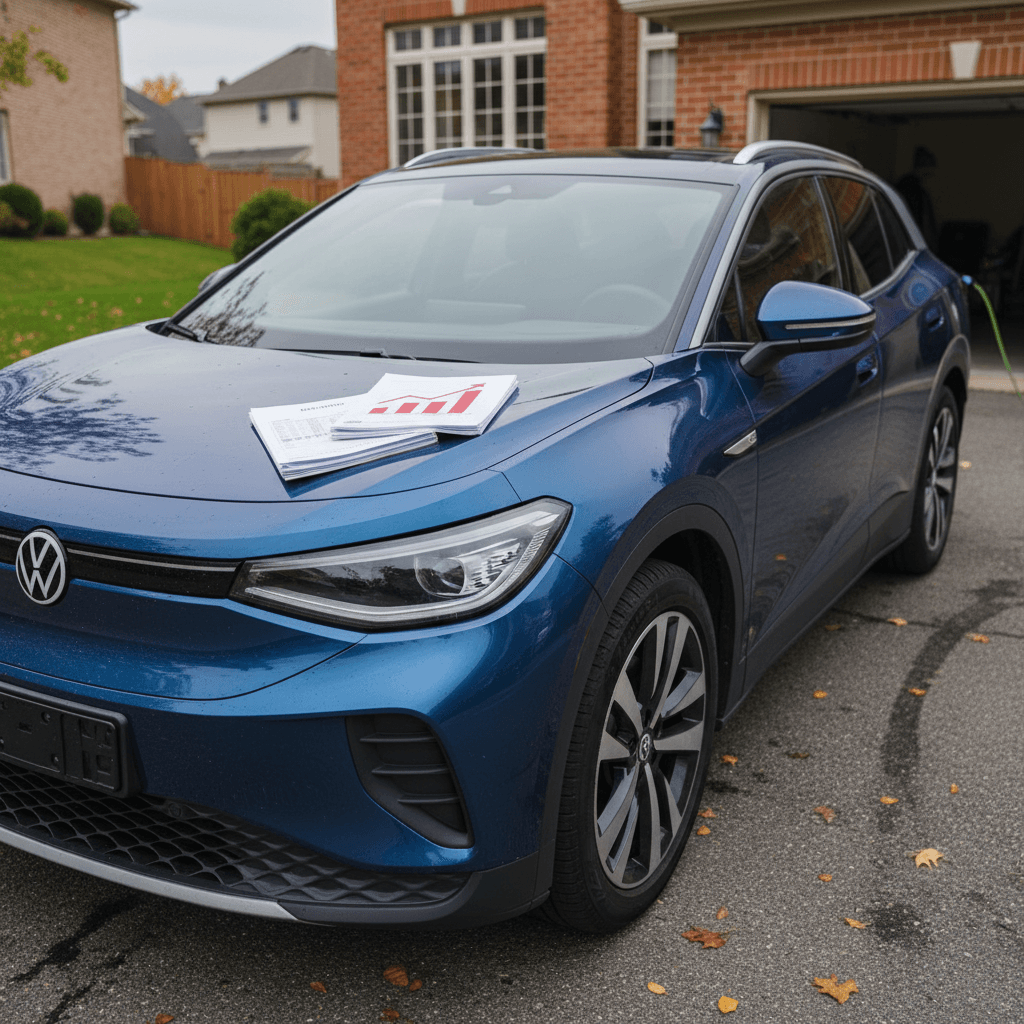
Estimated Volkswagen ID.4 insurance rates by age group
Insurers don’t publish official tables broken down by make, model, and age for every driver type, but you can use reasonable ranges to benchmark yourself. The table below assumes full‑coverage insurance (liability, collision, comprehensive) on a Volkswagen ID.4, good credit, and a clean record in a mid‑priced U.S. state. Your real‑world quote could be lower or higher, but the relative differences by age are what matter.
Illustrative Volkswagen ID.4 annual insurance costs by age
Approximate full‑coverage annual premiums for a Volkswagen ID.4 by age band. These are directional examples only, not offers from Recharged or any insurer.
| Driver age | Estimated annual premium | Monthly equivalent | Typical profile |
|---|---|---|---|
| 18–20 | $2,600–$3,400 | $215–$285 | Newly licensed or college‑age driver, short history, maybe on parents’ policy. |
| 21–24 | $2,200–$2,800 | $185–$235 | Still high‑risk in insurers’ eyes, but usually cheaper than teen years. |
| 25–29 | $1,800–$2,300 | $150–$190 | Rating improves as experience and credit history build. |
| 30–39 | $1,500–$2,000 | $125–$165 | Often the best balance of experience, stability, and lower claim frequency. |
| 40–54 | $1,400–$1,900 | $115–$160 | Commonly the lowest VW ID.4 insurance rates by age for many drivers. |
| 55–69 | $1,300–$1,800 | $110–$150 | Still favorable for many, sometimes with extra mature‑driver discounts. |
| 70+ | $1,500–$2,100 | $125–$175 | Rates can rise again as insurers factor slower reaction times and injury severity. |
Use these figures to compare age groups, not as guaranteed quotes.
State and city matter as much as age
Key factors that shape Volkswagen ID.4 insurance costs
Age is only one piece of an ID.4 insurance quote. Insurers also drill into how expensive the vehicle is to repair, how often it’s involved in certain types of claims, and how well it protects occupants. With an electric SUV, several details stand out.
Four big levers behind VW ID.4 premiums
These factors apply to any age group, but they can magnify or soften age-related pricing.
1. Repair and battery costs
EVs like the ID.4 have fewer moving parts than gas SUVs, but crash repairs can be pricey. Battery packs, sensors, and aluminum body panels drive up claim costs. Insurers build those averages into every quote.
2. Safety ratings and tech
The ID.4 scores well in crash tests and packs advanced safety tech like automatic emergency braking and lane‑keeping assist. For many carriers, those features lower claim frequency and help keep rates competitive for older drivers.
3. Where and how you drive
Annual mileage, commuting patterns, and ZIP code all matter. A 28‑year‑old ID.4 driver who commutes 5 miles of suburban roads may look safer than a 45‑year‑old doing 40 highway miles a day in heavy traffic.
4. Coverage choices and deductibles
Full coverage, high liability limits, and low deductibles protect you but cost more. Switching from a $500 to a $1,000 deductible on an ID.4 can noticeably cut premiums across most age bands.
Bundle EV‑friendly perks, not just price
How driving history and location interact with age
Two 30‑year‑old Volkswagen ID.4 drivers can see dramatically different quotes depending on what’s in their files. A clean record, stable address, and good credit can sometimes matter more than whether you’re 29 or 39.
Age plus driving history
- Teens with violations (speeding, at‑fault accidents) can see ID.4 insurance become nearly unaffordable. Some carriers will decline or require very high deductibles.
- Drivers in their 30s and 40s with DUIs or frequent claims can pay more than clean‑record 20‑somethings in the same vehicle.
- Going three to five years claim‑free often unlocks sizable discounts, especially after a rough patch earlier in your driving life.
Age plus location
- Urban, high‑traffic ZIP codes bring more fender‑benders, theft, and injury claims. Insurers bake that into ID.4 rates for every age group.
- Suburban and rural areas with lower claim frequency usually mean smoother pricing curves by age.
- Moving from a high‑cost city to a quieter suburb can sometimes drop your ID.4 premium more than turning a year older.
Don’t hide drivers on the policy
How to save on Volkswagen ID.4 insurance at every age
You can’t change your date of birth, but you have more control than you think over your VW ID.4 insurance bill. The levers differ slightly for young, middle‑aged, and older drivers, but the goal is the same: reduce your risk profile in the eyes of underwriters.
Practical steps to lower ID.4 insurance costs
1. Right‑size your coverage
Older ID.4s or vehicles financed for less than their market value may not need ultra‑low deductibles. Raising your collision or comprehensive deductible from $500 to $1,000 is one of the fastest ways to cut premiums for responsible drivers at any age.
2. Ask about EV and telematics discounts
Many insurers now offer <strong>EV ownership discounts</strong> or plug‑in hybrid incentives. Usage‑based programs that track driving via an app can reward gentle acceleration, light braking, and daytime driving, traits that often describe mature ID.4 owners.
3. Stack multi‑policy and multi‑car deals
Bundling your Volkswagen ID.4 with homeowner’s or renter’s insurance, or adding it as a second vehicle on a family policy, can soften the age penalty for younger drivers and sweeten savings for everyone else.
4. Shop around at renewal, not just once
Carriers constantly tweak how they price EVs and specific age bands. Re‑quoting your ID.4 every year or two, especially after a ticket falls off your record, can reveal a lower‑cost carrier that likes your age group more.
5. Lean on safety features
Make sure your insurer knows your ID.4 has automatic emergency braking, blind‑spot monitoring, and crash‑avoidance tech. Some rating systems don’t auto‑populate those features, and you could miss out on discounts.
6. For teens: driver training and good grades
If a younger driver uses the family ID.4, completing an approved driver‑education course and maintaining good grades can take a real bite out of high youth premiums in many states.
Pair insurance savings with your purchase decision
Why used Volkswagen ID.4 models can be cheaper to insure
For buyers looking at the total cost of owning a Volkswagen ID.4, used models often deliver an insurance advantage. As the vehicle ages and its market value drops, so does the maximum payout an insurer faces on collision and comprehensive claims. That typically translates into lower premiums, particularly for drivers in their 30s and beyond.
- A 3‑ to 5‑year‑old ID.4 generally costs less to repair relative to its insured value than a brand‑new one, helping keep full‑coverage costs in check.
- If you’re financing a used ID.4 with a smaller loan, you may be able to choose higher deductibles without putting yourself in financial danger.
- Used‑EV buyers are often more budget‑conscious and drive fewer miles. Insurers see those patterns in their data and sometimes price accordingly.
That’s one reason Recharged focuses on used electric vehicles. When you combine a lower purchase price, slower depreciation, and more manageable insurance, a used Volkswagen ID.4 can undercut the total cost of a comparable new gas SUV.
How the Recharged Score can support better insurance conversations
Every ID.4 sold on Recharged comes with a Recharged Score Report that includes verified battery health, odometer accuracy, and a transparent view of the vehicle’s condition. While insurers don’t yet plug that report directly into their rating systems, it gives you hard data you can reference when you shop for coverage.
What the Recharged Score tells you
- Battery health diagnostics show how much usable capacity remains, which can matter when deciding whether to carry certain coverage levels on an older ID.4.
- Usage and history indicators help you understand how the vehicle was driven, useful context if you’re a parent putting a young driver in the car.
- Fair market pricing keeps you from overpaying, which in turn makes it easier to handle insurance and financing costs.
How that helps during quoting
- You can accurately estimate replacement value when picking deductibles and limits.
- Clear condition documentation makes it easier to compare quotes across insurers using the same assumptions.
- Because Recharged vehicles are inspected and supported by EV specialists, you’re starting from a known baseline, something underwriters ultimately appreciate in their loss data.
Use your quote as a budgeting tool
Common Volkswagen ID.4 insurance questions
Volkswagen ID.4 insurance FAQs
Is a Volkswagen ID.4 a smart choice for your insurance budget?
When you zoom out, Volkswagen ID.4 insurance rates by age follow the same arc you see with most vehicles: costly in the teen and early‑20s years, more affordable through midlife, and potentially higher again later on. What makes the ID.4 compelling is that its strong safety scores, family‑friendly design, and maturing repair ecosystem are steadily improving how many carriers price this electric SUV.
If you’re a younger driver, focusing on training, clean driving, and a well‑priced used ID.4 can keep the numbers manageable. If you’re in your 30s, 40s, or 50s, shopping quotes and fine‑tuning your deductibles can make this EV’s insurance picture look very similar to a gas crossover, while you save on fuel and maintenance. And if you’re ready to compare real vehicles, Recharged combines fair pricing, verified battery health, and expert EV support so your insurance, financing, and ownership costs all stay aligned.