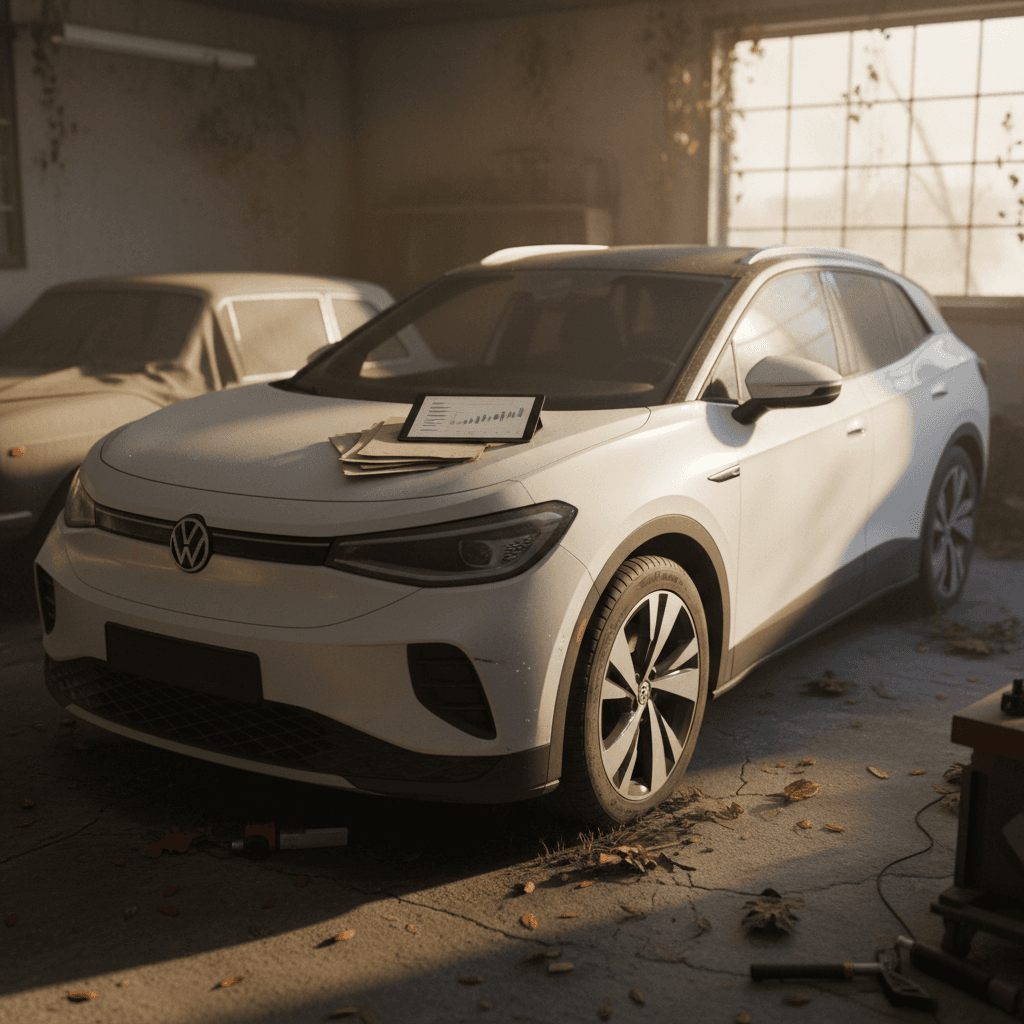
If you own a Volkswagen ID.4 or you’re shopping one used, the big money question for 2026 is simple: **what’s the ID.4 depreciation rate, and is it a smart buy**? With thousands of early ID.4s now coming off lease and hitting the used market, prices have shifted dramatically – and that can either cost you money or save you a lot, depending on which side of the deal you’re on.
Quick take: ID.4 depreciation in 2026
Overview: How the VW ID.4 Depreciates by 2026
Volkswagen ID.4 Depreciation Snapshot for 2026 (Typical Cases)
Those numbers are **typical real‑world patterns**, not guarantees. Local demand, incentives, and the condition of each individual vehicle still matter a lot. But they set the stage: the Volkswagen ID.4 drops quickly out of the gate, then its depreciation curve begins to flatten, much like other mainstream EV crossovers.
Depreciation is not one-size-fits-all
How Fast Does the Volkswagen ID.4 Depreciate?
To understand the **Volkswagen ID.4 depreciation rate in 2026**, it helps to separate two concepts: 1. **Nominal depreciation** – How much value the vehicle has lost versus its original MSRP. 2. **Market‑adjusted value** – What buyers are actually paying in a specific region, given incentives and EV supply‑and‑demand swings.
- In the **first 3 years**, the ID.4 typically loses around **40–55% of its MSRP**, especially on higher‑MSRP trims with big option packages.
- By **year 5**, many ID.4s will be tracking close to the broader EV trend of ~**55–60% total depreciation**, assuming average mileage and clean history.
- After that point, depreciation usually **slows**, and condition, battery health and repair history dominate the conversation.
In practical terms, that means a 2022 ID.4 that stickered around **$48,000** when new may realistically retail in the **low‑ to mid‑$20,000s by 2026**, while higher‑mile or base‑trim examples can dip into the high‑teens. A heavily optioned 2024 model with an MSRP in the low $50,000s might still sit in the **upper‑$20,000s to low‑$30,000s** as a 2‑year‑old used car, especially with low miles.
Volkswagen ID.4 Depreciation by Model Year (2021–2025)
Here’s a **big‑picture view** of how ID.4 values commonly look in early 2026 across key model years. These aren’t appraisal numbers – they’re directional ranges meant to help you sanity‑check asking prices or trade‑in offers. All examples assume typical equipment and mileage for the year.
Illustrative Volkswagen ID.4 Depreciation by Model Year in 2026
Approximate retail value ranges for typical ID.4 trims in early 2026 vs. original MSRP. Use this as a directional guide, not a quote.
| Model year | Typical original MSRP* | Age in 2026 | Illustrative 2026 retail range | Approx. depreciation |
|---|---|---|---|---|
| 2021 ID.4 Pro / Pro S | $42,000–$48,000 | 5 years | $17,000–$22,000 | ~55–65% lost |
| 2022 ID.4 (incl. more trims) | $43,000–$50,000 | 4 years | $18,000–$24,000 | ~50–60% lost |
| 2023 ID.4 | $43,000–$52,000 | 3 years | $22,000–$28,000 | ~40–50% lost |
| 2024 ID.4 | $44,000–$53,000 | 2 years | $25,000–$32,000 | ~35–45% lost |
| 2025 ID.4 | $45,000–$55,000 | 1 year | $34,000–$42,000 | ~20–30% lost |
Real offers will vary by region, trim, incentives, mileage, and battery health.
About the numbers

Lease Residuals vs. Real‑World Values in 2026
If you leased your ID.4, the **residual value** in your contract tells you what Volkswagen Credit assumed the SUV would be worth at the end of the term. For recent ID.4 leases, typical residuals for **36 months / 10,000–12,000 miles per year** have often landed in the **50–55% of MSRP** range, with higher residuals (mid‑to‑high‑50s) for 24‑month terms.
What your residual really represents
- It’s the **predicted future value** of the vehicle at lease signing.
- It affects your monthly payment: higher residuals = lower payments.
- It’s also your **lease buyout price** (plus fees and taxes) if you want to keep the car.
What often happens by 2026
- Fast EV depreciation + aggressive lease incentives can push **market prices below residuals**.
- Some lessees find that **buying out the lease costs more** than buying a similar ID.4 on the open market.
- In other cases – especially low‑mile, desirable trims – your **residual may actually be cheaper** than current retail pricing.
How to use your residual to your advantage
How the ID.4 Depreciation Rate Compares to Other EVs
The ID.4 doesn’t exist in a vacuum. To decide if its depreciation is “good” or “bad,” you need to stack it up against other compact and midsize EV crossovers like the Tesla Model Y, Hyundai IONIQ 5, Kia EV6, Ford Mustang Mach‑E, and Toyota bZ4X.
ID.4 vs. Other Electric SUVs: Depreciation Patterns
Where the Volkswagen ID.4 lands in the 2026 resale landscape
Tesla Model Y
Historically **one of the strongest resale performers** in the segment, especially for long‑range AWD trims. Price cuts on new Teslas have narrowed that advantage, but Model Y often still **holds value better than ID.4s** of the same age.
Hyundai IONIQ 5 & Kia EV6
These Korean EVs saw aggressive leasing and incentives, which pushed **used values down in 2024–2025**. In 2026, their depreciation curves often look **similar to or slightly steeper than the ID.4**, especially on high‑MSRP trims.
Ford Mustang Mach‑E & Toyota bZ4X
Mach‑E values softened as Ford chased volume and transitioned to new trims, and bZ4X depreciation has been pressured by early‑generation concerns. **Well‑equipped ID.4s often land in the same resale neighborhood** as comparable Mach‑E and bZ4X models.
Broadly speaking, the VW ID.4 sits in the **middle of the EV pack** on value retention. It doesn’t hold its price like a hot‑selling Model Y, but it usually outperforms some early‑generation or low‑demand EVs that have seen exceptionally heavy 5‑year depreciation.
Key Factors That Move Your ID.4’s Value Up or Down
Depreciation percentages tell only part of the story. In 2026, actual asking prices for ID.4s swing thousands of dollars based on a handful of predictable factors. Understanding these levers will help you either **pay less as a buyer** or **get more as a seller**.
7 Big Drivers of Volkswagen ID.4 Value in 2026
1. Model year & update cycle
Early‑build 2021 ID.4s with first‑generation software and hardware quirks typically sell for less than refreshed 2023–2025 examples. Shoppers will often pay a premium for later‑year software, improved infotainment, and additional driver‑assistance features.
2. Battery health and fast‑charging history
Because the battery is the most expensive component, **verified battery health** (via a professional diagnostic like the Recharged Score) can make a significant difference in price. Heavy DC fast‑charging and high mileage can nudge values down if capacity loss is measurable.
3. Mileage and usage pattern
An ID.4 averaging 8,000–10,000 miles per year will almost always be worth more than a similar one that has been driven 15,000+ miles per year. Urban stop‑and‑go duty, rideshare use, or commercial branding can also soften resale.
4. Trim level and options
Higher trims (Pro S, AWD, larger‑wheel packages, premium audio) start expensive and often **depreciate more in dollars**, but they can still bring stronger prices on the used market than stripped‑down base models. Poorly chosen options or unusual colors can hurt demand.
5. Local incentives and fuel prices
In 2026, state and local EV incentives, electricity rates, and gasoline prices continue to shape demand. Areas with strong EV adoption and higher gas costs usually support **better resale values** for ID.4s than regions where charging infrastructure or policy support lags.
6. Recalls, service history, and software updates
Documented recall repairs, software updates, and regular maintenance reassure buyers. A clean Carfax/AutoCheck, detailed service records, and proof of completed recalls can help your ID.4 stand out and justify a higher asking price.
7. Type of sale: trade‑in vs. private vs. marketplace
A dealer trade‑in often yields the **lowest number but the easiest transaction**. Private sales typically net more but require more work. Selling through a used‑EV specialist like Recharged can bridge the gap: **more transparent pricing than a traditional trade‑in with substantially less hassle than a DIY private sale.**
Where Recharged fits in
Ready to find your next EV?
Browse VehiclesBuying a Used Volkswagen ID.4 in 2026
Because the **Volkswagen ID.4 depreciation rate in 2026 is relatively steep in the first few years**, shoppers who come in after that initial drop can capture a lot of value. You’re often paying **roughly half of original MSRP for a 3‑ or 4‑year‑old ID.4**, while still getting a modern interior, a sizable battery, and full‑featured DC fast‑charging capability.
Best Used ID.4 Buys in 2026
Where depreciation starts working in your favor
2021–2022 Pro / Pro S, 30k–45k miles
These are the value leaders. Heavier early‑year depreciation means you often see **prices in the high‑teens to low‑$20k range** for clean examples. Prioritize:
- Strong battery‑health reading
- Completed software updates and recalls
- Documented maintenance history
2023–2024 with low miles
If budget allows, a 2–3‑year‑old ID.4 with **less than 25,000 miles** strikes a nice balance between cost savings and freshness. You’re often still under factory warranty and far from the end of the battery warranty, with **noticeably less wear and tear**.
Used VW ID.4 Buyer Checklist for 2026
1. Verify battery capacity and DC fast‑charge behavior
Ask for a **battery‑health report** rather than relying only on the dashboard range estimate. On a test drive, watch how the car charges at a DC fast charger: unusually low power or steep early taper might hint at issues.
2. Check recall completion and software level
ID.4s have seen a series of software and component updates. Confirm recalls are complete, and look for the latest software version in the infotainment system. Cars that are **behind on updates** may be cheaper, but factor the hassle into your offer.
3. Understand remaining warranty coverage
Most ID.4s carry an **8‑year / 100,000‑mile battery warranty** from original in‑service date. Ask the seller for documentation on when the car was first put into service so you know how much warranty runway remains in 2026.
4. Inspect tires, brakes, and suspension
EVs are heavy, and components like tires can wear faster than on a compact gas SUV. A car that **looks cheap but needs tires and brakes immediately** can quickly erase your savings.
5. Compare value against similar EVs
Before committing, compare pricing to alternatives like Model Y, IONIQ 5, EV6, and Mach‑E. Sometimes a **slightly higher price for a better‑equipped competitor** makes more long‑term sense.
6. Consider buying through an EV‑specialist marketplace
Used EVs are still new territory for many dealers. A marketplace like Recharged that focuses on EVs can help you compare **battery‑health scores, pricing, and financing** across multiple ID.4s without having to decode every listing yourself.
Selling or Trading In Your ID.4 in 2026
If you’re on the selling side, knowing how the **Volkswagen ID.4 depreciation rate in 2026** is playing out helps you avoid two mistakes: **holding out for yesterday’s prices** or **accepting the first lowball trade‑in offer** you hear.
1. Dealer trade‑in
Fast and convenient, but frequently the **lowest net value**. Dealers bake in auction risk, reconditioning costs, and profit margin. Trade‑ins can make sense if you’re upside‑down on a loan or want tax savings on a new‑car purchase, but don’t assume the first number is the only number.
2. Private sale or consignment
A well‑advertised private listing can bring **thousands more** than a trade‑in, especially for desirable trims with clean history. The trade‑off is time and hassle: photos, test‑drives, screening buyers, and paperwork. Consignment with a specialist like Recharged can offload that work while still exposing your ID.4 to a nationwide EV‑focused audience.
Know your walk‑away number
How to Protect Your ID.4’s Resale Value
You can’t stop time, and you can’t out‑run the used‑EV market. But you **can** make choices that keep your ID.4 closer to the top of its value range instead of the bottom. That’s especially important if you plan to sell in the next 2–4 years, when more lease returns will continue putting downward pressure on prices.
- Stay on top of **software updates and recalls** – buyers will pay more for a car that’s fully up to date.
- Avoid routinely charging to 100% and letting the car sit full or near‑empty; a **moderate state‑of‑charge habit** helps preserve battery health.
- Limit unnecessary high‑power fast charging when a slower Level 2 charge would do; it’s easier on the battery and your long‑term value.
- Keep a folder or digital file with **all service receipts, tire replacements, and charging‑equipment repairs**.
- Clean, fix, and detail the car before you sell – **cosmetics still matter**, even on an EV.
- Time your sale with **seasonal demand** in your area; in many states, spring and early summer bring stronger used‑EV interest.
Don’t ignore small warning lights
FAQ: Volkswagen ID.4 Depreciation Rate in 2026
Frequently Asked Questions About ID.4 Depreciation in 2026
Bottom Line: Is VW ID.4 Depreciation a Dealbreaker?
In 2026, the **Volkswagen ID.4 depreciation rate** is neither the hero nor the villain of the EV world. It depreciates faster than many comparable gas SUVs and a bit faster than the strongest EVs, but that very softness creates some of the **best used‑EV values on the market** for shoppers who do their homework. If you’re buying, use those drops to your advantage by insisting on proven battery health and fair‑market pricing. If you’re selling, focus on condition, documentation, and getting more than one offer so you’re not punished twice – once by normal depreciation and again by an under‑market bid.
Either way, the ID.4’s story in 2026 isn’t just about percentages on a chart. It’s about how you buy, maintain, and sell the vehicle. With transparent tools like the **Recharged Score Report**, EV‑savvy support, and nationwide delivery, you can let the depreciation curve work for you instead of against you – whether that means sliding into an affordable used ID.4 or extracting every last dollar from the one already in your driveway.