If you live in New York City in 2026, you don’t need a spreadsheet to know gas is expensive, you just have to look up at the glowing price signs over every corner station. The real question is whether EV charging costs in New York City are actually cheaper once you factor in rent, parking, and your daily grind through traffic. Let’s walk through the numbers like a New Yorker: fast, direct, and focused on what hits your wallet.
What this guide covers
Why NYC drivers are rethinking gas in 2026
New York City is tailor‑made for showing the difference between gas prices and EV charging cost. You’ve got short trips, brutal stop‑and‑go traffic, sky‑high parking rates, and a growing web of curbside chargers sprouting like street trees. At the same time, gasoline in the five boroughs usually sits well above the national average, and congestion means your MPG drops just when you need it most.
NYC 2026 fuel vs electricity snapshot (typical ranges)
Those numbers don’t mean much on their own. The meaningful comparison is cost per mile and monthly cost for the kind of driving you actually do, say, 600–800 miles a month of mixed city and outer‑borough use.
Gas prices in New York City 2026: what you’re paying today
NYC gas prices swing by neighborhood, what you see in Midtown Manhattan isn’t what you’ll pay along the Belt Parkway, but 2026 has settled into a familiar pattern: regular usually lives somewhere in the mid‑$3 to low‑$4 range at most city stations, with premium and luxury‑brand stations higher. That’s before you waste fuel circling for parking.
Typical NYC commuter in a compact gas car
- Car: 30 MPG combined (rated), often 20–25 MPG in NYC traffic.
- Miles/month: 700 (roughly 23 miles/day).
- Gas price: $3.90/gallon (representative NYC 2026 pump price).
At a real‑world 23 MPG in city traffic, that’s about 30 gallons/month, or around $117/month in fuel.
Crossover/SUV driver in the boroughs
- Car: 22 MPG combined rated, often 16–18 MPG in stop‑and‑go.
- Miles/month: 800 (city plus weekend trips).
- Gas price: $4.00/gallon at a convenient station.
At a realistic 17 MPG, that’s about 47 gallons/month, or roughly $188/month in fuel.
Gas stations charge for convenience
How EV charging is priced in New York City
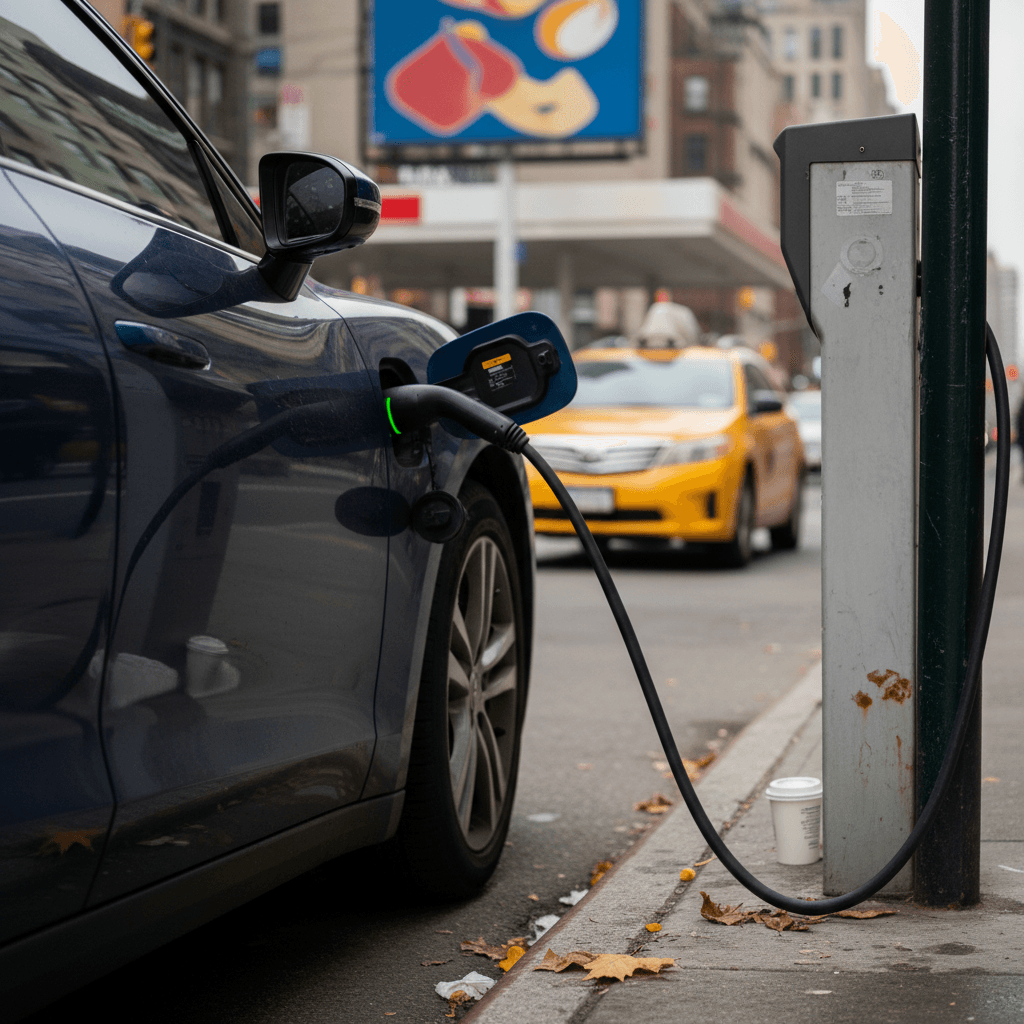
EV charging in NYC breaks down into three buckets: home charging (if you’re lucky enough to have it), public Level 2 in garages or on the street, and DC fast charging along highways and major corridors. Each has its own price structure and sweet spot.
The three ways most New Yorkers charge
Think in terms of how often you’ll realistically use each one.
Home charging
Best case is a driveway or garage with a 240V outlet or wallbox. You pay your residential rate (often $0.22–$0.30/kWh effective in 2026), and you decide when to plug in.
If you can charge at home even a few nights a week, your average cost per mile drops sharply.
Public Level 2
Curbside, municipal lots, employers, and garages. Pricing is usually per kWh (often $0.40–$0.55) plus, occasionally, a time‑based fee after a grace period.
Slower than DC fast, but much cheaper and kinder to your battery.
DC fast charging
Think road trips or emergency top‑ups. In NYC, expect roughly $0.45–$0.70/kWh, with higher demand sites at the upper end.
Great when you’re in a hurry, but too expensive to rely on 100% of the time.
Watch effective kWh cost, not just posted rates
Real-world cost per mile: gas vs EV in NYC
Let’s turn those prices into cost per mile using a realistic NYC commute, short trips, lots of idling, cold mornings in February, and the A/C blasting in August. We’ll use city‑friendly vehicles you actually see on the FDR or the BQE: a compact gas sedan, a small SUV, and a mainstream EV.
Gas vs EV cost per mile in New York City (2026 examples)
Approximate 2026 cost-per-mile using realistic NYC driving conditions.
| Vehicle type & use case | Energy efficiency (real NYC) | Energy price assumption | Estimated cost per mile |
|---|---|---|---|
| Compact gas car (city mix) | 23 MPG | $3.90/gal | ≈ $0.17/mile |
| Small gas SUV (boroughs + city) | 17 MPG | $4.00/gal | ≈ $0.24/mile |
| EV with mostly home charging | 3.0 mi/kWh | $0.25/kWh home effective | ≈ $0.08/mile |
| EV using mostly public Level 2 | 3.0 mi/kWh | $0.48/kWh average | ≈ $0.16/mile |
| EV relying heavily on DC fast | 2.7 mi/kWh | $0.60/kWh fast charging | ≈ $0.22/mile |
Assumes 700–800 miles per month of mostly city driving, with conservative real‑world efficiency numbers rather than optimistic EPA ratings.
Look at those last three lines. If you can charge mostly at home, your cost per mile can be less than half of a compact gas car and roughly a third of a thirsty SUV. Depend on public Level 2 and the cost per mile looks a lot like a compact gas car, still better than many SUVs, but not a slam dunk. Live on DC fast charging alone, and you’re paying gas‑like prices for energy, while putting more stress on the battery.
The fast-charging trap
Where you live matters: brownstone vs high-rise vs outer borough
Two New Yorkers can own the same EV and see completely different monthly fuel costs. The difference isn’t the car, it’s their building, parking situation, and routine. Here’s how the math shifts across three common scenarios.
Brownstone or small multi‑family with driveway
Setup: 240V outlet or wallbox in a shared driveway or backyard space.
- Can charge overnight 3–5 nights a week.
- Pays residential electricity rates.
- Uses public Level 2 or DC fast only on busy weeks or trips.
Result: Cost per mile close to the “home charging” line in the table, often half the cost of gas.
High‑rise renter in Manhattan
Setup: Monthly garage without charging, occasional use of building chargers or public stations.
- Relies on public Level 2 downstairs or in nearby garages.
- May pay a premium per kWh plus parking fees.
- Leans on fast charging for weekend getaways.
Result: Energy costs land between “public Level 2” and “fast‑charge heavy.” Still often cheaper than a thirsty SUV, but not always cheaper than a frugal gas compact.
Outer‑borough family with driveway or garage
Setup: Private driveway/garage, 240V outlet, mix of local driving and regional trips.
- Almost all charging happens at home.
- Uses DC fast only on long trips or rare busy weeks.
- Can shop electric plans and manage charging time.
Result: Big monthly savings vs gas, especially compared to a family SUV or minivan.
Your ZIP code shapes your savings
Time vs money: fast charging, homes without driveways, and your schedule
In New York City, your most precious asset isn’t your car, it’s your time. That’s why many drivers instinctively lean on DC fast charging: plug in, grab a coffee, and you’re back on the road in 30–45 minutes. The catch is that speed has a price, and over a year it adds up.
When fast charging makes sense
- Occasional road trips: You’re heading upstate or down the coast, fast charging is worth every penny.
- Crisis weeks: Extra miles, late work nights, visitors in town, paying more for a couple of sessions won’t kill the budget.
- No practical alternative: Your building has no charging and your schedule won’t allow regular Level 2 stops.
In these cases, think of fast charging the way you think of using a taxi over the subway, more expensive, but justified when time matters most.
When to slow down and save
- Predictable weekday rhythm: If you know your routine, even a single weeknight Level 2 session can replace a lot of fast‑charge use.
- Employer or school chargers: Workplace Level 2 can quietly become your “free or cheap gas station.”
- Garage with Level 2: Many buildings now offer slower chargers at better rates than nearby DC fast chargers.
If you can switch even half your energy from DC fast to Level 2 or home charging, your annual savings can jump dramatically.
Pro move: treat fast charging like highway tolls
Beyond fuel: insurance, maintenance, and parking
When you compare gas prices vs EV charging cost in New York City, it’s tempting to stop at the fuel line. But this is New York. Parking, maintenance, and even insurance can move the needle more than a few cents per kWh.
Costs that hide behind the pump or plug
Fuel is only one line in your NYC car budget.
Insurance
Some insurers now rate EVs comparably to gas cars in mainstream segments, but premiums can still vary by model and repair costs.
Ask for quotes on specific EVs you’re considering, don’t assume they’re automatically more expensive to insure.
Maintenance
EVs skip oil changes, exhaust repairs, and many transmission issues. Brakes often last longer thanks to regenerative braking.
Over several years, that can offset months of charging costs, especially if you currently own an older, repair‑prone gas car.
Parking & access
Some NYC garages now reserve charged spots or offer discounted EV parking packages, while others simply add a fee on top of charging.
In a few neighborhoods, EV‑only curb spots can make parking easier, an underrated perk.
“In a dense city, the most expensive thing about car ownership isn’t always the fuel. It’s every other line item that quietly stacks up around it.”
How a used EV changes the math, and where Recharged fits in
New EVs are still pricey, especially if you’re already stretching for New York rent. That’s where used EVs come into their own. You can capture the lower running costs of electric, especially if you have home or reliable Level 2 access, without taking the full brunt of new‑car pricing and depreciation.
Why the right used EV is a sweet spot in NYC
- Lower monthly payment: A used EV often costs less per month than a similarly equipped new gas car.
- City range is forgiving: Even if a used EV has some battery wear, New York’s shorter daily trips mean you rarely need the full original range.
- Electric torque in traffic: Instant response makes merging and short gaps less stressful.
The key is knowing what you’re getting, particularly when it comes to battery health and realistic range after a few NYC winters.
How Recharged helps stack the deck in your favor
- Recharged Score Report: Every vehicle comes with verified battery health and a transparent view of how that affects usable range and value.
- Fair market pricing: Listings are grounded in real‑world data so you’re not guessing whether that used EV is overpriced.
- EV specialist support: You can talk through your charging situation, driveway, garage, curbside, and get guidance on whether a particular car fits your NYC life.
- Fully digital, with local support: Shop online, arrange nationwide delivery, or visit the Recharged Experience Center in Richmond, VA if you want to see EVs in person.
Use the Recharged Score like a New Yorker uses Yelp
Checklist: can an EV save you money in New York City?
Quick decision checklist for NYC drivers
1. Do you have, or can you get, reliable Level 2 charging?
If you have a driveway, garage, or building spot where adding a 240V charger is feasible, your odds of beating gas on cost are excellent. Without that, look honestly at your access to curbside or workplace Level 2.
2. How many miles do you actually drive each month?
If you’re under ~400 miles a month, fuel savings will be modest regardless of powertrain. Over 600–800 miles, the EV advantage grows quickly, especially in traffic‑heavy neighborhoods.
3. Are you currently driving a thirsty SUV or an efficient compact?
Swapping a 17‑MPG SUV for an EV is a very different equation than swapping a 35‑MPG compact. The worse your current MPG, the more appealing EV energy costs look.
4. What’s your parking reality?
If you’re in a monthly garage that offers bundled EV charging at reasonable rates, you’re in great shape. If all you have is street parking and sporadic access to fast chargers, run the numbers carefully.
5. Can you flex your schedule for cheaper charging?
If you can plug in during off‑peak hours at home or use Level 2 while you’re at work or shopping, you can lower your effective cost per kWh compared with “charge only when I’m in a rush.”
6. Have you compared total monthly cost, not just fuel?
Use a simple spreadsheet or calculator that includes payment, insurance, parking, fuel/charging, and maintenance. A slightly higher car payment can be offset by lower running costs, especially if you’re coming from an older, repair‑heavy gas car.
FAQ: gas prices vs EV charging cost in New York City (2026)
Frequently asked questions for NYC drivers
Bottom line: should you go electric in NYC in 2026?
In 2026 New York City, there’s no one‑size‑fits‑all answer. If you have a driveway, garage, or predictable access to affordable Level 2 charging, an EV can slice your fuel spend in half compared with a typical SUV and still undercut many compact gas cars, while trimming maintenance and giving you that silent glide up the West Side Highway. If you’re locked into street parking with only sporadic fast‑charge options, the math gets tighter and convenience may matter more than pennies per mile.
What you can control is the car you choose and how clearly you see the costs before you buy. That’s where a well‑chosen used EV with verified battery health, and a partner like Recharged to help you navigate pricing, financing, trade‑ins, and delivery, can make the jump from gas to electric feel less like a gamble and more like a smart New Yorker’s move. Run your own numbers, be honest about how and where you’ll charge, and you’ll know whether it’s time to plug in.