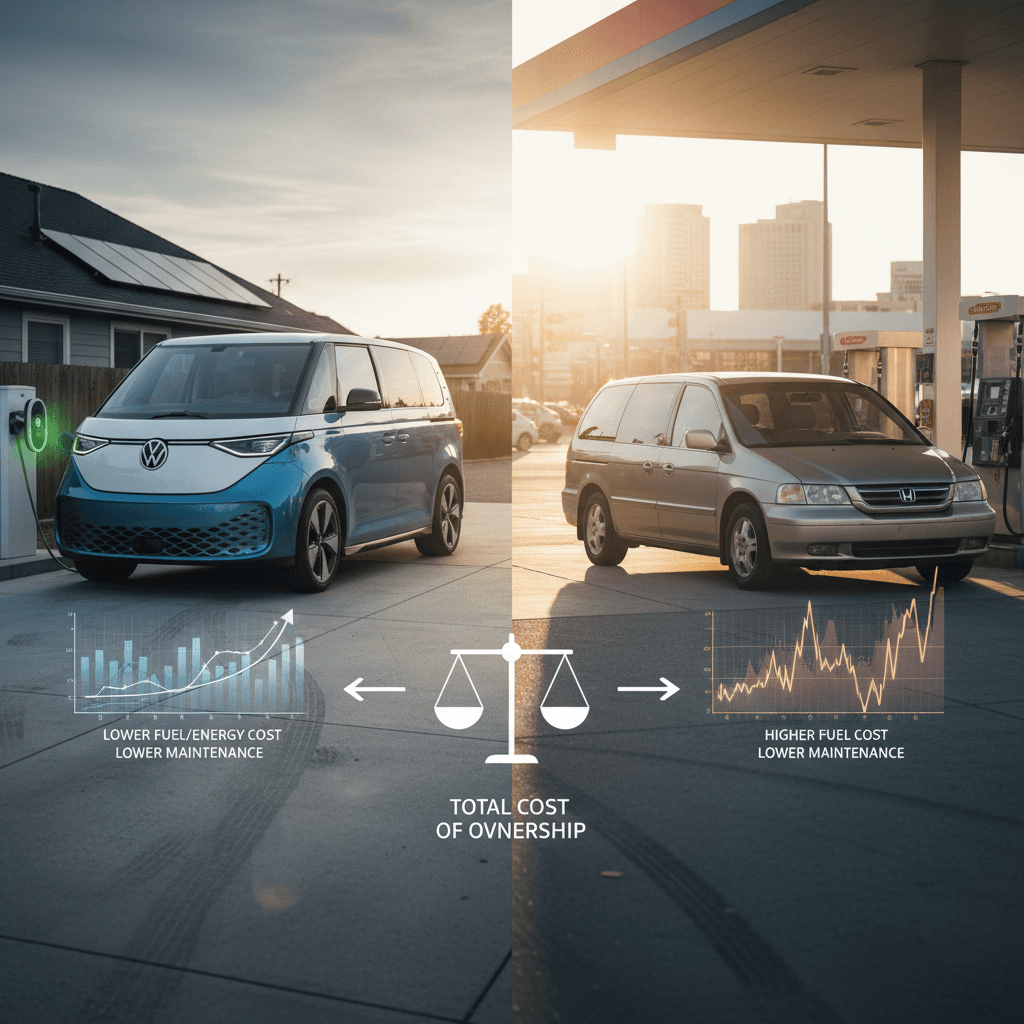
If you’re cross‑shopping the retro‑cool Volkswagen ID. Buzz against a traditional gas minivan like a Toyota Sienna, Honda Odyssey, or Chrysler Pacifica, the big question isn’t just “Which is cooler?”, it’s “What will I really pay over 5–10 years?” This guide walks through the total cost of ownership for a VW ID. Buzz vs a comparable gas minivan so you can see where the EV saves you money, where it doesn’t, and how your own driving pattern changes the answer.
A quick note on data and dates

Why compare the ID. Buzz to a gas minivan?
Volkswagen positions the ID. Buzz as a modern, all‑electric rethink of the classic Microbus, practical enough to replace a family minivan while doubling as a lifestyle road‑trip machine. The obvious gas equivalents in the U.S. are three‑row vans like the Toyota Sienna, Honda Odyssey, and Chrysler Pacifica.
- Similar footprint and interior space (three rows, family‑first packaging)
- Used by the same kinds of owners: families, dog people, road‑trippers, small‑business shuttles
- Real choice between paying more upfront for an EV vs. lower sticker price and higher fuel and maintenance for gas
The twist is that the ID. Buzz launched in the U.S. at a premium price point compared with mainstream minivans. So you’re trading higher monthly payments for potentially lower running costs. To evaluate that trade, we need to be explicit about the assumptions.
Key assumptions for this cost comparison
You can’t talk about Volkswagen ID. Buzz total cost vs gas car equivalent without making some clear, consistent assumptions. Here’s the baseline scenario used for the numbers in this article:
Our baseline 5‑year ownership scenario
Vehicle choice
New 2025 Volkswagen ID. Buzz Pro S vs a well‑equipped 2025 Toyota Sienna XLE (or similar Odyssey/Pacifica trim). Both purchased, not leased.
Ownership length & miles
5 years, 15,000 miles per year (75,000 miles total) – a common pattern for family road‑trip and commuting duty.
Energy prices
Gasoline at $3.75 per gallon (national-ish blended average over the next few years) and home electricity at $0.17 per kWh (close to recent U.S. residential averages).
Driving mix
70% suburban/highway, 30% city. Typical for American families who mix school runs, errands, and regional trips.
Financing
10% down, 60‑month loan at 6.0% APR. Your rate may be better or worse depending on credit and incentives.
Perspective
We focus on out‑of‑pocket costs: purchase, fuel/electricity, maintenance, and typical depreciation. Taxes and insurance are briefly discussed but not modeled in full detail.
Your numbers will vary
Sticker price, incentives, and financing
Let’s start with the painful part: what you write the biggest check for. In the U.S., a 2025 Volkswagen ID. Buzz Pro S starts in the low $60,000s before destination. Well‑equipped gas minivans typically transact in the mid‑$40,000s.
Approximate purchase prices: ID. Buzz vs gas minivan
Representative U.S. transaction prices for well‑equipped trims in 2025 dollars.
| Model | Trim example | Approx. MSRP / street price | Drivetrain |
|---|---|---|---|
| Volkswagen ID. Buzz | Pro S | $62,000 | Electric |
| Toyota Sienna | XLE FWD | $45,000 | Hybrid gas |
| Honda Odyssey | EX‑L | $43,000 | Gas |
| Chrysler Pacifica | Touring L | $44,000 | Gas (non‑hybrid) |
These are ballpark numbers meant for comparison, not official price quotes.
In other words, you’re looking at roughly a $17,000–$20,000 higher purchase price for the ID. Buzz vs a mainstream gas minivan at similar equipment levels.
What about tax credits?
Monthly payment impact
On a simple 60‑month loan at 6.0% APR with 10% down, that $17,000 price gap works out to roughly $320–$340 more per month for the ID. Buzz compared with a $45K gas minivan.
Even if you qualify for a partial incentive or negotiate a great deal, expect the EV van to cost you a few hundred dollars more every month in financing alone.
Where Recharged fits in
If you’re open to a used ID. Buzz or used minivan, buying through Recharged can shrink this gap substantially. Our financing tools let you pre‑qualify online and compare payments, and every used EV comes with a Recharged Score so you see verified battery health before you commit.
Energy costs: electricity vs gasoline
The core advantage of the ID. Buzz is cheaper energy. But because it’s a big, blunt van, it’s not as thrifty as a compact EV. We’ll use realistic, not best‑case, efficiency numbers.
Realistic efficiency assumptions
Energy cost per mile
Electricity vs gasoline: cost per mile
Using $0.17/kWh home electricity and $3.75/gal gasoline.
| Vehicle | Energy use | Unit price | Cost per mile |
|---|---|---|---|
| VW ID. Buzz | 2.7 miles per kWh | $0.17 per kWh | ≈ $0.063 |
| Hybrid Sienna‑type minivan | 35 miles per gallon | $3.75 per gallon | ≈ $0.107 |
Public fast charging can be much more expensive than home charging; we’ll account for that separately.
On home charging, the ID. Buzz costs roughly 6.3 cents per mile vs 10.7 cents per mile for a hybrid minivan at $3.75 gas. That’s a savings of about 4.4 cents per mile in this scenario.
Annual and 5‑year fuel/energy spend
Annual and 5‑year fuel or electricity costs
15,000 miles per year, assuming 80% of ID. Buzz charging is at home rates and 20% at pricier public fast chargers.
| Vehicle | Annual energy cost | 5‑year energy cost |
|---|---|---|
| VW ID. Buzz | ≈ $1,125 | ≈ $5,625 |
| Hybrid minivan | ≈ $1,605 | ≈ $8,025 |
Public fast charging is modeled at roughly double home rates, averaged into the ID. Buzz cost numbers.
Under these assumptions, the ID. Buzz saves you roughly $480 per year, or about $2,400 over 5 years, on fuel/energy compared with a frugal hybrid minivan. Against a non‑hybrid Odyssey or Pacifica that averages closer to 23–25 MPG, the gap widens; you could be saving well over $1,000 per year on fuel.
How to tilt the math in the Buzz’s favor
Maintenance and repairs: where EVs usually win
EVs eliminate oil changes, exhaust systems, and complex multi‑gear automatic transmissions. Large vans like the ID. Buzz still wear through tires and brakes, but overall maintenance spend tends to be lower than for similarly‑sized gas vehicles.
ID. Buzz typical maintenance
- No oil changes or transmission services
- Regenerative braking cuts rotor and pad wear, especially in city driving
- Fewer moving parts (no timing belt, spark plugs, etc.)
- Software updates can fix issues without shop visits
Gas minivan typical maintenance
- Regular oil and filter changes
- Transmission fluid services, possibly repairs down the line
- More complex cooling and emissions systems
- Exhaust and fuel system components that can fail with age
Ballpark 5‑year maintenance & repair costs
Out‑of‑warranty and wear‑item maintenance, not counting tires (similar for both).
| Vehicle | Annual maintenance estimate | 5‑year estimate |
|---|---|---|
| VW ID. Buzz | $500–$600 | $2,500–$3,000 |
| Gas/hybrid minivan | $900–$1,100 | $4,500–$5,500 |
Real‑world costs depend heavily on how and where you drive, and whether you use dealers or independents.
A conservative rule of thumb is that the ID. Buzz could save you about $2,000 over 5 years in routine maintenance and light repairs versus a comparable gas van. You still have big‑ticket items like tires and the possibility of out‑of‑warranty electronics faults, but the basic service cadence is simpler and cheaper.
Don’t ignore out‑of‑warranty risks
Depreciation and resale value
Depreciation is the hardest part of any Volkswagen ID. Buzz total cost vs gas car equivalent comparison because it’s driven by market psychology as much as engineering. The Buzz is a niche, high‑image vehicle; that can cut both ways.
- Early‑adopter EV vans often have steeper initial depreciation as incentives, lease deals, and newer versions appear.
- Mainstream minivans are boring but predictable; they tend to hold value decently, especially reliable nameplates like the Sienna and Odyssey.
- The ID. Buzz’s cool factor could support values in the long term, but import supply constraints or future incentives could also undercut used prices.
Illustrative 5‑year depreciation comparison
Very rough estimates based on segment behavior, not a price guide.
| Vehicle | Purchase price | Estimated 5‑year resale | 5‑year depreciation |
|---|---|---|---|
| VW ID. Buzz | $62,000 | $28,000–$32,000 | $30,000–$34,000 |
| Gas/hybrid minivan | $45,000 | $20,000–$24,000 | $21,000–$25,000 |
Actual resale values will depend on mileage, condition, market incentives, and where the EV and minivan cycle sit in 5 years.
In dollar terms, you might see the ID. Buzz lose roughly $8,000–$10,000 more value over five years than a gas minivan, simply because you started higher on the curve. As a percentage of purchase price, depreciation looks similar; as an absolute number, the EV van costs you more.
Where buying used helps
5‑year total cost of ownership: ID. Buzz vs gas minivan
Now let’s put the main pieces together for our 5‑year, 75,000‑mile scenario. These numbers assume purchase new in 2025, mostly home charging for the ID. Buzz, and a relatively efficient hybrid minivan as the gas benchmark.
5‑year total cost of ownership snapshot
Rounded to the nearest thousand dollars for clarity.
| Category | VW ID. Buzz (new) | Gas/hybrid minivan (new) |
|---|---|---|
| Purchase price (incl. fees) | $62,000 | $45,000 |
| 5‑year fuel/energy | $5,600 | $8,000 |
| 5‑year maintenance/repairs | $3,000 | $5,000 |
| 5‑year depreciation (est.) | $32,000 | $23,000 |
| Approx. 5‑year total | ≈ $102,600 | ≈ $81,000 |
Insurance and taxes are excluded here because they vary widely by driver and state, but we discuss them just below.
Even after factoring in lower fuel and maintenance, our baseline scenario shows the ID. Buzz costing roughly $20,000 more over 5 years than a similarly equipped gas or hybrid minivan bought new. More than half of that difference is simply driven by the higher purchase price and the larger absolute amount of depreciation attached to that price.
What about insurance?
New EVs, especially higher‑priced ones, often carry higher insurance premiums than mainstream gas minivans because of repair costs and parts pricing. That could add a few hundred dollars per year to the ID. Buzz side of the ledger.
Registration and taxes
Some states add EV‑specific registration fees; others offer property‑tax breaks or HOV perks. Over a 5‑year horizon, these effects are usually small compared with purchase and fuel, but they can nudge the comparison slightly one way or the other.
Charging practicalities and home upgrades
Total cost isn’t just a spreadsheet exercise, you also have to live with the vehicle. To get the best economics from an ID. Buzz, you’ll want reliable Level 2 charging at home, not just public DC fast charging.
Charging options and cost implications
How you plug in materially changes your cost per mile.
Existing 240V outlet
If you already have a 240V circuit in your garage (for a dryer or welder), you may only need a portable Level 2 charger. Hardware often runs $300–$700.
New home charger install
Adding a dedicated 240V circuit and wallbox can cost anywhere from $800 to $2,000+ installed, depending on panel capacity and distance.
Relying on public fast charging
If most of your charging is at highway DC fast chargers, your electricity cost per mile can double. That erodes or wipes out the ID. Buzz’s fuel‑cost advantage over a hybrid minivan.
Budget for home charging up front
Who actually saves money with an ID. Buzz?
So in the simple new‑vs‑new scenario, the ID. Buzz costs more overall. But there are realistic situations where it can be the smarter financial play, or at least come close enough that you’re basically paying a modest “fun tax” for the design and driving experience.
- High‑mileage drivers: If you’re doing 25,000+ miles per year, electricity savings compound quickly. Over 5 years you could save well into the five figures on energy vs a thirsty gas minivan.
- Owners with very high local fuel prices: In parts of California or the Northeast where gas regularly sits well above our $3.75 assumption, the hybrid’s fuel bill balloons while home electricity might not rise as much.
- Owners with cheap or free charging: If your workplace offers free Level 2 charging or you have very low off‑peak rates, your cost per mile in the ID. Buzz can fall to just a few cents.
- Buyers of used ID. Buzz vans: Once the first owner eats the initial depreciation, your purchase‑price gap vs a used minivan shrinks dramatically. Combined with lower fuel and maintenance, the math can flip.
Run your own scenario
How buying used changes the math
Where the Volkswagen ID. Buzz vs gas minivan comparison gets truly interesting is in the used market, Recharged’s home turf.
Used ID. Buzz example
Imagine a 3‑year‑old ID. Buzz that originally stickered for $62,000 now selling for around $38,000 with 30,000 miles. Most of the steep early depreciation is already gone, but the battery still has plenty of life.
Used gas minivan example
Now compare that to a similar‑age Sienna or Odyssey at maybe $28,000 with similar mileage. The upfront gap is now closer to $10,000 instead of $17,000–$20,000.
Now re‑run our 5‑year, 75,000‑mile ownership span but starting used instead of new:
Illustrative 5‑year TCO, buying used at 3 years old
Very rough numbers for directional comparison only.
| Category | Used ID. Buzz | Used gas minivan |
|---|---|---|
| Purchase price | $38,000 | $28,000 |
| 5‑year fuel/energy | $5,600 | $8,000 |
| 5‑year maintenance/repairs | $3,500 | $6,000 |
| 5‑year depreciation (resale at 8 years) | ≈ $18,000 | ≈ $14,000 |
| Approx. 5‑year total | ≈ $65,100 | ≈ $56,000 |
Both vehicles are owned from age 3 to age 8, driven 75,000 miles in that time.
In this used‑vehicle scenario, the ID. Buzz still comes out more expensive overall, but the gap shrinks to under $10,000 over 5 years. For some buyers, especially those who value the EV driving experience, quieter cabin, and unique design, that’s a premium they’re comfortable paying.
How Recharged reduces the risk
Ready to find your next EV?
Browse VehiclesFAQ: Volkswagen ID. Buzz total cost vs gas car equivalent
Common questions about ID. Buzz vs gas minivan costs
Bottom line: is the ID. Buzz worth it over a gas minivan?
If you only care about minimizing 5‑year total cost, a conventional gas or hybrid minivan still wins for most U.S. buyers today. The Volkswagen ID. Buzz’s higher purchase price and depreciation usually outweigh its fuel and maintenance savings in a typical 15,000‑mile‑per‑year, new‑vehicle scenario.
But total cost isn’t the only lens that matters. The ID. Buzz delivers a quieter, smoother drive, distinctive design, zero tailpipe emissions, and the ability to fuel at home for a fraction of the cost of gasoline. For high‑mileage drivers, owners with cheap or workplace charging, or shoppers considering a used ID. Buzz, the economic gap narrows enough that you’re no longer paying a huge premium for that experience.
If you’re ready to run the numbers on a real vehicle rather than a hypothetical, Recharged can help you compare used ID. Buzz vans and used gas minivans side‑by‑side, complete with battery‑health data, fair‑market pricing, and financing options, all online. That way, your decision isn’t based on guesses or hype, but on the specific vans and dollars in front of you.