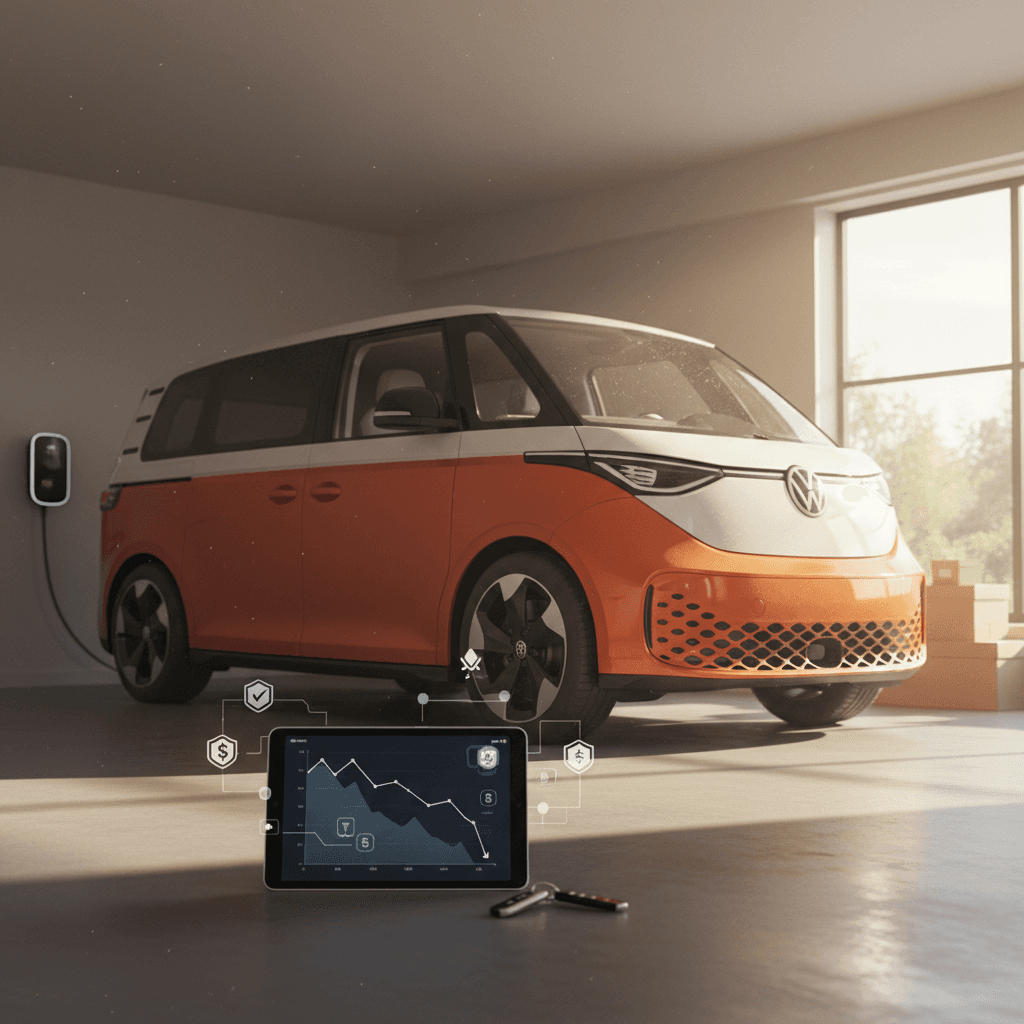
If you’re shopping for a Volkswagen ID. Buzz, you’re probably already doing the math on charging costs, road trips, and resale value. Insurance is the quiet line item that can make or break total ownership cost, and for an electric van like the ID. Buzz, premiums can surprise you. The good news: with a little strategy, you can get close to the cheapest ID. Buzz insurance available for your situation without cutting corners on protection.
Quick take
Why ID. Buzz insurance is its own animal
Insuring a Volkswagen ID. Buzz isn’t quite like insuring a traditional minivan, or even a compact EV. You’re dealing with three things at once: a relatively new model, a large people mover, and a modern battery-electric drivetrain. Insurers hate uncertainty, and new EV nameplates are nothing but uncertainty at first: they don’t have decades of loss data, aftermarket parts are thin on the ground, and battery repair procedures are still evolving.
What sets ID. Buzz insurance apart
Three dynamics that push premiums up, and one that helps pull them down
High-value battery pack
Big, versatile cabin
Advanced safety tech
EV insurance reality check
How much does Volkswagen ID. Buzz insurance cost?
Because the ID. Buzz is still ramping up in the U.S., public data is thinner than for high-volume EVs. But we can triangulate from a few sources: published Volkswagen insurance averages, early ID. Buzz quotes reported by owners, and broader EV insurance trends.
ID. Buzz insurance: ballpark numbers for 2026
Why there’s no single “cheapest number”
What makes ID. Buzz insurance more expensive or cheaper
To get the cheapest Volkswagen ID. Buzz insurance you realistically qualify for, you need to understand what insurers actually care about. Some are obvious, tickets, DUIs, claims. Others are more specific to EVs and the ID. Buzz itself.
Key factors that move ID. Buzz insurance up or down
Not every factor is under your control, but knowing which dials exist helps you focus on the ones you can turn.
| Factor | Pushes premiums UP | Pushes premiums DOWN |
|---|---|---|
| Driver profile | Recent at-fault accidents, speeding tickets, DUIs, young or very new drivers | Clean record, 35+ age bracket, multiple years of continuous insurance |
| Location | High-theft urban ZIPs, dense traffic, expensive medical care markets | Suburban or rural garaging, low theft and claim rates |
| Usage | High annual mileage, commercial or rideshare use, frequent road trips | Low annual mileage, mostly local commuting, stored in garage |
| Vehicle value & trim | New, high-MSRP trims with big wheels and options | Older, depreciated ID. Buzz or lower-priced trim |
| Battery & repair costs | Limited local EV repair capacity; expensive battery diagnostics and replacement | Strong VW repair network nearby, improving parts availability, lower average claim severity over time |
| Safety & driver assist | Disabled safety systems, worn tires, no telematics data | Active IQ.DRIVE features, good crash ratings, telematics or driver-score programs |
| Coverage & deductibles | Low deductibles ($250), rich optional coverages, low liability limits forcing high-risk pool | Higher deductibles ($500–$1,000), smart but not excessive add-ons, strong liability limits with clean record |
| Credit/insurance score (where allowed) | Poor credit tier or sparse credit file | Good-to-excellent credit and stable policy history |
Think of this as the ID. Buzz insurance control board: the more green boxes you stack on the right side, the closer you’ll get to the cheapest rates available to you.
Insurer-specific sweet spots
11 strategies to get the cheapest insurance on a Volkswagen ID. Buzz
You can’t change that the ID. Buzz is a large, high-tech EV. But you can change how risky you look on paper, which coverages you select, and which carriers you invite to quote you. Here are 11 practical ways to push your ID. Buzz premiums toward the bottom of your personal range.
Your ID. Buzz cheapest-insurance playbook
1. Start with at least three EV-friendly insurers
Don’t just auto-renew with your current company. Get quotes from at least three carriers that explicitly price EVs competitively in your state. Some offer green-vehicle discounts or specific EV programs, those can easily shave 5–10% off.
2. Adjust deductibles strategically
Raising your comprehensive and collision deductibles from $500 to $1,000 can cut full-coverage EV premiums by roughly $15–$40 per month in many markets. Only do this if you actually have that amount in emergency savings.
3. Right-size liability, then trim elsewhere
Liability (injuries and property damage you cause others) is where under-insuring hurts the most. Aim for at least 100/300/50 limits, then look at reducing non-essential extras, like roadside or rental, if you already get them from a credit card or EV membership.
4. Take advantage of low-mileage potential
If your ID. Buzz will be a second car or local family hauler, ask about low-mileage or usage-based programs. Telematics that track smooth braking, nighttime driving, and total miles driven can unlock big discounts for careful, low-mileage drivers.
5. Stack all possible discounts
Bundle home or renters, add multiple vehicles, complete a defensive driving course, and enable autopay and e-docs. None of these moves is glamorous, but together they can knock hundreds of dollars a year off your ID. Buzz coverage.
6. Lean into the safety story
The ID. Buzz’s strong crash performance and advanced driver-assistance features are a selling point to underwriters. Make sure your quote reflects every available safety feature, automatic emergency braking, blind-spot monitoring, lane-keeping, and more.
7. Decide if you really need gap or new car replacement
On a brand-new, heavily financed Buzz, gap or new car replacement coverage can be smart. But they’re expensive add-ons. As the van depreciates or if you buy used with a strong equity position, you may be able to drop them and save.
8. Avoid making small claims
With EVs, even cosmetic repairs can be pricey. But frequent small claims can cost you more in long-run premiums than you save. If you can comfortably pay for minor damage out of pocket, reserve insurance for significant losses.
9. Consider who’s listed as a driver
If you have a teen or high-risk driver in the household, talk to your agent about how they’re rated, especially if they won’t regularly drive the ID. Buzz. In some cases, assigning them to a cheaper, older vehicle can reduce the Buzz’s share of the premium.
10. Time your shopping around major life changes
Moving, changing jobs, getting married, or improving your credit score can all change how carriers price you. Use those moments to re-shop your ID. Buzz insurance instead of letting a subpar policy roll on for years.
11. Requote annually as EV repair data matures
Early in a model’s life, insurers often assume worst-case repair costs. As parts get cheaper and shops gain experience, some carriers quietly reduce EV surcharges. Build an annual requote reminder into your calendar, you may save money just by giving underwriters new data.
Aim for “cheapest for you,” not “cheap at any cost”
Choosing the right coverage level without overpaying
Because the ID. Buzz is both pricey and packed with tech, cutting coverage too aggressively is a risky way to chase lower premiums. Instead of just asking “How can I pay less?” it’s better to ask “Where can I take smart risk and where do I need to be conservative?”
Coverages worth keeping strong
- Liability coverage: Medical care and legal costs add up fast. Skipping from state minimums to 100/300/50 often costs less than you’d expect, especially compared with the ID. Buzz’s value.
- Uninsured/underinsured motorist: Protects you if someone with weak insurance hits your Buzz. With EV repair costs high, this is critical in states with lots of uninsured drivers.
- Comprehensive coverage: Handles non-collision events, hail, fire, theft, vandalism, flooded batteries. On an electric van, walking away from comp is rarely a smart move.
Where you can carefully trim
- Rental reimbursement: If you have a backup vehicle or can live without a car for a bit, you may shrink this coverage or drop it.
- Roadside assistance: Many EVs include roadside coverage, and some credit cards duplicate it. No need to pay for it three times.
- Glass and cosmetic add-ons: Specialty glass or cosmetic packages can add up quickly. Decide if you’d rather self-insure small annoyances.
Don’t under-insure the battery
Special considerations for used ID. Buzz buyers
If you’re looking at a used Volkswagen ID. Buzz, the insurance math changes in a few important ways. Depreciation works in your favor, but the condition of the battery, prior repairs, and any accident history start to matter much more. That’s where real transparency around battery health becomes more than just a resale talking point, it directly feeds into your risk profile as an owner.

- Battery health and range: A healthy pack is less likely to need early, expensive replacement after an incident. If your insurer ever totals EVs more aggressively when range is low, a strong battery score works in your favor.
- Accident and repair history: Repaired structural damage or prior battery work can make some underwriters skittish. Clean, well-documented histories tend to quote better than mystery vans.
- Prior use type: A former rental or commercial shuttle Buzz may be rated differently than a privately owned family vehicle, even on the used market. Clarify usage with your agent so it’s coded correctly.
How Recharged’s battery data helps your insurance story
How Recharged helps keep your ID. Buzz insurance lower
Recharged exists to make used EV ownership simpler and more transparent, and that includes the usually opaque world of insurance. While we’re not an insurer, the way we source, inspect, and present ID. Buzz vans can help you land closer to the cheapest realistic premium profile.
Ways Recharged can indirectly reduce your ID. Buzz insurance cost
Better information and smarter financing make you a lower-risk owner on paper and in practice.
Recharged Score battery diagnostics
Right-sized financing & coverage
Nationwide delivery & clean histories
Ready to find your next EV?
Browse VehiclesIf you want help modeling total cost of ownership, including insurance ranges, for a specific ID. Buzz you’re considering, Recharged specialists can walk you through the numbers alongside the vehicle’s Recharged Score. That way your insurance decision isn’t happening in a vacuum; it’s part of an end-to-end ownership plan.
FAQ: Volkswagen ID. Buzz & cheapest insurance questions
Volkswagen ID. Buzz cheapest insurance: common questions
The Volkswagen ID. Buzz is the rare vehicle that sells you with character first and spreadsheets second. But when you zoom out, insurance is a big part of the spreadsheet view, especially for a high-value electric van. The path to the cheapest ID. Buzz insurance isn’t a single trick; it’s a combination of choosing the right van, structuring coverage intelligently, and using the EV-friendliest insurers in your market. If you’re considering a used ID. Buzz, pairing that strategy with a transparent Recharged Score Report gives you a far clearer picture of both risk and cost than most early EV adopters ever enjoyed.