If you’re considering a Volkswagen ID. Buzz, you’re probably wondering one thing: what does the ID. Buzz battery warranty actually cover, and will it protect you from a costly pack replacement down the road? With any modern EV, the high‑voltage battery is the most expensive component on the vehicle, so it pays to understand the fine print before you buy, especially if you’re thinking about a used ID. Buzz.
Quick answer
ID. Buzz battery warranty at a glance
Volkswagen ID. Buzz battery & vehicle warranty highlights
- 8 years / 100,000 miles HV battery limited warranty (U.S. spec)
- A promise that usable capacity won’t fall below 70% of original during that period
- 4 years / 50,000 miles bumper‑to‑bumper coverage on the rest of the vehicle
- Separate coverage for high‑voltage components (power electronics, e‑motor, etc.) and 12‑volt systems
How long the Volkswagen ID. Buzz battery warranty lasts
For U.S. buyers, the Volkswagen ID. Buzz battery warranty runs for 8 years or 100,000 miles from the original in‑service date, whichever comes first. The in‑service date is when the vehicle was first sold or leased new, not when you buy it used.
- Time limit: 8 years from the original sale or lease date
- Mileage limit: 100,000 miles shown on the odometer, whichever comes first
- Applies to: The high‑voltage traction battery pack and its internal modules, as defined in VW’s warranty booklet
- Region differences: Canada and some other markets use the same 8‑year term but quote distance in kilometers (for example, 160,000 km)
Watch the start date
What the ID. Buzz high-voltage battery warranty actually covers
Volkswagen’s high‑voltage battery warranty is designed to protect you against defects and abnormal degradation, not everyday wear and tear. For an ID. Buzz, that typically includes three big buckets of coverage:
Three pillars of ID. Buzz battery warranty coverage
What VW is on the hook for, when conditions are met
1. Defects in materials & workmanship
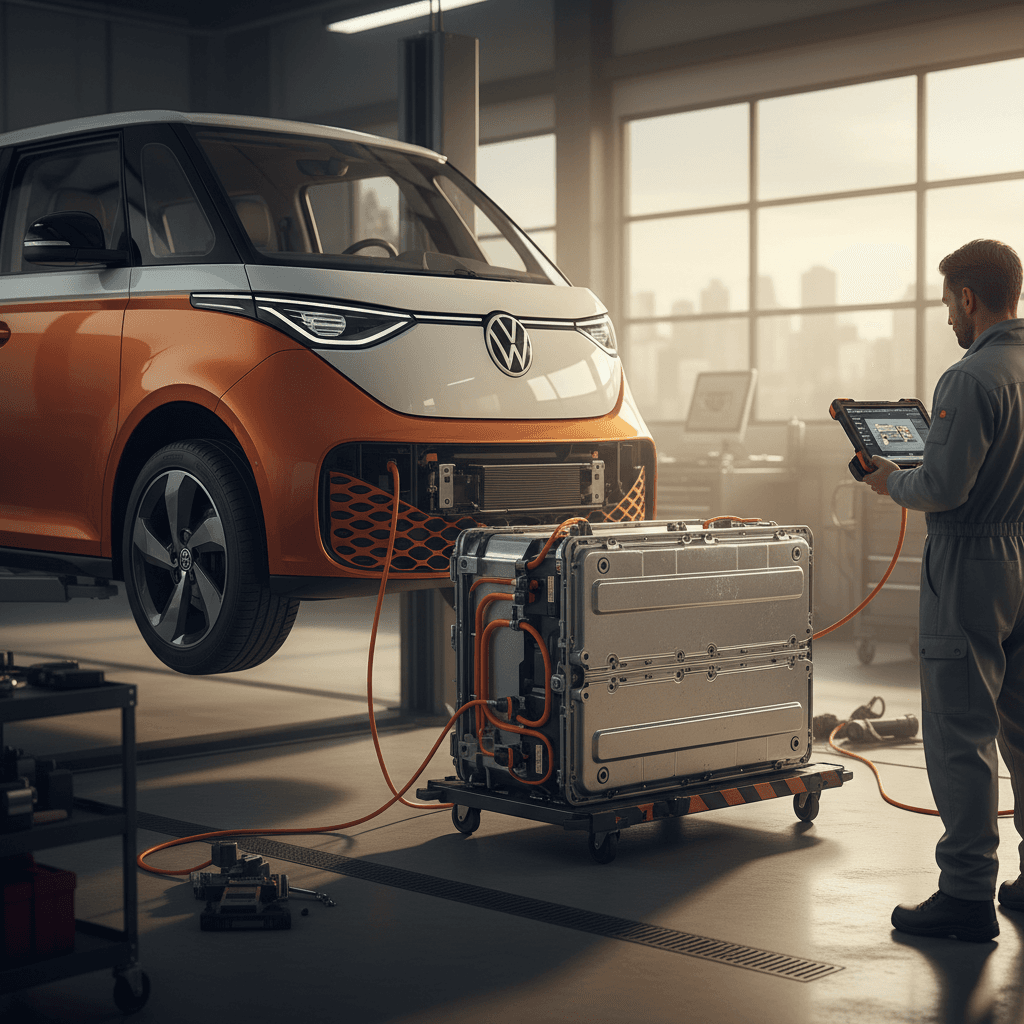
If the pack or a battery module fails prematurely because of a manufacturing defect, VW will typically repair or replace the battery under warranty, as long as you’re within the 8‑year/100,000‑mile window.
2. Internal battery failures
Issues like internal short circuits, faulty cell modules, or a failed battery management sensor, when not caused by external damage or misuse, are usually treated as warrantable high‑voltage battery failures.
3. Excessive capacity loss
Volkswagen guarantees your ID. Buzz battery will retain at least 70% of its original usable capacity during the warranty period. If verified capacity drops below that threshold, VW may repair or replace the pack.
In all three cases, Volkswagen typically has the option to repair individual modules or replace the pack with a new or remanufactured unit that restores performance to at least the warranted level. You don’t get a free upgrade to a larger‑capacity pack, but you should end up with a battery that meets VW’s original specifications for your trim.
How capacity is usually measured
What isn’t covered: common warranty surprises
An EV battery warranty is generous protection, but it’s not a blank check. The Volkswagen ID. Buzz battery warranty, like every OEM warranty, contains important exclusions that owners often overlook. Here are the big ones you should know about.
Typical ID. Buzz battery warranty exclusions
These are the scenarios where you should not expect VW to pick up the tab.
| Situation | Is it covered? | Why |
|---|---|---|
| Normal range loss over time above 70% capacity | No | Gradual, expected degradation is considered normal wear |
| Damage from crash, flood, or fire | No (insurance claim) | External damage is handled by your auto insurer, not warranty |
| Improper lifting or underbody damage to pack | Generally no | Physical damage from service errors or impacts is usually excluded |
| Modifications or tampering with HV system | No | Aftermarket tinkering can void coverage |
| Neglecting required software or recall updates | Can be denied | Skipping critical updates can void related claims |
| Using non‑approved coolant or bypassing thermal system | No | Improper fluids or bypassing systems counts as misuse |
Always confirm details in your specific model year’s warranty booklet, but this table reflects the patterns we see across modern VW EVs.
Easy way to void coverage
It’s also worth noting that the battery warranty doesn’t cover charging equipment that isn’t factory‑supplied. If a third‑party home charger fails or damages itself, that’s on the charger manufacturer. However, if a defective VW‑branded wallbox or included mobile charger damages the car, VW may handle that under separate warranty terms.
Capacity-loss coverage and real-world battery life
Volkswagen uses similar battery chemistry and architecture across the ID. family (ID.3, ID.4, ID.7, and ID. Buzz). That means we can look at real‑world data from other MEB‑platform cars to gauge how the ID. Buzz pack is likely to age. Long‑term testing of a 77 kWh VW ID.3 over roughly 100,000 miles showed capacity still around the low‑90% range after four years of mixed use, including plenty of DC fast charging.
- VW’s warranty threshold is 70% usable capacity at 8 years/100,000 miles.
- Real‑world data from similar packs suggests that, when used normally, most owners may see capacity well above that threshold even at high mileage.
- If an ID. Buzz battery did fall under the 70% mark while still in the time/mileage window, you’d have a strong case for a warranty repair or replacement.
The practical takeaway
ID. Buzz battery warranty vs other EVs
In terms of the big headline number, 8 years / 100,000 miles with a 70% capacity guarantee, the ID. Buzz is right in line with the mainstream EV market. That’s not an accident: federal rules in the U.S. essentially require this level of battery coverage, and most automakers match or slightly exceed it.
How the ID. Buzz battery warranty stacks up
Approximate U.S. high‑voltage battery warranties for popular EVs.
| Model | Battery warranty (years / miles) | Capacity guarantee |
|---|---|---|
| Volkswagen ID. Buzz | 8 / 100,000 | >= 70% usable capacity |
| Volkswagen ID.4 | 8 / 100,000 | >= 70% usable capacity |
| Hyundai Ioniq 5 | 10 / 100,000 | Typically to ~70% (market dependent) |
| Kia EV9 | 10 / 100,000 | Pack coverage; capacity language varies |
| Tesla Model Y | 8 / 120,000 (Long Range) | Typically to ~70% (per Tesla docs) |
Always verify current terms by model year, but this gives you a sense of where VW sits in the pack.
Where VW stands
How the battery warranty works for second owners and used ID. Buzz
If you’re shopping for a used ID. Buzz, either from a dealer, private party, or through a marketplace like Recharged, the good news is that Volkswagen’s high‑voltage battery warranty is typically transferable to subsequent owners. There’s no reset when the vehicle is sold; you receive whatever remains of the original term.
- Coverage follows the vehicle, not the owner, as long as the car stays in the same market (U.S. vs. Europe, etc.).
- A 2‑year‑old ID. Buzz with 20,000 miles may still have 6 years and 80,000 miles of battery coverage left.
- Certified Pre‑Owned (CPO) Volkswagen programs may add extra protection on top of the factory EV warranties, but the core 8‑year/100,000‑mile battery coverage already applies from day one.
How Recharged helps used buyers
Battery warranty vs high-voltage system and 12‑volt coverage
One common source of confusion is the difference between the High‑Voltage Battery Limited Warranty and the High‑Voltage System Limited Warranty. Many VW warranty booklets list them separately, and online owners’ discussions reflect the same split.
High‑Voltage Battery Limited Warranty
- Covers the traction battery pack itself and its internal modules.
- Term: typically 8 years / 100,000 miles.
- Focus: defects and excessive capacity loss (below ~70% usable capacity).
High‑Voltage System / Component Coverage
- Covers associated HV components: inverter, DC‑DC converter, charging modules, HV cables, etc.
- Term: often aligned with or slightly different from the New Vehicle Limited Warranty.
- Focus: failures of electronic components, not the battery cells themselves.
The ID. Buzz also has a conventional 12‑volt battery, the small one that powers accessories and wakes up the high‑voltage system. That battery is treated like any other wear item under the standard vehicle warranty, not the EV battery warranty. If a 12‑volt battery fails early within the basic warranty, it’s often covered; if it dies at year six, that’s typically an out‑of‑pocket expense.
Protecting your coverage: 6 practical habits
You don’t have to baby the ID. Buzz battery, but a few simple habits can both prolong pack life and make any future warranty claim easier if something does go wrong.
Everyday habits that help your ID. Buzz, and its warranty
1. Keep software and recalls up to date
Visit a VW dealer when recall or service campaign notices arrive, and keep over‑the‑air updates turned on if available. Ignoring a required update can give VW an excuse to deny a related claim.
2. Avoid sitting at 0% or 100% for long
It’s fine to charge to 100% before a trip, but don’t leave the van parked for days at either extreme. Lithium‑ion batteries age fastest when stored fully full or fully empty.
3. Use DC fast charging thoughtfully
The ID. Buzz is built for road trips, so fast charging is expected. Still, relying on DC fast charging for nearly all charging can accelerate wear. When possible, use Level 2 home or workplace charging for daily use.
4. Stick with approved coolants and service procedures
If the thermal management system needs service, use VW‑approved coolant and a technician familiar with high‑voltage EV systems. The wrong fluid or a DIY bypass could void coverage.
5. Document unusual behavior early
If you see sudden, unexplained range loss or frequent warnings related to the HV system, take screenshots or photos, note the mileage, and schedule service promptly. Waiting too long can muddy the warranty story.
6. Keep records if you buy used
Ask for past service records, charging habits, and recall history. When you buy through a marketplace like Recharged, much of this is summarized for you in the battery health report.
Don’t ignore warning lights
FAQ: Volkswagen ID. Buzz battery warranty
Frequently asked questions about the ID. Buzz battery warranty
Is the ID. Buzz battery warranty good enough?
For most shoppers, the Volkswagen ID. Buzz battery warranty strikes the right balance: it matches the industry‑standard 8‑year/100,000‑mile term, includes a clear 70% capacity guarantee, and is backed by a growing track record from VW’s other MEB‑platform EVs. It won’t stop every bit of range loss or cover abuse, but it does stand between you and the rare but expensive possibility of a premature pack failure.
If you’re buying new, that means you can focus more on whether the ID. Buzz fits your family, your road‑trip plans, and your budget. If you’re shopping used, it pays to look closely at how much warranty time and mileage remain and to get an objective view of current battery health. That’s exactly where a Recharged Score Report adds value, combining verified battery diagnostics with transparent pricing so you can choose the right ID. Buzz with confidence.