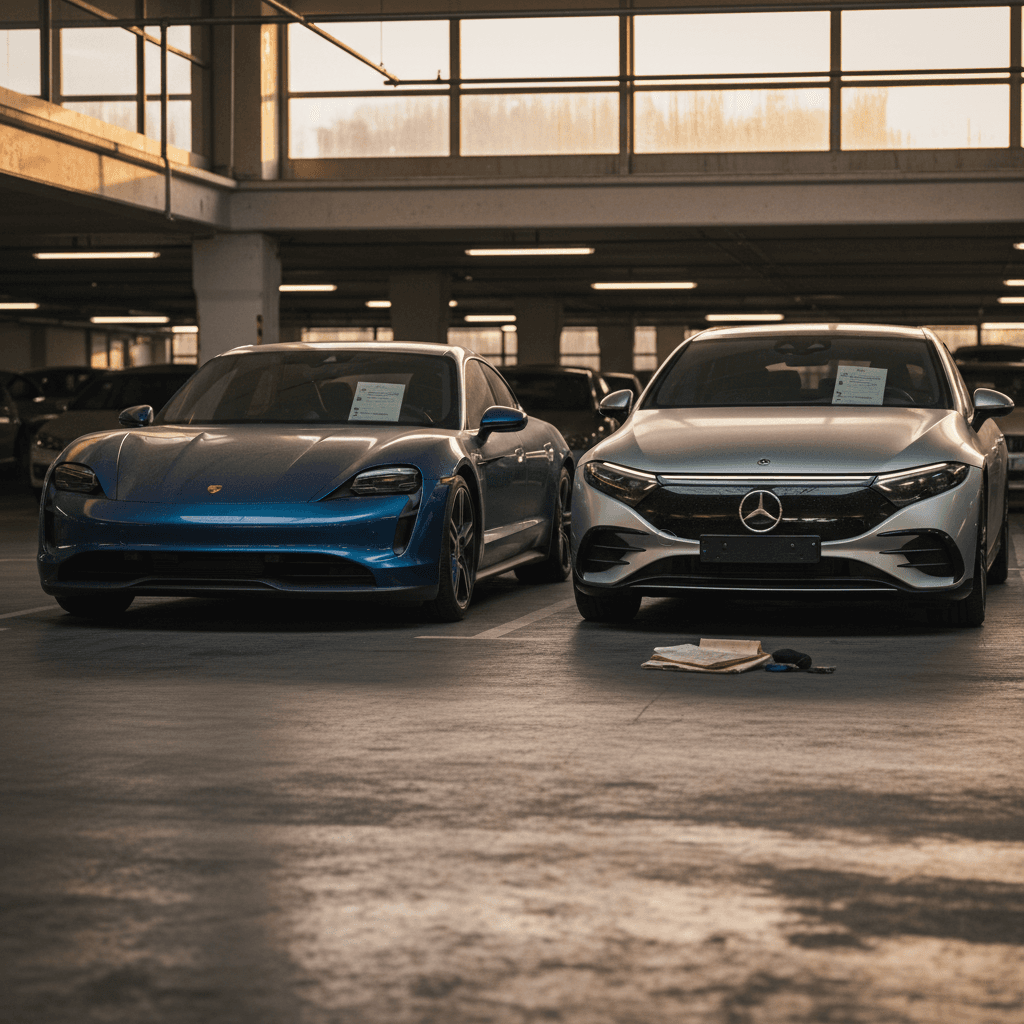
Shopping for a **used luxury EV in 2026** and stuck between a **Porsche Taycan** and a **Mercedes EQE**? You’re not alone. Both models now show up regularly on the used market, often at prices that would’ve seemed impossible a few years ago, thanks to aggressive EV depreciation and rapid tech updates. This comparison focuses on **used Porsche Taycan vs Mercedes EQE in 2026**, how they stack up on price, range, charging, comfort, and long‑term ownership so you can buy confidently, not emotionally.
Two different body styles, one shopper question
Overview: Used Taycan vs Used EQE in 2026
How these two luxury EVs are positioned
Sporty EV sports sedan vs tech-forward electric Benz
Porsche Taycan (used)
The Taycan is a **driver’s car first, EV second**. It’s a low, wide sports sedan (and wagon) with sharp steering, serious acceleration, and Porsche handling. Early examples (2020–2022) are now heavily depreciated, which makes them tempting, but also makes due diligence on battery health and warranty absolutely critical.
Mercedes EQE (used)
The EQE is **Mercedes’ electric E‑Class equivalent**, offered as a sleek sedan and a roomy SUV. It leans into comfort, quietness, and tech-heavy interiors rather than lap times. Used inventory is newer on average than Taycan, typically 2023 and up, so you’re often looking at fewer miles and a more relaxed ownership profile.
Used luxury EV snapshot for 2026 shoppers
Quick take: which used EV fits you?
Choose a used Porsche Taycan if you want…
- Best-in-class driving feel with sharp steering and sports‑car handling.
- Ultra-fast charging on road trips via its 800‑V architecture.
- A dramatic, low-slung design and Porsche badge appeal.
- Strong deals on 2020–2023 cars that have already taken a big depreciation hit.
Choose a used Mercedes EQE if you want…
- Comfort first: quiet cabin, soft ride, and luxury-car ergonomics.
- More space, especially with the EQE SUV’s rear seat and cargo room.
- High-tech interior with advanced driver assistance and big screens.
- A calmer ownership experience and potentially lower repair risk than a complex Porsche.
If you just want the best all‑around deal…
- Cross‑shop **mid‑spec Taycan 4S** vs **EQE 350+/350 4MATIC** models.
- Compare **verified battery health scores**, not just odometer readings.
- Factor in **warranty status and likely repair costs**, not only purchase price.
- Use a marketplace like Recharged where every car includes a Recharged Score Report so you can see real battery diagnostics and fair pricing up front.
Pricing and depreciation on the used market
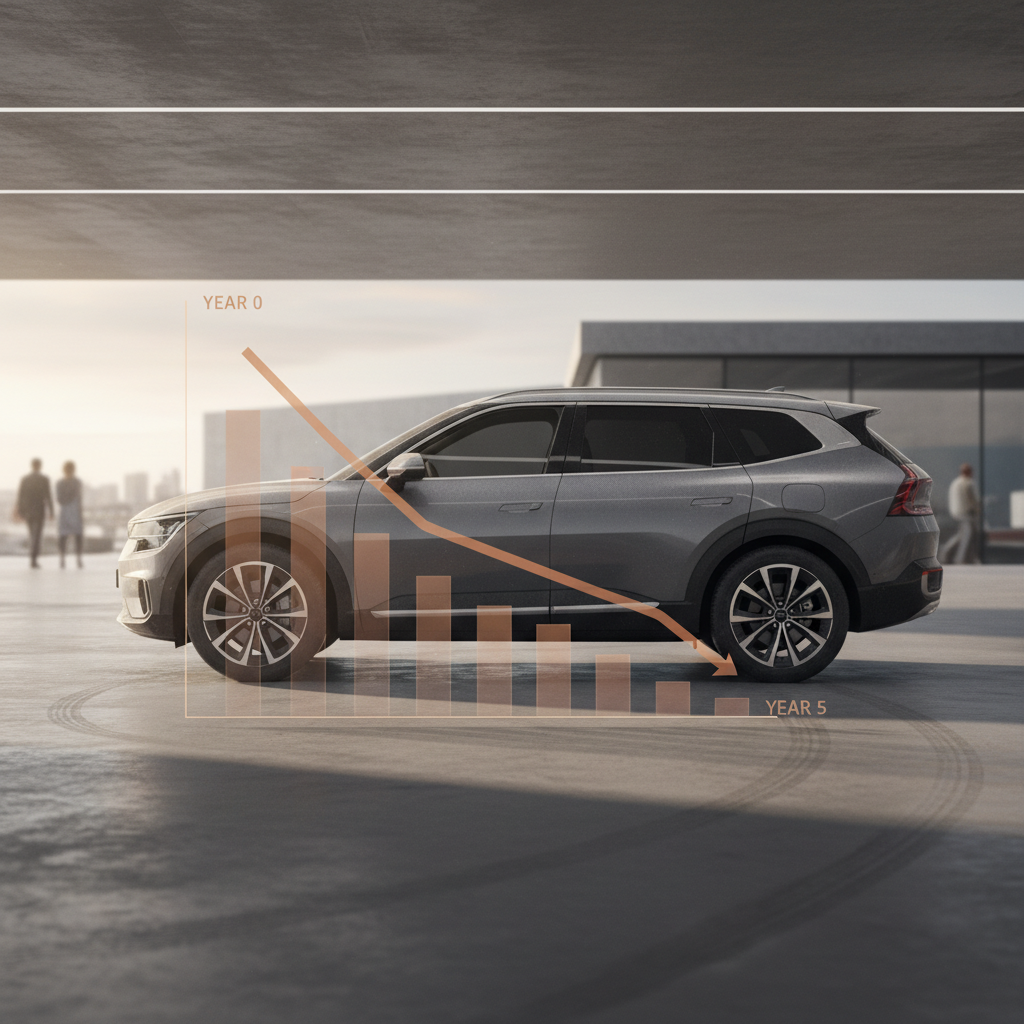
In 2026, both the Taycan and EQE are firmly established on the used market, but they’ve arrived there via **different depreciation stories**. Taycan hit U.S. showrooms earlier and carried higher original MSRPs, which means many early builds have already taken a bruising on value. Mercedes EQE arrived later with slightly lower pricing and a more conservative buyer base, so resale patterns look a bit calmer so far.
Typical 2026 used-market price ranges (U.S., non-CPO, ballpark)
Approximate asking-price brackets you’re likely to see from mainstream dealers and marketplaces, assuming clean history and average miles.
| Model & trim (used) | Model years commonly seen | Approx. price range (USD) | Original MSRP when new (approx.) |
|---|---|---|---|
| Porsche Taycan RWD | 2020–2023 | $45,000–$65,000 | $90,000–$105,000 |
| Porsche Taycan 4S | 2020–2024 | $55,000–$80,000 | $110,000–$140,000+ |
| Porsche Taycan Turbo/Turbo S | 2020–2023 | $80,000–$115,000 | $150,000–$200,000+ |
| Mercedes EQE 350+ sedan (RWD) | 2023–2025 | $48,000–$65,000 | $75,000–$85,000 |
| Mercedes EQE 350 4MATIC sedan | 2023–2025 | $52,000–$70,000 | $78,000–$90,000 |
| Mercedes EQE 350+ SUV | 2023–2025 | $55,000–$75,000 | $78,000–$90,000 |
| Mercedes EQE 500 / AMG | 2023–2025 | $65,000–$90,000+ | $90,000–$120,000+ |
These are directional ranges, not offers, always compare live listings in your region and condition.
Depreciation: where the Taycan stings, and helps
One key nuance for 2026: **inventory mix**. You’ll see far more early‑build Taycans (2020–2022) than early EQEs, which naturally pulls Taycan prices down into tempting territory. EQE stock is newer on average, so while asking prices can look similar on paper, you may be comparing a **3‑year‑old Taycan** with a **1–2‑year‑old EQE**.
Real-world range and efficiency
On paper, both lineups advertise big range numbers. In the real world, especially on U.S. highways at 70–80 mph, most used buyers should think in **realistic, not brochure, miles**. That means planning around something in the **220–280‑mile window** for the majority of trims in typical weather, and a bit less in winter.
Range: how Taycan and EQE usually behave in the real world
EPA ratings are a starting point, not a promise, especially for used cars.
Porsche Taycan (used)
- Depending on battery (Performance vs Performance Battery Plus) and trim, EPA ratings have historically run **low‑ to mid‑200s**, with updated 2025+ cars creeping higher.
- Real‑world highway range for popular trims like Taycan 4S often lands around **220–260 miles** when new; a used example with some degradation might sit on the lower half of that band.
- Efficiency isn’t Taycan’s strongest suit; it trades some range for performance and weighty Porsche hardware.
Mercedes EQE (used)
- Many EQE sedan and SUV variants are EPA‑rated in the **250–300‑mile** neighborhood, especially RWD EQE 350+ trims.
- Real‑world tests often show **high‑200s in mixed driving** and **low‑ to mid‑200s on fast highways**, assuming mild weather.
- EQE tends to be a bit more efficient and predictable, especially in comfort‑oriented driving.
Look beyond the window sticker
Charging speed and road-trip ability
If you plan to road‑trip your used EV, **charging curve** matters as much as peak kW numbers. Here, the Taycan’s engineering still shines in 2026. Its 800‑V system allows extremely quick DC fast charging sessions at high‑power stations, often translating into shorter stops than EQE for the same energy added.
DC fast charging and home charging: Taycan vs EQE
High-level overview of how these cars recharge in real usage.
| Aspect | Used Porsche Taycan | Used Mercedes EQE |
|---|---|---|
| DC fast-charging architecture | 800‑V system, peak rates often quoted up to ~270–320 kW on the latest packs | 400‑V system, typical peak around 170–200 kW depending on trim/year |
| 5–80% DC fast charge (ideal conditions) | Often in the **20–25 minute** range at a high‑power station, even on older models when the battery is warm | Commonly **30–35 minutes** to go from low state of charge into a comfortable road‑trip buffer |
| Charging curve behavior | Holds high power over a wider SOC band; excellent for rapid highway hops | Respectable but more traditional curve; slows sooner as SOC climbs |
| Home AC charging | Onboard AC chargers typically support **9.6 kW** with the right Level 2 setup | Similar 9.6 kW capability on many trims; overnight home charging is straightforward |
| Road‑trip verdict | Best if you prioritize **short, efficient fast‑charge stops** and plan routes around high‑power stations | Plenty capable, but expect **slightly longer stops** for the same miles added |
Exact times vary by charger, software updates, and temperature; always verify specs for the exact year and trim you’re considering.
Don’t forget network access and adapters
Performance and driving feel
From behind the wheel, these two used EVs feel very different, even at similar price points. The Taycan, even in base rear‑drive form, is engineered to feel like a Porsche, with quick steering, a low seating position, and suspension tuning that invites you to drive it hard. The EQE, meanwhile, channels the soft, isolating feel of a classic Mercedes E‑Class, especially in the SUV.
How they drive: character more than numbers
Raw 0–60 times tell part of the story, chassis tuning tells the rest.
Porsche Taycan (used)
- Even modest trims like Taycan RWD can feel **quicker and more responsive** than the spec sheet suggests.
- Higher trims (4S, Turbo, Turbo S) are legitimate super‑sedans with brutally quick launches.
- Ride quality is firm but controlled; adaptive air suspension and rear‑axle steering (on some trims) make the car feel smaller than it is.
- Best suited to drivers who **enjoy back roads and dynamic driving** as much as commuting.
Mercedes EQE (used)
- EQE 350+ and 350 4MATIC trims prioritize **smooth, quiet acceleration** over neck‑snapping launches.
- Steering is lighter and less communicative, but easy to live with in traffic and on long trips.
- EQE SUV rides higher and feels more like a traditional luxury crossover.
- Great fit if you want an EV that behaves like a **calm, modern Mercedes first**, performance car second.
If you grew up wanting a 911, the Taycan is the EV that scratches that itch. If you grew up wanting an S‑Class, the EQE is closer to that experience in an electric wrapper.
Comfort, interior, and in-car tech
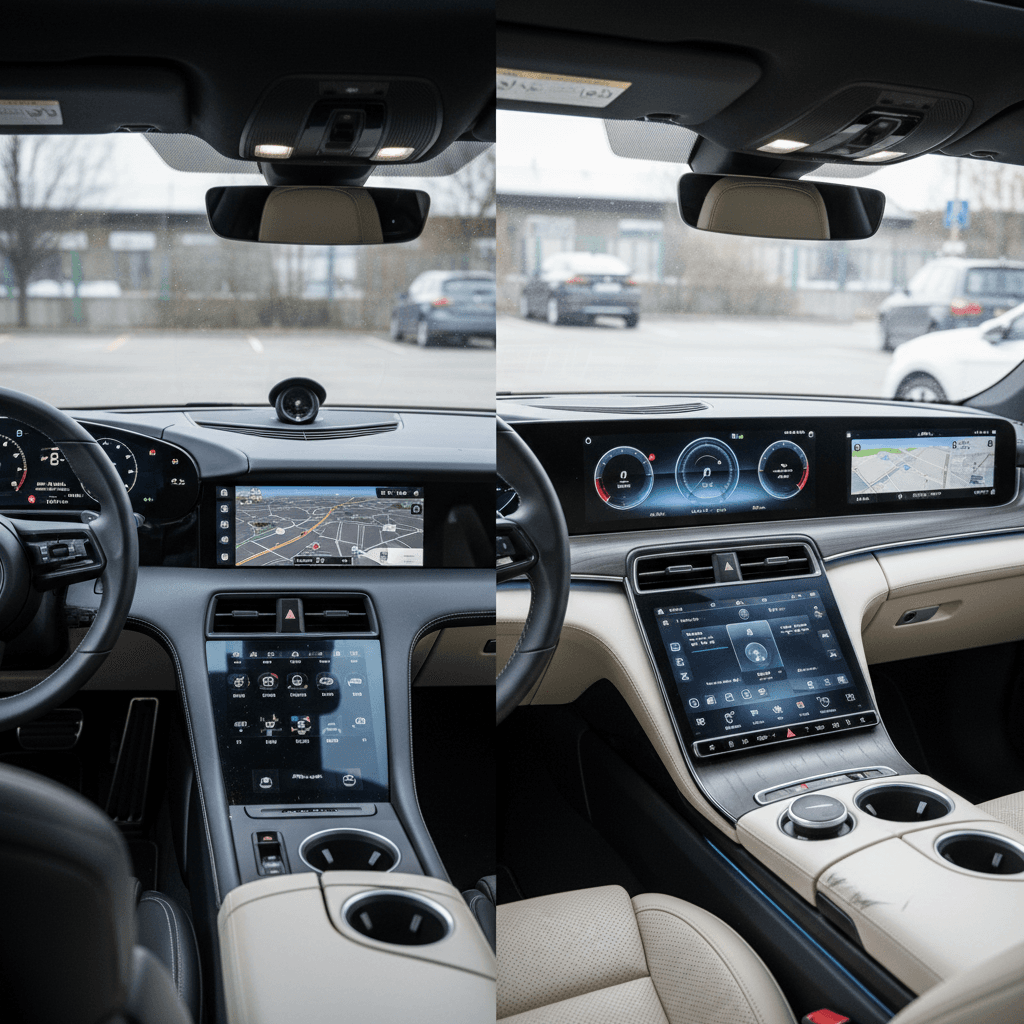
Inside, both cars look futuristic compared with many gas rivals, but they do it in different ways. The Taycan cabin is low, cocoon‑like, and driver‑centric; think of it as a modern riff on Porsche’s sports‑car cockpit. The EQE, particularly with Mercedes’ larger screen options, feels like a tech lounge on wheels, emphasizing ambient lighting, soft materials, and a more upright seating position in the SUV.
Taycan interior highlights
- Sporty driving position with a low roofline and deep footwells, great for enthusiasm, less so for mobility concerns.
- Supportive seats and a firm ride that can edge toward busy on rough pavement, especially on big wheels.
- Rear seat and trunk space are **adequate, not generous**; Cross Turismo wagon variants help but still feel sport‑oriented.
- Interface mixes touchscreens with physical controls; some owners love the minimalist vibe, others want more traditional buttons.
EQE interior highlights
- Roomier feel, especially in the EQE SUV, with easier ingress/egress and more rear headroom.
- Soft seats, a quiet cabin, and compliant suspension tuning that favors comfort.
- MBUX infotainment with large central and available passenger displays; plenty of ambient lighting and a more lounge‑like atmosphere.
- Controls and menus can be deep, but owners who like tech generally enjoy the configurability and features.
Practical family pick
Reliability, battery health, and warranties
Reliability is where many used‑EV shoppers get understandably cautious, and where the Taycan and EQE diverge in perception. The Taycan is packed with cutting‑edge hardware and software, and early cars saw their share of software gremlins, 12‑V battery issues, and occasional high‑voltage concerns. The EQE, being newer, has a shorter track record, but benefits from Mercedes’ experience with the larger EQS and more conservative tuning.
What to watch on a used Taycan vs EQE
Good inspection and diagnostics matter more than brand stereotypes.
Used Porsche Taycan watchpoints
- Verify all **software updates and campaigns** have been performed.
- Check for any history of high‑voltage battery work and confirm remaining **battery warranty** (typically 8 years with mileage cap).
- Inspect tires, brakes, and suspension carefully; performance driving and heavy weight can wear components quickly.
- Confirm there are no charging‑port issues and test both AC and DC charging before you buy.
Used Mercedes EQE watchpoints
- Review service records for software updates to **MBUX and driver‑assist systems**.
- Check for wind noise, water leaks, or fit‑and‑finish quirks, especially on early builds.
- Confirm active safety features (adaptive cruise, lane keeping, parking aids) are working cleanly, repairs can be pricey.
- As with Taycan, verify remaining **battery and drivetrain warranty** and get a current battery‑health snapshot.
Always get objective battery data
Ownership costs: insurance, maintenance, repairs
Neither of these cars is cheap to run compared with a mainstream EV, but they’re still often less expensive to fuel and service than a comparable gas‑powered luxury sedan or SUV. Where costs spike is **insurance and out‑of‑warranty repairs**. High‑tech bodywork, advanced driver‑assist hardware, and complex suspensions can turn even minor accidents into big bills.
- **Insurance**: Expect premiums in line with other high‑value luxury EVs, often higher than a Model 3/Y, potentially similar to or above a gas E‑Class or Panamera, depending on your market and driving record.
- **Routine maintenance**: No oil changes, but brake fluid, cabin filters, tires, and alignment still matter. Performance tires and big wheels on Taycan trims can wear fast; EQE SUV tires aren’t cheap either.
- **Repairs**: A Taycan with air suspension, rear‑axle steering, and big brakes will typically be more expensive to repair than a modest EQE 350+. AMG and high‑power EQE trims can also carry steeper parts prices.
- **Depreciation after you buy**: Much of the Taycan’s big drop happens in the first 3–4 years. If you buy after that, your personal depreciation hit can be more manageable. EQE is still finding its long‑term resale level, but expect EV‑typical softness compared with similar gas Mercedes.
Don’t stretch on a thin budget
Side-by-side comparison: key specs for used Taycan vs EQE
Exact specs vary by year and trim, but here’s how a few **popular used configurations** tend to line up in 2026. Use this as a sanity check, then verify details for any specific VIN you’re considering.
Representative used trims: Taycan vs EQE
Comparing popular mid-range variants that frequently appear on the used market.
| Attribute | Taycan 4S (2022–2024, Performance Battery Plus) | EQE 350+ sedan (2023–2025) | EQE 350+ SUV (2023–2025) |
|---|---|---|---|
| Drivetrain | Dual‑motor AWD | Single‑motor RWD | Single‑motor RWD |
| Peak power (approx.) | Up to ~500 hp with overboost | ~288 hp | ~288 hp |
| EPA range (new, est.) | ~230–270 mi depending on wheel/tire | ~260–300 mi depending on spec | ~250–280 mi depending on spec |
| Realistic highway range (used) | Often ~210–240 mi depending on battery health and weather | Often ~230–260 mi in mild weather | Often ~220–250 mi in mild weather |
| DC fast‑charge peak | Up to ~270–320 kW on suitable chargers | Around 170–200 kW | Around 170–200 kW |
| 0–60 mph (approx.) | Low‑3s to mid‑4s sec range | Mid‑6s sec range | High‑6s sec range |
| Cargo & space | Sport sedan; tight rear headroom and modest trunk | Mid‑size sedan; better rear comfort than Taycan | Roomy 2‑row SUV; best for families |
| Driving character | Sharp, sporty, engaging | Relaxed, comfort‑biased | SUV comfort and visibility, less sporty |
Values are rounded and representative; always confirm exact specs for the car you’re viewing.
How to choose: practical checklist for buyers
7 steps to pick the right used Taycan or EQE
1. Clarify your primary use case
Decide whether this EV is a **daily commuter, weekend toy, family hauler, or road‑trip machine**. Taycan skews toward fun and engagement; EQE sedan/SUV skew toward comfort and practicality.
2. Set a total-ownership budget
Look beyond sticker price. Include **insurance quotes, estimated charging costs, tires, and a repair buffer**. A cheaper Taycan with expensive options can still cost more to run than a modest EQE 350+.
3. Check remaining factory warranties
Confirm **battery and drivetrain coverage** in writing, including in‑service date and mileage limits. For out‑of‑warranty cars, consider extended coverage if available, and factor it into your price ceiling.
4. Demand a battery health report
Ask for **independent battery diagnostics**, not just the dashboard range estimate. On Recharged, every car includes a **Recharged Score** with verified battery health, fair‑market pricing, and range projections so you know what you’re buying.
5. Inspect charging hardware and history
Test both **Level 2 and DC fast charging** before you commit. Confirm there’s no physical damage to the charge port, and review any history of charging‑related repairs or error messages.
6. Drive both, back-to-back if possible
A short test drive will usually tell you whether you’re a **Taycan person** (you care about steering feel and acceleration) or an **EQE person** (you prioritize serenity and comfort). Pay attention to visibility, seat comfort, and ride quality on rough roads.
7. Cross-shop multiple VINs
Don’t fall in love with the first car you see. Compare **at least two Taycans and two EQEs** with similar years and mileage. Use a marketplace like Recharged to line up several options, each with a consistent battery and condition report so you can compare apples to apples.
FAQ: Used Porsche Taycan vs Mercedes EQE
Frequently asked questions
Bottom line: which used EV should you buy?
If you want a **driver’s car that happens to be electric**, and you’re prepared for occasionally higher repair and insurance bills, a **used Porsche Taycan**, especially a well‑specced 4S with documented battery health, remains one of the most rewarding EVs money can buy. Its combination of handling, charging speed, and presence is still rare in 2026, even as new competitors arrive.
If you’re looking for a **comfortable, tech‑rich, everyday luxury EV** that can handle family duty and long trips with less drama, a **used Mercedes EQE sedan or EQE SUV** makes a compelling case. You give up a bit of sporting edge and ultimate charging speed, but you gain space, refinement, and a calmer ownership experience.
Whichever way you lean, the smartest play in 2026 is to **treat battery health like the new odometer**, and to compare multiple cars with consistent, transparent data. That’s exactly what marketplaces like Recharged are built for, every vehicle includes a Recharged Score Report, access to EV‑specialist support, financing options, trade‑in or consignment paths for your current car, and **nationwide delivery**. Do your homework, lean on real diagnostics instead of guesses, and a used Taycan or EQE can be one of the most satisfying car purchases you’ll ever make.