If you’re shopping for used electric cars in New Jersey in 2026, you’re in the middle of one of the fastest‑moving EV markets in the country. New Jersey has aggressive zero‑emission goals, strong charging growth, new EV registration fees, and a maturing supply of off‑lease and second‑owner vehicles. That combination creates opportunity, but also a minefield, if you don’t understand how incentives, fees, battery health, and local driving patterns interact.
New Jersey is an EV leader
Why used electric cars in New Jersey are surging in 2026
New Jersey’s EV landscape heading into 2026
There are three main forces driving the 2026 used‑EV boom in New Jersey. First, the state has been punching above its weight on EV adoption; EVs have been more than 14% of new sales recently, so the pool of three‑ to six‑year‑old vehicles is finally substantial. Second, early adopters who leased 2020–2022 models are cycling into their next vehicles, creating a wave of off‑lease inventory. Third, new EV prices and interest rates remain relatively high, pushing price‑sensitive buyers to look hard at used options where depreciation has already done much of the work for them.
At the same time, policy is shifting from carrots to sticks. The generous stack of federal credits, New Jersey state rebates, and sales‑tax breaks that made new EVs almost a no‑brainer in 2023–2024 has been dialed back by 2026. That’s making the relative value of used electric cars even more compelling, especially if you commute within the dense North Jersey–New York–Philadelphia corridor where charging is increasingly easy to find.
What changed for EV incentives and fees by 2026?
Incentives: less generous, still meaningful
- Federal tax credits: As of late 2025, the familiar $7,500 new‑EV and $4,000 used‑EV federal credits are no longer available for purchases after September 30, 2025. For a 2026 New Jersey buyer, you should not count on federal help on a used EV.
- State rebates: New Jersey’s Charge Up program has historically focused on new EVs, not used. Funding has come and gone in waves and is typically capped per year. By spring 2026, you should assume that any available state rebate will apply only to qualifying new EVs and may be subject to price caps and income limits.
- Utility programs: Several New Jersey utilities have offered home‑charger rebates or bill credits. These are often limited‑time and may require enrolling in specific rate plans, but they can offset some charging costs if still active in your service area.
New costs: EV registration fee and taxes
- Annual EV registration fee: New Jersey now charges a dedicated EV fee on top of normal registration. The fee started at $250 on July 1, 2024 and rises by $10 each July through 2028. That means you’re looking at roughly $270–$280 per year in 2026 just for the EV surcharge, regardless of whether the car is new or used.
- Sales tax treatment: New Jersey’s long‑standing sales‑tax exemption for zero‑emission vehicles has been phased out. By July 2025, most EV purchases, including used, face the standard 6.625% sales tax, unless a temporary or targeted exemption is reinstated. That’s a meaningful line item on a $25,000 purchase.
- Local fees: Some municipalities add parking, residential permit, or charging access fees. They’re usually small individually, but worth checking if you’re in dense areas like Jersey City, Hoboken, or Newark.
Don’t assume incentives still exist
How much do used electric cars cost in New Jersey in 2026?
Used EV pricing in New Jersey in 2026 reflects two competing pressures: a steady stream of off‑lease vehicles pushing prices down, and strong local demand plus higher interest rates pushing payments up. Rough ballpark ranges (for typical mileage and clean histories) look like this:
Typical used EV price ranges in New Jersey (spring 2026)
Approximate asking‑price bands you’re likely to see from dealers and online marketplaces. Individual vehicles can fall above or below these ranges based on trim, battery size, mileage, and condition.
| Model & generation | Model years common in used market | Typical price band (NJ, 2026) | Notes |
|---|---|---|---|
| Chevrolet Bolt EV / EUV | 2018–2023 | $12,000–$22,000 | Often the lowest entry price; watch recall and battery warranty status carefully. |
| Tesla Model 3 RWD / Long Range | 2018–2022 | $20,000–$32,000 | Huge supply off lease; price swings with mileage, Autopilot options, and battery health. |
| Hyundai Kona Electric | 2019–2022 | $17,000–$26,000 | Good range; availability spottier than Tesla or Bolt but attractive for commuters. |
| Nissan Leaf (40–62 kWh) | 2018–2022 | $9,000–$18,000 | Usually cheapest, but air‑cooled batteries degrade faster, range can be limited. |
| Volkswagen ID.4 | 2021–2023 | $23,000–$33,000 | Plenty of space; software updates matter. Check transferability of remaining warranty. |
| Ford Mustang Mach‑E | 2021–2023 | $26,000–$38,000 | Sportier option; verify recent software and recall work, especially for early builds. |
These are directional market ranges, not offers or guarantees. Always compare multiple listings and factor in battery health and warranty coverage.
Look at payment, not just price
Best used EV models for New Jersey buyers
Four strong used‑EV choices for New Jersey in 2026
Matched to typical NJ driving patterns, weather, and charging options.
Chevrolet Bolt EV / EUV
Why it works in NJ: Compact footprint for tight parking, plenty of range for daily commuting, and consistently among the most affordable used EVs.
- Real‑world range: 200–250 miles when the battery is healthy.
- Great for: Central and North Jersey commuters, rideshare drivers, college students.
- Watch for: Completed battery‑recall work and clear documentation of pack replacement where applicable.
Tesla Model 3
Why it works in NJ: Excellent fast‑charging access on the Turnpike and Parkway, strong efficiency, and a massive used supply that keeps prices somewhat competitive.
- Real‑world range: 220–310 miles depending on trim and battery condition.
- Great for: Long‑distance commuters, frequent Turnpike road‑trippers.
- Watch for: Out‑of‑warranty repairs on older cars, prior accident damage, and Supercharger‑heavy histories with high mileage.
Hyundai Kona Electric & Kia Niro EV
Why they work in NJ: Efficient, compact crossovers with solid range and good winter manners, often at lower prices than comparable Teslas.
- Real‑world range: 200–260 miles.
- Great for: Suburban families who want hatchback practicality.
- Watch for: On‑board charger issues on some early models and dealer‑installed add‑ons inflating prices.
Volkswagen ID.4 / Ford Mustang Mach‑E
Why they work in NJ: Comfortable highway cruisers with enough space for kids, gear, and weekend trips down the Shore.
- Real‑world range: 200–270 miles depending on battery, wheels, and software.
- Great for: Families and small‑business owners needing cargo room.
- Watch for: Software update history and DC‑fast‑charging behavior on early builds.
Where Recharged fits in
Ready to find your next EV?
Browse VehiclesTotal cost of owning a used EV in New Jersey
To understand whether a used EV makes sense in New Jersey in 2026, you need to look beyond purchase price and consider energy, maintenance, registration fees, and depreciation together. When you do that, the picture is often more favorable than it looks at first glance, especially if you drive more than 8,000–10,000 miles per year.
Key cost components to run the numbers on
1. Electricity vs. gasoline
Assume roughly 3 miles per kWh for a compact EV. At an all‑in residential rate around $0.20–$0.23/kWh, that’s about 7–8 cents per mile. A comparable gasoline car at 30 mpg and $3.50/gallon costs closer to 12 cents per mile. Over 10,000 miles a year, that’s roughly $400–$500 in annual fuel savings.
2. EV registration surcharge
New Jersey’s dedicated EV fee adds roughly $270–$280 per year in 2026 to your registration bill, rising each July. That eats into some of your fuel savings, but for typical mileage the EV still comes out ahead on operating cost.
3. Insurance differences
Used EVs can be modestly more expensive to insure than comparable gasoline cars, especially Teslas and higher‑end models, due to repair costs. Shop quotes before you commit to a specific vehicle and trim, insurance can vary dramatically between a Leaf and a Model 3 Performance.
4. Maintenance and repairs
EVs eliminate oil changes, spark plugs, timing belts, and exhaust systems. You’ll still have tires, brakes (often lasting longer), cabin filters, and suspension components. Budget for occasional out‑of‑warranty electronics issues, especially on early‑generation models.
5. Depreciation curve
Much of an EV’s steepest depreciation happens in the first three to four years. Buying a 3–6‑year‑old vehicle often lands you in a sweet spot where you benefit from earlier incentives and depreciation without taking the biggest value hit yourself.
EV vs. gas: where the math flips
Where to find used electric cars in New Jersey in 2026
- Franchise dealers and brand stores. Many Chevy, Hyundai/Kia, Ford, VW, and Nissan dealers in New Jersey now maintain a pipeline of off‑lease EVs. You’ll often see certified pre‑owned (CPO) options, though pricing can be higher and EV‑specific expertise is hit‑or‑miss.
- Online marketplaces. National listing platforms and EV‑focused sites give you a broader view of prices and trim mixes, including cars located just over the border in New York or Pennsylvania that can be delivered to New Jersey.
- Dedicated used‑EV retailers. A small but growing number of companies, including Recharged, specialize exclusively in used EVs. They tend to offer deeper battery‑health diagnostics, remote‑purchase options, and home delivery, valuable if you’d rather not spend weekends hopping between dealers on Route 22.
- Private sellers. Facebook Marketplace, Craigslist, and local forums can surface deals, but you’ll need to do your own due diligence on battery health, recalls, and title status. This is where a third‑party inspection or a professional battery report becomes especially valuable.
Cast a slightly wider net
How to inspect a used EV before you buy
Traditional used‑car buying advice, title checks, accident history, and a mechanic’s inspection, still matters. But with EVs, battery health, charging history, and software status are just as important. Treat these as non‑negotiable checkpoints.
Essential used‑EV inspection checklist for New Jersey buyers
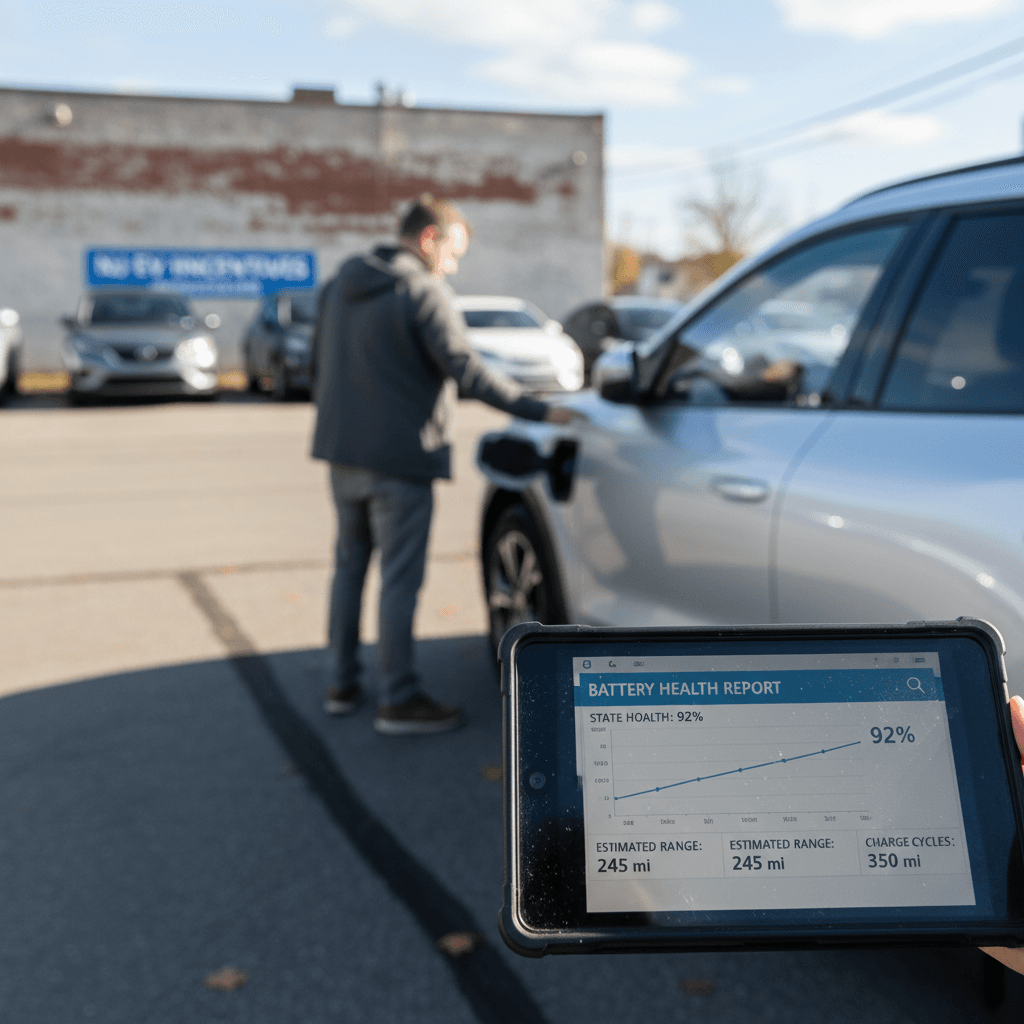
1. Verify real battery health, not just “range estimate”
Ask for a recent, objective battery‑health report rather than relying on the dash range reading. Tools and services can estimate remaining usable capacity; Recharged includes this in its Recharged Score Report on every vehicle.
2. Confirm recall and software‑update history
Many early EVs, Chevy Bolt, Kona Electric, various Teslas, have had important recall campaigns and major software updates. Ask for documentation or a print‑out from a franchised dealer service department showing that all critical campaigns have been completed.
3. Review charging behavior and patterns
If possible, look at charging logs from the vehicle or connected apps. A car fast‑charged daily to 100% at high power and left in hot climates will age differently from one mostly charged slowly at home to 80–90%.
4. Check included charging equipment and adapters
Confirm which charging cables and adapters come with the car: at least a portable Level 1/2 unit or a J1772/NACS adapter where applicable. Replacing lost equipment can easily cost $300–$700 or more.
5. Inspect underbody and cooling hardware
In snow‑belt states like New Jersey, road salt can affect suspension and underbody components. Have a shop put the car on a lift to check for corrosion, damage to battery shielding, and worn bushings or control arms.
6. Test features you’ll actually use
Spend time with climate control, heated seats and wheel, driver‑assist features, smartphone integration, and navigation. EV comfort in cold or hot weather depends more on these details than on 0–60 times.
Red flags that should make you walk away
Charging a used EV in New Jersey in 2026
New Jersey’s charging infrastructure has grown quickly, from basic workplace pilots to a dense mix of DC fast chargers along the Turnpike, Parkway, and major suburban corridors. For most used‑EV buyers, the best setup is still home or workplace Level 2 charging for daily needs, plus reliable public fast‑charging coverage for road trips.
How most New Jersey used‑EV owners charge in 2026
Match your charging strategy to your housing situation and driving patterns.
Home Level 2 (240V)
Best if you have a driveway or garage.
- Install a 240V circuit and wallbox or use a 240V outlet with a portable charger.
- Typical full recharge overnight, even on larger‑battery EVs.
- Most predictable and usually cheapest per kWh.
Apartment & condo charging
Growing, but uneven.
- Many new multifamily buildings in North and Central Jersey now include resident chargers.
- Older buildings may lag; look into workplace charging or nearby public Level 2 as a backup.
- Clarify access rules, pricing, and waitlists before you buy an EV.
DC fast charging on the road
Critical for Turnpike and Parkway travel.
- Dozens of fast‑charging sites from Tesla, Electrify America, and others now cover key corridors.
- Use fast charging mostly for trips, not daily use, to preserve battery life.
- Check your specific model’s maximum DC charging rate before banking on very quick stops.
Test your local charging network before committing
Common pitfalls when buying a used EV in NJ
- Ignoring the impact of the EV registration fee. When you pencil out your cost of ownership, include the extra ~$270–$280 annual EV fee for 2026 and its planned increases. It doesn’t erase fuel savings for most drivers, but it’s not trivial.
- Overestimating winter range. Cold New Jersey winters can shave 20–35% off rated range, especially for highway driving with cabin heat on. Buy for your worst‑case day, not the marketing number.
- Buying more range than you’ll ever use. A 300‑mile EV is great, but if you drive 40–60 miles a day and can charge overnight, a less expensive 200‑mile car may be the smarter choice.
- Assuming any mechanic can work on an EV. High‑voltage systems require specific training and tools. Make sure you have at least one trusted EV‑capable shop, dealer or independent, within a reasonable distance.
- Skipping a structured inspection. Too many used listings gloss over battery health, warranty terms, and charging behavior. Use a checklist and insist on documentation, or buy from a seller who provides a comprehensive report up front.
FAQ: used electric cars in New Jersey (2026)
Frequently asked questions about used EVs in New Jersey
Key takeaways for New Jersey used EV buyers
New Jersey in 2026 is a uniquely fertile market for used electric cars. EV adoption has been high for years, charging infrastructure is now widespread along the Turnpike, Parkway, and major commuter corridors, and a deep pool of off‑lease models is finally hitting the secondary market. At the same time, incentives have pulled back and a new EV registration fee has arrived, so the easy, heavily subsidized deals of 2022–2023 are gone.
If you treat battery health, charging access, and total cost of ownership as first‑class questions, not afterthoughts, you can still come out ahead financially while cutting emissions and enjoying a more refined daily drive. That means demanding documentation, pressure‑testing your charging plan, and comparing options across dealers, online platforms, and EV‑specialist retailers like Recharged that provide verified battery diagnostics and fully digital purchase paths.
Take the time to run your own numbers, be realistic about your range needs in New Jersey weather, and insist on transparency from any seller. Done right, a used EV bought in 2026 can carry you well into the 2030s with low running costs and far fewer compromises than early adopters had to accept.