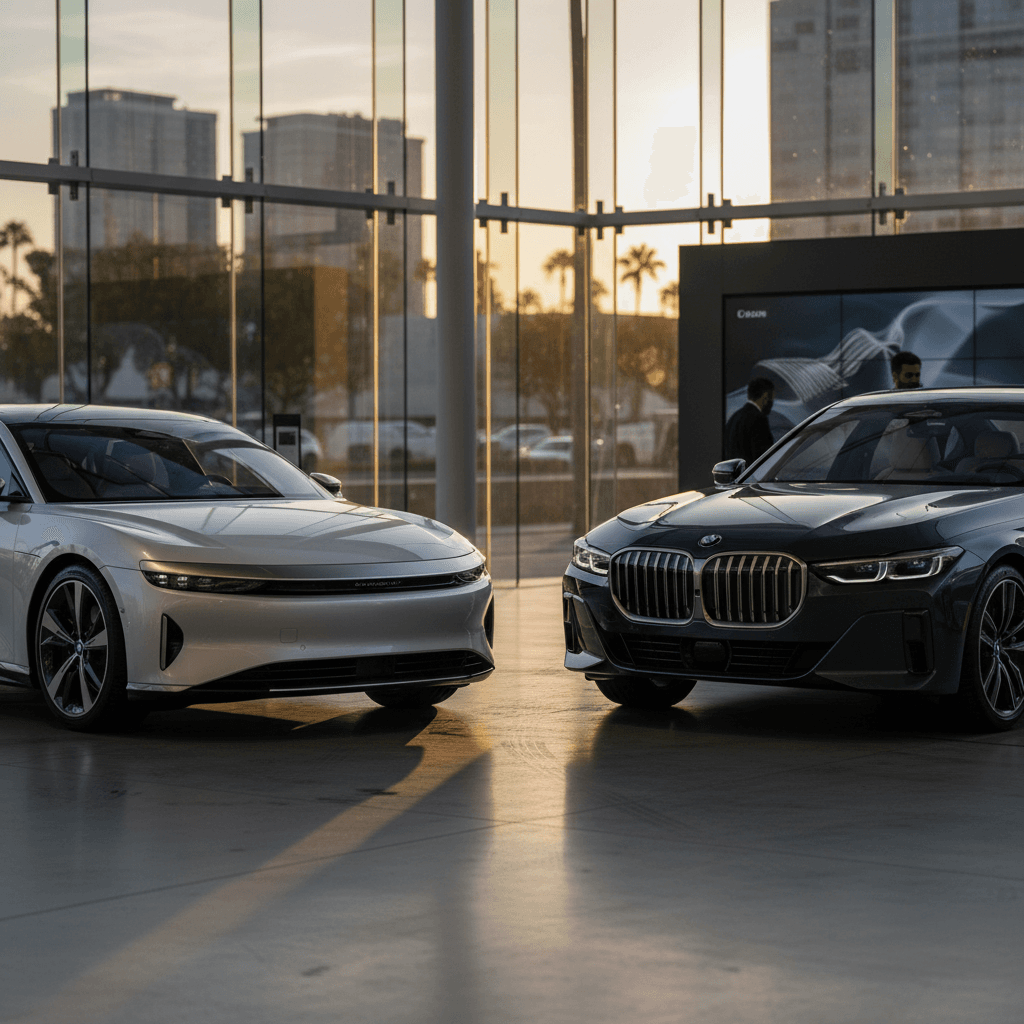
If you’re cross-shopping the Lucid Air vs BMW i7, you’re already in rare air: both are flagship electric luxury sedans with serious range, power, and tech. But they don’t appeal to the same kind of driver. One is an efficiency-obsessed EV upstart; the other is a tech-laden evolution of a classic German limo. This guide breaks down range, performance, comfort, tech, charging, and ownership so you can decide which is better for your real-world needs.
Two Very Different Takes on Electric Luxury
Lucid Air vs BMW i7: Quick Overview
How These Flagship EVs Position Themselves
Same segment on paper, different personalities in practice
Lucid Air: Range-First Tech Flagship
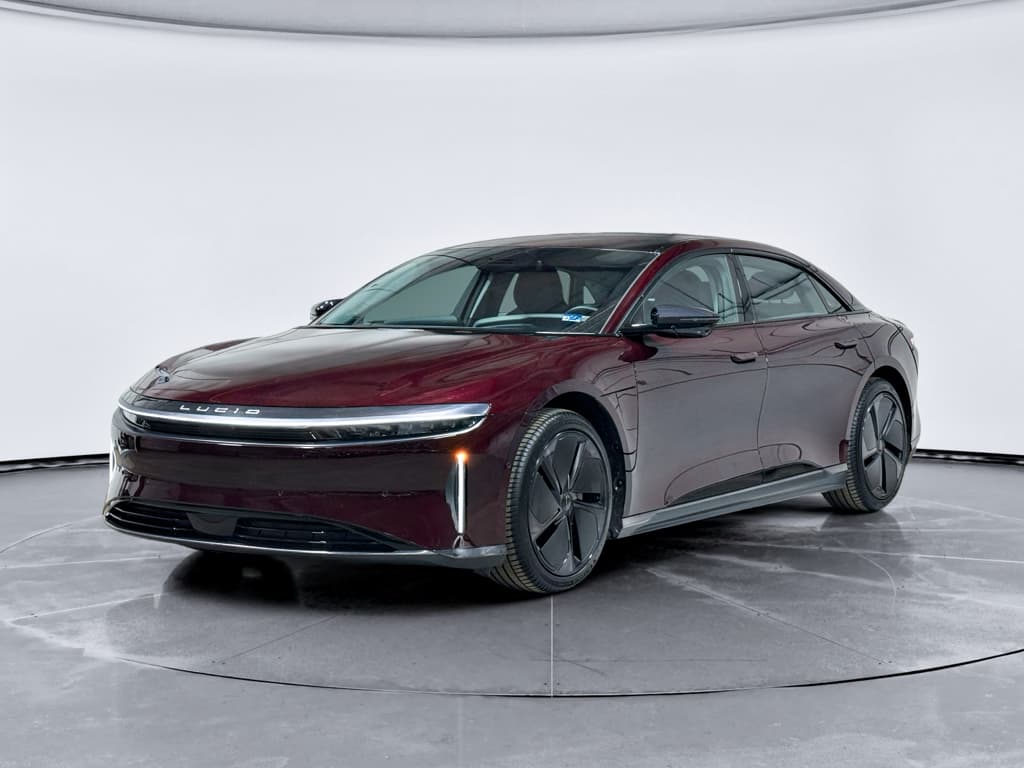
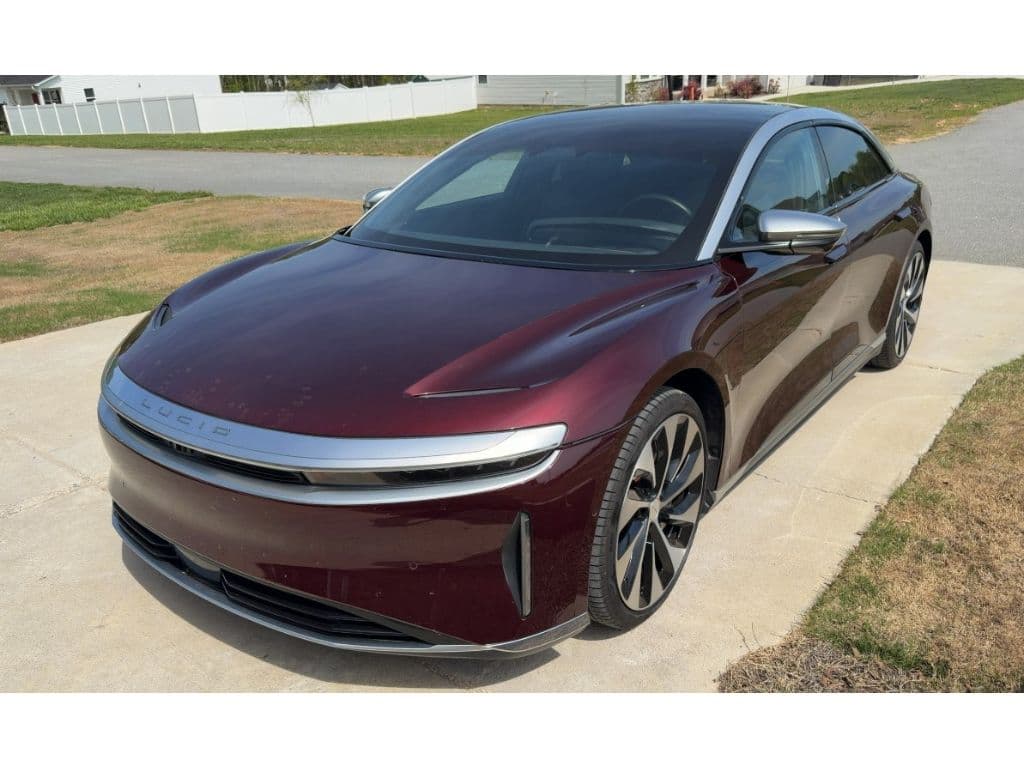
The Lucid Air is a clean-sheet electric sedan with a focus on maximum range, efficiency, and futuristic design. EPA-rated ranges around 400–500+ miles on some trims make it one of the longest-range EVs you can buy in the U.S. Its minimalist cabin, 900+ volt architecture, and blistering acceleration in higher trims scream tech-forward startup rather than traditional luxury.
BMW i7: Electric Evolution of a 7 Series
The BMW i7 is the fully electric version of the 7 Series, built on BMW’s long history of chauffeur-grade comfort and executive luxury. Range is solid but not class-leading, and the emphasis is on quiet isolation, rear-seat amenities, and a familiar BMW driving feel with cutting-edge infotainment layered on top.
Headline Numbers That Matter Most
Key Specs: Lucid Air vs BMW i7 at a Glance
Lucid Air vs BMW i7: Core Specs Snapshot (2025 Model Year)
Approximate U.S.-market figures for common trims. Exact numbers vary by wheel size, options, and test cycle.
| Model / Trim (Representative) | Battery (usable kWh, approx.) | EPA Range (mi, est.) | 0–60 mph (sec, est.) | Drivetrain | DC Fast Charge Peak (kW) | Base MSRP (new) |
|---|---|---|---|---|---|---|
| Lucid Air Pure (RWD) | ~88–90 | ~400 | ~4.5 | RWD | ~200 | $69,900+ |
| Lucid Air Touring (AWD) | ~92–96 | ~410–430 | ~3.4 | AWD | ~250 | $77,900+ |
| Lucid Air Grand Touring (AWD) | ~118 | ~450–512 | ~3.0 | AWD | ~300+ | $109,900+ |
| BMW i7 eDrive50 | ~105 | ~305–320 | ~5.3 | RWD | ~195 | Low $90,000s |
| BMW i7 xDrive60 | ~105 | ~295–310 | ~4.5 | AWD | ~195 | Upper $90,000s |
| BMW i7 M70 | ~105 | ~285–295 | ~3.5 | AWD | ~195 | $150,000+ |
Use this table as a directional comparison, not a substitute for checking a specific VIN’s window sticker.
Spec Sheets Don’t Tell the Whole Story
Range and Efficiency: Where Lucid Pulls Ahead
If your top priority is maximum range per charge, the Lucid Air is the clear winner. Many trims comfortably exceed 400 miles of EPA-estimated range, and the most efficient versions have been independently measured around 4–5 miles per kWh in real-world driving. That’s unmatched among large luxury sedans and means fewer stops, more flexibility on routing, and extra buffer in bad weather.
- Lucid Air Grand Touring can exceed 450 and, in some configurations, around 500+ miles of EPA-estimated range.
- Lucid’s high-efficiency motors and sleek aero design help it deliver excellent highway efficiency, not just in city driving.
- BMW i7 models generally land in the low-to-mid 300-mile EPA range, which is solid but not segment-leading.
Think in Miles You Actually Use
When Lucid’s Range Advantage Matters
- Frequent interstate road trips where you’d rather skip a stop.
- Living in regions with sparse DC fast-charging, where every extra mile of buffer counts.
- Heavier loads, family, luggage, winter tires, where extra capacity reduces anxiety.
When BMW i7 Range Is “Enough”
- Mostly urban and suburban commuting with reliable home charging.
- Chauffeur use or executive transport where trips are predictable and planned.
- Drivers more focused on comfort and brand experience than ultimate range bragging rights.
Performance and Driving Feel
Both cars are fast in ways that make old V8 flagships feel slow, but they deliver speed differently. The Lucid Air’s character leans toward light, ultra-responsive sports sedan, especially in Touring and Grand Touring trims. The BMW i7, even in quicker variants, feels more like a planted, silent executive express that happens to be very quick when you ask.
How They Drive: Side-by-Side Impressions
Acceleration is only part of the story
Lucid Air Driving Character
- Very quick across the lineup; higher trims are supercar-fast.
- Steering is light and precise, with a low driving position that feels sporty.
- Chassis tuning prioritizes efficiency and precision more than plush isolation.
- Best choice if you enjoy driving and want something that feels distinct from a traditional luxury sedan.
BMW i7 Driving Character
- Silky and composed, with adaptive air suspension and rear-wheel steering on many trims.
- Acceleration is strong but the car feels heavier and more deliberate.
- Excellent noise isolation; it feels engineered to keep the rear passengers relaxed.
- Best choice if you value comfort, refinement, and that classic “7 Series” feel over sharpness.
Enthusiast vs Executive
Interior Luxury and Comfort
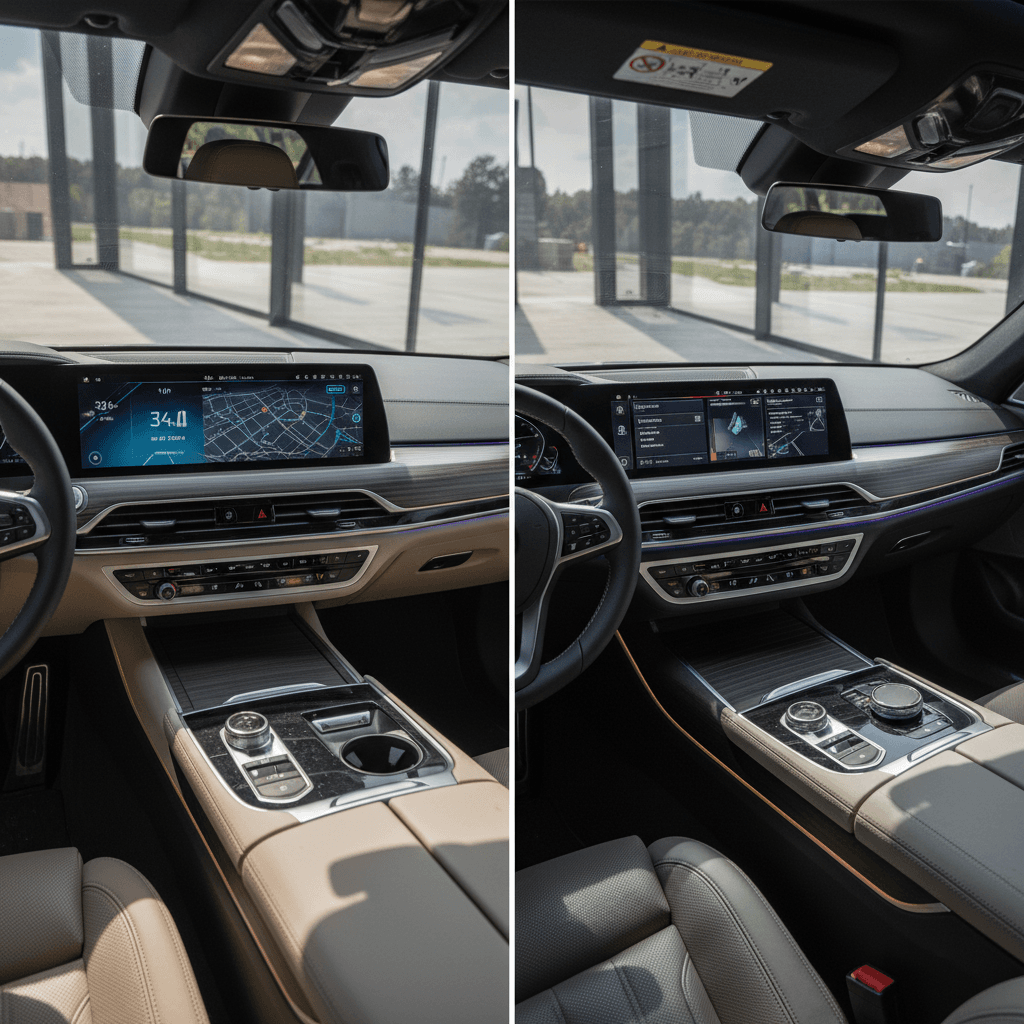
Step inside and the differences sharpen. The Lucid Air’s cabin is clean, modern, and airy with big glass and a minimalist dashboard. Materials are high quality, but the overall vibe is tech-forward startup. The BMW i7 interior is sumptuous, layered, and theatrical, with crystal controls, intricate ambient lighting, and classic BMW ergonomics refined for an EV age.
Lucid Air Interior Highlights
- Open, modern design with a low cowl and great forward visibility.
- Large curved display plus a lower center touchscreen that retracts for extra storage.
- Plenty of rear legroom but less emphasis on rear-seat “theater” features.
- Feels special and futuristic, but some owners still report occasional software quirks and fit-and-finish nitpicks compared with German stalwarts.
BMW i7 Interior Highlights
- Optional 31-inch rear theater screen, reclining rear seats, and Executive Lounge Package that turns the back seat into a rolling first-class pod.
- Crystal trim, high-end leather and wool blends, and extensive ambient lighting scenes.
- Infotainment UI packed with features; can be overwhelming at first but feels robust and polished.
- Feels immediately familiar if you’ve owned recent BMWs, just turned up to 11.
Test the Back Seat, Not Just the Driver’s Seat
Tech, Infotainment, and Driver Assistance
Both sedans offer advanced driver assistance, huge screens, and over-the-air updates, but the experience is different. Lucid’s software focuses on EV efficiency tools and minimalist UI, while BMW packs in a feature-rich operating system with deep integration to its dealer and service network.
Software and Driver-Assist: What Stands Out
It’s not just about the size of the screens
Lucid Air Tech
- Sleek UI focused on navigation, efficiency, and EV-specific info.
- Good visualization of energy use and route-based charging suggestions.
- Highway driver-assist that’s competent but still evolving; behavior may change with updates.
- Feels like a modern smartphone-style interface; occasional reports of bugs after major updates.
BMW i7 Tech
- BMW Operating System with large curved display and robust voice control.
- Route planning that automatically considers range and public charging stops.
- Advanced driver-assist with lane keeping, adaptive cruise, and available hands-free features in some regions.
- More conservative layout but backed by BMW’s long experience with driver-assist systems.
Safety & Updates
- Both support over-the-air updates to add features or refine behavior.
- Lucid tends to move faster with new software features; BMW tends to roll out more cautiously but with extensive validation.
- For risk-averse buyers, BMW’s conservative approach and dealer network may feel more reassuring.
Charging Speed and Road-Trip Ability
On paper, Lucid’s 900+ volt architecture and claimed 300+ kW DC fast-charging peak make it one of the quickest-charging EVs sold in North America. In practice, your experience depends heavily on the public charging network, adapter limitations, and how often you road-trip. BMW’s i7 charges a bit slower at peak but benefits from straightforward compatibility with major CCS networks and, in many cases, complimentary charging offers.
Charging Comparison: Lucid Air vs BMW i7
Approximate, real-world oriented charging characteristics for typical trims.
| Aspect | Lucid Air | BMW i7 |
|---|---|---|
| Architecture | ~900+V system (depending on trim) | ~400V system |
| Peak DC Fast Charge | ~200–300+ kW (charger-dependent) | Up to ~195 kW |
| 0–80% DC Charge Time (ideal conditions) | ~25–35 minutes on a capable high-power DC charger | ~30–35 minutes on a 150–200 kW DC charger |
| Home AC Charging | Up to ~19 kW on suitable hardware in some markets; 11 kW typical in U.S. | Up to ~11–22 kW depending on onboard charger and market |
| Network Access (North America) | CCS public networks; gaining access to Tesla Superchargers via adapter, often with lower effective power on some sites | CCS public networks; select trims offer complimentary DC fast charging for a limited term |
Exact times depend on charger hardware, starting state of charge, temperature, and software limits.
About Tesla Supercharger Access
If you road-trip often on major interstates with good high-power CCS coverage, the Lucid Air’s combination of big battery and fast charging makes it exceptional for long-haul travel. If you mostly travel along corridors with solid but not ultra-fast chargers, the i7’s slightly shorter range but predictable charging curve will still work well, especially with hotel or workplace charging in the mix.
Ownership Costs, Incentives, and Depreciation
Sticker price is only part of the equation. Insurance, maintenance, incentives, and, especially with these cars, depreciation all matter. New Lucid Air and BMW i7 models often list well above $90,000, and both can easily cross six figures with options. Neither generally qualifies for the U.S. federal clean vehicle tax credit when new due to price caps and assembly rules, though state incentives, lease loopholes, and used-EV credits can shift the math.
Cost and Value Considerations
Where each car may cost you more, or less, over time
Depreciation
- As newer entries and high-MSRP luxury EVs, both Lucid Air and BMW i7 tend to depreciate faster than mainstream EVs.
- Lucid, as a younger brand, has seen especially steep early depreciation on some trims, which can make used examples compelling relative values.
- BMW’s brand strength and dealer network can help residual values, but six-figure EV sedans still drop quickly in the first 3–4 years.
Maintenance & Repairs
- EVs skip oil changes and many traditional wear items, but complex air suspensions, four-wheel steering, and high-end electronics are not cheap to fix out of warranty.
- BMW’s global dealer footprint gives the i7 an advantage for convenience and parts availability.
- Lucid’s service model is improving, but access can still be more limited depending on where you live.
Energy & Charging Offers
- Real-world efficiency favors Lucid; you’re likely to use fewer kWh per mile than in an i7 of similar size.
- Both brands have offered limited-time free DC fast-charging promotions with certain model years, which can lower road-trip fuel costs.
- Home charging is usually the cheapest way to “fuel” either car; rate plans from your utility matter more than minor efficiency differences if you charge mostly at home.
Budget for Out-of-Warranty Complexity
Lucid Air vs BMW i7: Which Is Better for You?
There’s no universal winner; there’s only the car that’s better for your priorities. The Lucid Air is the range and efficiency outlier that feels like a glimpse of the EV future, while the BMW i7 is the comfort-first flagship that wraps its EV hardware in familiar German luxury.
Choose Lucid Air if you:
- Want class-leading range and efficiency for long road trips.
- Prefer a futuristic design and minimalist interior over traditional wood-and-leather opulence.
- Care deeply about charging speed, energy use, and cutting-edge EV tech.
- Are comfortable with a newer brand and a service network that’s still expanding.
Choose BMW i7 if you:
- Value ride comfort, rear-seat luxury, and heritage as much as the EV tech.
- Plan to use the car as an executive shuttle or family limo where back-seat experience matters.
- Prefer a mature dealer network, established service processes, and a familiar brand.
- Are okay trading some range and efficiency for the overall BMW experience.
Simple Takeaway
Buying a Used Lucid Air or BMW i7
For many shoppers, the sweet spot for these cars is the used market, where steep first-owner depreciation can translate into serious value. But a used flagship EV is not a purchase you want to make blind.
Key Checks When Shopping Used Lucid Air or BMW i7
1. Verify Battery Health and Range
Ask for a recent battery health report or screenshot of the car’s displayed range at a known state of charge. With Recharged, every vehicle includes a <strong>Recharged Score Report</strong> with verified battery diagnostics so you know how much usable range is really left.
2. Confirm Software and Feature Status
Both cars rely heavily on software and connected services. Confirm that key driver-assist features, navigation, and infotainment subscriptions are active, or what it costs to renew them.
3. Inspect for Suspension and Wheel Damage
Large wheels, heavy curb weight, and low-profile tires can mean bent wheels or tired suspension components. Have a qualified EV or luxury specialist inspect before you commit.
4. Check Warranty Timeline
Review in-service date and mileage to see what’s still covered under factory bumper-to-bumper and high-voltage battery warranties. High-end electronics and air suspension repairs add up fast once coverage ends.
5. Review Charging History
Look for signs of heavy fast-charging use (for example, a former rideshare or livery vehicle that quick-charged daily). Occasional DC fast charging is normal, but constant 0–100% cycles put more stress on the pack.
6. Use a Transparent Marketplace
Platforms like <strong>Recharged</strong> specialize in used EVs, combining battery health data, fair market pricing, and EV-savvy support. That’s especially valuable when you’re comparing complex cars like a used Lucid Air and BMW i7.
How Recharged Can Help
FAQ: Lucid Air vs BMW i7
Frequently Asked Questions
Bottom Line: The Right Flagship EV for Your Drive
If you had to draw one line between these two cars, it would look like this: the Lucid Air is the choice for drivers who want the most advanced, long-range EV tech on the market today, while the BMW i7 is the choice for buyers who want an electric 7 Series that just happens to be battery-powered. Neither is wrong, only the wrong fit for your priorities.
If you’re leaning Lucid, focus on trims that balance range and price, and be honest about how often you’ll exploit that 400–500-mile capability. If you’re leaning BMW, spec the interior and rear-seat packages that make the car feel special, you’re paying for that experience as much as the powertrain. And if you’re looking at either one used, consider searching on Recharged, where every EV comes with verified battery health data, fair market pricing, financing options, trade-in support, and nationwide delivery. That way, whichever side of the Lucid Air vs BMW i7 debate you land on, you’re starting with the clearest picture of the car you’re actually buying.