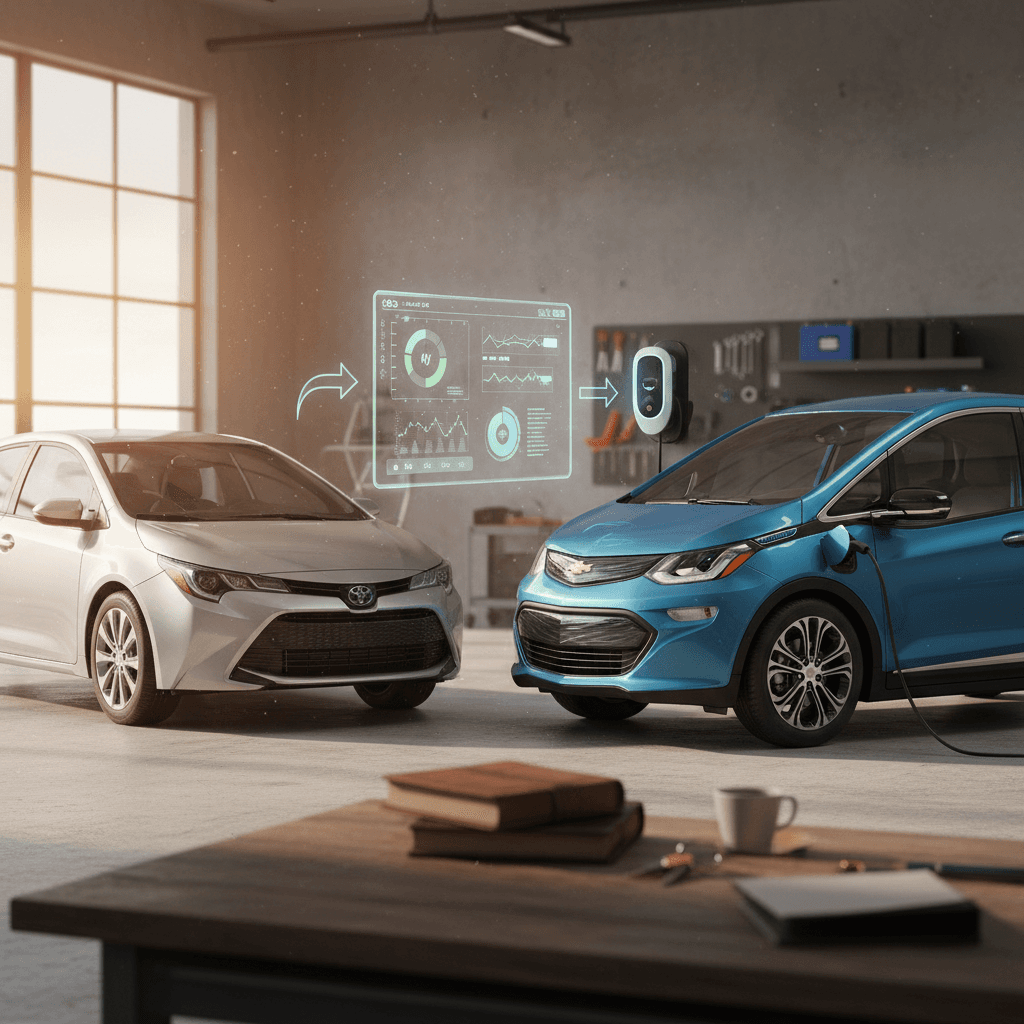
If you’re cross‑shopping a trusty Toyota Corolla against a Chevrolet Bolt EV, you’re really asking one big question: which one will cost less to own over the next few years? Looking beyond sticker price to total cost of ownership, fuel or electricity, maintenance, insurance, and resale, often flips the story on its head, especially when you factor in today’s surprisingly affordable used Bolt EV market.
Big picture
Why compare Toyota Corolla vs Chevrolet Bolt EV on ownership cost?
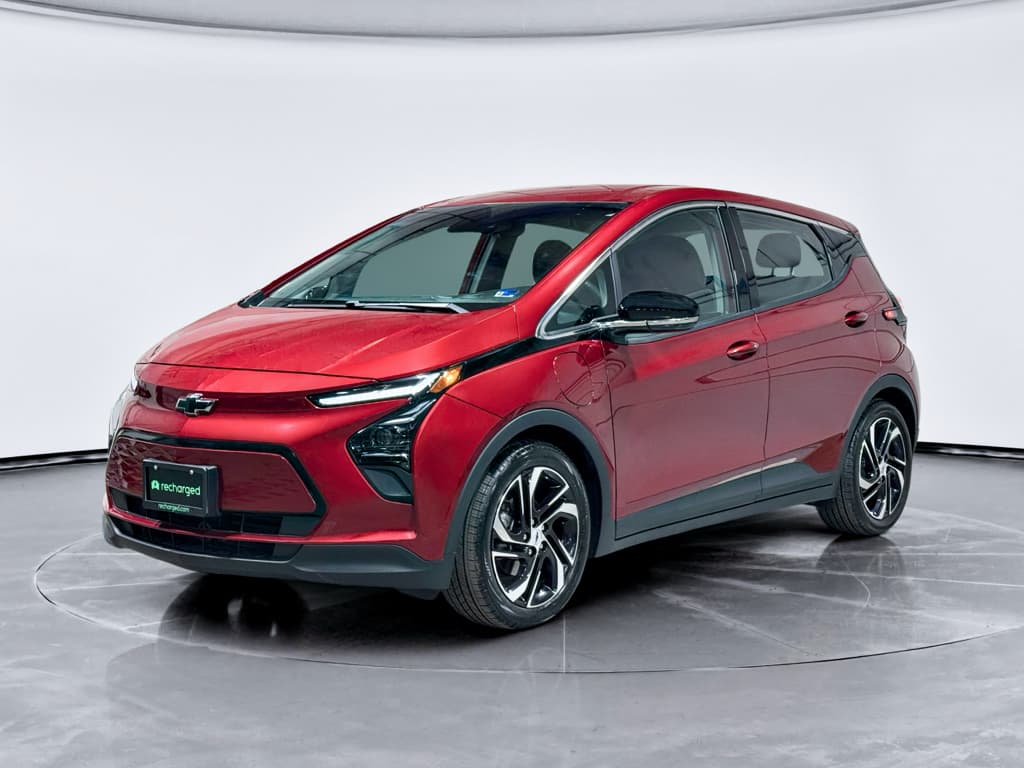
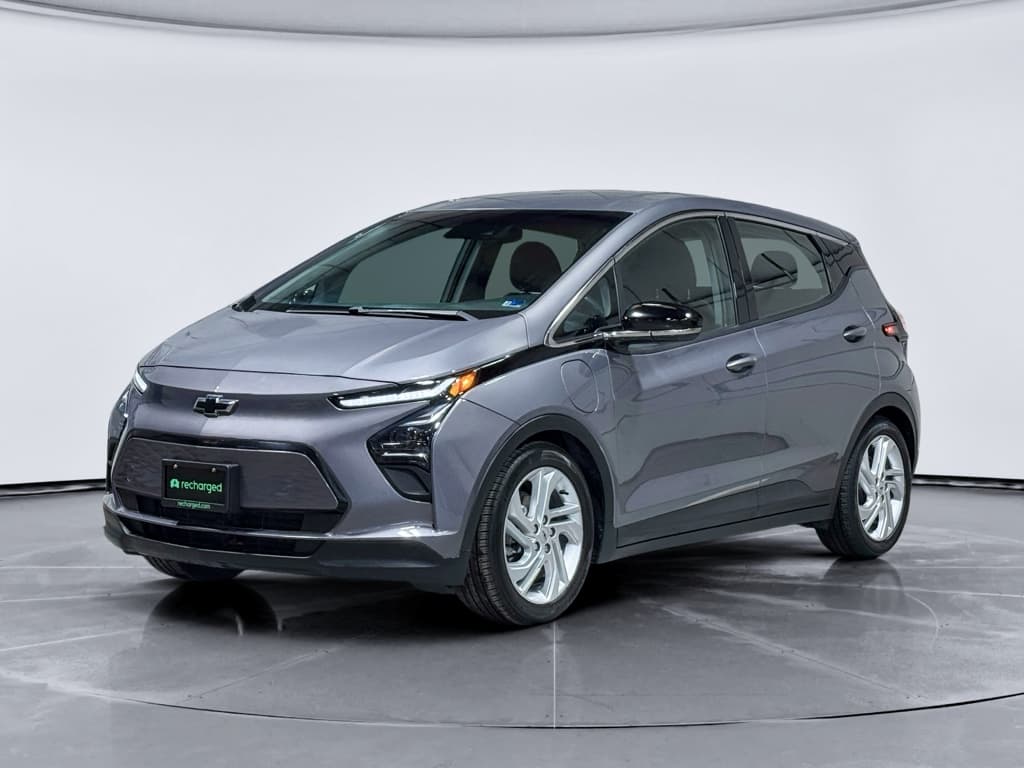
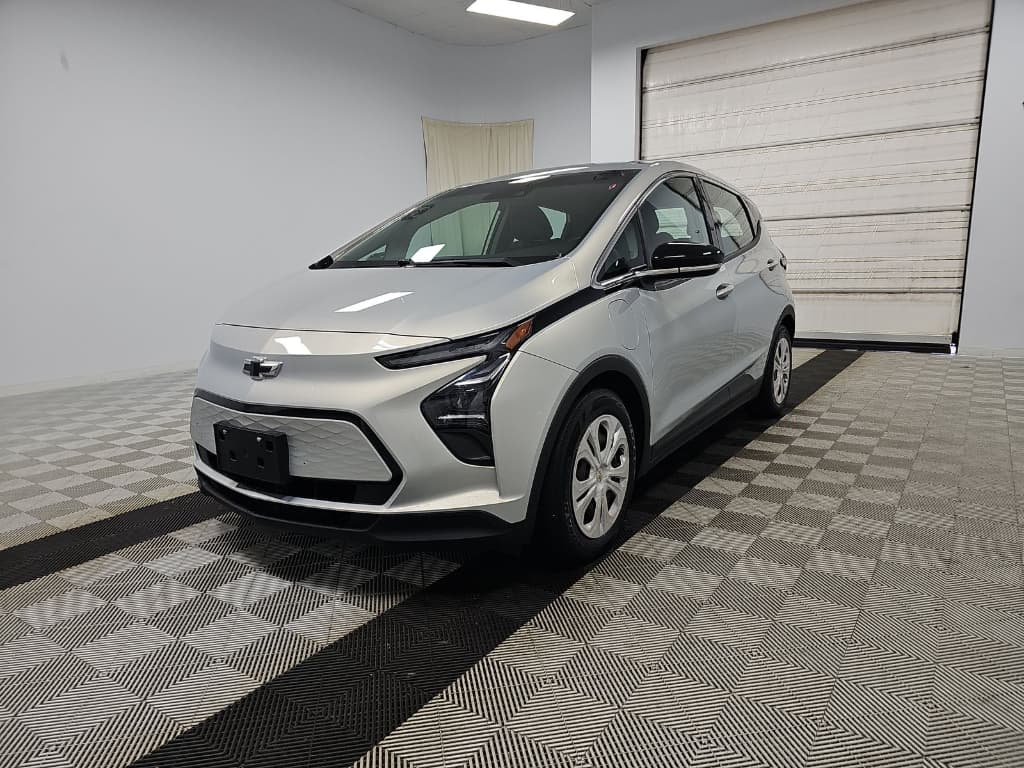
On paper, the Toyota Corolla is the safe, familiar pick: low purchase price, great reliability, and strong resale. The Chevrolet Bolt EV looks riskier because it’s an all‑electric hatchback from a brand newer to EVs and it went through a well‑publicized battery recall. But when you run the numbers, the Bolt EV’s low energy and maintenance costs can more than offset that nervousness, particularly if you buy a used example that’s already had its battery replaced.
This guide focuses on the U.S. market and uses typical assumptions: about 12,000 miles per year, a mix of city and highway driving, and home charging as the primary way to charge a Bolt EV. Your exact numbers will vary, but the direction of the math usually doesn’t.
Corolla vs Bolt EV: quick cost snapshot (typical U.S. driver)
About the numbers
Snapshot: which one really costs less to own?
Toyota Corolla: strengths
- Lower upfront price than a new Bolt EV.
- Excellent reliability record and wide dealer network.
- Gas everywhere, no planning for charging on long trips.
- Easy resale thanks to name recognition and demand.
Chevrolet Bolt EV: strengths
- Much cheaper "fuel" when you charge at home.
- Lower maintenance (no oil changes, fewer wear items).
- Great used values because early depreciation already happened.
- Quiet, quick city driving and one‑pedal operation many drivers love.
If you compare brand‑new MSRPs, the Corolla often looks like the bargain. But the market reality in 2026 is that used Chevrolet Bolt EVs are frequently priced in the same ballpark as late‑model used Corollas. When purchase price is a wash, the Bolt’s much lower running costs start to tilt the total cost of ownership in its favor.
Purchase price, incentives, and used market reality
Typical price ranges (U.S. market, early 2026)
Approximate transaction prices for common trims in the used and new markets.
| Vehicle | Scenario | Typical Price Range | Notes |
|---|---|---|---|
| Toyota Corolla | New LE/SE | $23,000–$27,000 | Before tax, title, and fees |
| Toyota Corolla | 3‑year‑old used | $16,000–$22,000 | Normal mileage, clean history |
| Chevrolet Bolt EV | New 2LT (when available) | $28,000–$32,000 | Pricing can shift with incentives |
| Chevrolet Bolt EV | 3‑ to 5‑year‑old used | $14,000–$22,000 | Varies with battery recall status and mileage |
Actual prices vary by region, mileage, condition, and interest rates. Always shop current local listings.
The recall twist that helps used buyers
For a monthly budget, the payment piece is often similar: a used Corolla and a used Bolt EV can both land in the same finance range once you plug in real interest rates and down payments. That’s why the rest of the ownership story, fuel or electricity, maintenance, and resale, matters so much.
Gas vs electricity: what you’ll actually spend to drive
Fuel is where the Bolt EV quietly sprints away from the Corolla. Even though the Toyota sips fuel compared with many gas cars, it’s still buying gasoline at retail prices. The Bolt is buying electricity, usually at your residential rate, and turning a much higher share of that energy into motion.
Estimated annual energy cost at 12,000 miles/year
Using typical U.S. averages for early 2026.
| Vehicle | Assumptions | Cost per Mile | Annual Energy Cost |
|---|---|---|---|
| Toyota Corolla | 34 mpg combined; $3.50/gal gas | ~$0.10/mi | ≈ $1,235/year |
| Chevrolet Bolt EV (home charging) | 0.28 kWh/mi; $0.15/kWh | ~$0.04/mi | ≈ $505/year |
| Chevrolet Bolt EV (50% DC fast charging) | 0.30 kWh/mi; $0.40/kWh DC fast | ~$0.12/mi | ≈ $1,430/year |
Your numbers will change with your actual fuel economy, electricity rate, and charging habits.
Home charging is the secret sauce
Run that math for five years at 12,000 miles a year, and you’re looking at roughly $6,000+ in gas for the Corolla versus around $2,500 in electricity for a home‑charged Bolt EV. That’s several car payments’ worth of difference.

Maintenance and repairs: where the EV quietly wins
Toyota has earned its reputation for low maintenance costs, and the Corolla is no exception: oil changes, filters, brakes, and tires, plus the occasional fluid or belt, are all straightforward and affordable. But an EV like the Bolt simply has fewer moving parts, so there’s less to service in the first place.
Maintenance needs: Corolla vs Bolt EV
What you’ll see on the repair order over the first 5–8 years.
Toyota Corolla maintenance
- Regular oil and filter changes.
- Engine air filter, cabin air filter.
- Transmission fluid service over time.
- Spark plugs and ignition components later in life.
- Brake pads and rotors (though modern cars stretch these further).
Chevrolet Bolt EV maintenance
- No engine, so no oil changes.
- Fewer fluids (no traditional transmission service).
- Brake pads last longer thanks to regenerative braking.
- Tires may wear a bit faster due to torque and weight.
- Coolant service for the battery/thermal system on schedule.
Real‑world data and owner reports suggest that many Bolt EV drivers spend only a few hundred dollars a year on routine service, often less if the car is still under warranty. Over five years, that can easily undercut Corolla maintenance by $1,000–$1,500, especially if you’re paying a dealership for every oil change.
Watch the battery warranty on a used Bolt EV
Insurance, taxes, and fees
Insurance can go either way. The Corolla’s lower initial price and plentiful parts can keep comprehensive premiums in check. The Bolt EV can sometimes cost a bit more to insure thanks to higher repair bills for EV‑specific components, and because insurers are still learning how to price them in some regions.
- In many zip codes, insurance costs for a Corolla and a Bolt EV land within shouting distance, especially for experienced drivers with clean records.
- Registration and property taxes (where applicable) generally track vehicle value. If a used Corolla and a used Bolt EV have similar prices, their annual taxes tend to be similar too.
- Some states and utilities offer EV‑specific discounts or perks, reduced registration fees, HOV lane access, or off‑peak electricity rates that effectively cut your charging cost. These sweeten the Bolt’s ownership story but vary widely by location.
Get real quotes, not guesses
Resale value and depreciation over time
The Corolla plays the long game. Gas Corollas historically hold their value well, especially if you maintain them by the book and keep mileage reasonable. They’re easy to sell because almost everyone knows what a Corolla is and what to expect from one.
The Bolt EV’s story is more complicated. Early on, high MSRP and consumer hesitation around range and recalls drove steep depreciation. That was bad news for first owners, but it’s exactly why used shoppers can find attractive prices now. The battery recall, oddly enough, can be a plus if the car you’re eyeing already has a new pack with newer chemistry.
Thinking beyond 5 years
5‑year total cost of ownership: simple model
Let’s put the major pieces together. We’ll keep the math simple and conservative, skipping edge cases and ultra‑low interest specials. Think of this as a back‑of‑the‑envelope comparison for a typical buyer in early 2026.
Approximate 5‑year total cost of ownership
Assumes 12,000 miles/year, 5‑year loan, and average U.S. prices.
| Category | Used Toyota Corolla (≈$19k) | Used Chevy Bolt EV (≈$19k) |
|---|---|---|
| Loan payment (5 yrs, avg rate) | ≈ $335/mo | ≈ $335/mo |
| Fuel or electricity | ≈ $1,235/yr (~$103/mo) | ≈ $505/yr (~$42/mo) |
| Routine maintenance | ≈ $600/yr (~$50/mo) | ≈ $350/yr (~$30/mo) |
| Insurance | ≈ $1,200/yr (~$100/mo) | ≈ $1,300/yr (~$108/mo) |
| Registration/taxes (avg) | Similar at same price | Similar at same price |
| Estimated 5‑yr resale | Strong; modest edge | Improving; depends on EV demand |
Numbers rounded for clarity; actual costs vary by region, credit score, and how you drive.
Add it up and you get roughly:
- Corolla: around $450/month all‑in over 5 years.
- Bolt EV: around $430/month all‑in over 5 years, assuming mostly home charging.
When the Bolt EV loses the math
Which is better for you: Toyota Corolla or Chevy Bolt EV?
Quick fit check: which side are you on?
You mostly drive under 200 miles a day
The Bolt EV shines for commuters and around‑town driving. If your daily routes are short and you take only a couple of long road trips a year, its range is usually more than enough.
You can reliably charge at home
A driveway or garage with access to at least a standard 120V outlet (Level 1) is the starting point. A 240V Level 2 outlet makes living with a Bolt EV effortless.
You care about lowest running costs
If shaving $60–$100 a month off your combined fuel and maintenance budget matters, the Bolt EV looks better the longer you own it.
You do a lot of road tripping
Frequent cross‑country driving still favors gas. The Corolla wins if you’re regularly covering long distances where charging infrastructure is sparse or time is tight.
You want simple, proven, and predictable
If you’re risk‑averse, don’t want to think about charging, and plan to keep the car a long, long time, the Corolla is tough to beat.
You like tech and smooth driving
If quiet, instant torque, and one‑pedal driving appeal to you, as well as skipping gas stations, the Bolt EV delivers a very different, very modern experience.
Bottom line
How Recharged helps you shop a used Bolt EV with confidence
If the numbers are nudging you toward a used Bolt EV, the next question is: how do you buy one without guessing about the battery or overpaying? That’s exactly where Recharged comes in.
What you get with a used Bolt EV from Recharged
Less guessing, more knowing.
Recharged Score battery health report
Fair market pricing and financing
Trade‑in and nationwide delivery
Ready to find your next EV?
Browse VehiclesIf you’re comparing a Corolla you can buy anywhere to a Bolt EV you’re thinking about buying online, having that battery health transparency and EV‑specialist support can be the difference between a great deal and a regrettable guess.
FAQ: Toyota Corolla vs Chevrolet Bolt EV total cost of ownership
Frequently asked questions
In the end, a Toyota Corolla and a Chevrolet Bolt EV answer slightly different questions. If you want simple, proven, and familiar, the Corolla delivers exactly what it promises. If you’re ready to plug in, can charge at home, and care about shaving your running costs, a used Bolt EV often wins the long‑game math. Run the numbers for your life, not just the brochure, and if you go electric, lean on tools like the Recharged Score and EV‑savvy support so you’re getting the best version of that bet, not rolling the dice on a mystery battery.