If you own a Toyota bZ4X and you’re thinking about selling or trading it in 2026, you’re not alone. Early discounts, lease deals, and fast-moving EV incentives have made Toyota bZ4X resale value a moving target, and this guide is here to make sense of it so you don’t leave thousands of dollars on the table.
What this 2026 bZ4X resale guide covers
Why bZ4X resale value looks different in 2026
The bZ4X launched into a tough part of the EV cycle. Early demand was soft, Toyota offered heavy discounts and lease incentives, and then cut pricing again for the 2025 model year. That helped new sales, but it also pushed used values down faster than Toyota hybrids or gas SUVs usually fall.
- Aggressive discounts on new 2024–2025 bZ4X models made late‑model used examples relatively cheaper.
- The federal EV tax credit rules shifted multiple times, changing how competitive the bZ4X looked versus rivals.
- EV resale values in general cooled from 2023 onward as more supply hit the used market and buyers became more price‑sensitive.
By early 2026, the result is a used bZ4X market where pricing has largely found its footing: still weaker than Toyota’s legendary hybrids, but more stable than some first‑generation EVs that suffered high-profile battery or software issues.
Toyota bZ4X resale snapshot for 2026
How much a Toyota bZ4X is worth in 2026
Exact values will vary by trim, mileage, options, and condition, but as of 2026 the used market has enough data to sketch out realistic ranges for U.S. buyers and sellers. Below is a simplified view aimed at personal-use, clean-title vehicles in good condition.
Illustrative 2026 Toyota bZ4X resale value ranges
Approximate private-party resale ranges for typical U.S. vehicles in good condition. High-mileage, damaged, or branded-title vehicles will fall below these numbers; low‑mile, one‑owner examples can land above them.
| Model year / trim | Typical mileage in 2026 | Illustrative resale range (private party) | Trade‑in range at dealer |
|---|---|---|---|
| 2022 bZ4X XLE FWD | 35,000–50,000 miles | $20,000–$24,000 | $17,000–$21,000 |
| 2022 bZ4X Limited AWD | 30,000–45,000 miles | $22,000–$26,000 | $19,000–$23,000 |
| 2023 bZ4X XLE AWD | 25,000–40,000 miles | $23,000–$27,000 | $20,000–$24,000 |
| 2024 bZ4X XLE AWD | 15,000–30,000 miles | $25,000–$29,000 | $22,000–$26,000 |
| 2025 bZ4X XLE AWD | 10,000–20,000 miles | $27,000–$31,000 | $23,000–$27,000 |
Use these numbers as a starting point, then refine using live-market tools and a professional appraisal.
Don’t treat these as offers
Toyota bZ4X depreciation: 5-year outlook
To understand your 2026 resale value, you need to understand the bZ4X’s depreciation curve. Independent cost-to-own tools and Kelley Blue Book modeling show the bZ4X dropping faster than a RAV4 Hybrid, but roughly in line with many mainstream electric crossovers.
- A sample 2025 bZ4X shows roughly $24,000 in depreciation over the first five years of ownership, according to cost‑to‑own modeling.
- KBB data for a 2024 bZ4X suggests that after just a couple of years, retained value can fall into the mid‑40% range relative to original MSRP.
- By most rankings, the bZ4X lands in the lower tier for 2024 SUV value retention, but not an outlier among EVs hit by price cuts and incentive swings.
How it compares to typical EV depreciation
Across the EV market, heavy discounting and rapid tech turnover have pushed many models to lose 45–60% of their value in three years. The bZ4X sits inside that band, not dramatically better or worse than key rivals like the VW ID.4 or Hyundai Ioniq 5.
How it compares to other Toyotas
Where the bZ4X disappoints is versus Toyota’s own gas and hybrid lineup. A well-optioned RAV4 Hybrid or Highlander tends to retain value far better over 5–7 years. That matters, because buyers bring those expectations into EV negotiations, often underestimating how much the early EV price war pulled used values down.
Rule-of-thumb depreciation for planning
Key factors that move bZ4X resale up or down
Main drivers of Toyota bZ4X resale value in 2026
Some factors you can’t control, but many you can.
Mileage & usage
Like any vehicle, low mileage helps. For a 2022–2023 bZ4X in 2026, the sweet spot is roughly 20k–40k miles. Once you’re past ~60k miles, buyers start to worry more about wear items and long‑term battery health.
Battery condition
EV buyers are laser‑focused on range. A bZ4X that still delivers near‑original real‑world range is worth more than one that’s noticeably degraded or frequently fast‑charged at high SOC. Independent battery health data is a big differentiator.
Accidents & cosmetic condition
Even minor accidents, poorly repaired paint, or curb‑rashed wheels can shave thousands off your resale. Clean Carfax/Autocheck plus a tidy interior go a long way in a crowded used EV market.
Original price & incentives
If you bought before Toyota’s price cuts or without taking advantage of big lease incentives, your effective depreciation is steeper than the next owner’s. Buyers care about today’s transaction price, not what you paid.
Regional demand
Coastal EV hotspots and ZEV states typically support stronger resale values. In regions where charging infrastructure lags or electricity is expensive, bZ4X demand can be softer, and so are offers.
Charging & tech expectations
By 2026, buyers expect easy fast‑charging access and competitive range. How confidently you can explain your bZ4X’s charging experience, and whether you include cables, adapters, and software updates, affects perceived value.
Battery health, warranty, and resale value
For any used EV, resale value ultimately lives or dies on the battery. The bZ4X benefits from Toyota’s conservative approach: a relatively modest pack, cautious charging curves, and long warranty coverage aimed at keeping capacity loss in check.
- Toyota designed the bZ4X’s battery to retain around 90% capacity after 10 years under typical use, according to Toyota technical and press materials.
- U.S. battery warranty coverage is generally 8 years/100,000 miles for EV components, with some extended coverage available or enhanced programs in other regions.
- Real‑world owner reports through 2025 show few widespread traction-battery failures, though isolated issues do exist, as with any first‑generation EV.
Why independent battery health data matters
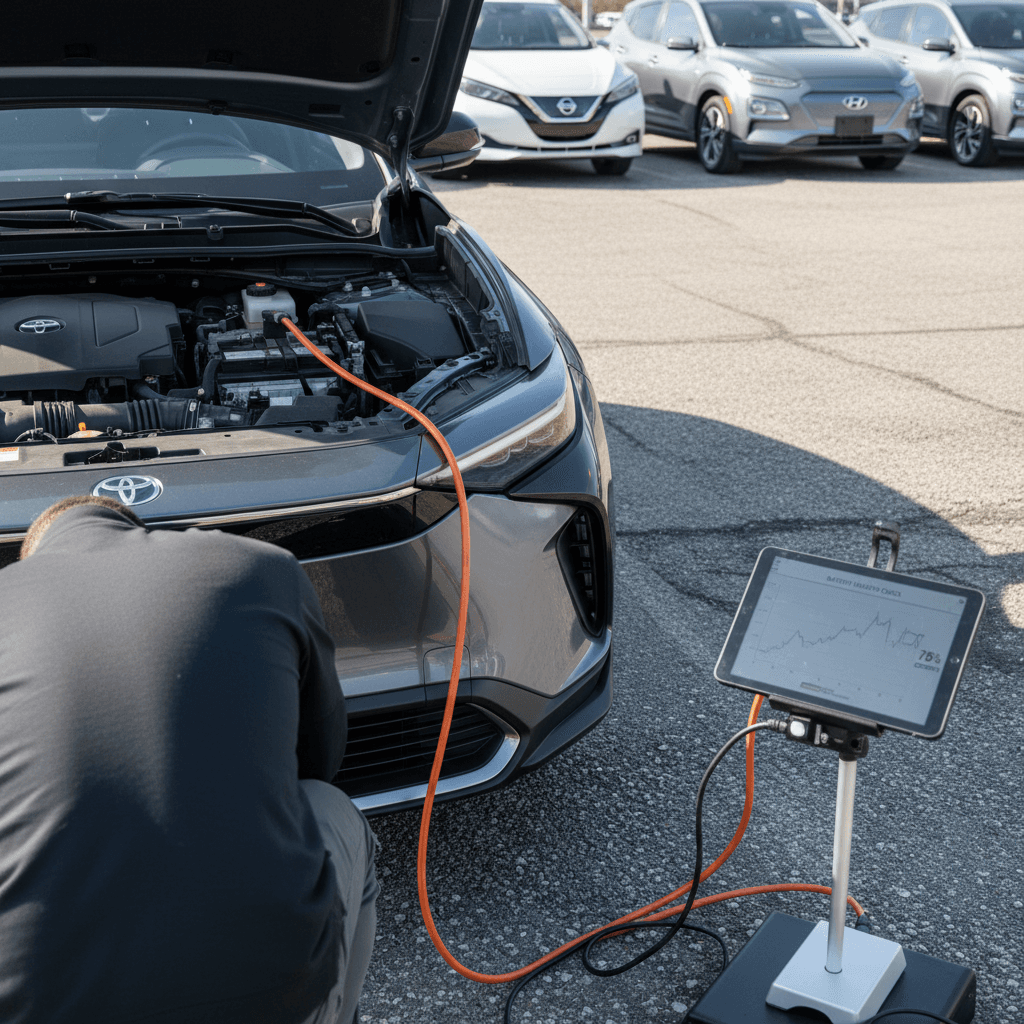
Battery-health checklist before you list your bZ4X
1. Document charging habits
Buyers pay more for EVs that haven’t lived on DC fast chargers. If most of your charging has been Level 2 at home and you avoid frequent 0–100% cycles, note that in your listing.
2. Get a third-party battery report
Use a specialist service, like the Recharged Score, to generate a <strong>verifiable battery-health report</strong>, not just an in‑dash range estimate. Upload or print that report for potential buyers.
3. Gather service and recall records
Make sure any bZ4X recalls or software updates have been completed and that you can prove it. A clean service history reassures buyers that the battery has been properly managed.
4. Show real-world range
If you routinely get a certain highway or city range, track it over a few weeks and be ready to share. Real‑world numbers, especially in winter, matter more than brochure estimates.
How the bZ4X compares to competing EVs on resale
The bZ4X doesn’t exist in a vacuum. Shoppers comparing used electric SUVs in 2026 are cross‑shopping Tesla, Hyundai, Kia, Ford, VW, and more. Your resale value is shaped by how your Toyota stacks up against those alternatives on range, charging, perceived quality, and price.
Used resale positioning: Toyota bZ4X vs rival EV SUVs (2026 snapshot)
High-level view of how the bZ4X tends to compare in U.S. used-EV conversations for 2022–2024 model years.
| Model | Perceived resale strength | Typical buyer perception in 2026 |
|---|---|---|
| Toyota bZ4X | Below Toyota norm, mid-pack for EVs | Great brand reputation and warranty, but modest range and early discounts drag values down. |
| Tesla Model Y | Strong | Better range and Supercharger access; Tesla’s brand and OTA updates support higher resale. |
| Hyundai Ioniq 5 | Mid-pack | Stylish, good charging speed, but also hit by price cuts; resale similar or slightly stronger than bZ4X in many markets. |
| VW ID.4 | Weaker | Deeper discounts and software headlines have hurt confidence; bZ4X can look safer long‑term. |
| Ford Mustang Mach‑E | Mid-pack | Solid brand and performance image offset by frequent price changes; similar volatility to bZ4X. |
These are generalized trends; specific vehicles can buck the pattern depending on mileage, options, and local demand.
Where the bZ4X quietly shines for used buyers
Best time to sell a Toyota bZ4X in 2026
Timing matters more for EVs than it does for gas cars, because new incentives, software updates, or next‑generation models can move the market quickly. For bZ4X owners in 2026, a few practical rules of thumb help you choose the moment to exit.
- For most owners, the sweet spot to sell is between 2 and 5 years of age and roughly 20,000–60,000 miles. That’s when you’ve used some of the car’s value but the battery and warranty still look very attractive to the next buyer.
- If you bought early at a high price, 2026–2027 may be your best window to sell before newer Toyota EVs or major range upgrades arrive and reset used values downward again.
- Seasonality still matters. Late spring through early fall tends to be stronger for selling an EV, especially in colder regions where winter range performance is top of mind.
Watch new-EV incentives before you list
Pricing your used Toyota bZ4X for a 2026 sale
The biggest mistake bZ4X owners make is anchoring on what they paid rather than what the market will pay today. Because EVs have moved so quickly, your personal transaction price, especially if you bought before big discounts, may be badly out of sync with reality.
Four-step process to price your bZ4X realistically
Combine data sources and real buyer behavior, not just book values.
1. Scan live listings
Search major marketplaces for same-year, similar‑mileage bZ4X listings near you. Note both asking prices and how long each listing has been sitting.
2. Check multiple value guides
Compare Kelley Blue Book, Edmunds, and other tools for trade‑in and private‑party numbers. Treat them as ballparks, not guarantees.
3. Get at least two real offers
Get an instant offer from a dealer, large used‑car buyer, or a marketplace like Recharged. Real offers reveal where cash buyers actually are in 2026.
4. Decide on your lane
If you want a quick, low‑hassle exit, price near trade‑in offers. If you’re willing to wait and show the car, aim for a 5–10% premium over those numbers for private sale.
Anchor buyers with your total value story
Maximizing your bZ4X trade-in or private-sale value
Once you’ve aligned on a realistic price range, your next job is to move your bZ4X to the top of that range, or at least avoid slipping to the bottom. The good news: most of what matters here is completely under your control.
Practical steps to squeeze the most value from your bZ4X
Detail the car before any appraisal
A professional interior and exterior detail can easily pay for itself. EV shoppers tend to assume a clean cabin correlates with careful charging and maintenance habits.
Fix obvious, low-cost issues
Replace cracked windshield glass, burned‑out bulbs, or severely worn tires if you can do it cheaply. These are the first things appraisers and private buyers notice, and they’ll mentally overestimate the cost of fixing them.
Prepare a simple “EV facts” sheet
List your average efficiency (mi/kWh), typical daily range, home charging setup, and any public-charging networks you use. For buyers new to EVs, this makes your bZ4X feel lower risk than a similar listing with no context.
Gather all keys, cables, and accessories
Missing charge cables or second keys cost more to replace than most sellers expect. Having the full kit ready to go makes your bZ4X feel complete and supports a stronger offer.
Be realistic about trade‑in vs private sale
Dealers and online buyers build in margin, reconditioning, and risk. If you want their convenience, you’ll accept less than top‑of‑market private‑party numbers. Decide upfront which matters more: time or money.
How Recharged helps bZ4X owners capture fair value
Selling an EV is harder than selling a gas car, because buyers have more questions: How healthy is the battery really? What’s a fair price given wild incentive swings? Will I regret this when the next model lands? Recharged is built specifically to close that information gap for used EVs like the bZ4X.
Why bZ4X owners use Recharged in 2026
Specialized EV tools and services aimed at transparent resale value.
Recharged Score battery diagnostics
Every vehicle sold through Recharged includes a Recharged Score Report that measures real‑world battery health and range. That independent data helps justify your asking price and builds trust with buyers who might otherwise be nervous about a used bZ4X.
Multiple ways to sell
Recharged offers instant offers, trade‑ins, and consignment. If you’re after speed, you can get a fast, digital offer. If you want top dollar, consignment lets Recharged market and sell your bZ4X to the right EV audience while you keep driving it until it’s sold.
Financing & nationwide delivery
Because Recharged also helps buyers with financing and nationwide delivery, your bZ4X can reach shoppers far beyond your local market, often increasing demand and supporting stronger resale values than a local‑only listing.
Ready to find your next EV?
Browse VehiclesA more transparent used-EV experience
Toyota bZ4X resale value FAQ (2026)
Frequently asked questions about Toyota bZ4X resale in 2026
The 2026 Toyota bZ4X resale story is complicated: a solid, conservative EV saddled with the growing pains of a fast‑moving market. You can’t rewrite the early‑EV price war, but you can control when and how you sell, how you document battery health, and whether you lean on EV‑specific tools and marketplaces. If you approach your bZ4X sale with real data instead of wishful thinking, and, ideally, with a transparent partner like Recharged, you’ll be in a far better position to get every dollar your used electric Toyota is actually worth.