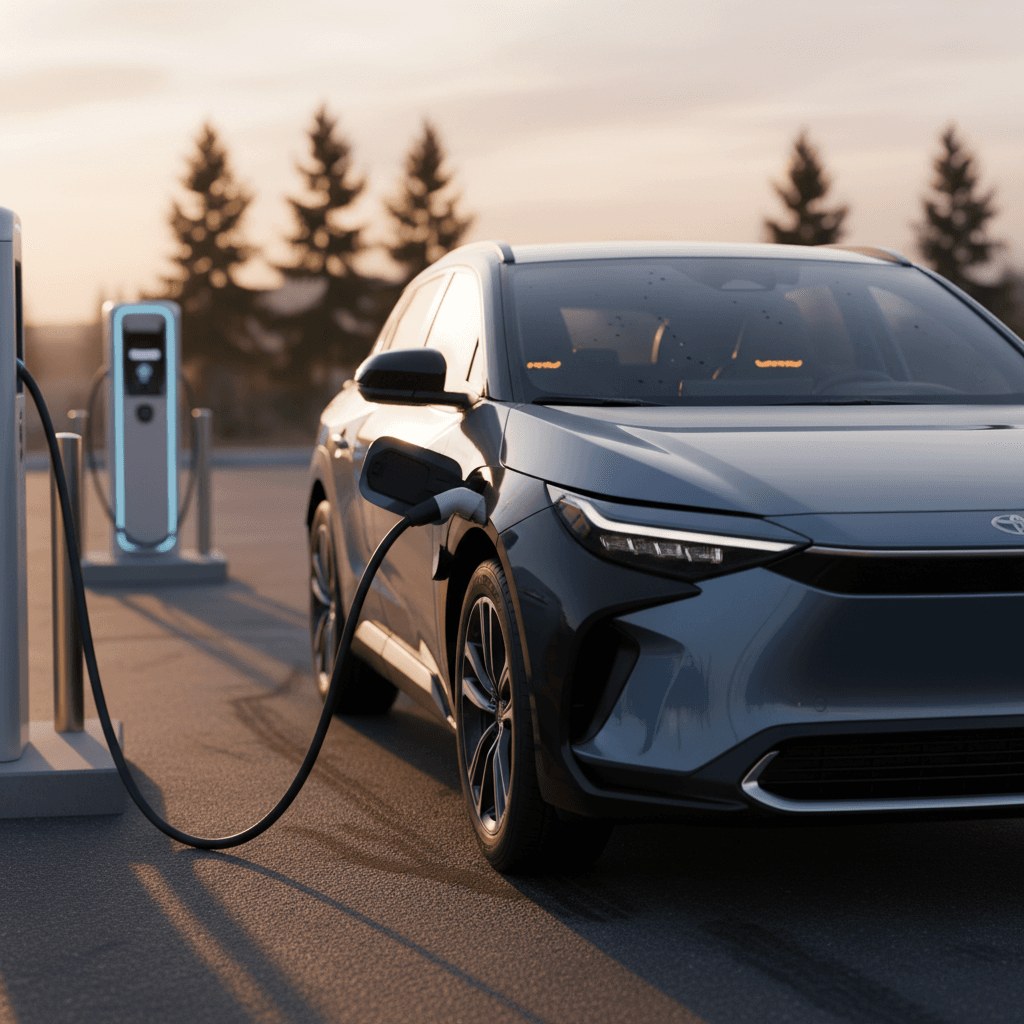
The Toyota bZ4X has a reputation: sensible, efficient, and, depending on who you ask, frustratingly conservative about fast charging. If you’re trying to decode the official claims versus real‑world experience, this Toyota bZ4X charging speed guide will walk you through what to actually expect at home, on DC fast chargers, and on road trips, plus how to keep the battery healthy for the long haul.
At a glance
Toyota bZ4X charging basics
Before you get lost in kilowatts and curves, it helps to separate three different questions: How big is the battery? How quickly can the car accept power? And what kind of charger are you actually plugged into? The bZ4X sits in the middle of the compact‑SUV pack here: a ~71–73 kWh battery, a modest 6.6 kW on‑board AC charger, and DC fast‑charging that’s officially rated higher than it often delivers in the real world.
- Battery size (North America): roughly 71–73 kWh gross, mid‑60s kWh usable depending on FWD vs AWD and model year.
- On‑board AC charger: 6.6 kW, which caps your maximum Level 2 charging speed.
- DC fast‑charging peak: up to 150 kW for FWD, up to 100 kW for most AWD trims.
- Connector standards: J1772 for AC charging and CCS1 for DC fast charging (until NACS migrates across the industry).
Don’t confuse kW and kWh
Battery size and charging hardware explained
What’s inside the bZ4X matters for how it charges
Toyota’s conservative engineering shows up in both chemistry and charging hardware.
Battery pack
Most North American bZ4X models use a lithium‑ion pack around 71–73 kWh gross, with roughly 64–67 kWh usable. Toyota deliberately keeps a big buffer to extend pack life, which is great for longevity but means usable capacity is a little lower than some rivals on paper.
On‑board charger & ports
The car’s built‑in AC charger is rated at 6.6 kW. That means even if you plug into an 11 kW Level 2 station, the car will only ever take about 6–7 kW. For DC fast charging, FWD trims can theoretically pull up to 150 kW, while AWD trims are capped around 100 kW under ideal conditions.
Toyota also programs the bZ4X with very conservative thermal management and charge curves. In plain English: the car is cautious about heat and long, repeated fast‑charging sessions. That’s partly why you’ll see decent peak numbers on a warm battery, but also why the car backs off quickly, especially in cold weather or after several DC sessions in one day.
Home charging speeds: Level 1 vs Level 2
For most bZ4X owners, home charging is where the car makes the most sense. You plug in at night, wake up to a full (or deliberately partial) battery, and forget the rest. The question isn’t “How fast can it charge?” so much as “Will it be ready by morning?”, and the answer is almost always yes with a properly sized Level 2 setup.
Toyota bZ4X home charging speed estimates
Approximate times from low state of charge to 80% and 100% on typical home setups.
| Charger type | Outlet / circuit | Approx. power to car | 10–80% time | 10–100% time | Miles added per hour* |
|---|---|---|---|---|---|
| Level 1 | 120V, 15A household outlet | ~1.2 kW | ~35–40 hours | ~45–50 hours | 3–4 mi/hr |
| Level 2 (low) | 240V, 20–30A circuit | ~3.3–5.0 kW | ~9–13 hours | ~12–16 hours | 10–18 mi/hr |
| Level 2 (max for bZ4X) | 240V, 40A+ circuit (32–40A to car) | ~6.0–6.6 kW | ~8–10 hours | ~10–12 hours | 20–25 mi/hr |
Times assume roughly 65 kWh usable battery and normal temperatures. Your exact results will vary.
Where Level 2 sweet‑spot lives
If you’re commuting 30–60 miles a day, even a mid‑range Level 2 charger will refill your daily use in just a couple of hours each night. Level 1 can work for shorter commutes or apartment dwellers plugging in every single night, but it’s not ideal if you frequently arrive home low or need to recover big mileage quickly.
Real‑world DC fast charging speeds
On paper, Toyota says that under ideal conditions a bZ4X can go from 10–80% in roughly 30 minutes (FWD) or 35 minutes (AWD) on a high‑output DC fast charger, usually 150 kW or more. In practice, real‑world tests and owner data show that you’ll often land somewhere between the brochure numbers and the grumbling on internet forums.
Typical DC fast‑charging performance for bZ4X (warm battery)
bZ4X DC fast‑charging: what to expect by drivetrain
These are realistic trip‑planning numbers, not just marketing claims.
| Drivetrain | Peak power (ideal) | 10–80% time (typical) | Best SOC window for trips | Notes |
|---|---|---|---|---|
| FWD | Up to ~150 kW | ~30–35 minutes | 10–70% | Faster initial ramp, good to leave once you’re above ~70%. |
| AWD | Up to ~100 kW | ~35–45 minutes | 10–65% | Lower peak, more conservative taper, don’t linger above ~70% unless necessary. |
Assumes warm battery, temps around 60–80°F, and a healthy 150 kW charger with no power sharing.
Cold weather is the bZ4X’s kryptonite
There are also differences between early‑build cars and later software revisions. Toyota has improved the charging curve over time, but the car still prioritizes battery life over headline‑grabbing speed. If you’re cross‑shopping with a Hyundai Ioniq 5 or Tesla, understand that the bZ4X simply won’t sprint up the charger in quite the same way, and that’s by design.
Toyota’s fast‑charging limits in a 24‑hour period
One of the most misunderstood quirks of the bZ4X is Toyota’s approach to limiting repeated DC fast‑charging sessions. Buried in the fine print is guidance that after several 10–80% fast‑charge sessions in a 24‑hour window, the car may deliberately slow subsequent DC charging to protect the pack.
- Toyota documentation in some markets references roughly 3–5 full 10–80% DC fast‑charge sessions in a 24‑hour period before speed is reduced.
- After that threshold, additional DC charging may still work, but at much lower power levels, think 30–50 kW instead of 100–150 kW.
- This limit is based on accumulated DC fast‑charging time and heat, not an arbitrary counter that switches off your fast‑charge privileges.
- For normal daily driving with occasional road trips, you’ll almost never hit this ceiling; it’s mainly a concern for marathon road‑trippers.
What this means on a long road trip
Road‑tripping in a bZ4X without losing your mind
Can you road‑trip a bZ4X? Absolutely. Will it feel like a Lucid Air at a 350 kW charger? No. The trick is to lean into the car’s strengths, usable mid‑pack efficiency and Toyota’s conservative battery management, while staying out of the slow parts of the charge curve as much as possible.
Smart bZ4X road‑trip charging strategy
1. Live in the 10–70% window
You get the best kW‑per‑minute bang between roughly 10–60 or 70% state of charge. Above that, the car tapers hard and you’re paying a lot of time for a few extra miles.
2. Pre‑warm the battery when you can
Arrive at DC fast chargers with at least 20–30 minutes of highway driving behind you so the pack isn’t ice‑cold. In very cold weather, plan a short first stop to wake things up, then a normal‑length stop later.
3. Favor 150 kW (or higher) stations
A 350 kW charger won’t make the bZ4X faster than 150 kW, but it’s usually newer and less likely to be power‑limited. Avoid sharing pedestals where one cabinet splits power between stalls, if possible.
4. Don’t chase 100% on the road
Going from 80–100% on DC can take as long as going from 20–60%. Unless the next stretch is truly charger‑desert territory, leave at 70–80% and save yourself 15–30 minutes per stop.
5. Watch the weather and elevation
Headwinds, cold, and mountains all chew through range. Give yourself more buffer in winter or at high speeds, pretend your max range is 15–20% lower than the dash estimate.
6. Build in real breaks
Use the bZ4X’s natural 30–40 minute stop rhythm as actual meal and rest breaks. You’ll enjoy the trip more and care less that you aren’t charging at 250 kW like your neighbor’s Tesla.
Where the bZ4X shines on trips
How to charge for long‑term battery health
Toyota engineered the bZ4X for boringly long life, this is the Camry of EV batteries. If you want that longevity on your side, a few habits will keep the pack happier and reduce degradation, especially if you’re buying or selling a used bZ4X and want to preserve value.
Battery‑friendly charging habits
Small changes in how and when you plug in can pay off years down the road.
Avoid living at 100%
For daily use, charge to 70–80% instead of 100% whenever you can. Save full charges for road trips or days when you know you’ll need the range. High state of charge plus heat is what really ages lithium‑ion packs.
Use DC fast charging sparingly
There’s no problem using fast chargers on trips, but try not to treat them as your daily fuel pump. Frequent DC charging, especially from very low to very high SOC, accelerates wear versus gentler Level 2 at home.
Be kind in extreme temps
In very hot or cold weather, avoid leaving the car sitting for days at 100% or near empty. In winter, let the car pre‑condition while plugged in so the pack warms up on grid power, not just during your drive.
Good news for used‑EV shoppers
What bZ4X charging really costs
Charging speed is only half the story; cost is the other half. The bZ4X’s efficiency is solid for a square‑shouldered SUV, which keeps your electricity bill in check whether you’re topping off at home or on public networks.
Home charging costs
Assume the bZ4X averages around 3.2–3.7 miles per kWh in mixed driving. On a $0.15/kWh residential rate, that’s roughly 4–5 cents per mile. A full 10–100% charge on a ~65 kWh usable pack is in the ballpark of $9–11, and you won’t be doing that every night.
If your utility offers off‑peak EV rates, schedule charging for those hours; it’s common to cut that cost by 25–40% with time‑of‑use plans.
Public DC fast‑charging costs
On many U.S. networks, you’ll see $0.35–$0.60 per kWh depending on region and membership. At $0.45/kWh, that’s about 12–14 cents per mile in a bZ4X, still cheaper than a thirsty crossover, but more than home charging.
Because the car slows down dramatically above ~80%, you’re often better off unplugging early and saving that expensive, slow electricity for your home charger.
Used bZ4X tip: check the charging mix
Extra charging tips if you’re shopping used
A used bZ4X can be a quietly excellent value, especially if the first owner wasn’t trying to reenact cannonball runs. Charging behavior leaves fingerprints; you just have to know where to look.
Charging‑focused checks for a used Toyota bZ4X
1. Look at range vs state of charge
On a full or mostly full battery, does the indicated range line up reasonably with EPA estimates and owner reports? A healthy pack shouldn’t be showing dramatically shrunken numbers unless it lives in harsh conditions.
2. Ask about charging habits
You want answers like “plugged in at home every night” and “used fast charging mostly on trips,” not “supercharged it twice a day because it was free at work.”
3. Inspect the charge port and cables
Check for damage, corrosion, or melted plastic around the CCS port and any included home charging equipment. Excessive wear can hint at rough use or overheating events at cheap public stations.
4. Review service and software history
Make sure the car has received Toyota’s battery‑management and charging software updates. A dealer or EV‑focused retailer like Recharged can pull this history and explain what’s been done.
5. Get an independent battery health report
Whenever possible, back up your impressions with a <strong>battery health diagnostic</strong>. At Recharged, every used EV comes with a <strong>Recharged Score Report</strong> that quantifies pack health and helps you compare cars apples‑to‑apples.
Toyota bZ4X charging FAQ
Frequently asked questions about Toyota bZ4X charging speeds
Bottom line: Is the bZ4X “too slow” to charge?
The Toyota bZ4X is not a charging‑lane hero, if you live on the interstate and worship 350 kW numbers, there are better choices. But for the way most people actually use an electric crossover, home charging, school runs, commuter duty, and a few road trips a year, it’s entirely workable, even quietly reassuring. The car is engineered to protect its battery first and impress spec‑sheet warriors second.
If you can charge at home and you’re willing to plan road‑trip stops around the 10–70% sweet spot, the bZ4X’s charging quirks fade into the background, and you’re left with a roomy, efficient crossover backed by Toyota’s long‑term battery confidence. If you’re exploring a used bZ4X, a retailer like Recharged can fill in the blanks with verified battery diagnostics, transparent pricing, and EV‑savvy guidance so you know exactly what kind of charging performance you’re signing up for, today and years down the road.