If you’re considering a Toyota bZ4X, or already driving one, the question that really matters isn’t just range. It’s **what the Toyota bZ4X charging cost per mile looks like** in your day‑to‑day life. The good news: once you understand a few simple numbers, you can quickly estimate what every commute, errand run, and road trip will actually cost.
Key takeaway up front
Toyota bZ4X charging cost per mile: the short answer
Let’s start with a simple, big‑picture answer before we dig into the math. Across typical U.S. electricity prices and real‑world efficiency, most owners will see their **Toyota bZ4X charging cost per mile** land in these ranges:
- Home Level 2 charging (typical U.S. rate ~17¢/kWh): about $0.05–$0.07 per mile
- Cheap off‑peak home electricity (~12¢/kWh): as low as $0.04 per mile
- Public DC fast charging (around 40–45¢/kWh on major networks): roughly $0.12–$0.16 per mile
- Expensive markets or peak pricing (50–60¢/kWh fast charge): up to $0.18–$0.20 per mile
Those ranges assume **real‑world efficiency around 3.0–3.7 miles per kWh** for mixed driving. In city driving you can do better; high‑speed winter road trips will be worse. We’ll walk through those scenarios in detail next so you can plug in your own numbers.
Toyota bZ4X cost per mile snapshot (2026 U.S. averages)
How efficient is the Toyota bZ4X in kWh per mile?
To get to **charging cost per mile**, you need two building blocks: how much energy the bZ4X uses and what you pay per kilowatt‑hour (kWh). Efficiency is usually given in **kWh per 100 miles** or **miles per kWh**.
Toyota bZ4X efficiency numbers
Official EPA figures plus reasonable real‑world ranges many owners report.
| Scenario | Metric | Approx. value |
|---|---|---|
| EPA combined (example AWD trim) | kWh per 100 miles | ~32 kWh/100 mi |
| EPA combined (same) | Miles per kWh | ~3.1 mi/kWh |
| Real‑world city/suburban | Miles per kWh | 3.5–4.0 mi/kWh in mild weather |
| Real‑world mixed driving | Miles per kWh | 3.0–3.5 mi/kWh |
| High‑speed winter highway | Miles per kWh | 2.2–2.8 mi/kWh |
Exact numbers vary by trim, drivetrain (FWD vs AWD) and conditions, but these benchmarks are useful for cost calculations.
For the rest of this guide, we’ll use **3.3 miles per kWh** as a reasonable mixed‑driving baseline for a bZ4X. That lines up with EPA data and what many owners report in real use. You can substitute your own average from the car’s trip computer if you want a more personalized estimate.
A quick rule of thumb
Home charging: bZ4X cost per mile with real examples
Most bZ4X owners will do the bulk of their charging at home. In 2025 U.S. residential electricity averaged around the **mid‑teens cents per kWh** nationwide, with 2026 early data still in that neighborhood. Some states are closer to 12¢/kWh, others well above 25¢/kWh, but **17¢/kWh is a fair national ballpark** for planning.
Example 1: Typical U.S. rate
Assumptions:
- Electricity price: 17¢/kWh
- Efficiency: 3.3 mi/kWh mixed driving
Cost per mile:
0.17 ÷ 3.3 ≈ $0.052 per mile (about 5.2 cents)
Cost per 1,000 miles:
1,000 × $0.052 ≈ $52
Example 2: High‑cost electricity state
Assumptions:
- Electricity price: 28¢/kWh
- Efficiency: 3.0 mi/kWh (more highway)
Cost per mile:
0.28 ÷ 3.0 ≈ $0.093 per mile (about 9.3 cents)
Cost per 1,000 miles:
1,000 × $0.093 ≈ $93
Even in a relatively expensive electricity market, your **Toyota bZ4X charging cost per mile at home** is typically still comfortably lower than a comparable gas SUV, especially if you can shift charging to off‑peak hours.
Quick steps to estimate your own bZ4X home charging cost per mile
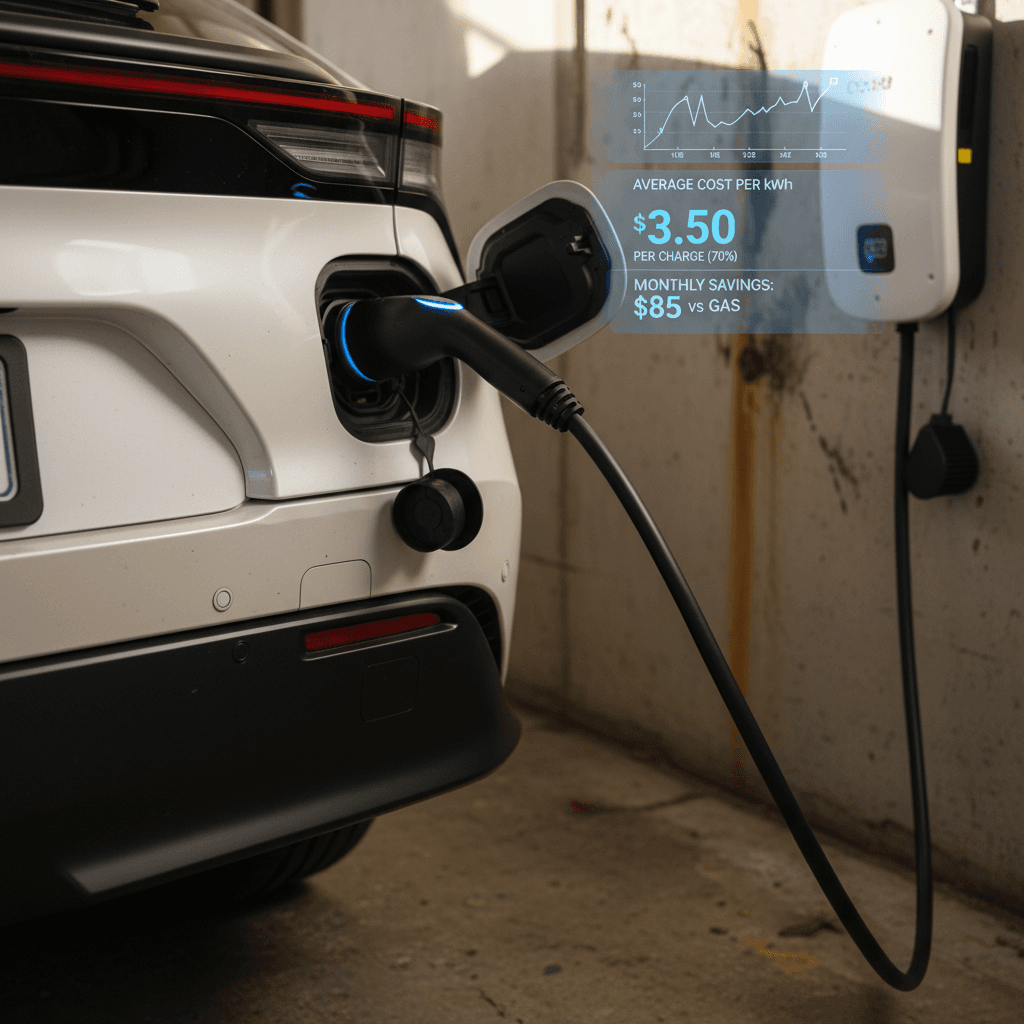
1. Find your kWh price on your bill
Look for the line that lists your total cents per kWh, including delivery and fees. If rates vary by time of use, note both peak and off‑peak prices.
2. Check your recent efficiency
In your bZ4X’s trip computer, find your average miles per kWh over a few hundred miles. Use that real‑world number for better accuracy.
3. Divide price by efficiency
Take your electricity price (in dollars per kWh) and divide by your miles per kWh. That’s your personal <strong>charging cost per mile</strong>.
4. Multiply by monthly miles
If you drive 1,000 miles a month, multiply your cost per mile by 1,000 to see your approximate monthly “fuel” cost.
Public DC fast charging cost per mile
Public DC fast charging is all about **speed and convenience**, and you pay for the privilege. By 2025, big U.S. fast‑charging networks commonly priced standard rates in the **mid‑40‑cents‑per‑kWh range**, with membership discounts bringing some sessions into the **mid‑30‑cents** band. Guest or peak rates can push higher.
Toyota bZ4X fast‑charging cost per mile scenarios
Use these as reference points when planning road trips or if you rely heavily on public charging.
Member, fair pricing
Assumptions:
- Energy price: 0.35 $/kWh
- Road‑trip efficiency: 2.8 mi/kWh
Cost per mile:
0.35 ÷ 2.8 ≈ $0.13 per mile
Standard public rate
Assumptions:
- Energy price: 0.42 $/kWh
- Efficiency: 2.7 mi/kWh
Cost per mile:
0.42 ÷ 2.7 ≈ $0.16 per mile
High‑cost / peak pricing
Assumptions:
- Energy price: 0.55 $/kWh
- Cold‑weather efficiency: 2.3 mi/kWh
Cost per mile:
0.55 ÷ 2.3 ≈ $0.24 per mile
Don’t judge EV costs by roadside fast charging alone
City vs highway, winter vs summer: how your driving changes costs
Just like a gas SUV, your **Toyota bZ4X charging cost per mile** depends heavily on speed, temperature, and how you drive. Unlike gas, you see this directly as miles per kWh instead of mpg.
How conditions affect Toyota bZ4X cost per mile
Estimates assume 17¢/kWh at home and 42¢/kWh on DC fast charging.
| Scenario | Miles per kWh | Home cost per mile | Fast‑charge cost per mile |
|---|---|---|---|
| Warm‑weather city commuting | 3.8 mi/kWh | ≈ $0.045 | ≈ $0.11 |
| Mixed driving, mild temps | 3.3 mi/kWh | ≈ $0.052 | ≈ $0.13 |
| 70–75 mph highway, mild | 2.8 mi/kWh | ≈ $0.061 | ≈ $0.15 |
| Cold‑weather highway | 2.3 mi/kWh | ≈ $0.074 | ≈ $0.18 |
Your actual results will vary, but the pattern, cheap city miles, pricey cold‑weather highway miles, is consistent.
Why winter hurts EV cost per mile
How bZ4X charging cost per mile compares to a gas SUV
Cost per mile only makes sense when you compare it to what you’d otherwise be driving. The bZ4X competes with compact and midsize gasoline SUVs that often average **around 25 mpg combined** in real use.
Gas SUV example
- Fuel economy: 25 mpg
- Gas price: $3.75/gal (nationally plausible in recent years)
Cost per mile (gas):
$3.75 ÷ 25 ≈ $0.15 per mile
Toyota bZ4X example
- Efficiency: 3.3 mi/kWh
- Home electricity: 17¢/kWh
Cost per mile (EV, home charging):
0.17 ÷ 3.3 ≈ $0.052 per mile
On those assumptions, your **Toyota bZ4X charging cost per mile at home is roughly one‑third of a typical gas SUV’s fuel cost**. Even if you did half your miles on ordinary‑priced DC fast charging, you’d still come out ahead overall.
Realistic annual savings
7 ways to lower your Toyota bZ4X charging cost per mile
Practical ways to keep your bZ4X cost per mile low
1. Charge at home whenever possible
Home Level 2 charging is usually **2–4× cheaper per mile** than DC fast charging. Install a 240‑volt charger where you park most often if you can.
2. Use off‑peak or EV‑specific rates
Many utilities offer lower prices overnight. Schedule your bZ4X to charge when rates drop; in the app or vehicle settings you can set a preferred charging window.
3. Drive smoothly and slow down a bit
Hard acceleration and high freeway speeds eat into miles per kWh. Cruising at 70 instead of 80 mph can noticeably cut your energy use and cost per mile.
4. Precondition while plugged in
On very hot or cold days, pre‑heat or pre‑cool the cabin while the car is still plugged in so more of your battery is used for driving, not HVAC.
5. Watch your tire pressure
Under‑inflated tires increase rolling resistance. Checking pressures monthly helps preserve efficiency and tire life, both reduce ownership costs.
6. Plan fast‑charge stops strategically
When you must use public fast charging, favor lower‑priced networks or membership plans and arrive with a lower state of charge so you take fuller advantage of high charge speeds.
7. Consider your housing and driving pattern
If you can’t install home charging and rely heavily on high‑priced public fast chargers, your cost per mile rises. In that situation, compare total cost of ownership across EVs and efficient hybrids carefully.
Buying a used bZ4X? What battery health means for cost per mile
If you’re looking at a **used Toyota bZ4X**, your charging cost per mile depends not only on electricity prices but also on **how much usable battery capacity the car still has**. As batteries age, usable capacity slowly declines, so you may get fewer miles from the same number of kWh drawn from the grid.
- A healthy battery helps you maintain **strong miles per kWh** and practical driving range.
- A more degraded battery doesn’t necessarily use more kWh per mile, but you’ll hit your range limit sooner, which can push you toward more frequent, and potentially more expensive, charging stops.
- Knowing the true state of the battery makes it easier to compare different used bZ4X listings on equal footing.
How Recharged can help on a used bZ4X
Toyota bZ4X charging cost per mile: FAQ
Frequently asked questions about bZ4X charging costs
Bottom line: what to expect from bZ4X charging costs
When you break the numbers down, the **Toyota bZ4X charging cost per mile** is easy to live with, and in many cases dramatically cheaper than a comparable gas SUV. For a typical U.S. driver charging mostly at home, you’re realistically looking at **five to seven cents per mile**, with road‑trip fast charging landing in the low to mid‑teens per mile.
The real key is matching the bZ4X to your situation: your electricity rates, how often you can charge at home, and the kind of driving you do. If you’re leaning toward a used bZ4X, working with a specialist marketplace like Recharged, with Recharged Score battery health diagnostics, transparent pricing, nationwide delivery, and EV‑savvy support, can make it far easier to understand your true cost per mile before you ever sign paperwork.
Run the math with your own electricity rate, think about where you’ll plug in most often, and compare that to what you’re currently spending at the pump. For many shoppers, that exercise is the moment an electric crossover like the bZ4X stops being an abstract idea and starts looking like a smart, predictable ownership decision.