If you own, or are shopping for, a used EV, you’ve probably heard passionate opinions about Tesla Supercharger vs Electrify America. One camp swears by Tesla’s massive, reliable network. The other points to Electrify America’s ultra‑fast 350 kW chargers and open access. In 2026, with most new EVs moving to Tesla’s NACS plug, the comparison is changing fast. Let’s unpack what really matters when you’re the one staring at the battery gauge on a dark interstate.
At a Glance
Why Tesla Supercharger vs Electrify America Matters in 2026
A few years ago, the choice was simple: if you drove a Tesla, you used Superchargers; if you drove anything else, you hunted for CCS fast chargers from Electrify America, EVgo, and others. Today, that line is blurred. Major automakers have adopted Tesla’s NACS connector, adapters are rolling out, and Tesla has opened much of its network to non‑Tesla EVs. At the same time, Electrify America has quietly bulked up its footprint and upgraded thousands of chargers.
For you, this isn’t a tech story, it’s a quality‑of‑life story. The difference between these two networks can decide whether a 600‑mile trip in your used Mach‑E, Ioniq 5, or Model 3 feels like a smooth cruise or a stress test. It also affects which used EVs feel easy to live with in your region, which is exactly the kind of tradeoff we think about every day at Recharged when we evaluate vehicles and battery health for our marketplace.
Network Size & Coverage: Who’s Easier to Find?
Tesla Supercharger vs Electrify America: 2025–2026 Footprint
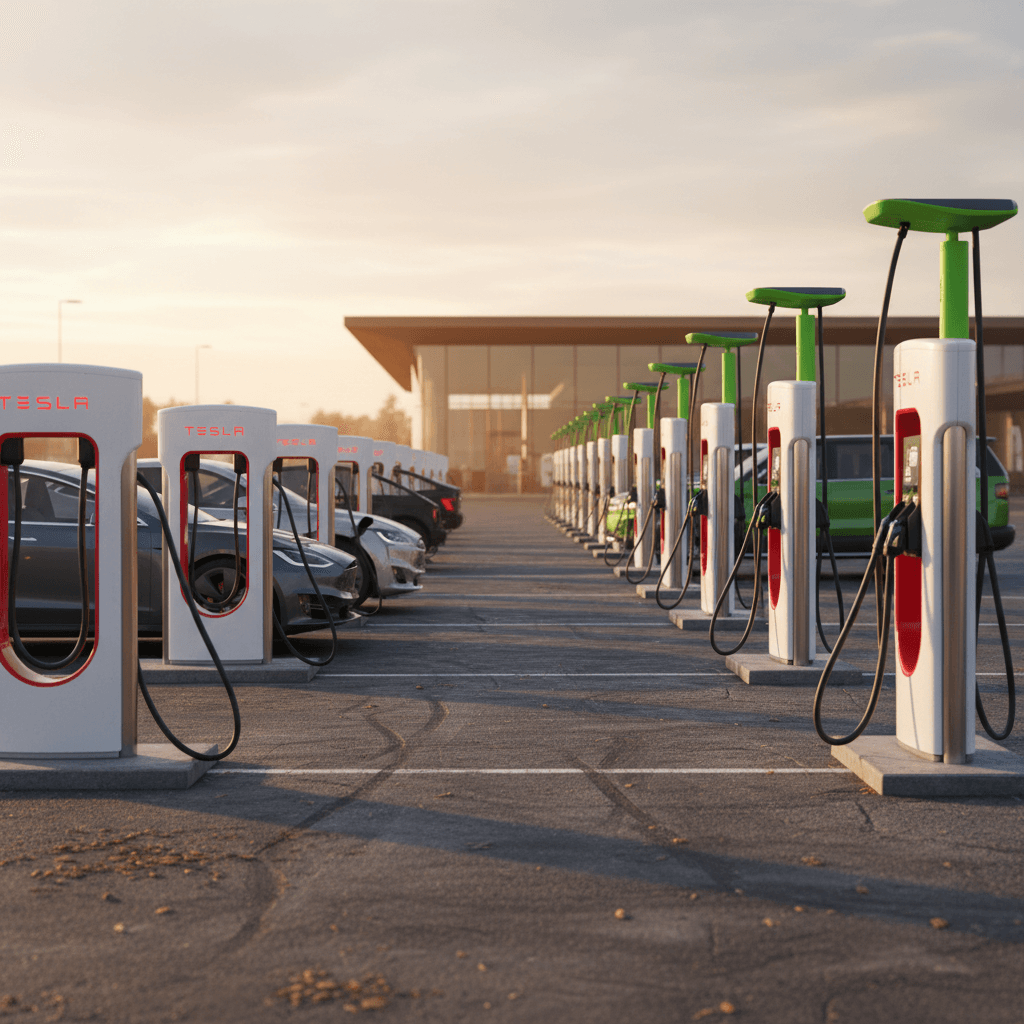
From a pure numbers standpoint, Tesla’s network is still in another league. Superchargers blanket U.S. highways, with stations typically every 100–150 miles along major routes. That density is what has long made cross‑country Tesla road trips feel almost casual.
Electrify America’s coverage strategy is different. The network leans into urban and suburban hubs, shopping centers, Walmart parking lots, and big retail corridors, while also building along interstate routes. You’re more likely to find EA chargers in town, and more likely to find Superchargers in the middle of nowhere between towns. If you live in a city and mainly fast‑charge near errands, Electrify America can be very convenient. If you’re a long‑haul highway driver, Tesla still feels like the easier safety net.
Coverage Strengths: Supercharger vs Electrify America
Different networks, different sweet spots
Tesla Supercharger: Long-Haul Specialist
- Dense coverage on major interstate corridors.
- Many large sites (20+ stalls) reduce wait times.
- Global footprint if you road‑trip into Canada or Mexico.
- Growing access for non‑Tesla EVs via NACS and adapters.
Electrify America: Everyday Errand Runner
- Strong presence in urban and suburban retail centers.
- Strategic highway sites roughly every 100 miles in many regions.
- Open to nearly all CCS and CHAdeMO EVs out of the box.
- Expanding rapidly, with 800+ additional chargers added in 2025 alone.
How to Check Coverage for Your Routes
Charging Speed & Technology: 250 kW vs 350 kW and Beyond
On paper, Electrify America wins the spec-sheet race. Many of its latest units can deliver up to 350 kW on 800‑volt EVs like the Hyundai Ioniq 5, Kia EV6, or Porsche Taycan. In ideal conditions, that can mean 20–25 miles of range per minute at the start of a session.
Tesla’s V3 Superchargers are rated up to 250 kW, and newer V4 cabinets are stepping up to around 325 kW. In real life, that translates to roughly 16–18 miles per minute on compatible Teslas and many NACS‑equipped non‑Tesla EVs. Tesla’s strength isn’t just peak power; it’s how predictable those speeds feel from site to site.
Charging Speed Comparison: Tesla Supercharger vs Electrify America
Peak power and real‑world behavior for popular EVs
| Aspect | Tesla Supercharger | Electrify America |
|---|---|---|
| Peak power (current hardware) | Up to ~325 kW (V4), 250 kW (V3) | Up to 350 kW on latest stations |
| Best‑case vehicles | Tesla models, newer NACS EVs | 800V EVs (Ioniq 5/6, EV6, Taycan, etc.) |
| Typical real‑world peak | 150–250 kW | 150–300 kW (when everything behaves) |
| Common limiting factor | Battery state of charge, sharing a cabinet | Thermal throttling, site power limits, derated units |
| Session consistency | High, similar behavior across most sites | Mixed, some fantastic, some frustrating |
Remember that your EV’s battery and software, not just the charger, determine how much power you actually see.
Don’t Chase Peak kW Alone
Pricing & Memberships: What Will You Actually Pay?
Public fast charging prices move around with utility rates and local markets, but some patterns are clear in 2026. Both networks bill mostly by kWh in states that allow it, and by the minute where regulations require.
Tesla Supercharger Pricing
- Typical range: roughly $0.25–$0.60/kWh depending on region, time of day, and whether you’re a Tesla owner or using a supported non‑Tesla.
- In some areas, Tesla undercuts competing networks during off‑peak hours to keep sites busy.
- Pricing is clearly shown in the Tesla app before you start a session, so you can do a quick mental cost‑per‑mile check.
Electrify America Pricing
- EA Pass (no subscription): higher per‑kWh or per‑minute pricing, often in the $0.40–$0.60/kWh equivalent range.
- EA Pass+ (paid membership): a monthly fee unlocks lower energy rates, often trimming $0.05–$0.10/kWh off your bill if you fast‑charge regularly.
- Peak vs off‑peak pricing, plus some session fees or idle fees at busy sites.
Estimate Your Real Cost per Mile
If you only fast‑charge a few times a year on road trips, the monthly membership for Electrify America may not pencil out. If you road‑trip every month in a CCS‑only EV, EA Pass+ can make a noticeable dent in your yearly charging budget.
Reliability & User Experience: Plug-and-Play vs Plug-and-Pray
Every EV owner has a charging horror story. The question is: how often do those stories happen? In independent comparisons and fleet testing through 2024–2025, Tesla consistently posts uptime numbers near 99.9%, while public data and owner surveys typically place Electrify America’s reliable‑session rate somewhere in the 90–95% band.
In the driver’s seat, those percentages translate into something simple: with Tesla, most stops feel boring, in a good way. You back in, plug in, walk away. With Electrify America, you can have excellent sessions, but you’re more likely to encounter a broken connector, a charger that won’t handshake with your car, or one that derates to low power unexpectedly.
User Experience: How It Feels to Charge
It’s not just about plugs and power, it’s about how your trip goes.
Apps & Start-Up
Tesla: Start, monitor, and pay directly in the Tesla app or car’s screen. Minimal steps, tight integration.
EA: Start via EA app, RFID card, or some in‑vehicle integrations. Slightly more fiddly, but improving.
Session Reliability
Tesla: Very high ‘plug & charge’ success rate; most stalls at a site behave the same.
EA: Huge progress in 2024–2025 with upgraded hardware, but still more variance site‑to‑site.
Site Amenities
Tesla: Increasingly pairs chargers with coffee, food, and even flagship diner concepts.
EA: Often at big‑box retailers with restrooms and shopping nearby, great for errands.
Arrive With a Plan B
NACS vs CCS: Connector Standards and Compatibility
Until recently, the U.S. fast‑charging world was split between Tesla’s proprietary plug and the industry‑standard CCS connector. In 2023 and 2024, that started to change as most major automakers announced plans to adopt Tesla’s NACS (North American Charging Standard) port on future models.
Electrify America built its network around CCS (plus a dwindling number of CHAdeMO connectors for older Nissan LEAFs). Starting in 2025, EA began adding NACS cables to new and upgraded sites, turning many locations into true dual‑standard hubs. Meanwhile, Tesla has been opening a growing portion of its Superchargers to non‑Tesla EVs via built‑in adapters and external NACS‑to‑CCS adapters supplied by automakers.
If You Drive a Tesla
- You can use Superchargers natively, no adapter required.
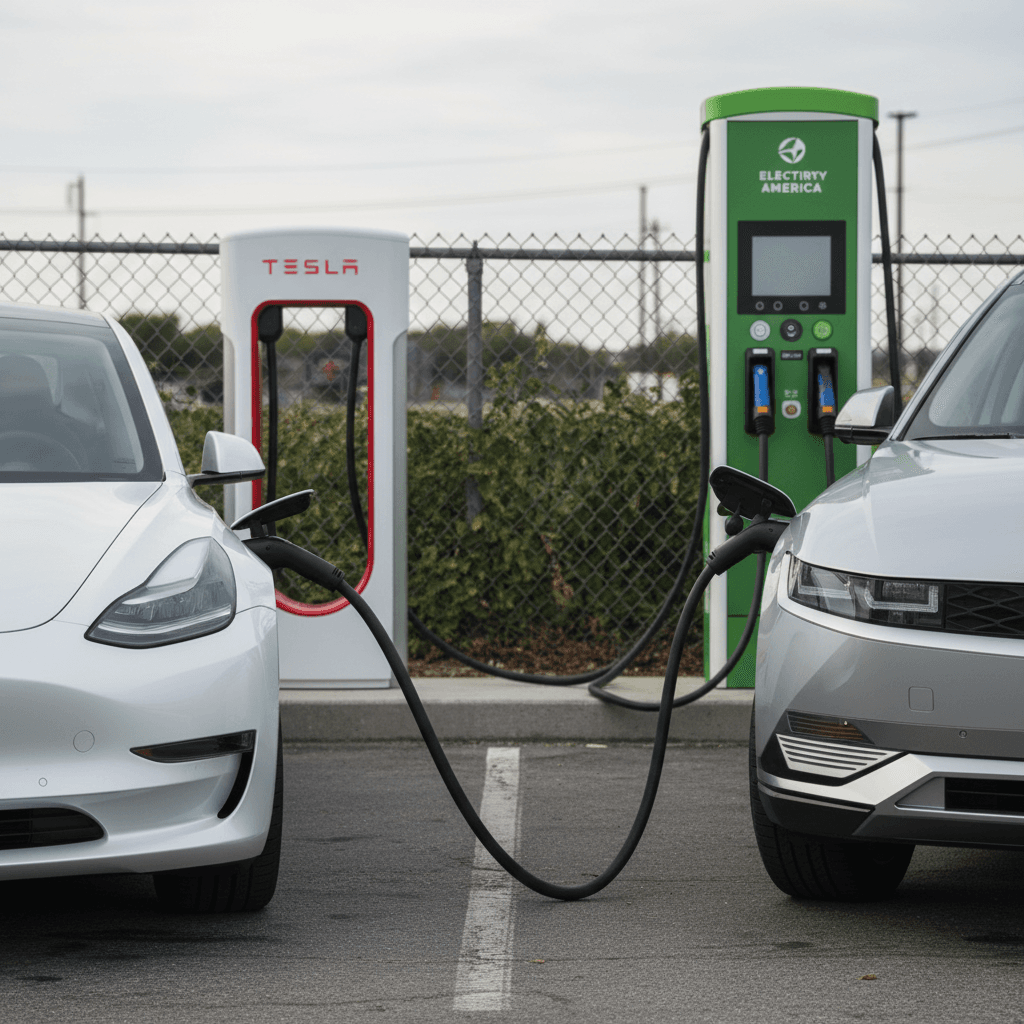
- You can also use many Electrify America stations with a CCS adapter (sold separately), though real‑world speeds and reliability can vary.
- For most Tesla owners, Superchargers will remain the primary long‑distance solution, with EA as a useful backup in certain areas.
If You Drive a Non-Tesla EV
- CCS‑only models (older Mach‑E, ID.4, Bolt, etc.) currently rely on Electrify America and similar networks. Automaker‑supplied adapters may unlock Superchargers on some models.
- Newer NACS‑equipped models will plug straight into Tesla Superchargers and, increasingly, NACS cables at EA sites.
- Over the next few years, owning a NACS‑port EV will feel like flying with TSA PreCheck, you’ll have more lanes to choose from.
Adapters Are a Bridge, Not a Lifestyle
Which Network Is Better for You? Scenarios by Driver Type
Best-Fit Network by Driving Style
High-Mileage Highway Commuter
If you drive 25,000+ miles a year up and down interstate corridors, Tesla’s dense Supercharger grid and strong reliability are hard to beat.
A used Tesla Model 3 or Model Y gives you native access; a newer NACS‑equipped non‑Tesla can work almost as seamlessly.
Electrify America remains a valuable backup, save EA sites in your navigation for peak holiday travel when Superchargers get crowded.
Urban/Suburban Errand Runner
If your ‘road trip’ is mostly Costco, soccer, and school drop‑off, Electrify America’s big‑box locations can be more convenient.
Fast‑charging while you shop can make sense if you don’t have home charging or drive a plug‑in company car.
Tesla Superchargers near malls and retail centers are growing, but EA still has the edge in some shopping corridors.
Occasional Road-Tripper
If you take 2–4 road trips a year, total network reliability and simple wayfinding matter more than tiny price differences.
A Tesla or newer NACS‑equipped EV plus Superchargers is the lowest‑stress option today.
If you own a CCS‑only EV, map your favorite destinations against Electrify America sites and other CCS networks before you leave.
Apartment Dweller Without Home Charging
You may live on public fast charging, which means cost and site convenience add up quickly.
EA Pass+ can be worth it if you’re using Electrify America weekly.
Some Tesla Superchargers are now colocated with grocery stores and lifestyle centers, check which network sits closest to your front door, not just your highway route.
Real-World Road Trip Tips Using Both Networks
On a real 2,000‑plus‑mile loop in 2025 with a non‑Tesla SUV, the pattern was clear: Superchargers reduced mental load, while Electrify America sometimes required a bit more improvisation, but also delivered some wonderfully fast sessions on modern hardware.
- Plan around 10–80% state of charge. Both networks (and your battery) are happiest when you avoid dwelling at 95–100% unless you truly need the range.
- Use multiple apps. Keep Tesla, Electrify America, PlugShare, and your automaker’s app on your phone so you can cross‑check station status and amenities.
- Favor larger sites. A 12‑stall location is more forgiving than a lonely two‑stall stop if one unit is misbehaving.
- Think about food and restrooms first. You’re going to be there 20–40 minutes anyway, pick stops that feel comfortable after dark.
- In winter, arrive with more buffer. Cold batteries and derated chargers are a double whammy; a 15–20% arrival target is safer than rolling in at 5%.
Winter Battery Warm-Up
What This Means for Used EV Buyers
Fast‑charging access is now a major part of a used EV’s real‑world value. A low‑mileage crossover that only plays nicely with one finicky network can be more stressful to own than an older sedan that taps into multiple robust networks.
Questions to Ask Before You Buy a Used EV
Supercharger vs Electrify America is part of the bigger charging story.
1. Which plug does it have?
2. How’s the battery health?
3. What’s near your home and routes?
At Recharged, every EV listing includes a Recharged Score Report with verified battery health and fair‑market pricing, so you’re not guessing how many road‑trip summers that pack has left. Our EV specialists can also walk you through which nearby Supercharger and Electrify America locations will pair best with the car you’re eyeing, before you sign anything.
Checklist: How to Choose Your Primary Fast-Charging Network
6-Step Fast-Charging Decision Checklist
1. Map Your Top 5 Regular Routes
Open both the Tesla and Electrify America apps and drop pins on your commute, kid activities, and common weekend drives. Count how many reliable options each network offers within 5–10 minutes of those routes.
2. Confirm Your EV’s Connector and Adapter Options
Check whether your current or future EV uses CCS, NACS, or both, and whether the automaker sells a trusted adapter for Supercharger access. Avoid off‑brand adapters that lack clear testing data.
3. Compare Real-World Pricing
Look up typical per‑kWh rates for the exact stations you’d use, not just averages. Factor in EA Pass+ or loyalty discounts and check idle fees for both networks.
4. Read Recent Station Reviews
A five‑star rating from 2020 doesn’t help you in 2026. Scan recent user reviews on PlugShare or inside the networks’ apps for notes about broken units, busy times, and site lighting.
5. Test-Charge Before You Depend on It
If possible, do a shakedown run on each network before a big trip, charge from 20% to about 70% and note how long it takes, how simple it feels, and whether the site layout works for you.
6. Factor in the Next 5 Years
Think ahead. NACS adoption means Tesla Superchargers will likely get even more flexible, and Electrify America will add more NACS cables. Choose a car and home base that will age gracefully with the charging landscape.
FAQ: Tesla Supercharger vs Electrify America
Frequently Asked Questions
Bottom Line: Supercharger vs Electrify America in 2026
Stacked side by side, Tesla Supercharger is still the benchmark for long‑distance EV travel: bigger footprint, smoother user experience, and notably higher reliability. Electrify America, meanwhile, has matured into a genuinely important second pillar, especially for CCS‑only EVs and for drivers who live their lives in retail corridors rather than on the interstate.
The good news is that the choice is getting less binary. As NACS spreads and more sites add dual‑standard hardware, your car will increasingly decide which network you favor, not the other way around. Your job is to pick a used EV whose connector, battery health, and charging behavior match the roads you actually drive.
If you’re ready to make that call, Recharged can help you line up the pieces: a used EV with transparent battery health, guidance on home charging, and a clear-eyed look at how both Tesla Supercharger and Electrify America fit into your daily life and road‑trip dreams.