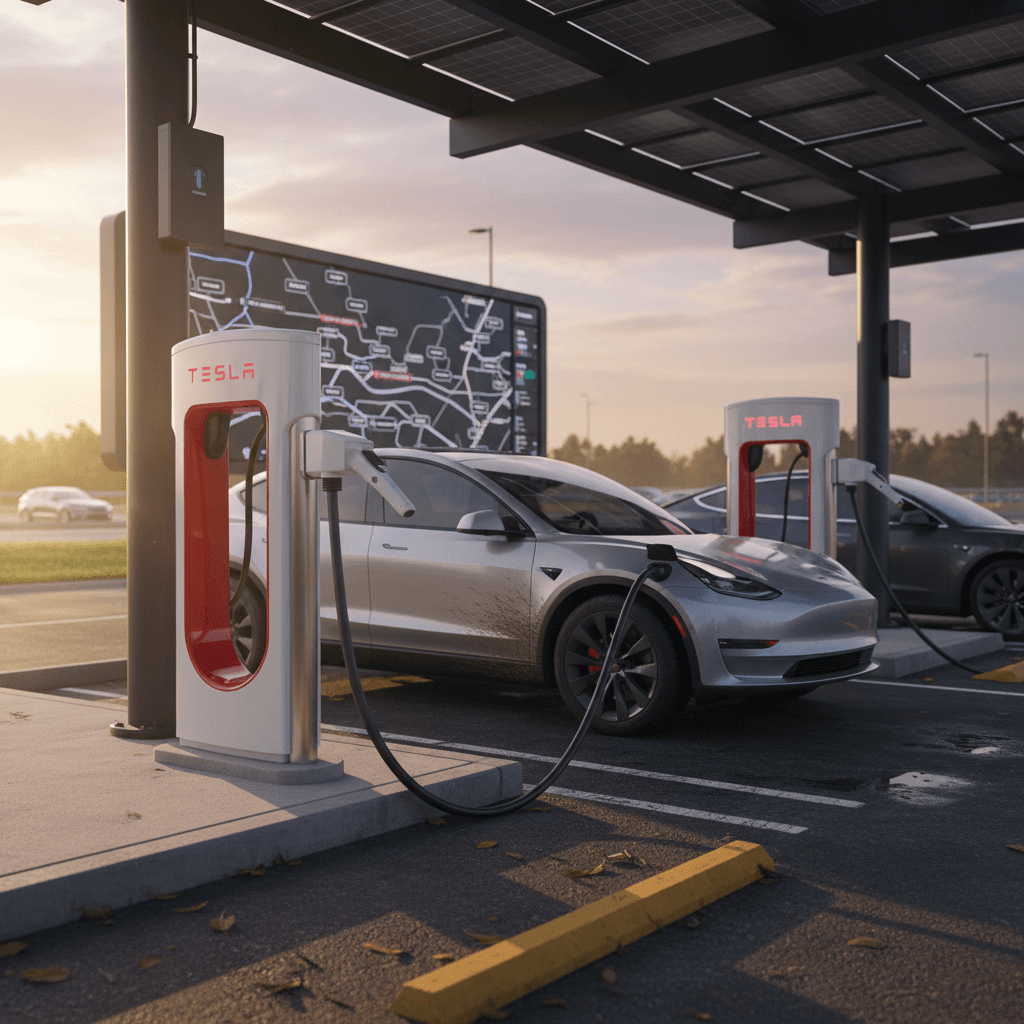
If you drive a non‑Tesla EV, it’s hard not to notice those bright red Tesla Supercharger stalls everywhere you go. For years, they were off‑limits unless you owned a Tesla. As of 2026, that line is finally blurring. Many non‑Tesla EVs can now plug into the Tesla Supercharger network, with the right hardware and account setup. This guide breaks down exactly how Tesla Superchargers work for non‑Tesla EVs, which brands are in, what adapters you need, and how to use them with confidence on a road trip.
Big picture: what changed?
Can non‑Tesla EVs use Tesla Superchargers in 2026?
Yes, many non‑Tesla EVs can use Tesla Superchargers in 2026, but it’s not as simple as “any EV can plug in anywhere.” Access depends on three things:
- Whether your automaker has an official agreement with Tesla for Supercharger access
- Whether your particular model and model year are covered yet
- Whether you have the right NACS adapter (if your car still uses a CCS plug) or a native NACS port
Think of it this way: Tesla owns the hardware and the software. Your automaker has to shake hands with Tesla on both. That’s why a 2024 Mustang Mach‑E with the official Ford adapter can charge at a Supercharger, but a random CCS‑equipped EV without that OEM blessing usually can’t, even if an aftermarket adapter lets the plug physically fit.
How Tesla Supercharger access actually works
Three pieces of the Supercharger puzzle
You need more than just a cable that fits
1. Physical connector
Tesla Superchargers use the NACS plug. Most non‑Tesla EVs sold before 2025 in North America use CCS1. That’s why you’ll often need a CCS→NACS adapter from your automaker.
2. Software + billing
The charger needs to know who you are and how to bill you. That can happen via the Tesla app or your automaker’s app or in‑car system once they’ve integrated with Tesla’s network.
3. Safety & compatibility
Automaker‑approved adapters are tested for things like voltage, current limits, and communication. That’s why most brands explicitly warn against cheap third‑party DC adapters for Superchargers.
Don’t rely on random adapters
Which non‑Tesla brands have Supercharger access?
By early 2026, most major EV brands in North America either already offer Supercharger access or have formally committed to it. The details, timing, models, and whether adapters are free, vary brand by brand, so always confirm with the latest info from your automaker. Here’s a high‑level snapshot for shoppers and owners in the U.S.
Non‑Tesla brands with Tesla Supercharger access (high‑level snapshot)
This is a simplified overview, availability can change by model year, trim, and rollout timing. Always confirm with your automaker before planning a trip around Superchargers.
| Brand (US) | Access Status in 2025–2026 | How You Connect | Example Models |
|---|---|---|---|
| Ford | Live with OEM adapter; native NACS ports rolling out on new EVs | Ford‑branded CCS→NACS adapter + FordPass / Tesla app integration | Mustang Mach‑E, F‑150 Lightning |
| General Motors (Chevrolet, GMC, Cadillac) | Live with OEM adapter; NACS ports on newer models from 2025 onward | GM‑approved CCS→NACS adapter + GM app / Tesla app integration | Chevy Blazer EV, Equinox EV, Silverado EV, Cadillac Lyriq |
| Hyundai | Access enabled via adapter; newer models adding native NACS | Hyundai CCS→NACS adapter; newer Ioniq models with NACS port | Hyundai Ioniq 5, Ioniq 6, Kona Electric |
| Kia | Access enabled via adapter; newer models adding native NACS | Kia CCS→NACS adapter or native NACS on some 2025+ models | Kia EV6, EV9, Niro EV |
| Rivian | Live since 2024 at thousands of Superchargers | Rivian‑supplied NACS hardware / adapter | R1T, R1S, R2 (future) |
| Volvo & Polestar | Adapters and native NACS ports rolling out | OEM CCS→NACS adapter; newer models with NACS ports | Volvo EX30, EX90; Polestar 2, 3, 4 |
| Mercedes‑Benz | Adapter access with deeper integration rolling out through 2025 | Mercedes‑approved CCS→NACS adapter, app integration | EQE SUV, EQS, EQB |
| BMW Group (BMW, Mini, Rolls‑Royce) | Adapter access starting 2025; native NACS later | BMW‑approved CCS→NACS adapter + in‑car navigation integration | BMW i4, i5, i7, iX; Mini EVs; Rolls‑Royce Spectre |
| Honda & Acura | Adapters available for first new‑generation EVs | Honda/Acura CCS→NACS adapter | Honda Prologue, Acura ZDX |
| Volkswagen Group (VW, Audi, Porsche) | Adapters and phased software rollout; some models get free adapters | OEM CCS→NACS adapter; native NACS ports on newer EVs | VW ID.4, Audi Q6 e‑tron, Porsche Taycan, Macan Electric |
| Nissan | Adapter access for Ariya; future models adding NACS ports | Nissan CCS→NACS adapter | Nissan Ariya |
| Lucid | Adapter access with some speed limitations vs max car capability | Lucid‑branded NACS adapter for CCS port | Lucid Air |
Use this table as a starting point, not a legal document. Automakers update access and pricing frequently.
What if your brand isn’t listed?
What you need to use a Tesla Supercharger with a non‑Tesla
Pre‑flight checklist for non‑Tesla Supercharging
1. Confirm your brand’s agreement
Open your automaker’s app or website and search for "Tesla Supercharger" or "NACS." You’re looking for an official statement that your brand and model can use Tesla Superchargers with a specific adapter or NACS port.
2. Verify your specific model and year
Even within a brand, access can roll out model by model. A 2025 EV6 might be in while a 2022 Niro EV is waiting on an adapter. Check your VIN in the automaker’s app or portal if possible.
3. Obtain the correct OEM adapter (if needed)
If your EV has a CCS1 fast‑charge port, you’ll likely need a <strong>brand‑approved CCS→NACS adapter</strong>. These are usually ordered through your automaker’s app, website, or dealer, not from a generic marketplace listing.
4. Install and update the right apps
At minimum you’ll need the <strong>Tesla app</strong>. Many newer EVs also support starting and paying for Supercharger sessions directly via the car’s built‑in navigation or your automaker’s app.
5. Add a payment method to Tesla
No card on file means no charging. Before your first trip, open the Tesla app, create an account, and add a payment method so you’re not wrestling with sign‑ups at 2 a.m. on a chilly off‑ramp.
6. Test locally before a big trip
If possible, do a short shakedown session at a nearby Supercharger. Confirm everything works, watch how your car ramps up charging speed, and see how the cable and adapter fit.
Step‑by‑step: How to charge a non‑Tesla at a Supercharger
- Plan your stop. Use your EV’s built‑in navigation, your automaker’s app, or the Tesla app to find a compatible Supercharger. Make sure it supports "Non‑Tesla" or your brand’s access program, and check real‑time stall availability.
- Arrive and park carefully. Supercharger cables are designed around Tesla charge port locations, usually rear driver‑side. With many non‑Teslas, you’ll need to back in tight or nose in creatively so the cable reaches without straining it.
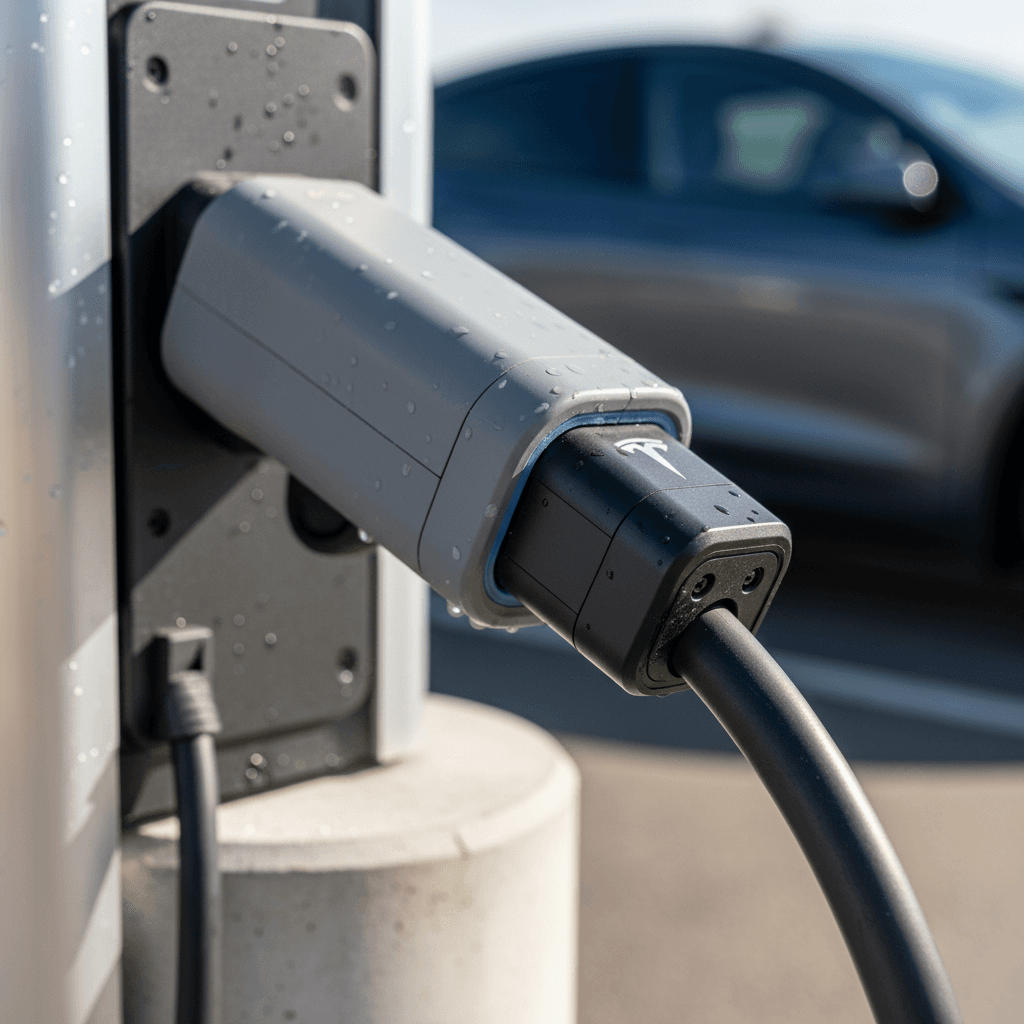
- Get your adapter ready (if needed). If your car is CCS, attach your OEM CCS→NACS adapter to the Tesla connector before plugging into the car. Make sure it clicks fully into place.
- Start the charging session. Depending on your setup, you’ll either plug in and let "plug‑and‑charge" handle everything, or you’ll select the stall in the Tesla app or your automaker’s app to start the session.
- Watch initial ramp‑up. For the first few minutes, watch your car’s charging screen. You’re checking that power is flowing, speed looks reasonable, and there are no error messages.
- End the session. When you’ve got the range you need, stop the session via your car, your automaker’s app, or the Tesla app. Unplug, remove the adapter, and be sure to return the cable to its holster so the next driver isn’t tripping over it.
Arrive low, leave fast
Magic Dock vs adapter access: what’s the difference?
Tesla’s early experiment in opening Superchargers to non‑Tesla cars was something called Magic Dock, a built‑in CCS adapter that lives right on the charger pedestal. You selected "non‑Tesla" in the Tesla app, the dock popped out with a CCS head attached, and you plugged in like any other fast charger.
Magic Dock sites
- Have a built‑in CCS adapter at each Magic Dock stall.
- Let many CCS EVs charge without buying their own NACS adapter.
- Are still relatively limited in number and location compared with the full Supercharger network.
Adapter‑based access
- Relies on your automaker’s CCS→NACS adapter or a native NACS port.
- Works at a far larger share of Supercharger stalls.
- Is the long‑term direction as more EVs ship with NACS from the factory.
What to expect going forward
What it costs and how fast you’ll charge
Tesla doesn’t charge non‑Tesla drivers a flat membership fee; instead, you’ll typically see per‑kWh pricing that can be slightly higher for non‑Teslas than for Tesla owners, and it varies by location and time of day. In many states you’ll see one price off‑peak and a higher rate during peak hours. The Tesla app (or your automaker’s app, if integrated) will show live pricing before you start charging.
Typical Supercharger experience for non‑Tesla drivers
Cold weather caution
When it makes sense to use a Tesla Supercharger
Great times to lean on Tesla Superchargers
You don’t have to use them all the time, just when they solve a problem better than CCS networks.
Long highway trips
The Supercharger map was built around road‑tripping. On long interstate runs, Superchargers often fill gaps where CCS networks are sparse or unreliable.
Rural or remote travel
Headed into the mountains or across the plains? In many rural areas, the nearest reliable fast charger may well be wearing a Tesla logo.
Time‑sensitive errands
If you’re short on time and the local Tesla site is faster and less crowded than the CCS alternative, paying a few extra dollars can be well worth it.
On the other hand, if you’re charging near home, have plenty of CCS options, or your apartment complex offers reliable Level 2, there’s no rule that says you must use a Tesla Supercharger just because you can. It’s another tool in the toolbox, not a replacement for all your other charging options.
Real‑world tips and common pitfalls
Road‑tested tips from experienced EV drivers
Bring a short extension for your life, not the charger
You should never use extension cords or power strips with DC fast charging, but you can plan your parking so your adapter and the Supercharger cable have a relaxed, untwisted reach to your charge port.
Favor end stalls when possible
End stalls often give you a bit more room to angle your car so the short Tesla cable reaches your non‑Tesla charge port without strain.
Watch for shared power cabinets
Some older Superchargers share power between paired stalls (like 2A/2B). If you and another car are hammering the same pair, you may see slower speeds than the sign suggests.
Mind your SOC before the climb
If you’re about to tackle a long grade or winter storm, leave a Supercharger with more buffer than your nav suggests. Headwinds, cold, and hills will all eat into that estimate.
Don’t block stalls while you eat
Once you’re done charging, move the car, even if you’re mid‑sandwich. Supercharger etiquette matters, and idle fees are a very real thing at busy sites.
Keep receipts and session logs
If you’re tracking total cost of ownership or comparing networks, download your Tesla charging history periodically. It’s eye‑opening to see your real‑world cost per mile over time.
Safety first, always
FAQ: Tesla Superchargers for non‑Tesla EVs
Common questions about using Tesla Superchargers with non‑Tesla EVs
How Recharged fits into your charging game plan
Charging isn’t just a technical detail, it’s a core part of how livable an EV will feel three years down the road, especially if you’re buying used. That’s exactly why every EV sold through Recharged comes with a Recharged Score Report that looks beyond cosmetics and into battery health, charging history where available, and fair‑market pricing.
Buying a used EV?
Our EV specialists can walk you through which used models already support Tesla Superchargers, which need an adapter, and how that affects real‑world road‑trips. You can shop and complete financing fully online, or visit our Experience Center in Richmond, VA if you prefer to see a car in person.
Already own and thinking of selling?
If your EV has Supercharger access, that’s a strong selling point. Recharged can give you an instant offer or help you consign your car, highlighting features like NACS ports, adapter eligibility, and verified battery health so buyers know exactly what they’re getting.
Tesla Superchargers for non‑Tesla EVs used to be a fantasy. In 2026, they’re quickly becoming part of everyday life for Ford, Hyundai, Kia, GM, Rivian, Honda, BMW, and many other drivers. The key is knowing whether your specific EV is supported, which adapter you need, and how to use the network wisely. Get those pieces right, and that sea of red‑and‑white stalls turns from background scenery into a powerful safety net, especially if you’re shopping for your next used EV with Recharged.