You don’t really feel how good, or how frustrating, an electric SUV is until you live with its charging speed. The Tesla Model Y is one of the easiest EVs to charge, but the way you plug in changes everything. This Tesla Model Y charging speed guide breaks down how fast it charges at home, at public Level 2 stations, and on Superchargers, with real-world numbers you can actually plan around.
Quick snapshot: Model Y charging speeds
Why Tesla Model Y charging speed matters
Driving a Model Y day to day, you’re not thinking in kilowatts, you’re thinking in **time**. How long will it take to recover your commute overnight? Can you grab enough range for soccer practice while you grocery shop? On a road trip, will your kids make it to the next stop before your battery or your patience runs out?
Understanding Tesla Model Y charging speed turns all of that from guesswork into a simple routine. Once you know what your Y will gain **per hour** at home and **per minute** at fast chargers, range anxiety mostly dissolves into trip planning. It also helps you choose the right home charging setup and evaluate a **used Model Y**, including the battery-health insights you’ll see in a Recharged Score Report when you shop for a pre-owned Tesla on Recharged.
Tesla Model Y headline charging numbers
Tesla Model Y charging basics: connectors, kW and miles per hour
Before you get lost in charging charts, it helps to simplify the language. Every Tesla Model Y sold in North America uses the **NACS connector** (now also standardized as SAE J3400), which handles both AC and DC charging through the same port. What changes from charger to charger is the **power** it can deliver, measured in kilowatts (kW).
kW: the raw charging power
- kW (kilowatts) = how fast energy flows into the battery.
- Think of this like the diameter of the fuel hose: bigger hose, faster flow.
- Level 1 home charging is ~1–1.4 kW, Level 2 is often 7–11.5 kW, DC fast can be 50–250+ kW.
Miles per hour of charge
- Your Model Y’s screen and Tesla app show mi/hr or km/hr while charging.
- This converts kW into something human: range added per hour.
- Because Model Y efficiency varies by trim and wheels, mi/hr at the same kW can differ a bit between cars.
A simple rule of thumb
Home charging speeds for the Model Y (Level 1 vs Level 2)
Home is where the Model Y shines. You plug in, walk away, and wake up with the range you need. But your charging speed at home depends heavily on whether you’re using a basic outlet or a 240V Level 2 setup like a Tesla Wall Connector or high‑amp circuit.
Typical Tesla Model Y home charging speeds
Approximate charging speeds for North American Model Y trims. Exact numbers depend on voltage, temperature, wheels, and driving efficiency, but these are realistic planning figures.
| Home setup | Voltage / amps | Approx. power (kW) | Typical mi/hr added | Best for |
|---|---|---|---|---|
| Standard outlet (Level 1) | 120V / 12 A | 1.3–1.4 | 3–4 mi/hr | Very light daily driving, temporary setups |
| NEMA 14‑50 with Mobile Connector | 240V / 32 A | ~7.7 | ~25–30 mi/hr | Moderate commutes, overnight charging |
| Tesla Wall Connector on 60A circuit* | 240V / 48 A | Up to 11.5 | ~35–44 mi/hr | Heavier driving, multiple EVs, fast overnight recovery |
Use this table to decide whether a 120V outlet is enough or if you should move up to a 240V solution.
Check your car’s onboard charger limit
- If you drive **20–30 miles a day**, a 120V outlet can work, but you’ll want to stay plugged in most nights.
- If you drive **40–70 miles a day**, a 240V Level 2 solution around 7–8 kW is more comfortable.
- If you road‑trip often, share the charger with another EV, or just hate waiting, go for the fastest Level 2 the car will accept (often up to 11.5 kW).
Home charging and your electric bill
Public Level 2 charging: what to expect away from home
Public Level 2 stations, at workplaces, parking garages, hotels, and shopping centers, deliver roughly the same sort of power as a home 240V charger, just with more variables. You’ll see everything from a sleepy 6 kW post in a municipal lot to a full‑tilt 11.5 kW unit at an office park.
How your Model Y behaves on public Level 2
Realistic expectations when you plug into that random charger at the mall.
Power limits
Many public Level 2 stations are rated around 6–7 kW. Your Model Y will cap at whichever is lower: the station’s rating or your onboard charger’s limit (often 7.7–11.5 kW).
Time expectations
At 6–7 kW, expect roughly 18–28 miles of range per hour. That’s perfect for topping off while you eat, shop, or work a half day.
Planning tip
Use apps like Tesla, PlugShare, ChargePoint, or others to filter for Level 2 and see real‑world user check‑ins before you rely on a specific charger.
Hotel charging strategy
Supercharging & DC fast charging speeds for Tesla Model Y
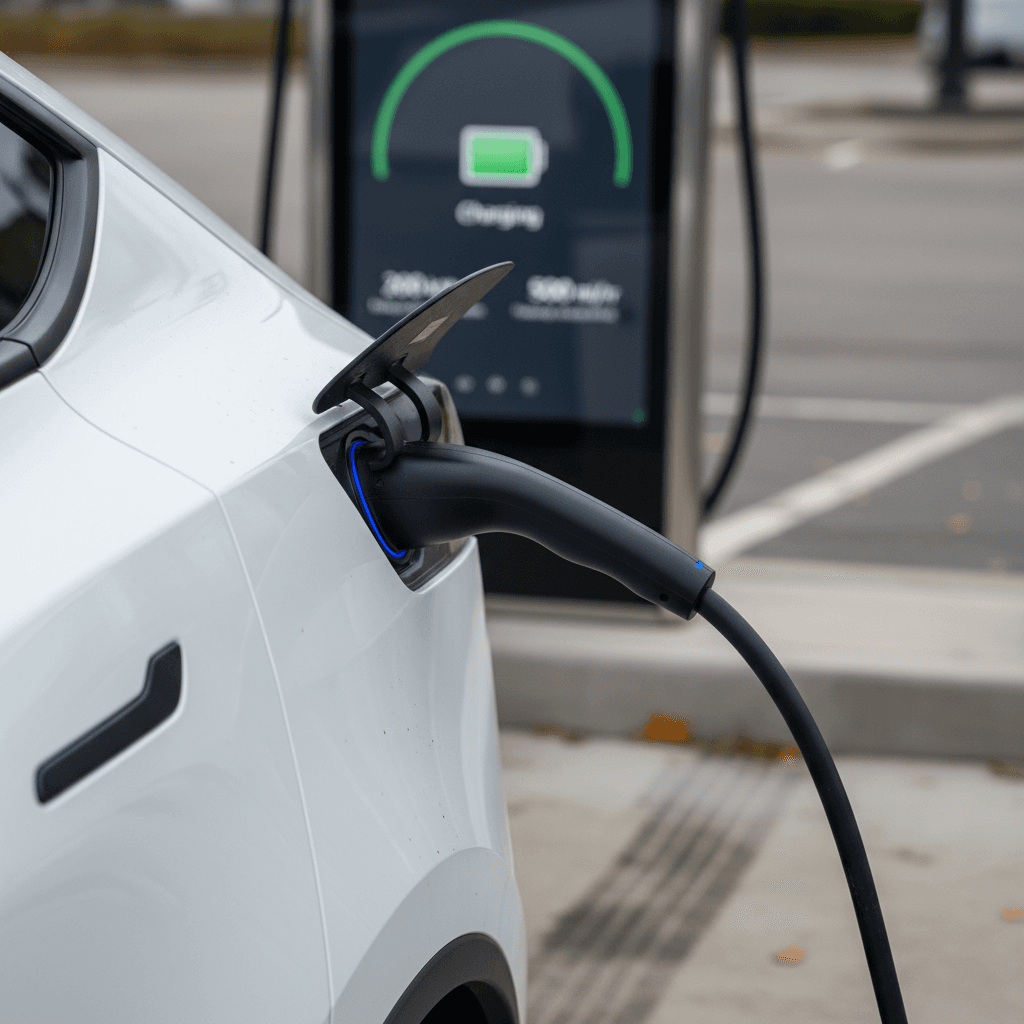
When people talk about Tesla Model Y charging speed, they usually mean **Supercharging**, or DC fast charging on third‑party networks with the right adapter. This is where you add road‑trip range in minutes instead of hours, but it’s also where expectations get out of whack if you only look at the peak number.
Tesla Model Y DC fast charging cheat sheet
Approximate numbers for a healthy battery on a modern Tesla Supercharger or equivalent DC fast charger, under good conditions.
| Charger type | Peak power seen | Typical sweet spot | Range added |
|---|---|---|---|
| Tesla Supercharger V3/V4 | Up to ~250 kW | 10–60% | ~150–175 miles in ~15–20 minutes |
| Older Tesla Supercharger V2 | Up to ~145 kW | 10–60% | ~120–140 miles in ~20–25 minutes |
| Third‑party DC fast (CCS via adapter) | 50–150 kW | 10–70% | ~80–150 miles in ~20–35 minutes |
Road‑trip planning is easier if you think in ranges and time windows, not exact to‑the‑minute promises.
Charging is fast, then it tapers
- On a strong V3 or V4 Supercharger, it’s realistic to regain **150+ miles in around 15 minutes** in the 10–60% range.
- On cooler days, or with a cold battery, initial charging can be much slower until the pack warms up.
- The car will automatically **precondition the battery** when you navigate to a Supercharger, helping it hit higher speeds sooner.
Real‑world Tesla Model Y charging time examples
Let’s turn these numbers into everyday scenarios. Exact times will vary, but these examples reflect what many Model Y drivers see in normal use. Assume a long‑range Model Y with an EPA range in the mid‑200s to low‑300s and typical efficiency.
Common Model Y charging scenarios
1. Overnight on 120V (no Level 2 yet)
You park in a driveway with only a standard 120V outlet. Plug in from 6 p.m. to 6 a.m. at roughly 1.3–1.4 kW, and you’ll typically add **35–50 miles of range**. That’s enough for short commutes, but not ideal if you rack up highway miles daily.
2. Overnight on a 7.7 kW Level 2
With a 240V / 32 A setup, your Model Y gains about **25–30 miles per hour**. Six hours of charging can restore roughly **150–180 miles of range**, plenty to refill a typical day’s driving while you sleep.
3. Deep refill from 10% to 80% at home
On a strong 11.5 kW Level 2, going from 10% to 80% on a long‑range pack (roughly 70 kWh of usable energy) takes about **6–7 hours**. This is the kind of charge you might schedule overnight once or twice a week if you drive a lot.
4. Road‑trip stop on a V3 Supercharger
You arrive at 15% and want to leave around 65%. On a healthy battery and a warm day, expect **20–25 minutes** plugged in for something like **140–170 miles** of added range, plus just enough time to hit the restroom and grab coffee.
5. Top‑off before the day’s errands
You get home at 30% and want 70% by late afternoon. At 7–11.5 kW, that 40% window usually fits in **3–4 hours** on Level 2, so a mid‑day plug‑in gets it done while you’re working from home.
How Recharged tests real charging speeds
Ready to find your next EV?
Browse Vehicles7 key factors that change your charging speed
Two Model Ys can plug into the same charger and see different speeds. Here are the levers you can actually feel from behind the wheel.
What really controls your Model Y’s charging speed
Beyond the kW rating on the pedestal.
Battery temperature
Cold batteries charge slowly. If you pull into a Supercharger right after highway driving or after the car preconditions, you’ll see much higher speeds than if you arrive with a cold-soaked pack on a winter morning.
State of charge (SoC)
Below ~50–60%, the car will happily gulp power. Above ~80%, it tapers aggressively to protect the pack. Don’t judge your charging system by the last 10% of a session.
Charger capability
A 50 kW DC fast charger can’t magically become a 250 kW Supercharger. Likewise, a 6.6 kW Level 2 unit in a public lot is the bottleneck even if your car can accept 11.5 kW.
Battery health & age
As a Model Y ages, its **peak DC charging rate** and the time it can hold that peak may drop slightly. Good battery care keeps this effect modest, but it’s one reason a battery-health report matters on a used Tesla.
AC onboard charger limit
Your home or public Level 2 charger might be rated for 48 A, but if your Model Y’s onboard charger is capped at 32 A, you’ll never see that extra speed. The car decides the ceiling.
Driving and climate control
Blasting the heater on a winter day or driving significantly above the speed limit burns more energy, so the same kWh added translates into fewer miles of actual range.
Don’t chase screenshots
How fast charging affects Model Y battery health
Tesla designs the Model Y’s battery management system to take a lot of abuse. You can road‑trip from Supercharger to Supercharger without “ruining” your pack. That said, **how** you use DC fast charging over years does influence long‑term health and peak speed.
Fast charging myths vs. reality
- Myth: A few Supercharger sessions will destroy your battery.
Reality: Occasional or even regular road‑trip fast charging is fine. Tesla batteries are engineered for it. - Myth: You must avoid going over 80% at all costs.
Reality: 80% is a good everyday target, but 90–100% for trips is perfectly reasonable if you don’t leave it sitting there for days.
Habits that help your battery (and speed)
- Favor **Level 2 home charging** for daily use; save DC fast for trips.
- Set a **daily charge limit around 70–80%** in the Tesla app.
- Let the car **precondition** the battery before fast charging by navigating to the charger in the built‑in nav.
- Avoid leaving the car parked at 0–5% or 100% for long periods.
When to worry about lost charging speed
Used Tesla Model Y: quick charging-speed checklist
Shopping for a used Tesla Model Y? Charging speed is one of the easiest ways to tell whether you’re getting a great long‑term companion or a problem child. You can’t see battery health just by glancing at the paint, but you can ask smart questions, and, on Recharged, see verified data.
Charging questions to ask about a used Model Y
1. Daily charging habits
Ask the prior owner how they typically charged: mostly at home Level 2 with an 80% limit, or constantly fast‑charging to 100%? The calmer the routine, the happier the battery.
2. Supercharger vs. home split
Heavy reliance on DC fast charging isn’t automatically bad, but a car that lived on Superchargers its whole life deserves closer scrutiny of its peak rates and range.
3. Current fast‑charging behavior
If you can, join the seller for a quick Supercharger session from ~10–20% SoC. Does it ramp up briskly into the 100–200+ kW range and hold strong through 50–60%? Or does it crawl?
4. Home charging limit & hardware
Check what the car actually pulls on a known 240V circuit. If it’s capped at 32 A, that’s fine as long as you know it; don’t pay extra assuming you’ll see 11.5 kW if the onboard charger doesn’t support it.
5. Third‑party battery health data
When you buy through <strong>Recharged</strong>, you get a <strong>Recharged Score Report</strong> with battery diagnostics and fair‑market pricing built in, so you’re not relying on vague seller impressions.
Tesla Model Y charging speed FAQ
Frequently asked questions about Tesla Model Y charging speed
Bottom line: making Tesla Model Y charging work for you
Charging a Tesla Model Y doesn’t have to be a science project. At home, think in **miles per hour of charge** and choose the Level 2 setup that easily covers your weekly driving. On the road, aim to arrive at fast chargers low, leave around 60–80%, and let the car handle battery preconditioning. Do that, and your "fuel stops" start to look a lot like natural breaks you’d take anyway.
If you’re stepping into a **used Tesla Model Y**, the right information turns curiosity into confidence. Recharged pairs every vehicle with a Recharged Score Report that includes verified battery health, fair‑market pricing, and expert guidance on charging behavior, so you know exactly what kind of charging speeds to expect from day one. That way, when you plug in, whether it’s a sleepy garage outlet or a bank of gleaming Superchargers, you’ll already know how fast your Model Y is going to get you back on the road.