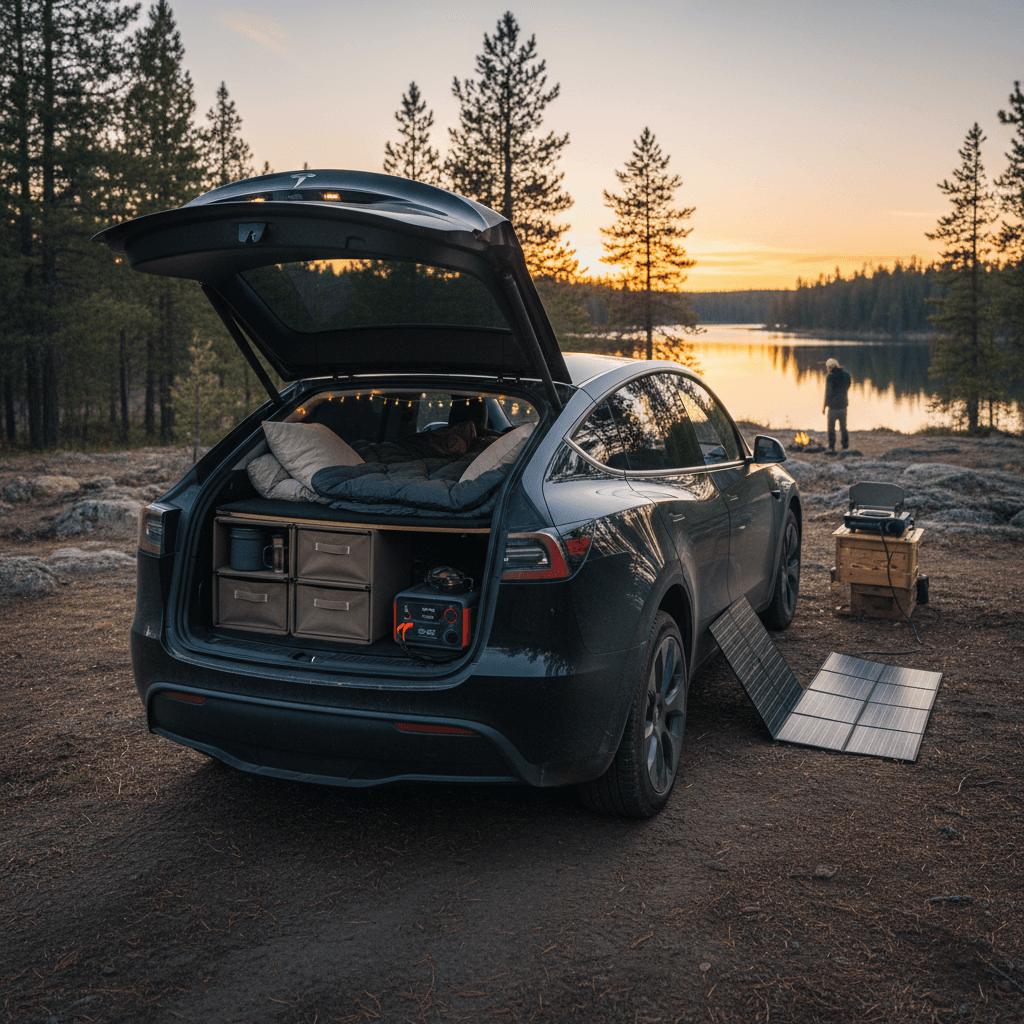
You don’t need a rooftop tent or a trailer to wake up to mountain views. With the right setup, your Tesla Model Y can double as a surprisingly comfortable micro‑camper. This Tesla Model Y camping setup guide walks you through mattress sizing, Camp Mode, battery use, storage, and safety so you can sleep in your EV without guesswork.
Who this guide is for
Why the Tesla Model Y Makes a Great Camper
Core advantages of camping in a Model Y
Why many EV drivers are ditching tents and vans
Built‑in climate control
With Camp Mode, the Model Y can quietly maintain your chosen temperature overnight without idling an engine, and you can still run lights and charge devices.
Flat cargo floor
The battery "skateboard" layout and folding rear seats create an almost flat surface that’s long enough for most adults to sleep inside.
Easy recharging
On a road trip, you’re rarely far from a DC fast charger. Plan stops around camp spots and top up your battery while you grab food or explore.
Compared with a traditional SUV, the Tesla Model Y gives you a flatter sleeping area, a huge amount of hidden storage, and precise digital control over temperature and airflow. You also avoid exhaust fumes and engine noise because there’s no idling engine, just the battery pack and heat pump quietly doing their work.
Think of it as a hard‑sided tent
Key Tesla Model Y Dimensions for Sleeping
Model Y interior measurements that matter for camping
Officially, the Model Y offers about 70–71 cubic feet of cargo volume with the second row folded, depending on trim, plus roughly 4 cubic feet in the front trunk. Real‑world measurements show around 76–79 inches of cargo length from the back of the front seats to the hatch, and about 43–45 inches of width between the wheel wells at floor level. That’s enough space for a full‑size or short queen mattress if you choose carefully.
Common mattress sizes vs. Model Y interior
Use this table as a quick reference when shopping for a mattress or pad.
| Mattress Size | Dimensions (L × W) | Will It Fit Flat? | Comments |
|---|---|---|---|
| Full | 75" × 54" | Length: Yes, Width: Tight | May need to compress or slightly trim foam around wheel wells. |
| Full XL | 80" × 54" | Length: Borderline, Width: Tight | Works for taller campers if you slide the front seats forward. |
| Short Queen (RV) | 75" × 60" | Length: Yes, Width: No | Too wide at the wheel wells unless heavily trimmed. |
| 48" Camping Pad | 72–78" × 48" | Yes | Great one‑person or cozy two‑person size. |
| Custom 72" × 48" | Yes | Yes | Ideal if you’re under ~6 ft and want extra floor space for bags. |
You can trim foam or choose a narrower camping mattress to improve fit around the wheel wells.
Mind the taper
Choosing a Mattress and Building a Sleeping Platform
- Decide whether you want a fast, no‑build setup (fold seats + mattress) or a more permanent wooden platform.
- Measure your height and sleeping preferences (side vs. back sleeper) to pick the right mattress size and firmness.
- Plan for how your platform or mattress will clear the slight step between folded seats and cargo floor.
Mattress & pad options
- Tri‑fold memory foam mattress: Popular for Model Y camping because it folds into the sub‑trunk or rear footwell. Look for 3–4" thick and 72–75" long.
- Self‑inflating camp pads: Lighter and easier to store. Two 25" backpacking pads fit side by side and are easier to angle around the wheel wells.
- Custom‑cut foam: You can buy a 4" foam slab and cut it to ~72–75" × 45–48" to match your exact layout.
Do you need a platform?
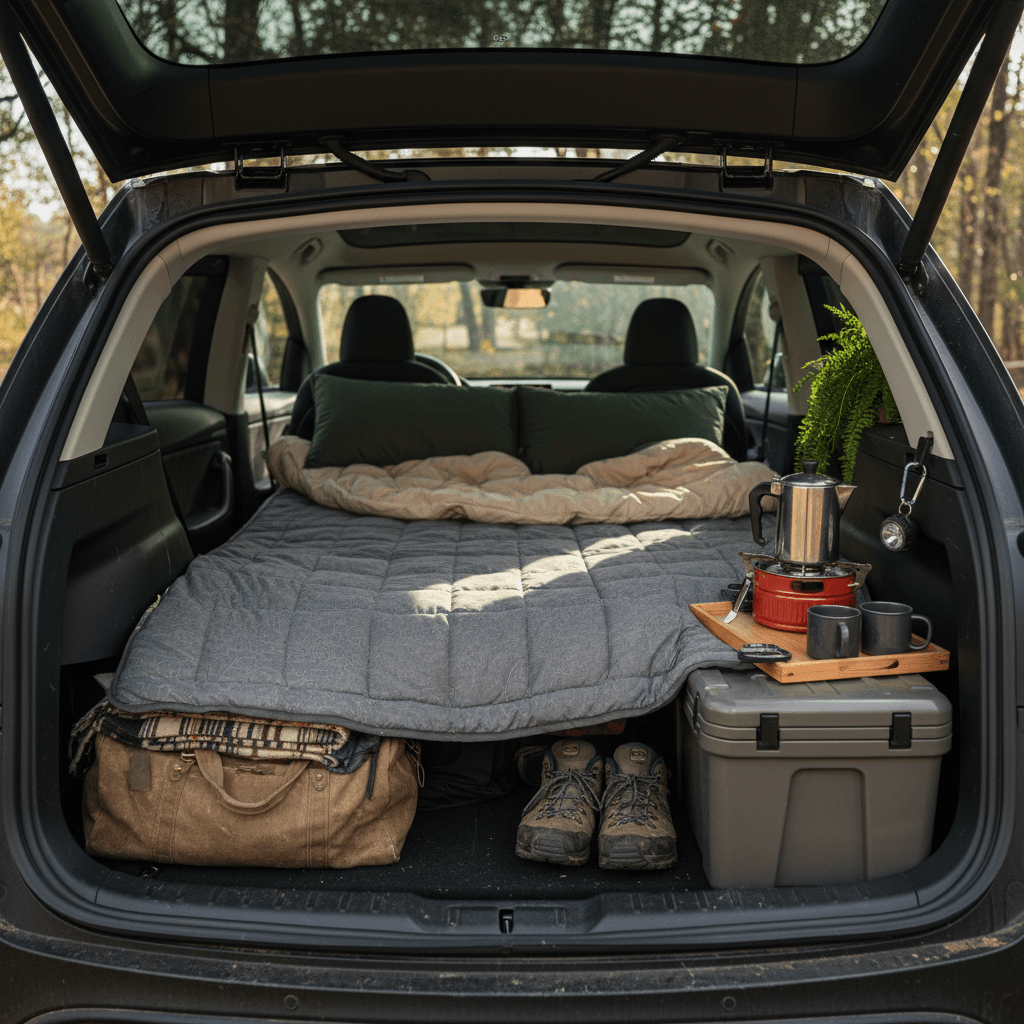
- No‑platform setup: For most people, a tri‑fold foam mattress laid directly on the folded rear seats is enough. The small step between the cargo floor and seat backs can be leveled with a yoga mat or extra blanket.
- Simple platform: If you want a perfectly flat bed, use 1/2"–3/4" plywood cut into two or three panels, supported by folding legs or storage bins in the rear footwell. Leave cutouts for the sub‑trunk lid so you can still access storage.
Make the step disappear
Setting Up Camp Mode and Managing Climate
Camp Mode is the Tesla‑specific feature that makes car camping feel civilized. It keeps the HVAC running, disables automatic shutoff, and lets you use lights, USB ports, and the infotainment system while you sleep.
How to enable Camp Mode in your Model Y
1. Park safely and level
Choose a level spot away from traffic. Avoid tall grass or deep snow under the battery pack and ensure you’re allowed to sleep there, some rest areas and lots prohibit overnight parking.
2. Set your charge level
Before you settle in, set your charge limit for the next morning (for example, 80–90%) so you don’t forget. If you’re on a trip, plan your next Supercharger stop before bed.
3. Adjust climate & fan speed
Set your desired temperature, most campers find <strong>66–70°F</strong> comfortable. Use a low fan speed for quieter operation and fewer drafts while you sleep.
4. Activate Camp Mode
From the climate screen, tap <strong>Camp</strong>. The display will show a campsite graphic and the car will maintain your selected temperature, keep USB power active, and prevent the vehicle from powering down.
5. Dim or turn off the screen
Tap the screen brightness control or use the "Screen Clean"/display off options at night. A dim cabin makes it easier to sleep and keeps light from attracting attention.
6. Lock the doors
Use the lock icon on the screen or your phone. With Camp Mode active, the doors stay locked from the outside but you can still exit normally from inside in an emergency.
Noise level expectations
Power Use, Battery Drain, and Charging Strategy
How much battery your Model Y uses while camping depends on outside temperature, wind, and how tightly you seal the cabin. But with a little planning, you can sleep comfortably without risking range anxiety the next day.
Typical overnight Camp Mode battery use
Always keep a reserve
- On a temperate night, many Model Y owners report using roughly 5–7% battery over 8 hours of Camp Mode at moderate fan speed.
- In freezing or very hot conditions, usage can jump closer to 10–15% per night as the heat pump or AC works harder.
- Waking up with at least 20–30% remaining gives you room to reach a Supercharger or Level 2 station without stress.
If you’re planning a multi‑night trip, build charging stops into your route the same way you’d plan gas stops, except you can combine them with meals, hikes, or sightseeing while the car charges. For home‑base camping or stays at RV parks, a 240‑volt outlet or Level 2 charger can refill most or all of what you used overnight by midday.
Use the car as your trip planner
Organizing Gear and Using Model Y Storage
A comfortable Tesla camping setup is as much about organization as it is about the mattress. The Model Y offers deep storage wells, a front trunk, and flexible seat layouts that make it easy to keep luggage out of your sleeping space.
Model Y storage zones to use when camping
Divide your gear by access and weight to keep the cabin clutter‑free.
Sub‑trunk (rear well)
Great for heavy or rarely used items such as tools, spare fluids, small jack, and backup water. It’s out of the way but accessible if you lift the cargo floor.
Rear footwells
Ideal for soft bags and clothing cubes. Once you lay the seats flat, these sit under the front seat backs and support your sleeping platform or mattress.
Frunk (front trunk)
Use for smelly or dirty items like hiking boots, small propane stove (for use outside the car only), or trash bags. Keeps the cabin clean and odor‑free.
Packing strategy that works
- Keep a dedicated "sleep kit" (mattress, sheets, pillows, eye masks) together so you can convert from driving mode to sleep mode in under 10 minutes.
- Use soft‑sided duffel bags or cubes that can squish into gaps around the wheel wells and footwells.
- Reserve the space near the hatch for items you need last at night and first in the morning: toiletries, camp chairs, and breakfast gear.
Recharged tip for used‑car shoppers
If you’re eyeing a used Model Y primarily for camping and road trips, look for one with rear seats and cargo liners in good shape, heavy camping use can leave scuffs and stains. Vehicles listed on Recharged include a Recharged Score Report, so you can see battery health and overall condition before you build your rolling cabin around it.
Privacy, Bug Screens, and Window Management
Sleeping in a glass‑roofed EV can feel like being in a fishbowl if you don’t plan for privacy. Light control and airflow are just as important as your mattress.
Simple privacy & bug‑control upgrades
Magnetic or snap‑on window shades
Custom Tesla window shades block light and add insulation. At minimum, cover the rear hatch glass and side windows so nearby cars can’t see inside at night.
Windshield cover or sun shade
A folding or roll‑up windshield shade blocks streetlights and early‑morning sun. Some Tesla‑specific kits include a matching front side‑window set.
DIY mesh bug screens
For summer trips, consider mesh window socks or DIY screens that slip over the rear doors. You can crack the windows slightly for fresh air while bugs stay out.
Vent windows carefully
If you rely on Camp Mode, you typically don’t need open windows. If it’s mild and you prefer fresh air, open windows only a little to avoid dew and insects.
Control interior lights
Turn off the "Dome Lights On Open" setting so doors don’t blast light into the campground after dark. A small USB lantern or headlamp is less disruptive.
No cooking or open flames inside
Safety Checklist for Tesla Model Y Camping
Safety checklist before you fall asleep in your Model Y
Confirm parking rules
Check signage, campground rules, or local regulations to ensure overnight parking is allowed. Some lots permit "resting" but not vehicle camping.
Check ground clearance & conditions
The Model Y’s ground clearance is modest. Avoid large rocks, deep ruts, or snow piles under the battery pack and don’t block airflow around the front and rear.
Verify charge and morning plan
Double‑check your state of charge and your next charging stop in the navigation. Adjust your morning departure if overnight temps are extreme.
Lock doors and keep key accessible
Use your phone key or key card and keep it within reach while you sleep. Make sure child locks aren’t preventing you from exiting quickly if needed.
Secure loose items
Stow heavy items low and toward the front so they can’t become projectiles if someone bumps your car or you need to move it unexpectedly at night.
Know your surroundings
Note the nearest restroom, building, or ranger station, and keep a small flashlight or headlamp by your pillow for quick exits.
Extreme temperature caution
Sample One‑Night Tesla Model Y Camping Setup
To pull this together, here’s a simple, realistic overnight scenario you can copy for your first Tesla Model Y camping trip.
From arrival to departure: a practical timeline
Evening arrival (around sunset)
Arrive at your chosen campsite, rest area, or trailhead with 55–70% battery.
Pick a level parking spot, then move luggage from the cargo floor into the front seats or frunk.
Fold the rear seats, lay down your base pad (yoga mat or thin foam), then your tri‑fold mattress and bedding.
Install window shades and adjust privacy screens before it gets fully dark.
Night routine
Set climate to ~68°F and low fan speed, then enable Camp Mode.
Dim or turn off the touchscreen and switch interior lights to manual only.
Charge phones and lights from the USB ports; keep one small light within easy reach.
Lock the doors and enjoy a movie, audiobook, or quiet time until you’re ready to sleep.
Morning departure
Open shades and windows briefly to air out bedding and cabin.
Pack away bedding and tri‑fold mattress, store in the sub‑trunk or rear footwells.
Check remaining state of charge. If you’re below your comfort threshold, drive gently to the next Supercharger or Level 2 station.
Do a quick sweep for trash or forgotten items, then switch from "camp" mindset back to "road trip" mode.
Buying a Used Tesla Model Y Specifically for Camping
If camping and road‑tripping are high on your priority list, you can shop for a used Model Y with those use cases in mind. Beyond the usual EV checks, focus on range, interior wear, and charging flexibility.
Features that matter most for a camping‑focused Model Y
You don’t need every option package, but a few details make life easier.
Battery health & range
For weekend camping, even a Standard Range Y can work. For cross‑country trips, a Long Range trim gives you more flexibility between chargers. A Recharged Score battery report helps you see real‑world capacity before you buy.
Interior & seat condition
Frequent folding of the second row can wear hinges and upholstery. Check that the seatbacks fold flat and lock properly, and that cargo trim isn’t heavily gouged from prior gear hauling.
Heat pump & cold‑weather performance
All newer Ys use a heat pump, which is more efficient for winter Camp Mode than older resistive heaters. That means less overnight battery loss on ski trips or winter camping.
Charging flexibility
If you’ll stay at cabins or RV parks, confirm you have the right mobile connector and adapters. Recharged can help you understand home and travel charging options when you’re evaluating a used EV.
How Recharged can help
Tesla Model Y Camping FAQ
Frequently asked questions about Tesla Model Y camping
With smart packing, a properly sized mattress, and a basic understanding of Camp Mode and battery use, your Tesla Model Y can be more than a daily driver, it can be your rolling cabin. Start with a simple weekend trip close to home, refine your setup, and you’ll quickly discover how comfortable and flexible EV camping can be. And if you’re shopping for a Model Y specifically with camping and road trips in mind, a used EV with verified battery health from Recharged can give you confidence before that first night under the stars.