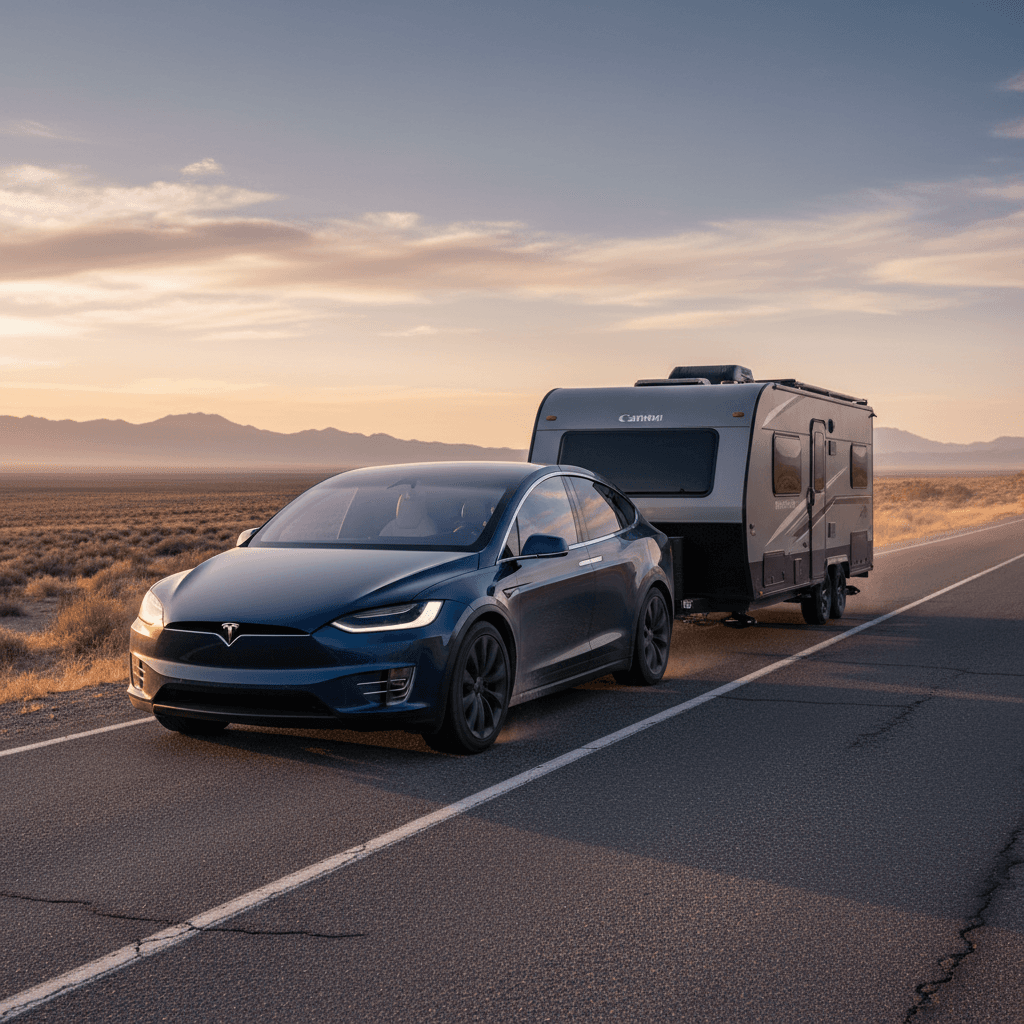
If you’re eyeing a Tesla Model X as a tow vehicle, you’re probably trying to answer two questions: how much can it tow, and how much range do you actually lose while towing? On paper the Model X has a solid tow rating, but in the real world many owners see their usable range cut in half once they hook up a trailer.
Quick take
Overview: Model X towing and range at a glance
Tesla Model X towing & range snapshot
Those numbers don’t mean the Model X is a bad tow rig; they mean you need to plan differently than you would with a gas SUV. The combination of instant torque, a big battery, and an efficient drivetrain makes the X a surprisingly capable tow vehicle, as long as your expectations about range are realistic.
Tesla Model X towing capacity by year and configuration
Since launch, the Tesla Model X has offered one of the highest tow ratings among electric SUVs. But there are nuances by year and trim, especially if you’re shopping used.
Model X towing capacity by generation (U.S.)
Approximate tow ratings for U.S.‑market Model X when equipped with the factory tow package.
| Model years | Common trims | Max tow capacity | Approx. tongue weight limit | Notes |
|---|---|---|---|---|
| 2016–2020 (pre-refresh) | 75D, 90D, 100D, P100D | 5,000 lbs | ~500 lbs | Optional tow package; some early EU cars rated higher with different hitches. |
| 2021–2023 (refresh) | Long Range, Plaid | 5,000 lbs | ~500 lbs | Tow package increasingly common but still optional on some builds. |
| 2024–2025+ | Dual Motor (AWD), Plaid | 5,000 lbs | ~500 lbs | Current U.S. configuration; no higher factory rating announced as of 2026. |
Always confirm tow rating and tongue weight limits for your specific VIN in the onboard manual or Tesla app before towing.
Don’t assume your used Model X can tow
Tongue weight matters too. Tesla typically limits tongue weight to about 10% of the rated tow capacity, or roughly 500 lbs on a 5,000‑lb hitch. That’s enough for many small campers and cargo trailers but can be a constraint with heavier travel trailers that like 12–15% tongue weight for stability.
How towing actually affects Tesla Model X range
EV range while towing is dominated less by weight and more by aerodynamic drag. A tall, flat‑front cargo trailer can nearly double the energy required to push air out of the way at highway speeds. Add hills, cold weather, and crosswinds, and it’s easy to see why range drops so sharply compared to solo driving.
- Without a trailer, a modern Model X typically uses ~280–320 Wh/mi in mixed highway driving when driven reasonably.
- Hook up a small, low trailer and you might see consumption rise into the 350–450 Wh/mi range (modest 20–40% range hit).
- Tow a tall, boxy camper near the 5,000‑lb limit at 65 mph and you can see 500–700 Wh/mi or more, often a 40–60% reduction in usable range, sometimes worse.
Why speed matters so much
Real‑world examples of Model X towing range loss
Let’s translate the theory into miles you can actually plan around. These are synthesized from owner reports and test drives to give you ballpark expectations, not exact promises for your route, weather, or trailer.
Typical Model X towing scenarios
Approximate outcomes assuming a ~330‑mile rated Model X on a mild‑weather day starting from 90–100% state of charge.
Light utility trailer
Load: 5×8 open utility trailer, ~1,000–1,500 lbs with cargo, below roofline.
- Energy use: ~350–450 Wh/mi
- Range loss vs. solo: ~25–35%
- Usable towing leg: ~170–210 miles
Streamlined small camper
Load: Aerodynamic teardrop or narrow single‑axle camper, ~2,500–3,000 lbs.
- Energy use: ~450–550 Wh/mi
- Range loss vs. solo: ~40–50%
- Usable towing leg: ~130–170 miles
Tall box trailer / big camper
Load: 18–22 ft boxy camper or enclosed trailer, 4,000–5,000 lbs.
- Energy use: ~550–700+ Wh/mi
- Range loss vs. solo: ~55–65%+
- Usable towing leg: ~90–140 miles
Outliers happen
Key factors that increase or reduce range loss
Factors that hurt range
- Speed above 60 mph – aero drag skyrockets with speed.
- Tall, blunt trailers – think box trailers and many conventional campers.
- Headwinds and crosswinds – effectively increase your speed through the air.
- Cold weather – a cold pack is less efficient, and you’ll use more cabin heat.
- Steep climbs – you’ll win some range back on descents, but not all.
- Overloaded or heavy tongue weight – more rolling resistance and potential instability.
Factors that help range
- Slower cruising – 55 mph can feel painfully slow, but it’s a range multiplier.
- Aerodynamic trailers – teardrops and rounded designs make a huge difference.
- Moderate weather – 50–75°F is ideal for battery and HVAC efficiency.
- Route planning – favor gentle grades and dense charging corridors.
- Proper tire pressures – under‑inflated tires on the car or trailer waste energy.
- Trailer Mode – optimizes stability and disables features (like Autopilot) that aren’t trailer‑compatible.
Use energy graph instead of guess‑o‑meter
Planning trips with a trailer: usable range & charging
On a solo road trip, it’s common to run a Tesla down to 5–10% state of charge before fast charging. With a trailer, you generally want more margin and shorter legs to protect yourself from headwinds, detours, or a busy charger.
Step‑by‑step: planning a towing route in a Model X
1. Start with a conservative range assumption
For a medium camper or tall cargo trailer, assume you’ll only get <strong>35–50% of rated range</strong> at highway speeds. If your X is rated for 330 miles, plan around 115–165 miles per leg to start.
2. Use Superchargers with easy trailer access
Look for sites with <strong>pull‑through stalls</strong> or end stalls you can back into without unhooking. Satellite view in Google Maps and community photos can help. In some cases you may still need to briefly unhitch.
3. Aim to arrive with 15–20% state of charge
Plan your legs so you reach chargers with a comfortable buffer, not on zero. This protects you from sudden headwinds or a closed station and reduces stress behind the wheel.
4. Charge slightly higher than usual
Instead of stopping from 10–60% like you might without a trailer, towing trips often work better with <strong>20–80% or 25–85%</strong> charging windows so you’re not constantly searching for the next plug.
5. Re‑plan after your first towing leg
Once you’ve driven 50–100 miles with the trailer, look at your actual Wh/mi and update your leg lengths. If you’re using more energy than expected, slow down or shorten your hops.
6. Have a backup charging option
When possible, identify at least one <strong>backup fast charger</strong> or a Level 2 option near your destination, especially if you’re camping somewhere without on‑site charging.
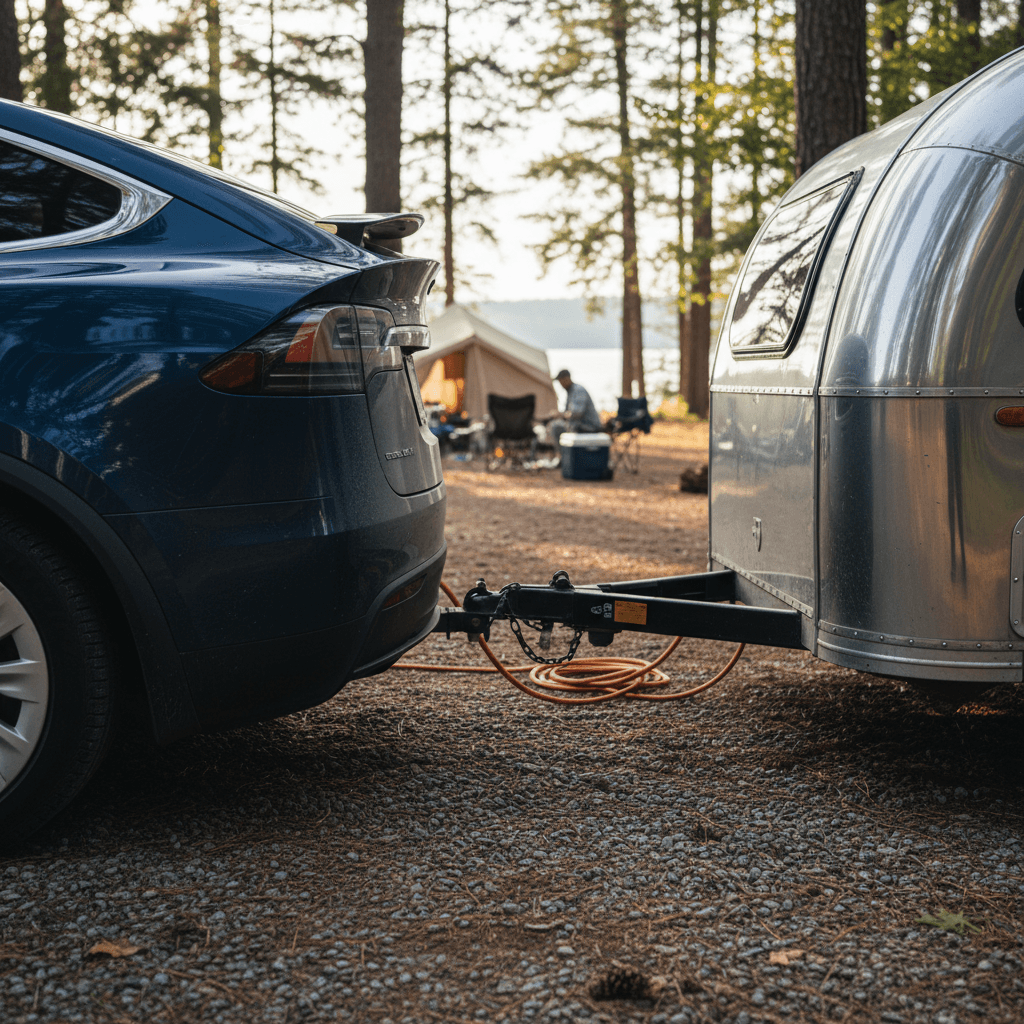
Good news for campground stays
Choosing the right trailer for a Model X
The right trailer can make the difference between a frustrating slog from charger to charger and a surprisingly smooth EV‑towing experience. With a Tesla Model X, you’re generally better off prioritizing aerodynamics and weight over sheer square footage.
Better vs. worse trailer matches for a Model X
You don’t have to go tiny, but shape and weight distribution matter a lot.
More EV‑friendly trailer types
- Teardrop campers that tuck behind the car’s roofline.
- Compact pop‑ups that tow low and expand at camp.
- Rounded fiberglass campers with smooth front caps.
- Small cargo trailers that stay below or near roof height.
Challenging trailer types
- Tall box trailers with square noses and high roofs.
- Heavy tandem‑axle campers near the 5,000‑lb limit.
- Toy haulers with big flat fronts and high drag.
- Any trailer that puts more than ~500 lbs on the hitch.
Mind the tongue weight
Tips for safer, more efficient Model X towing
- Enable Trailer Mode so the vehicle adjusts stability control, disables rear parking sensors and Autopilot functions that aren’t trailer‑compatible, and changes range estimates.
- Set your own speed cap, many experienced EV towers stick to 55–62 mph for a huge efficiency gain with only a modest impact on trip time.
- Check all tires cold before each towing day: both the Model X and the trailer. Under‑inflation is a double hit: worse efficiency and worse stability.
- Distribute trailer weight properly, with roughly 60% of the load ahead of the axle and 10% of total trailer weight on the tongue, staying within Tesla’s stated limits.
- Practice braking and lane changes in a safe area before you hit the freeway so you know how the combination behaves under load.
- Avoid aggressive acceleration; the X has more than enough torque to overwhelm a lightly loaded trailer if you aren’t smooth with the pedal.
Autopilot and FSD aren’t for towing
Towing with a used Tesla Model X: what to check
If you’re considering a used Model X specifically because of its tow rating, you’ll want to look beyond the glossy photos and focus on hardware, battery health, and vehicle history. This is where Recharged’s focus on EV specifics can save you guesswork.
Used Model X towing checklist
Verify factory tow package
Confirm that the vehicle has the <strong>OEM tow package</strong>, not just an aftermarket receiver. Check the owner’s manual in the car or app for a listed tow rating tied to your VIN.
Review battery health
Towing with a degraded battery means shorter legs and longer fast‑charge sessions. A <strong>Recharged Score battery health report</strong> can show you how much capacity the pack has retained vs. new.
Inspect rear structure & hitch
Look under the rear for signs of rust, damage, or poorly installed aftermarket hitches. Any evidence of past towing accidents or overloading is a red flag.
Check brake wear and tires
Towing is harder on brakes and tires. Uneven wear or cheap, low‑load‑rating tires at the rear are a sign the previous owner may not have respected the limits.
Confirm software and settings
Make sure Trailer Mode is present and functioning, and that all stability and ABS systems are error‑free. Persistent warnings are a reason to walk away or negotiate repairs.
Ask about towing history
A light‑duty bike rack life is very different from years spent pulling a near‑max‑weight camper. Honest history, plus a third‑party inspection, helps you understand how hard a used X has worked.
How Recharged can help
Ready to find your next EV?
Browse VehiclesFAQ: Tesla Model X towing capacity and range loss
Frequently asked questions
Bottom line: Is the Tesla Model X good for towing?
The Tesla Model X is a legitimately capable tow vehicle within its design envelope: up to 5,000 lbs, ideally with an aerodynamic trailer and a driver who’s willing to slow down and plan charging stops. If you expect to tow a tall, heavy camper 400 miles between fuel stops at 75 mph, it’s going to disappoint you. But if you’re realistic about the 40–60% range hit that comes with EV towing and you choose your trailer carefully, the X delivers quiet, stable, low‑maintenance towing with the bonus of emissions‑free camping.
If you’re considering a used Model X specifically for towing, it’s worth getting specialized EV diagnostics rather than treating it like any other SUV. At Recharged, every vehicle comes with a Recharged Score battery health report, transparent pricing, and EV‑savvy support that can help you understand exactly what kind of towing lifestyle a given Model X can support, before you hitch up and head out.