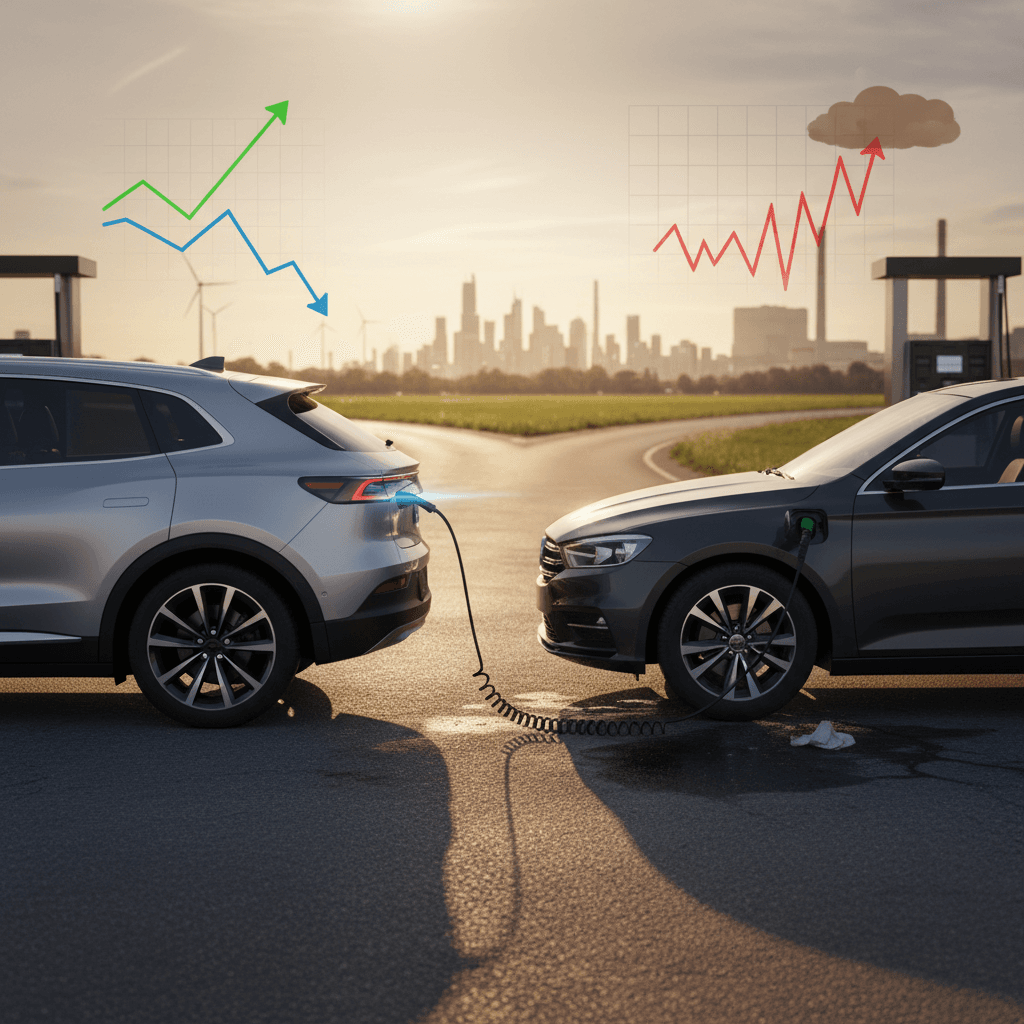
If you’re cross-shopping a Tesla Model S vs a gas car like a BMW 5 Series, Mercedes E‑Class, or Audi A6, the sticker price only tells part of the story. What you really care about is total cost of ownership: how much money leaves your pocket over five or ten years once you factor in fuel, maintenance, insurance, and resale value.
Big picture
Why compare a Tesla Model S to a gas car?
The Model S competes directly with midsize to large luxury sedans. A fair Tesla Model S vs gas car cost comparison usually pits it against models like the BMW 5 Series, Mercedes‑Benz E‑Class, Audi A6/A7, or Lexus GS. These cars all target similar buyers: people who want performance, comfort, and technology, and who drive enough miles that running costs matter.
- Model S: all‑electric, large hatchback sedan, long range, strong acceleration, access to Tesla Superchargers.
- Gas luxury sedan: gasoline engine, traditional drivetrain, wide dealer network, familiar service model.
- Use case: mixed commuting, errands, and highway trips, often 10,000–15,000 miles per year.
Used vs. new
Key assumptions for a fair cost comparison
There’s no single “correct” answer because costs depend on how and where you drive. To keep this comparison grounded, we’ll use realistic 2025–2026 U.S. averages and make our assumptions explicit so you can tweak them for your situation.
Baseline assumptions for this comparison
For vehicles, we’ll compare a recent‑generation Long Range Tesla Model S to a similarly equipped midsize luxury sedan with a turbocharged gasoline engine:
Vehicles we’ll use in the comparison
Approximate U.S. market positioning as of 2025–2026
Tesla Model S Long Range (newish)
- Purchase price (well‑equipped): ~$80,000
- Efficiency: ~35 kWh/100 miles (about 3 miles per kWh)
- Energy: ~0.35 kWh/mile
- Range: ~370–400 miles on a full charge
Gas Luxury Sedan (BMW 540i / Mercedes E450)
- Purchase price (well‑equipped): ~$70,000
- Real‑world fuel economy: ~25 mpg combined
- Fuel use: 0.04 gal/mile
- Range: 450–550 miles per tank
Your numbers will differ
Purchase price and financing
On a pure sticker‑price basis, a new Tesla Model S tends to cost more than a comparable gas sedan. However, luxury brands also discount heavily, and used pricing can flip the script. Let’s keep the example simple and assume both cars are bought new with 10% down and financed over 72 months at similar interest rates.
Approximate upfront cost comparison (new)
Representative pricing for well‑equipped models, your local dealer or used‑EV marketplace will vary.
| Item | Tesla Model S Long Range | Gas Luxury Sedan |
|---|---|---|
| MSRP (well‑equipped) | $80,000 | $70,000 |
| Down payment (10%) | $8,000 | $7,000 |
| Amount financed | $72,000 | $63,000 |
| Estimated monthly payment (72 mo, similar APR) | Higher by ~$120–$150 | Lower by ~$120–$150 |
Tesla still carries a price premium new, but that gap often shrinks in the used market.
Used pricing can favor the Tesla
Fuel vs. electricity costs: what you’ll actually spend to drive
Fuel is where EVs usually pull ahead quickly. Let’s walk through the math step by step so you can plug in your own numbers.
Gas luxury sedan fuel cost
- Assumed efficiency: 25 mpg combined
- Gas price: $3.10/gal (2025 U.S. average)
- Cost per mile: 3.10 ÷ 25 ≈ $0.12/mile
- Annual miles: 12,000
- Annual fuel cost: 12,000 × 0.12 ≈ $1,440
- 5‑year fuel cost: ≈ $7,200
Tesla Model S electricity cost
- Assumed efficiency: 0.35 kWh/mile (≈35 kWh/100 miles)
- Electricity rate: $0.18/kWh (2026 U.S. average)
- Cost per mile: 0.35 × 0.18 ≈ $0.063/mile
- Annual miles: 12,000
- Annual electricity cost: 12,000 × 0.063 ≈ $756
- 5‑year electricity cost: ≈ $3,780
Five‑year fuel vs. electricity spend
Charging smart cuts costs further
Maintenance and repairs: fewer moving parts, fewer surprises
The Model S doesn’t need oil changes, spark plugs, timing belts, or transmission services. It still needs tires, cabin air filters, brake fluid service, and the occasional alignment, but on average, maintenance costs are lower and more predictable than in a gas luxury sedan filled with complex hardware.
Typical maintenance profile: Tesla Model S vs gas luxury sedan
Averages will vary by driver, region, and how aggressively you drive.
Tesla Model S
- No oil changes or exhaust work
- Regenerative braking reduces brake wear
- Far fewer fluids and filters
- Biggest routine costs: tires, cabin filters, periodic inspections
- Potential big‑ticket items: out‑of‑warranty repairs, battery or drive unit work (rare but expensive)
Gas luxury sedan
- Regular oil and filter changes
- Transmission service over time
- More belts, pumps, valves, and emissions components
- Potential big‑ticket items: turbo, transmission, fuel system, emissions repairs
Illustrative 5‑year maintenance and repair costs
Broad, ballpark ranges for a well‑maintained car out of warranty; real numbers depend heavily on driving conditions and luck.
| Category (5 years) | Tesla Model S | Gas Luxury Sedan |
|---|---|---|
| Routine maintenance (fluids, filters, inspections) | $1,000–$1,500 | $2,000–$3,000 |
| Wear items (tires, brakes, wipers, etc.) | $2,000–$2,500 | $2,000–$2,500 |
| Unexpected repairs (average) | $1,000–$2,000 | $2,000–$3,000 |
| Estimated 5‑year total | ~$4,000–$6,000 | ~$6,000–$8,500 |
These are directional estimates, not guarantees, and exclude insurance‑covered collision repairs.
Battery replacement fears
Insurance, taxes, and fees
Insurance can be slightly higher for EVs because of repair complexity and parts prices, and the Model S is no exception. At the same time, gas luxury sedans aren’t cheap to insure either, and many states now treat EVs similarly for registration fees.
Insurance expectations
- Model S: often 5–15% higher than a comparable gas car, depending on trim, wheels, and driver profile.
- Gas sedan: still a premium to insure, especially with high‑output engines or AMG/M performance packages.
- Shopping quotes matters: different carriers price EVs very differently.
Taxes & registration
- Sales tax: based on purchase price, so the Model S may cost more upfront here.
- Registration: some states add small EV surcharges; others still offer perks or HOV access.
- Property or excise taxes (where applicable): follow vehicle value, not powertrain.
Don’t ignore local policy
Resale value and depreciation
Both luxury EVs and luxury gas sedans depreciate quickly in the first few years, but patterns are shifting. As more buyers seek used EVs and as Tesla continues over‑the‑air feature updates, late‑model Model S values have held relatively competitive with German luxury sedans that also drop fast once they leave the showroom.
Five‑year depreciation snapshot (illustrative)
Assuming average mileage, normal wear, and no major accidents.
Tesla Model S
- Purchase: ~$80,000
- Estimated value after 5 years: ~$35,000
- Depreciation: ≈ $45,000
- Technology and battery health play big roles; clean history helps a lot.
Gas luxury sedan
- Purchase: ~$70,000
- Estimated value after 5 years: ~$28,000
- Depreciation: ≈ $42,000
- High‑end options often recoup little; buyers value condition and mileage most.
How Recharged helps on resale
Ready to find your next EV?
Browse VehiclesFive‑year total cost of ownership: Tesla Model S vs gas sedan
Now let’s roll the big pieces together for a five‑year view. We’ll keep the math simple and focus on major, recurring costs. Numbers below are rounded and illustrative; use them as a framework.
Illustrative 5‑year total cost of ownership (12,000 mi/year)
Rounded numbers for a typical driver. Excludes financing interest, parking, tolls, and insurance‑covered accidents.
| Cost category (5 years) | Tesla Model S | Gas Luxury Sedan |
|---|---|---|
| Purchase price (depreciation impact) | $45,000 lost value | $42,000 lost value |
| Fuel / electricity | $3,800 | $7,200 |
| Maintenance & repairs | $5,000 (mid‑range) | $7,000 (mid‑range) |
| Insurance, taxes & fees | Slightly higher insurance, similar taxes | Slightly lower insurance, similar taxes |
| Estimated 5‑year running costs (fuel + maintenance) | ~$8,800 | ~$14,200 |
| Combined: depreciation + running costs | ≈ $53,800 | ≈ $56,200 |
Even with a higher purchase price, the Model S can land in a similar or slightly better place over five years, depending on how you drive and charge.
What this means in plain English
10‑year view: what happens if you keep the car longer?
Stretch the horizon to 10 years and the fuel and maintenance curves keep diverging. The gas car keeps burning fuel and accumulating wear on complex mechanical systems. The Model S keeps sipping electrons and mostly wearing out consumables, tires, brakes, and suspension parts.
Key 10‑year ownership considerations
1. Fuel consumption keeps adding up
At 12,000 miles per year and $3.10 gas, the sedan burns around $14,400 of fuel in 10 years. The Model S uses about $7,500 worth of electricity at 18¢/kWh, roughly half.
2. Maintenance gap widens
Major services and mechanical failures tend to pop up in years 7–10 on gas cars: cooling systems, transmissions, emissions hardware. EVs can have failures too, but they face fewer stress points overall.
3. Battery health becomes central
For a 10‑year‑old Model S, remaining battery capacity and charging behavior are crucial. A car that’s been fast‑charged exclusively and neglected may be worth much less than one with gentle usage plus documented health from tools like the Recharged Score.
4. Resale vs. run‑it‑into‑the‑ground
At 10 years, both cars may have modest resale value. The Model S’s worth will largely mirror its battery health and cosmetic condition; the gas car’s will hinge on engine, transmission, and rust.
How buying a used Tesla Model S changes the math
Most shoppers today are looking at used Tesla Model S models, not brand‑new ones. That’s where the value story often gets better: someone else has already taken the early depreciation hit, but you still enjoy EV running costs.
Why used Model S buyers often win on cost
This is where marketplaces like Recharged change the equation.
Lower purchase price
A 3–6‑year‑old Model S can cost similar money to a much newer gas sedan, yet still offers modern tech, strong performance, and low energy costs.
Known battery health
With tools like the Recharged Score, you can see how healthy the battery really is, instead of guessing based on odometer alone.
Simpler cost planning
Between lower fuel use and fewer routine services, it’s easier to estimate your real monthly ownership cost, and compare it directly to that gas alternative.
Use total cost per month, not just price
Is a Tesla Model S worth it for you?
After walking through this Tesla Model S vs gas car cost comparison, you’re probably wondering whether the EV advantage applies to your specific situation. The answer depends mostly on how much you drive, how you charge, and how long you keep cars.
Drivers who usually come out ahead with a Model S
- Commute or road‑trip enough to cover 12,000–15,000+ miles/year.
- Can charge primarily at home or work at reasonable electricity rates.
- Plan to keep the car at least 5 years.
- Value smooth performance and modern tech (which the Model S delivers in spades).
Cases where a gas sedan can still make sense
- You drive very little each year (under ~7,000 miles).
- You can’t install home charging and public rates are expensive.
- You live where electricity is unusually costly while gas is cheap.
- You prioritize traditional dealer service and brand familiarity.
Next steps to run your own numbers
1. Gather your real mileage and fuel history
Look at your last 6–12 months of driving and fuel receipts. Your actual miles and price per gallon are better inputs than national averages.
2. Check your electric rate and off‑peak options
Your utility bill or website will show your cents per kWh. Ask if they offer EV‑specific or off‑peak plans that make home charging cheaper.
3. Compare specific cars, not just categories
Pick an actual Model S listing and a real gas sedan you’d buy, then compare price, mileage, options, and condition. Recharged makes this easy with transparent used EV listings.
4. Estimate 5‑year fuel and maintenance
Multiply your annual miles by cost per mile for fuel or electricity, then add a realistic maintenance budget for each car. Even a rough estimate will usually reveal the trend.
5. Get pre‑qualified and shop used EVs
Pre‑qualification (which Recharged offers with no impact to your credit) gives you a clear budget so you can focus on finding the right Model S with the right battery and history.
FAQ: Tesla Model S vs gas car costs
Frequently asked questions
When you look beyond the sticker and compare a Tesla Model S vs a gas luxury car on total cost of ownership, the EV is often as affordable, or more affordable, over the long haul, particularly for higher‑mileage drivers with access to home charging. If you’re ready to run the numbers on a specific car, a used Model S with a verified battery report and transparent pricing from Recharged can turn that math into a confident purchase decision.