If you own, or are shopping for, a Tesla Model S, battery condition is the single most important part of the car’s value. A clear Tesla Model S battery health check can tell you whether you’re looking at years of reliable range or a pack that’s sliding toward an expensive repair. The good news: you don’t need to be an engineer to get a solid read on battery health.
Model S battery longevity in the real world
Why Model S battery health matters, especially used
The Model S is one of the longest‑running EV nameplates on the road. That means there are plenty of 7–12‑year‑old cars with six‑figure mileage. Two examples with identical paint and interiors can have very different batteries, and that’s what drives real‑world range, performance, and resale value.
- Range and usability: A healthy 85–100 kWh pack can still deliver road‑trip‑ready range; a tired pack can turn a luxury sedan into a commuter only.
- Warranty implications: Tesla’s original Model S battery warranty is typically 8 years and a set mileage (or unlimited miles on some early packs) against excessive degradation or failure. Many early cars are now outside that window.
- Resale value: Buyers are increasingly savvy. A documented, healthy battery can add thousands in perceived value versus a similar car with unknown history.
- Fast‑charging behavior: Degraded or unbalanced packs may charge more slowly at Superchargers, stretching road trips.
Used luxury car, EV rules
What “normal” Tesla Model S battery degradation looks like
Battery degradation isn’t a defect, it’s chemistry. Every Model S loses some capacity over time. The key question is whether the loss is normal for the car’s age and mileage.
Typical Tesla Model S battery degradation patterns
You’ll see the largest percentage drop in the first few years, then a slower, almost linear decline. Climate, fast‑charging habits, and how often the pack sits at 100% or near empty all have an impact. That’s why two 2016 Model S cars can show very different usable ranges today.
How to think about “good enough”
Quick Tesla Model S battery health check using range
You can get a surprisingly accurate first impression of Model S battery health using just the car’s range display and a bit of math. This doesn’t replace a full diagnostic, but it’s a strong filter, especially when you’re test‑driving or looking at online listings.

5‑minute Model S battery health check (no tools required)
1. Switch to distance‑based range
On the center screen, set the battery display to <strong>miles or kilometers</strong> instead of percentage. This makes it easier to compare against original EPA‑rated range for your year and pack size.
2. Charge close to 100% (once)
Ask the seller, or do it yourself, to fully charge the car once for testing. You don’t want to live at 100% regularly, but it’s appropriate for a health check if the pack isn’t already at full.
3. Compare to original EPA range
Look up the original EPA range for that Model S trim (e.g., ~265 miles for early 85 kWh cars, ~335+ miles for later 100D/LR variants). Divide the <strong>displayed 100% range</strong> by the original rating to get an approximate health percentage.
4. Check for big surprises
If a car that should have ~300 miles at 100% is showing ~225, that’s about 25% degradation. That’s high for a low‑mileage or still‑under‑warranty car and worth investigating.
5. Repeat at 50–70%
On a test drive, note projected range at a mid‑pack state of charge (like 60%). Large jumps or inconsistent estimates can hint at <strong>BMS calibration</strong> issues rather than true hardware loss, but both deserve a closer look.
Don’t panic over one number
Deeper Model S battery diagnosis: tools and data
Once you’ve done a quick range‑based check, you can go deeper. Modern Tesla software, third‑party tools, and professional diagnostics can give you a clearer picture of pack health, cell balance, and how the car has been used.
Ways to check Tesla Model S battery health in more detail
From built‑in tools to full professional diagnostics
Tesla app battery health info
On many newer software builds, Tesla surfaces basic battery‑health information in the Service section of the mobile app. Some Model S owners see either a simple verdict like “Healthy” or percentages based on the most recent battery test.
Useful as a quick reference, but it usually reflects the last detailed test rather than live, continuous tracking.
Third‑party logging apps
Apps and services that read Tesla telemetry (via API or OBD where available) can estimate usable capacity based on charge/discharge data and driving history.
- Track degradation over months, not minutes.
- Spot trends like accelerating capacity loss.
Professional EV diagnostic tools
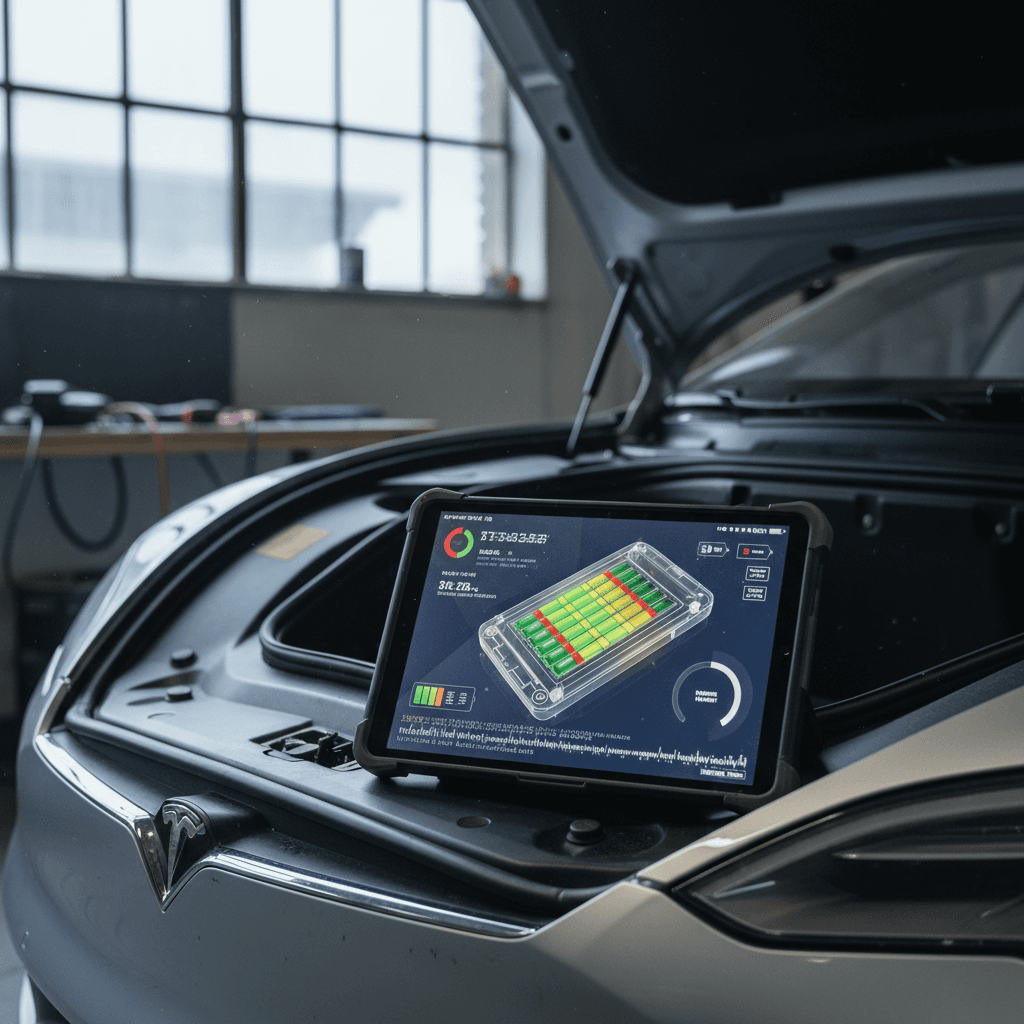
Specialized equipment, often used at EV‑focused retailers and independent shops, can read pack voltage, cell‑group imbalances, temperature behavior, and charge‑cycle history.
This is the level of analysis you want before writing a big check for a used Model S.
About Tesla’s built‑in battery tests
Tesla has rolled out (and recently revised) a Battery Health Test in both the in‑car Service menu and the mobile app on some models. When available, this test fully cycles and measures the pack to estimate remaining capacity as a percentage of new.
In 2025, Tesla changed access to this tool on several vehicles and software versions, limiting how often owners can run it and, in some cases, removing self‑service options entirely. On some Model S builds, you may only see the result of an older test rather than being able to start a new one.
Bottom line: if you can see a recent battery‑health percentage in the Tesla app or Service menu, it’s useful, but don’t assume every Model S will expose this feature, especially older cars or those on certain firmware.
Third‑party tools & OBD dongles
On some configurations, owners and technicians can access deeper battery data via an OBD‑II adapter and apps built specifically for Teslas. These tools can estimate:
- Usable pack capacity in kWh
- Cell‑group voltage spread (a sign of pack balance)
- DC fast‑charge vs. AC charge history
- Temperature‑related stress patterns
If you’re a private buyer without this hardware, consider having an EV‑savvy shop or retailer run this kind of test for you rather than guessing from range alone.
Be careful with DIY Service‑mode experiments
How to check Model S battery health before buying used
Shopping for a used Model S is where battery health checks really pay off. The process is a bit different depending on whether you’re buying from a private seller, a traditional dealer, or an EV‑focused retailer like Recharged.
Pre‑purchase Tesla Model S battery health checklist
1. Verify build year, trim, and battery size
Get the exact year, trim (e.g., 85, 90D, 100D, P100D, Long Range), and original battery size. This determines the EPA range you’ll compare against and which warranty rules apply.
2. Ask for a recent 100% range screenshot
Request a photo of the center screen or app showing the car at (or near) 100% with predicted miles. Compare that to the original EPA‑rated range to estimate degradation.
3. Review charging habits and climate
Ask how the car was typically charged (home AC vs. frequent Supercharging), what charge limit was used for daily driving, and whether it lived in extreme heat or cold. Long‑term high‑state‑of‑charge and heat are harder on the pack.
4. Scan for battery‑related alerts
On the test drive, check the main screen for any <strong>BMS</strong> or high‑voltage system warnings. Even historic alerts in the car’s service history can justify a deeper inspection.
5. Look at real‑world trip data
If possible, review a recent road‑trip energy graph or trip‑meter data. Compare distance driven versus energy used to see whether consumption looks reasonable for a Model S of that vintage.
6. Get a professional battery report
For higher‑value cars or anything with questionable history, it’s worth having an EV‑specialist or a retailer like <strong>Recharged</strong> run a formal battery health diagnostic and document the results.
What you get with a Recharged vehicle
Warning signs your Model S battery needs attention
Most Model S packs age gracefully, but a few patterns should prompt a closer look or a service visit, especially if the car is still under battery warranty.
Common Model S battery warning signs and what they may mean
These symptoms don’t automatically mean the pack is failing, but they’re your cue to investigate.
| Symptom | What you’ll notice | What it can indicate | What to do next |
|---|---|---|---|
| Sudden large range loss | Range at 100% suddenly drops by 15–20% with no obvious reason | BMS mis‑calibration, cell imbalance, or actual capacity loss | Perform a controlled full charge and drive cycle; if it persists, schedule Tesla service or seek a pro diagnostic. |
| Battery or BMS alerts | Messages referencing the high‑voltage battery, BMS, or “maximum charge level reduced” | Potential hardware issue, pack imbalance, or safety limit triggered | Do not ignore. Get a service appointment and avoid long trips until inspected. |
| Very slow Supercharging | Car tapers early or never approaches expected kW at a Supercharger | High‑mileage pack with protective limits, low‑temperature operation, or pack health concerns | Check charging behavior in warmer conditions; if still abnormal, have the pack evaluated. |
| Inconsistent state‑of‑charge reading | SOC jumps several percent up or down during normal driving | BMS struggling to estimate pack state; sometimes follows long storage or unusual charging patterns | A few full‑to‑low cycles may re‑calibrate; if not, plan for diagnostics. |
| Range loss out of proportion to mileage | For example, 25–30% loss on a relatively low‑mileage, garage‑kept car | Hard use, extreme climate history, or pack‑specific issues | Treat as a yellow flag, negotiate price accordingly or insist on a professional report. |
Always confirm with proper diagnostics, don’t rely solely on one symptom.
Don’t assume Tesla will replace a weak‑feeling battery
Best practices to protect your Model S battery health
Once you’ve bought the car, the same habits that protect a new battery will slow degradation on a used Model S. You can’t reverse chemistry, but you can make the remaining life as long and predictable as possible.
- Keep daily charging in the middle: For non‑LFP Model S packs, use a daily charge limit around 70–80% and avoid sitting at 100% except for trips.
- Don’t live at 0% or 100%: Deep discharges and long‑term full charges both stress the pack. Plan trips so you arrive with a buffer, not on fumes.
- Be thoughtful with Supercharging: Fast charging is fine, but relying on it daily, especially in hot weather, adds stress. Home Level 2 charging is kinder to the pack.
- Watch temperature: Whenever practical, park in shade or garages in hot climates; the car will protect itself, but you pay with more fan/compressor use and potential long‑term stress.
- Run full battery tests sparingly: Whether in‑app or via service tools, each full‑cycle test is another deep charge/discharge. Use them for diagnosis, not monthly curiosity checks.
Plan for seasonal swings
How Recharged evaluates Tesla battery health on used cars
From a remarketing and retail‑tech standpoint, battery transparency is quickly becoming a differentiator in the used‑EV market. At Recharged, every Tesla Model S goes through a structured battery‑health workflow before it’s listed.
Inside a Recharged Tesla battery health evaluation
What happens before a used Model S ever hits the site
1. Data pull & history review
Technicians gather build data (year, pack size, trim), pull available software logs, and review any recorded battery‑related alerts or warranty work.
This gives context before we look at any single range number.
2. Capacity & balance assessment
We use EV‑focused diagnostic tools to estimate usable pack capacity, check cell‑group balance, and understand how the battery responds to charge and discharge.
The goal is a clear, quantitative picture, not just “it feels fine on a drive.”
3. Fair‑market pricing & Recharged Score
Battery results feed directly into the Recharged Score Report, which combines pack health, cosmetic condition, and market data to price the car fairly.
If a Model S has above‑average degradation, that’s reflected in price and transparency, not hidden in the fine print.
4. Buyer‑facing transparency & support
Shoppers see battery insights alongside photos and specs, and can talk with EV specialists about whether a specific car’s range suits their use case.
From financing to trade‑in and nationwide delivery, the experience is fully digital with expert guidance when you need it.
Ready to find your next EV?
Browse VehiclesTesla Model S battery health check: FAQ
Frequently asked questions about Model S battery health
The Tesla Model S proved that long‑range EVs could handle real‑world commuting and road‑tripping years before most competitors. The flip side is that many of these sedans are now old enough that battery condition makes or breaks the deal. By combining a simple range‑based Tesla Model S battery health check with deeper diagnostics where it counts, you can separate truly healthy cars from risky bets. And if you’d rather not decode kWh charts yourself, a used EV marketplace like Recharged can do the heavy lifting, testing battery health, pricing fairly, and guiding you through a fully digital purchase from first click to delivery.