If you’re looking at a Tesla Model S, especially a used one, your biggest long‑term question is probably the battery. How much battery degradation per year is normal? How fast will range drop, and when does it become a problem? The good news: real‑world data suggests Model S packs generally age better than many shoppers fear, as long as you understand the numbers and how to care for them.
Key takeaway up front
Tesla Model S battery degradation basics
Before you worry about exact percentages, it helps to define terms. Battery degradation is the slow, permanent loss of usable energy a pack can store. In a Tesla Model S, you feel this as fewer miles of rated range at 100% charge than when the car was new. This isn’t a defect; it’s normal wear in lithium‑ion cells driven by age, temperature, state of charge, and how the car is used.
- Tesla reports range based on a fixed battery model; as usable capacity shrinks, displayed range at 100% shrinks too.
- Degradation is usually fastest in the first 1–2 years or ~30,000–40,000 miles, then slows down significantly.
- Software updates can slightly change displayed range without any real change in the cells, so you should look at long‑term trends, not one‑off drops.
Model S degradation in the real world
How much range do Model S batteries lose per year?
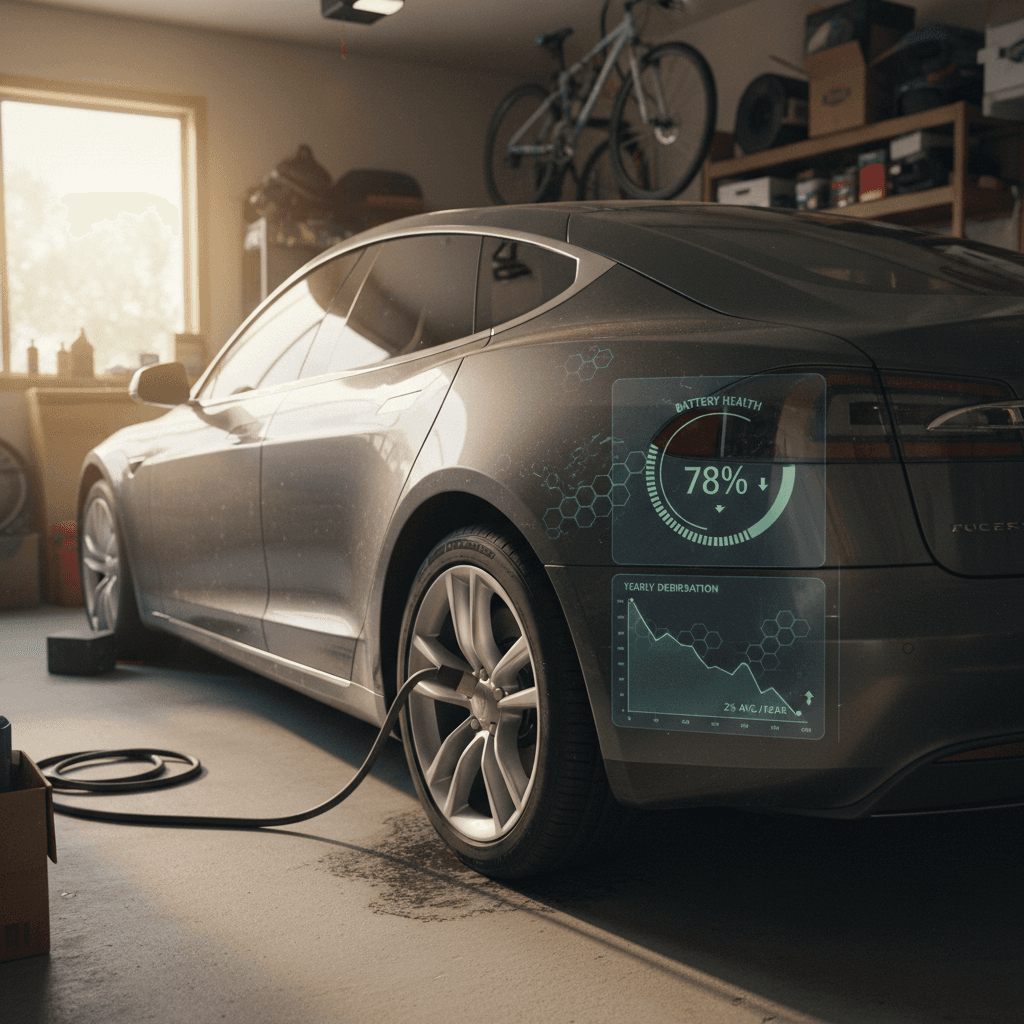
If you condense all the data down to one number, a typical Tesla Model S battery degradation per year works out to about 2–2.5% capacity loss, averaged over 8–10 years. In practice it’s not a straight line: you’ll likely see a noticeable early dip, followed by a long, slow glide.
Average Tesla Model S battery degradation per year
Approximate, smoothed averages combining age and mileage for mainstream Model S battery packs. Your exact results will vary by climate, driving style, and charging habits.
| Age (years) | Typical mileage | Expected capacity vs new | Approx. annualized loss |
|---|---|---|---|
| 1 | 10,000–15,000 mi | 93–96% | 4–6% in first year |
| 3 | 30,000–45,000 mi | 90–93% | ~2–3% per year overall |
| 5 | 50,000–75,000 mi | 86–90% | ~2–2.5% per year overall |
| 8 | 80,000–120,000 mi | 78–85% | ~2–2.7% per year overall |
| 10+ | 100,000–160,000+ mi | 75–82% | ~2–2.5% per year overall |
These numbers assume 10,000–15,000 miles per year in mixed conditions, with mostly AC charging and occasional DC fast charging.
Why the first years look “worse”
Degradation by age and mileage: what real data shows
If you zoom out from the year‑by‑year view, two things matter most for a Model S pack: mileage and time. High‑mileage highway cars often look surprisingly healthy, while low‑mileage city cars that sat at 100% state‑of‑charge for years can lose more capacity than you’d expect.
Mileage-driven degradation
- Fleet analyses of Tesla Model S/X suggest roughly 10–12% loss by around 200,000 miles, assuming mostly moderate climates and charging habits.
- That translates to roughly 1.5–2% capacity loss per 50,000 miles once the early drop is out of the way.
- Owners who do lots of highway miles on AC charging often see gentler degradation than urban drivers who fast‑charge frequently.
Calendar (age‑driven) degradation
- Age on the calendar matters even if mileage is low, lithium‑ion cells slowly degrade just sitting, especially at high state‑of‑charge and high heat.
- In independent EV studies, average calendar‑driven loss works out to roughly 1.5–2.3% per year for modern chemistries in real‑world use.
- That’s why you can see a 7‑year‑old Model S with only 60,000 miles showing similar capacity to a 7‑year‑old car with 110,000 miles if both were treated well.
What about early Model S packs?
What Tesla’s 70% battery warranty really means
For modern Model S vehicles in the U.S., Tesla’s battery and drive unit warranty is typically 8 years or 150,000 miles, whichever comes first, with a minimum 70% battery capacity guarantee. In plain English, if your pack falls below about 70% of its original usable capacity during that window under normal use, Tesla is obligated to repair or replace it under warranty terms.
- The 8‑year clock starts from the original in‑service date (when the first owner took delivery), not the model year.
- The 70% threshold is based on Tesla’s internal measurement of usable capacity, not just what the range display says on a cold day.
- Some older unlimited‑miles Model S warranties did not include an explicit 70% clause; those cars are now aging out of their original coverage window in 2026.
Watch for software vs. hardware effects
Factors that speed up or slow down Model S degradation
Not all 2017 or 2020 Model S sedans age the same way. Two cars built the same month can show very different degradation by 2026 depending on climate, charging, and use. If you understand the levers, you can tilt odds in your favor, whether you own one already or you’re evaluating a used example.
Biggest drivers of Model S battery degradation
Use these levers to keep your annual capacity loss on the low end of the normal range.
Heat and cold
High temperatures accelerate battery aging; long periods parked in the hot sun at high state‑of‑charge are especially tough on a pack. Very cold weather doesn’t cause permanent loss but can temporarily reduce available range.
Charging habits
Frequent DC fast charging (Supercharging) and charging to 100% daily will wear the pack faster. Moderating charge levels (often 50–80%) and relying on Level 2 home or workplace charging is gentler.
Driving patterns
Hard acceleration, high sustained highway speeds, and heavy loads make the pack work harder and run warmer. Smooth driving and avoiding repeated 0–100% cycles can keep degradation closer to the fleet average.
Simple rules to stay on the low‑degradation side
How to check battery degradation on a Model S
If you already own a Model S, or you’re standing on a dealer lot with one unlocked, you can get a surprisingly good sense of health from a few simple checks. For more serious decisions, like buying a high‑mileage used car, it’s worth going one level deeper with diagnostics.
Quick steps to estimate Model S battery degradation
1. Note the battery size and trim
Know whether you’re looking at a 70, 75, 85, 90, 100 kWh, or later long‑range pack. Compare against the EPA‑rated range for that trim year, which you can find in owner forums or EV databases.
2. Check 100% rated range (or extrapolate)
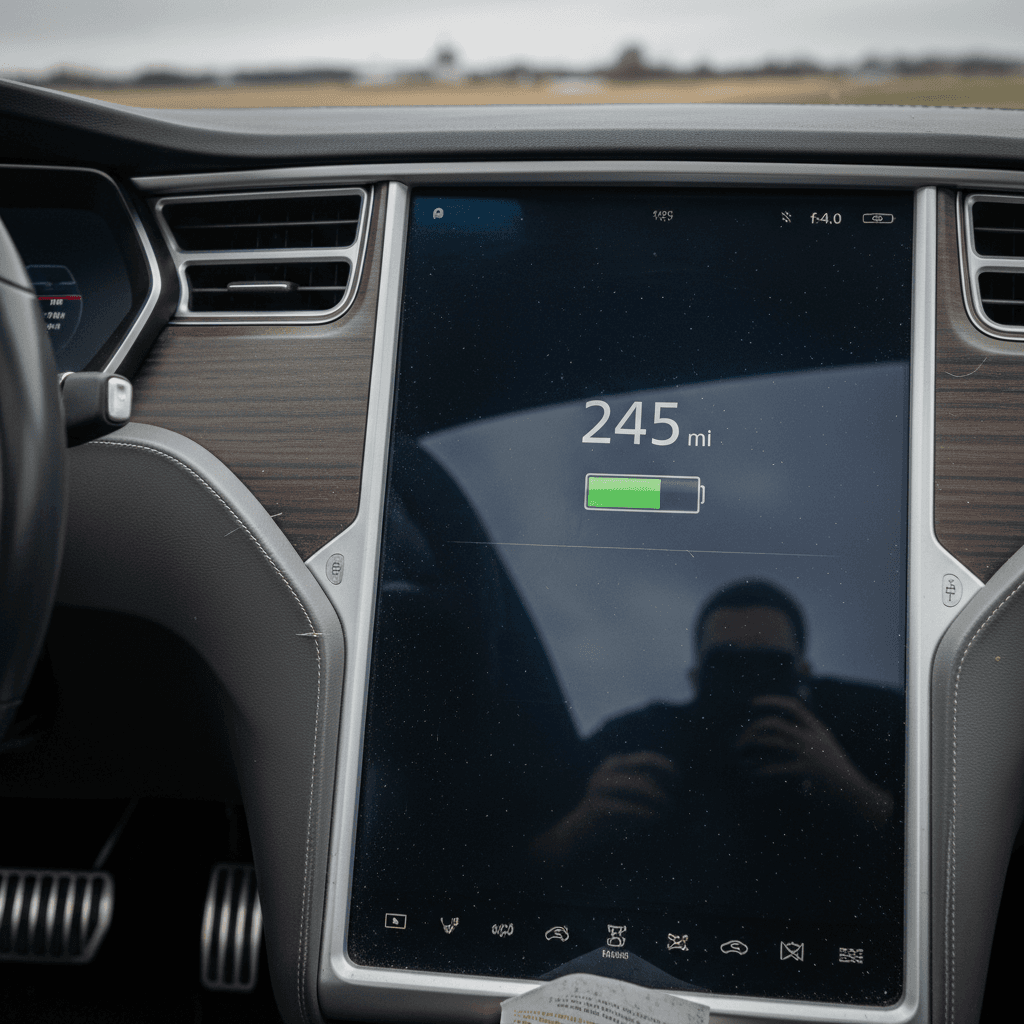
Ideally, look at the rated range at a full charge on a warm day. If you only see, say, 90%, you can divide the displayed range by 0.9 to estimate 100% range. Compare that to the original rating to estimate capacity loss.
3. Use a scan tool or battery report
Third‑party tools and apps can read pack State of Health more precisely via OBD or Tesla’s data APIs. At Recharged, every vehicle gets a Recharged Score battery health report based on direct pack diagnostics, not guesses.
4. Look at charging history and habits
Ask the seller how they charged: mostly home Level 2 at 60–80% or daily Supercharging to 100%? Frequent fast charging and long sessions at high state‑of‑charge are yellow flags for faster degradation.
5. Drive it and watch consumption
On a short highway loop, compare energy consumption (Wh/mi) to typical values for that trim. If energy use is reasonable but the rated range at 100% is low, degradation, not driving style, is likely the culprit.
6. Cross‑check against similar cars
Compare the car’s apparent State of Health with similar‑age, similar‑mileage Model S data from reputable owner datasets. If it’s a clear outlier on the low side, you’ll want a deeper inspection, or a lower price.
How Recharged handles battery checks
Ready to find your next EV?
Browse VehiclesUsed Model S shopping: battery health checklist
If you’re evaluating a used Model S, whether from a private seller, franchise dealer, or online marketplace, battery health should sit right next to price, options, and accident history on your checklist. Here’s a simple framework that keeps you grounded in the numbers instead of the seller’s promises.
Buyer checklist: is this Model S battery in the “normal” range?
Confirm remaining battery warranty
Look up the in‑service date and mileage. If the car is less than 8 years old and under 150,000 miles, ask the seller to confirm whether the 70% capacity warranty is still active and transferable.
Ask for a recent full‑charge screenshot
Have the seller share a photo of the instrument cluster or app at 100% charge on a mild‑weather day. Use that range vs. original EPA rating to estimate degradation.
Request a third‑party battery health report
A professional battery assessment, like the Recharged Score, is worth far more than a generic inspection. It can validate State of Health and detect outlier modules or past abuse.
Match price to battery health
Two similar cars with 80% vs. 90% remaining capacity should not be priced the same. If the battery is clearly down 20% or more, you should see that reflected in the number, or walk.
Check for software‑limited or replaced packs
Some used Model S vehicles have had warranty pack replacements or software‑limited configurations in their past. Those can be positives, but they’re worth understanding clearly before you sign anything.
Evaluate climate and usage history
A car that lived its life in Phoenix and Supercharged daily is a different risk profile than a garage‑kept car in Seattle that mostly trickle‑charged. Ask questions and weigh that context.
Example scenarios: what’s normal vs concerning?
Numbers on a page are one thing; real‑world examples are another. Here are a few common Model S scenarios and how their annualized degradation shakes out. Use these as directional guides rather than rigid rules.
Model S degradation scenarios by age and mileage
Rough annualized loss helps you decide when to dig deeper, or when to relax.
Scenario 1: 3‑year‑old, 40k miles
Original rated range: 405 miles
Current 100% range: 372 miles
That’s about 8% loss over 3 years (~2.7%/yr). For a 2023–2024 Long Range Model S with mixed driving, this is well within the normal window.
Scenario 2: 7‑year‑old, 110k miles
Original rated range: 335 miles
Current 100% range: 280 miles
Roughly 16% loss over 7 years (~2.3%/yr). For a 2018 car at this mileage, this is a solid, healthy result that should still feel like a long‑range EV.
Scenario 3: 6‑year‑old, 60k miles
Original rated range: 370 miles
Current 100% range: 255 miles
That’s about 31% loss over 6 years (~5%/yr). This is an outlier on the high side. You’d want a full battery‑health report and a price that reflects the reduced capacity, or you might walk away.
When degradation is a red flag
Frequently asked questions about Model S battery degradation
Tesla Model S battery degradation FAQ
The bottom line on Model S battery life
Step back from the noise, and the story is surprisingly reassuring: for most owners, a Tesla Model S battery degradation per year of around 2–2.5% is normal, and many packs keep 80% or more of their original capacity well into the second decade. The big risks, heavy fast‑charging, extreme heat, or cars that lived at 100% charge, are real, but they’re also visible if you know where to look.
If you already own a Model S, smart charging and storage habits can keep you on the lower‑degradation side of the curve. If you’re shopping used, the combination of a clear battery‑health report, transparent pricing, and remaining warranty coverage matters more than any single percentage point. That’s exactly the gap Recharged aims to close with our Recharged Score diagnostics, expert EV support, and nationwide used‑EV marketplace, so you can pick the right Model S with confidence instead of guesswork.