If you’re cross-shopping a Tesla Model 3 and a Toyota Camry in 2026, you’re not alone. One is America’s archetypal family sedan; the other helped make EVs mainstream. The real question most shoppers care about is simple: which one is actually cheaper to own over the next 5 years? This 2026 Tesla Model 3 vs Toyota Camry cost comparison walks through purchase price, fuel, maintenance, insurance, depreciation, and incentives so you can run the numbers for your situation.
Scope of this comparison
Why Compare the Tesla Model 3 and Toyota Camry in 2026?
On paper, the Tesla Model 3 and Toyota Camry don’t look like obvious rivals. The Tesla is a fully electric, tech‑heavy compact sport sedan; the Camry is a midsize hybrid workhorse. But if you’re simply asking, “Where does my money go over five or ten years?” they end up on the same spreadsheet.
Model 3 vs Camry: why they end up on the same shopping list
Different drivetrains, similar roles in real life
Same job, different tools
Monthly payment focused
Lower running costs
Because both cars are now common on the used market, you’re likely deciding between a new or used Camry, a new Model 3, or a used Model 3 from a marketplace like Recharged, where you can see battery health and fair pricing up front.
Baseline assumptions for this cost comparison
To make the Tesla Model 3 vs Toyota Camry cost comparison meaningful, we’ll standardize a few things. You can adjust the inputs later to reflect your own driving and utility rates.
Key assumptions for 5‑year cost comparison (2026)
These are reasonable national‑average assumptions; adjust them to match your reality.
| Category | Assumption used | Notes |
|---|---|---|
| Annual mileage | 12,000 miles/year | Roughly the U.S. average for personal vehicles |
| Ownership period | 5 years | Good balance between short lease and long‑term ownership |
| Gas price | $3.75 per gallon | Approximate national average in recent years |
| Home electricity rate | $0.16 per kWh | Blended residential average; some states are higher or lower |
| Driving mix | 60% city / 40% highway | Reflects typical commute plus weekend trips |
| Tesla Model 3 efficiency | ~26 kWh/100 miles | Recent Model 3 EPA figures and real‑world testing |
| Camry hybrid efficiency | ~50 mpg combined | Aligns with current Camry LE hybrid estimates |
| Financing | 60‑month loan, average credit | We’ll focus more on total cash cost than on financing structure |
All costs are in 2026 U.S. dollars and exclude taxes and fees that vary widely by state.
Use your own numbers
Purchase price and incentives in 2026
In 2026, the Tesla Model 3 remains more expensive to buy new than a Toyota Camry, even as Tesla has introduced lower‑priced “Standard” models and Camry pricing has crept up with its move to an all‑hybrid lineup.
Approximate 2026 starting MSRPs (new, before destination)
That MSRP gap is why many shoppers assume the Camry must be cheaper to own. But incentives and running costs complicate the story.
Federal and state EV incentives
Depending on how the Inflation Reduction Act rules evolve and how Tesla sources batteries, a new Model 3 may or may not qualify for a federal clean‑vehicle tax credit in 2026. Several states also add rebates or tax credits for EVs.
When the full $7,500 credit is available, it can nearly erase the sticker‑price gap to a Camry. When it isn’t, the Tesla remains meaningfully more expensive up front.
Hybrid incentives and dealer discounts
The Camry hybrid generally doesn’t qualify for the federal EV tax credit, though some states offer small hybrid or efficiency incentives. On the other hand, Toyota dealers often discount inventory, and you may see real‑world transaction prices below MSRP, especially on mainstream trims.
In a competitive market, a negotiated Camry price vs a no‑haggle Tesla price can widen the gap beyond the paper MSRPs.
Don’t forget used pricing
Fuel vs electricity: what you’ll really spend to drive
Fuel is where EVs like the Model 3 claw back serious money. The latest Camry hybrid is impressively efficient, but electrons are still cheaper than gasoline in most of the U.S. on a cost‑per‑mile basis.
Estimated 5‑year energy cost: Tesla Model 3 vs Toyota Camry
12,000 miles per year, 60% home charging for Tesla, average 2026 energy prices.
| Metric | Tesla Model 3 (EV) | Toyota Camry Hybrid |
|---|---|---|
| Energy use | ~26 kWh/100 mi | ~50 mpg |
| Effective energy price | $0.16/kWh (home), higher on road trips | $3.75/gal gasoline |
| Cost per mile (blended) | ≈ $0.05–$0.06 | ≈ $0.07–$0.08 |
| Annual energy cost (12,000 mi) | ≈ $650–$720 | ≈ $900–$960 |
| 5‑year energy cost | ≈ $3,300 | ≈ $4,500 |
These rounded estimates compare a typical Camry hybrid to a Model 3 primarily charged at home with some road‑trip fast charging.
Real‑world driving matters
Maintenance and repairs: EV simplicity vs Toyota reliability
Toyota built its reputation on low maintenance costs, and the Camry hybrid continues that tradition. But a modern EV undercuts even a thrifty hybrid on routine service. No oil changes, spark plugs, timing belts, or exhaust work go a long way.
Tesla Model 3 typical maintenance
- Tire rotations and eventual replacement (performance tires can wear quickly).
- Cabin air filter every 2 years.
- Brake fluid check/flush every few years.
- Coolant checks for the battery/drive unit.
Over five years, many Model 3 owners report only tire and minor service costs, often well under $1,000 if nothing unexpected fails.
Toyota Camry hybrid typical maintenance
- Regular oil and filter changes.
- Engine air and cabin filters.
- Brake service and fluid.
- Transmission and cooling‑system service around mid‑life.
Toyota’s hybrid system is proven and robust, but it’s still attached to a gasoline engine and conventional driveline that require more routine attention than an EV.
5‑year maintenance and repair cost ballpark
Watch for out‑of‑warranty surprises
Insurance costs: where the Tesla usually loses ground
Insurance is one line item where the Model 3 often comes out higher than a Camry. Advanced sensors, aluminum body panels, and fewer independent repair options can drive up premiums for the Tesla, even as its crash performance and active safety tech are very good.
Illustrative 5‑year insurance cost comparison
National averages assuming clean driving record and full coverage; your state and personal profile may differ dramatically.
| Metric | Tesla Model 3 | Toyota Camry Hybrid |
|---|---|---|
| Estimated annual premium | ≈ $1,800–$2,100 | ≈ $1,200–$1,500 |
| 5‑year insurance cost | ≈ $9,000 | ≈ $6,500 |
| Relative difference | +~$500–$700 per year | Baseline |
These broad estimates illustrate the direction of the difference, not a quote for your ZIP code.
Shop insurers that understand EVs
Depreciation and resale value
Depreciation, how much value your car loses, is often the biggest single cost of ownership, and both the Model 3 and Camry have seen shifting patterns over the last few years.
- Tesla Model 3: Early on, used prices were sky‑high; more recently they’ve corrected as Tesla cut new‑car prices and more competition hit the market. That’s painful for first owners but a boon for used‑EV buyers.
- Toyota Camry hybrid: Camry values have been consistently strong thanks to Toyota’s reputation and the demand for efficient family sedans. The shift to an all‑hybrid lineup should help long‑term desirability.
Rough 5‑year depreciation picture
Five-year total cost: Tesla Model 3 vs Toyota Camry
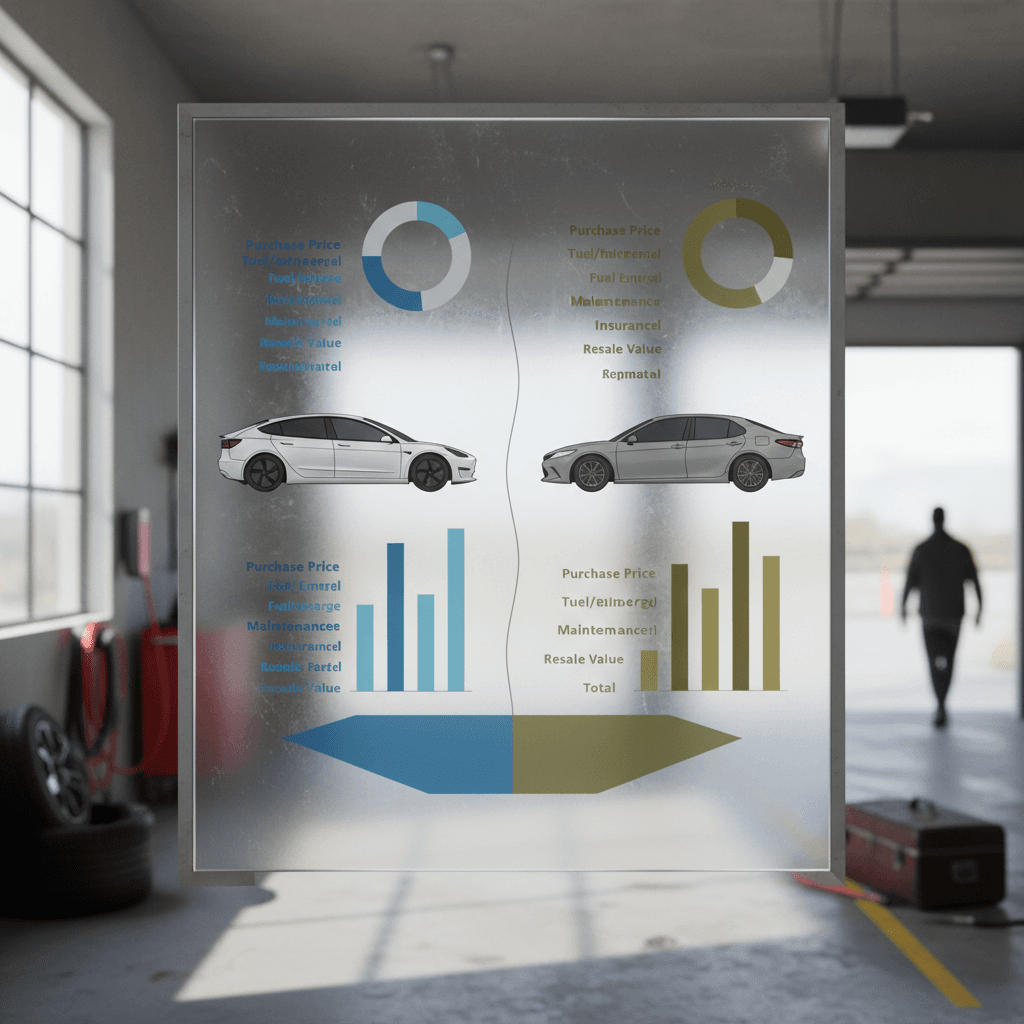
Let’s put the major cost buckets together. These are ballpark figures for a new Tesla Model 3 RWD vs a new Toyota Camry LE hybrid bought in 2026 and kept for five years, assuming average U.S. conditions and no major accidents or repairs.
Approximate 5‑year cost of ownership (new 2026 vehicles)
12,000 miles per year, mostly home charging for the Tesla, average energy prices, and typical insurance/maintenance costs.
| Cost category (5 yrs) | Model 3 (no tax credit) | Model 3 (with $7,500 credit) | Toyota Camry Hybrid |
|---|---|---|---|
| Purchase price (incl. dest., before tax/fees) | $40,500 | $40,500 | $29,500 |
| Less federal tax credit (if eligible) | , | −$7,500 | , |
| Effective initial outlay | $40,500 | $33,000 | $29,500 |
| Energy (fuel/electricity) | ≈ $3,300 | ≈ $3,300 | ≈ $4,500 |
| Maintenance & minor repairs | ≈ $1,000 | ≈ $1,000 | ≈ $2,000 |
| Insurance | ≈ $9,000 | ≈ $9,000 | ≈ $6,500 |
| Total cash out (ex‑depreciation) | ≈ $53,800 | ≈ $46,300 | ≈ $42,500 |
All numbers are rounded estimates in 2026 dollars and exclude taxes, registration, and financing interest.
If you strip away depreciation and focus on cash actually leaving your pocket over five years (down payment plus running costs), the Camry generally wins unless the Tesla qualifies for strong incentives and you pay relatively high gasoline prices.
What independent studies are finding
When the Tesla Model 3 is cheaper, and when the Camry wins
Who comes out ahead?
Situations where each car has the financial edge
Model 3 is likely cheaper if…
- You drive 15,000+ miles per year, maximizing fuel savings.
- You can charge mostly at home at $0.10–$0.16/kWh.
- Your state offers solid EV incentives or HOV/car‑pool benefits.
- You qualify for a full or partial federal clean‑vehicle credit on a new Tesla.
- You plan to keep the car for 7–10 years, stretching maintenance savings further.
Camry is likely cheaper if…
- You drive under 10,000 miles a year, limiting any fuel advantage.
- You pay high electricity rates or lack home charging.
- You face expensive EV insurance in your ZIP code.
- You can negotiate a strong discount on a Camry or buy lightly used.
- You prioritize simplicity and ubiquity of service options over EV tech.
Beware one‑size‑fits‑all calculators
New vs used: how Recharged changes the math
So far we’ve mostly talked about new vehicles. In the real world, a big share of Camrys, and an ever‑growing share of Model 3s, are bought used. This is where the economics can tilt in the Tesla’s favor, especially through a specialized used‑EV marketplace like Recharged.
Used Tesla Model 3 advantages
- Early Model 3s have taken their big depreciation hit already, bringing prices into the low‑to‑mid‑$20Ks.
- Many still offer modern range and tech, especially when you verify battery health.
- Fuel and maintenance savings vs a used Camry remain in play.
On Recharged, every used Tesla comes with a Recharged Score Report that quantifies battery condition, usage history, and fair market pricing, making the EV side of the equation less of a mystery.
Used Camry hybrid realities
- Used Camrys retain value well, so discounts from new can be modest for late‑model cars.
- Battery packs in Toyota hybrids are generally durable, but replacement is expensive if needed outside warranty.
- Maintenance remains higher than an EV, though independent shops can keep costs reasonable.
If you can buy a used Model 3 with verified good battery health for similar money to a newer Camry, the total cost of ownership can favor the EV for many drivers.
Checklist: key questions to choose between a Model 3 and a Camry
Decision checklist: Tesla Model 3 vs Toyota Camry
1. How many miles do you drive each year?
If you’re closer to 20,000 miles than 8,000, the Model 3’s fuel and maintenance savings become much more compelling. Low‑mileage drivers won’t benefit as much from EV efficiency.
2. Can you reliably charge at home or work?
Home charging at a reasonable electricity rate is the foundation of EV savings. If you rely mostly on public fast charging, your energy costs and convenience equation change dramatically.
3. What do real insurance quotes look like?
Before deciding, get actual premiums for both the Tesla and the Camry from at least two insurers. In some ZIP codes the gap is small; in others, it’s hundreds of dollars a year.
4. How long do you typically keep a car?
If you swap cars every 3 years, purchase price and depreciation dominate. If you keep vehicles for 8–10 years, the EV’s low maintenance and fuel costs have more time to win.
5. Are you open to buying used?
A used Model 3 with a strong <strong>Recharged Score</strong> can drastically narrow or even reverse the cost gap vs a new Camry, while still delivering modern tech and range.
6. How much do you value EV driving experience?
Instant torque, quiet operation, and over‑the‑air updates are real advantages that don’t show up on a spreadsheet. If those matter to you, a small cost premium might be justified.
FAQ: Tesla Model 3 vs Toyota Camry cost questions
Frequently asked questions about Model 3 vs Camry costs
Bottom line: which is the smarter buy in 2026?
Looking strictly at dollars, a new Toyota Camry hybrid still tends to undercut a new Tesla Model 3 on 5‑year ownership cost in 2026, mainly because of the lower purchase price and cheaper insurance. But the gap isn’t nearly as dramatic as the stickers suggest, and in the right circumstances the Model 3 can pull ahead, especially if you qualify for EV incentives and do most of your charging at home.
Where the Tesla shines is in day‑to‑day experience: instant acceleration, quiet operation, at‑home “refueling,” and fewer routine service stops. Where the Camry shines is in predictability: widely available service, excellent reliability, and proven hybrid tech that fits neatly into the existing fuel infrastructure.
If you’re comfortable with EV charging and can find a new or used Model 3 at a price that fits your budget, the numbers can make a lot of sense, particularly with verified battery health and transparent pricing from a marketplace like Recharged. If you want the most straightforward, low‑drama ownership experience with no charging learning curve, the Camry hybrid remains a smart, cost‑effective choice.
Either way, thinking in terms of total cost of ownership instead of just monthly payment or sticker price puts you ahead of the game, and that’s the kind of disciplined, big‑picture approach that pays dividends long after the new‑car smell fades.