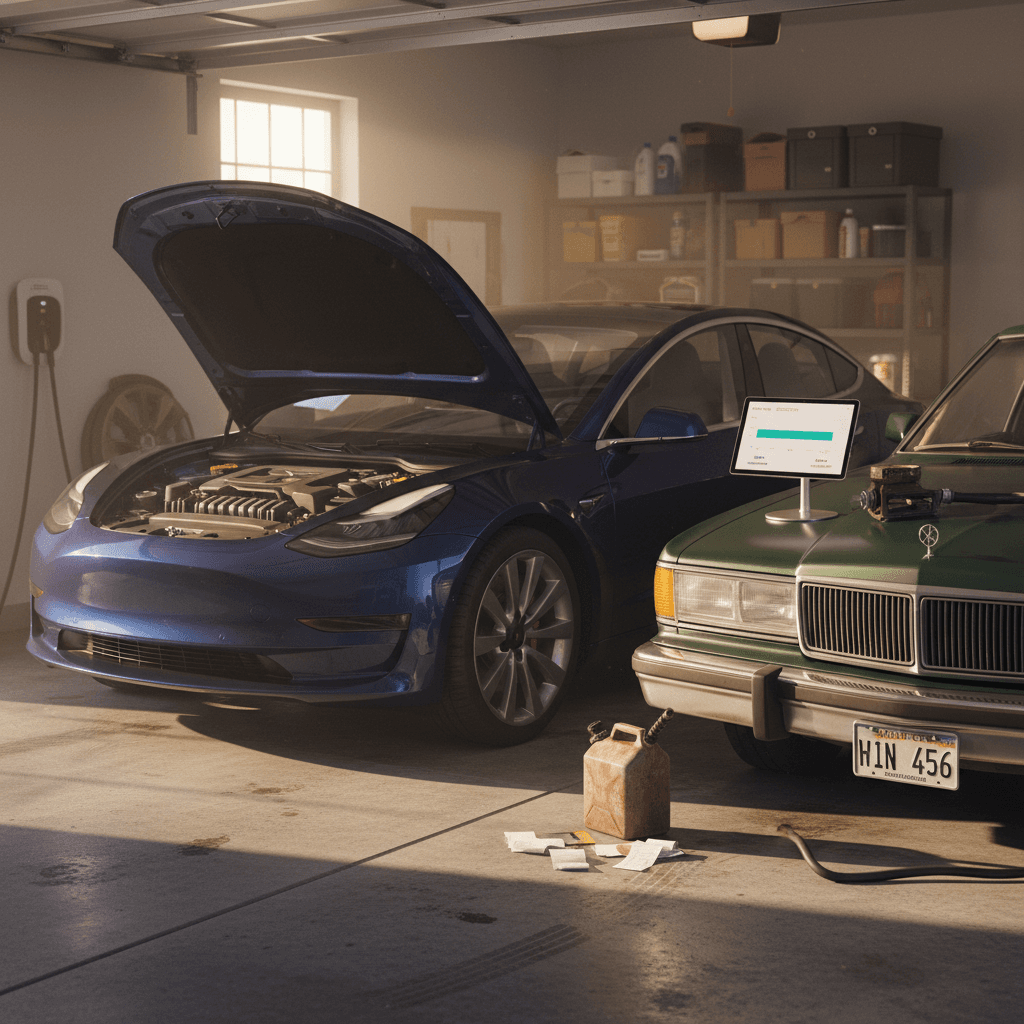
You don’t buy a Tesla Model 3 just to save a couple bucks on gas. You buy it because you want something quieter, quicker, and frankly more fun than the average commuter. But the money still matters. When you stack up a Tesla Model 3 total cost vs a similar gas car over five years, does the EV actually come out ahead, or is that just internet folklore?
What this article gives you
How this Tesla Model 3 vs gas comparison works
Before we start throwing dollar signs around, we need a fair fight. For this comparison, imagine you’re cross‑shopping a Tesla Model 3 with a well‑equipped compact or midsize gas sedan, think Honda Accord, Toyota Camry, Hyundai Sonata, or similar. You care about comfort, tech, and safety, not bare‑bones transportation.
- Timeframe: 5 years / 75,000 miles (15,000 miles per year).
- Driver profile: mostly commuting and errands, plus a couple of road trips a year.
- Location: typical U.S. electricity and gasoline prices (no extreme outliers).
- Vehicle age: you can apply the same math to new or used, numbers below assume late‑model cars with similar age and mileage.
Reality check on prices
Headline results: Tesla Model 3 total cost vs gas car
5‑year cost snapshot (example scenario)
Key takeaway up front
Purchase price and financing: where the gap starts
For years, the main knock on EVs was sticker shock. Tesla has brought Model 3 pricing closer to mainstream sedans, but depending on trim and incentives, you may still pay a bit more up front than a gasoline equivalent.
Illustrative purchase scenario (late‑model used)
Example pricing for a late‑model Tesla Model 3 vs a similar‑age, similarly‑equipped gas sedan. Adjust to match your market.
| Tesla Model 3 RWD | Comparable gas sedan | |
|---|---|---|
| Purchase price | $29,000 | $25,000 |
| Down payment (10%) | $2,900 | $2,500 |
| Amount financed | $26,100 | $22,500 |
| Term / APR | 60 mo @ 5.5% | 60 mo @ 5.5% |
| Monthly payment (approx.) | $500 | $430 |
| Total payments over 5 yrs (principal + interest) | $30,000 | $25,800 |
Assumes 60‑month loan, 10% down, and average credit. Numbers rounded for clarity.
In this scenario, the Model 3 costs about $4,000–$5,000 more to buy and finance over five years than an equivalent gas car. That’s the hole the EV has to climb out of with fuel, maintenance, and resale.
Where used EVs shine
Ready to find your next EV?
Browse VehiclesFuel vs electricity costs: where EVs claw it back
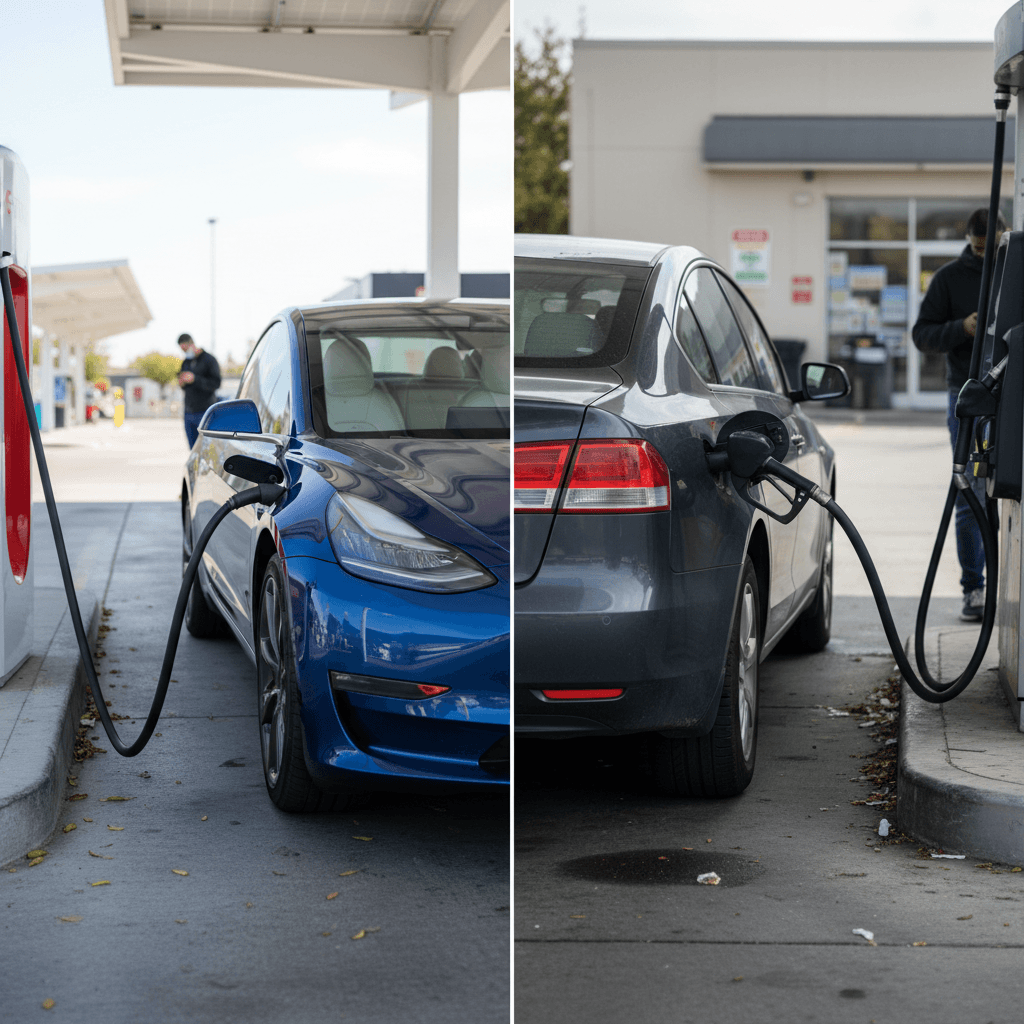
This is the big one. The Tesla doesn’t sip fuel at all; it runs on electricity that’s usually much cheaper per mile, especially if you can charge at home.
Gas sedan: fuel costs
- Mileage: 30 mpg combined (not unusual for a modern midsize)
- Annual miles: 15,000
- Fuel needed per year: 15,000 ÷ 30 = 500 gallons
- Gas price: $3.50 per gallon (round number)
- Annual fuel cost: 500 × $3.50 = $1,750
- 5‑year fuel cost: about $8,750
Tesla Model 3: electricity costs
- Efficiency: roughly 4 miles per kWh (varies by model and driving)
- Annual miles: 15,000
- Electricity needed per year: 15,000 ÷ 4 = 3,750 kWh
- Home electricity rate: $0.15 per kWh (blended average)
- Annual electricity cost: 3,750 × $0.15 ≈ $560
- 5‑year electricity cost: about $2,800
Fuel vs electricity, summed up
How your charging habits change the math
The less you rely on pricey fast charging, the better the Model 3 looks.
Mostly home charging
If you can plug in at home most nights, your effective cost per mile stays low and predictable. Off‑peak rates or time‑of‑use plans make the savings even bigger.
Mixed home + public
A mix of home charging and occasional paid fast charging still favors the Model 3. Your savings shrink versus all‑home charging, but usually stay ahead of a gas sedan.
Mostly fast charging
If you rely heavily on high‑priced DC fast charging, especially at highway rates, you can eat into or even erase your fuel‑cost advantage. In that case, total cost may end up similar to a gas car.
Maintenance and repairs: why EVs age differently
Gas cars are full of wearable parts, oil, filters, spark plugs, exhaust systems, that an EV simply doesn’t have. Over five years, that gap can be worth thousands of dollars, especially as the odometer climbs.
Typical 5‑year maintenance & repair costs
High‑level, directional estimates for mainstream vehicles with regular service, not luxury outliers or neglected beaters.
| Tesla Model 3 | Comparable gas sedan | |
|---|---|---|
| Oil changes | $0 | $800–$1,000 |
| Routine inspections & fluids | $400–$700 | $600–$900 |
| Brakes (pads/rotors) | Lower wear thanks to regen; ~$300–$600 if needed | More frequent; ~$600–$900 |
| Repairs outside warranty | $500–$1,200 (varies widely) | $800–$1,500 (varies widely) |
| Tires (both) | $800–$1,200 | $600–$1,000 |
| Estimated 5‑yr total | ~$2,000–$3,000 | ~$3,400–$5,000 |
Battery replacement is not included, because it’s rare within the first 5 years / 75,000 miles for a well‑cared‑for Model 3.
Battery health is the big question
Insurance, taxes, and fees
Here’s where reality gets a little messy. Insurance premiums can be slightly higher for EVs, including the Model 3, depending on your region and insurer. On the flip side, some states reduce registration fees for EVs while others add road‑use surcharges to replace gas‑tax revenue.
Insurance costs
- Model 3: Many owners see premiums that are similar to or slightly higher than comparable gas sedans, thanks to higher repair costs and expensive electronics.
- Gas sedan: Slightly cheaper to insure on average, especially for simpler, non‑luxury models.
- Rule of thumb: Budget for the Model 3 to cost $100–$300 more per year to insure than the equivalent gas sedan, but get quotes for your exact situation.
Taxes and fees
- Registration: Some states give EV breaks; others charge extra EV fees. Over 5 years this might swing total cost by a few hundred dollars either way.
- Incentives: Federal or state EV incentives (where available) can dramatically improve the economics of a new or used Model 3.
- Sales tax: Higher purchase price means more tax up front for the Tesla, unless incentives offset it.
Don’t guess on insurance
Resale value and depreciation: who holds value better?
Depreciation is the silent heavyweight in total cost of ownership. Both gas sedans and Teslas lose value fastest in the first few years, then level out. Lately, EV prices have been more volatile than gasoline models, but the Model 3 remains one of the stronger resale performers among EVs.
Simple 5‑year depreciation example
Very high‑level illustration; real‑world values depend on mileage, condition, and market swings.
| Tesla Model 3 | Comparable gas sedan | |
|---|---|---|
| Initial price (used example) | $29,000 | $25,000 |
| Estimated value after 5 yrs | $15,000 | $10,000 |
| Total depreciation | $14,000 | $15,000 |
Assumes good condition, average mileage, and no major accidents.
In this scenario, the Tesla actually loses slightly less value than the gas car over five years, helped by its tech appeal and ongoing over‑the‑air updates. But EV values can move quickly when new‑car prices or incentives change, so think of these as conservative ballpark figures, not a guarantee.
Total cost “stack” at 5 years
Used Tesla Model 3 vs used gas sedan: where it gets interesting
If you’re shopping used, the equation tilts even more in favor of the Tesla, if you buy wisely. That early‑years depreciation hit has already happened, but the car still has plenty of useful life left, especially if the battery is healthy.
Why a used Model 3 can beat a used gas sedan
You’re skipping the steepest depreciation but keeping the low running costs.
Battery‑first evaluation
A strong battery means you still get excellent range and charging performance. With tools like the Recharged Score, you can see real battery health instead of guessing.
Fewer aging components
A gas car with 70,000+ miles has a lot of wear hiding under the hood. A Model 3 simply has fewer moving parts to age out, so maintenance surprises are often smaller.
Stronger demand
There’s robust demand for clean, well‑cared‑for used Teslas. That can help your resale value later, further improving your true cost of ownership.
Don’t ignore history
Beyond the spreadsheet: intangibles to consider
Total cost of ownership is more than math. Living with a Tesla Model 3 every day is a very different experience from living with a gas sedan, and that has a value, positive or negative, depending on your life.
Reasons the Model 3 feels “worth more”
- Driving feel: Instant torque, low center of gravity, and one‑pedal driving make errands more fun.
- Silence: Quiet cruising is addictive, especially in traffic.
- Convenience: Waking up to a “full tank” at home changes how you think about range.
- Software: Over‑the‑air updates keep the car feeling fresh years into ownership.
Reasons a gas car might still win for you
- No charging worries: If you can’t charge at home or work, a gas car may simply fit your life better right now.
- Rural driving: Sparse charging infrastructure in some regions still favors gasoline.
- DIY service: If you like wrenching on your own car, a simple gas sedan may be cheaper to keep forever.
Step-by-step: how to calculate your own total cost
No article can match your exact commute, electric rate, or favorite back‑road gas station. But you can absolutely run your own Model 3 vs gas comparison with a simple framework.
DIY total cost of ownership worksheet
1. Start with realistic purchase prices
Get actual quotes or listings for a Tesla Model 3 and the gas sedan you’d truly buy. If you’re looking at used EVs, tools like the <strong>Recharged Score</strong> can signal when a slightly higher price is justified by better battery health.
2. Estimate your annual miles
Look at your last year of driving or map your commute and trips. A higher annual mileage usually favors the Model 3 because fuel savings compound.
3. Plug in fuel and electricity costs
Use your local gas price and your home electric rate (and any off‑peak or EV plans). Estimate your mix of home charging vs public fast charging.
4. Add maintenance and repairs
Ask your independent shop what they typically see for your target gas model over 5 years. For the Model 3, budget routine service plus a reasonable cushion for out‑of‑warranty repairs.
5. Get real insurance quotes
Don’t rely on averages. Ask your insurer for quotes on both vehicles with the same coverage. Capture 5 years of premiums in your spreadsheet.
6. Estimate 5‑year resale value
Browse recent sales for 5‑year‑old versions of both cars with mileage similar to what you expect. Subtract that future value from your all‑in costs to see what you truly “spent” to own each car.
Sanity‑check your result
FAQ: Tesla Model 3 total cost vs gas car equivalent
Frequently asked questions
Bottom line: is a Tesla Model 3 cheaper than gas?
Run the numbers honestly and you’ll find that a Tesla Model 3 usually matches or beats the total cost of a comparable gas sedan over five years, without asking you to give up comfort or performance. The EV’s higher upfront price is real, but it’s often offset by cheaper “fuel,” lower maintenance, and a strong resale story.
Where you charge, how far you drive, and whether you buy new or used will push the answer one way or the other. If you’re leaning toward a Model 3 but want the math to make sense, a well‑priced used car with verified battery health is a sweet spot. That’s exactly the gap Recharged is built to fill: a marketplace focused on transparent used EVs, complete with Recharged Score reports and EV‑savvy support from first click to delivery.
The smart move now is to grab your own numbers, gas price, electric rate, quotes on a Model 3 and a gas equivalent, and build your personal five‑year picture. If the Tesla fits your life and the math is close, the daily experience often tips the scale in its favor.