If you’re looking at a Tesla Model 3, you’re probably wondering one thing: **how much does it actually cost per mile to drive** compared with a gas car. With electricity rates, Supercharger fees and insurance all moving targets in 2026, you need real numbers, not hype.
Key takeaway
How much does a Tesla Model 3 cost per mile to drive?
Tesla Model 3 cost per mile at a glance (2026, U.S. averages)
Let’s anchor this with a simple reference point. For a typical U.S. driver doing **12,000–15,000 miles per year** in a Model 3, expect to spend roughly **$540–$900 per year on electricity** if you mostly charge at home. That translates to about **3–6 cents per mile in energy costs**. When you add light maintenance, tires and other running costs, many owners land in the **6–9 cents per mile** range over a multi‑year period.
Your cost per mile will vary
Tesla Model 3 efficiency: the numbers behind cost per mile
To estimate **Tesla Model 3 cost per mile to drive**, you need two ingredients: **efficiency (kWh per mile)** and **electricity price (cents per kWh)**. Multiply them and you’ve got your energy cost per mile.
- Most recent Model 3 variants sit around **240–260 Wh/mi (0.24–0.26 kWh/mi)** in mixed real‑world driving when driven reasonably and on standard wheels.
- Owners in milder climates often report long‑term averages near **200–230 Wh/mi** on RWD trims, especially at moderate speeds.
- Performance trims, big wheels, high speeds and cold weather can easily push real‑world use to **280–330 Wh/mi** or more.
For cost estimates in this article, we’ll use **0.25 kWh/mi** as a realistic middle‑of‑the‑road figure for a Model 3 driven in mixed U.S. conditions. You can adjust that up or down later based on your own experience.
Quick mental math
Home charging vs. Supercharging: cost per mile
Most of your **Tesla Model 3 cost per mile** is decided by **where you charge**. Home charging and fast DC charging can differ by a factor of two or more.
Tesla Model 3 electricity cost per mile by charging scenario
Approximate U.S. averages for 2026, assuming 0.25 kWh/mi real‑world efficiency.
| Charging scenario | Example rate ($/kWh) | kWh per mile | Energy cost per mile | Cost per 1,000 miles |
|---|---|---|---|---|
| Home, average U.S. residential rate | $0.18 | 0.25 | $0.045 | $45 |
| Home, low‑cost power (cheap states or off‑peak plans) | $0.12 | 0.25 | $0.03 | $30 |
| Home, high‑cost power (expensive coastal markets) | $0.25 | 0.25 | $0.0625 | $62.50 |
| Mix: 80% home / 20% Supercharger | $0.18 home, $0.40 SC | 0.25 | ≈$0.054 | ≈$54 |
| Mostly Supercharger heavy use (road‑warrior pattern) | $0.40–$0.45 | 0.27 (less efficient at high speeds) | ≈$0.11–$0.12 | ≈$110–$120 |
Your actual numbers will depend heavily on your local rates and driving style.
Why home charging wins
Scenario 1: Mostly home charging (what most owners do)
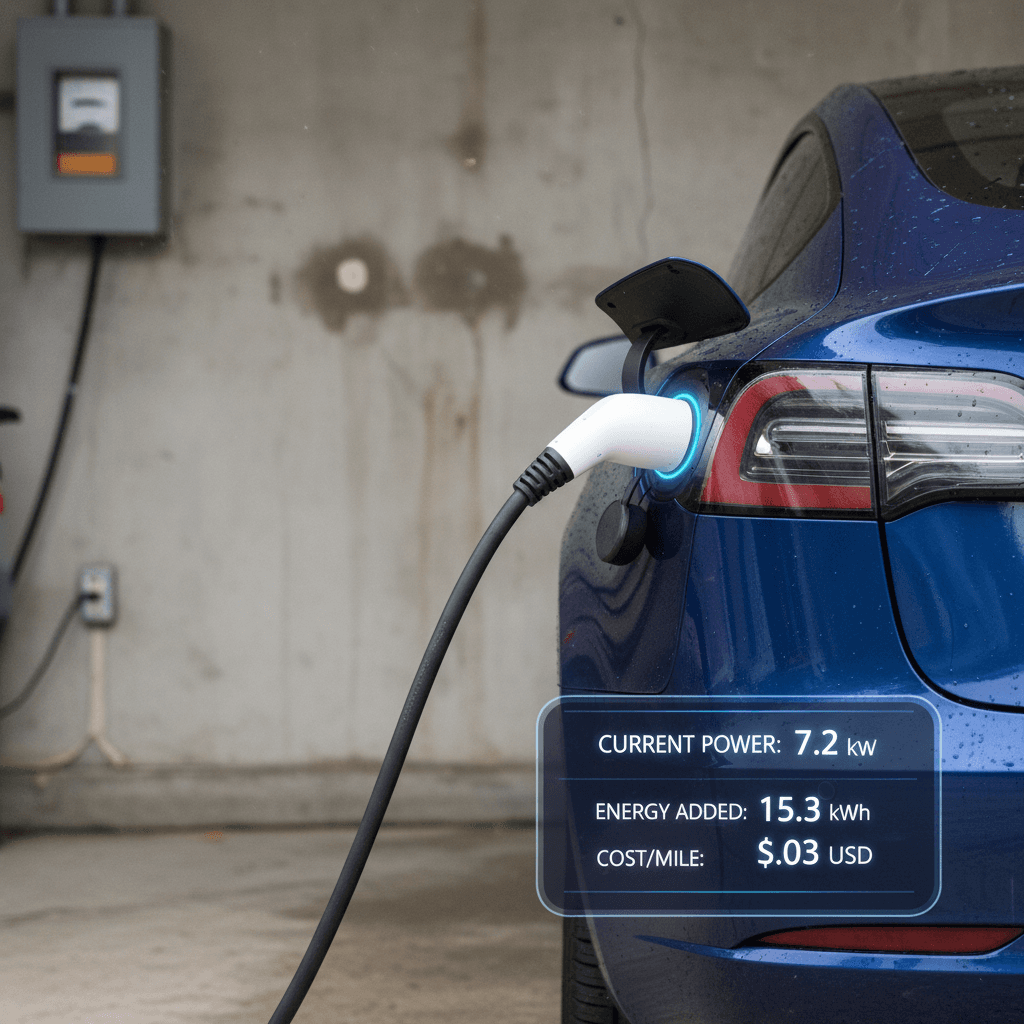
If you do **90% of your miles at home** at roughly **$0.18/kWh**, and the rest on the road at **$0.40/kWh**, your blended electricity cost per mile will typically land around **$0.05–$0.06**. For **15,000 miles a year**, that’s about **$750–$900** in energy.
Scenario 2: Heavy fast‑charging (rideshare, frequent road trips)
If you rely heavily on Superchargers or third‑party DC fast chargers, figure on **$0.10–$0.13 per mile** just in electricity. That’s still competitive with a 25–30 mpg gas car, but the efficiency edge of the Model 3 shrinks quickly when you live on DC power.
Tesla Model 3 vs. gas car: cost per mile comparison
To understand the **Tesla Model 3 cost per mile to drive**, you have to stack it against a realistic gas benchmark. Think of a **Toyota Corolla, Honda Civic or similar compact sedan**, the kind of car many Model 3 shoppers are cross‑shopping.
Electric vs. gas: fuel cost per mile comparison
Approximate U.S. averages as of early 2026.
| Vehicle type | Fuel/energy price assumption | Efficiency | Fuel/energy cost per mile | Fuel cost per 1,000 miles |
|---|---|---|---|---|
| Tesla Model 3 (mostly home charging) | $0.18/kWh electricity | 0.25 kWh/mi | $0.045/mi | $45 |
| Tesla Model 3 (heavy fast‑charging) | $0.42/kWh DC charging | 0.27 kWh/mi | ≈$0.11/mi | ≈$110 |
| Fuel‑efficient compact gas sedan | $3.50/gal gasoline | 32 mpg | ≈$0.11/mi | ≈$110 |
| Average U.S. gas car (mixed segment) | $3.50/gal gasoline | 27 mpg | ≈$0.13/mi | ≈$130 |
Gas prices and electricity rates move constantly; this table uses rounded national averages for illustration.
In other words, **a home‑charged Model 3 can use less than half the “fuel” cost per mile** of a typical gas compact. Even when you lean on fast charging, your per‑mile cost usually stays in the same ballpark as a very efficient gas sedan, and below many crossovers and SUVs.
Where the big spread shows up
Other costs per mile: maintenance, tires, depreciation
Energy is only part of your **Tesla Model 3 cost per mile to drive**. To get a realistic picture, you need to spread **maintenance, tires, repairs and depreciation** across every mile as well.
Non‑fuel costs that affect Model 3 cost per mile
Here’s what typically moves the needle beyond electricity.
Routine maintenance
No oil changes, spark plugs or timing belts. For most Model 3s, routine maintenance looks like:
- Cabin air filters (every 2–3 years)
- Brake fluid checks
- Occasional alignment
- Coolant checks for the battery/drive unit
Spread over several years, this often works out to **1–2 cents per mile**.
Tires and brakes
The Model 3 is quick and relatively heavy, which can **wear tires faster** than economy sedans, especially Performance trims.
Budget roughly **1.5–3 cents per mile** for tires depending on your driving and wheel size. Brake wear is usually light thanks to regen.
Depreciation & repairs
Depreciation can be **10–25+ cents per mile** on any modern vehicle, EV or gas. The Model 3 has held value reasonably well, but used prices have softened since their 2022 peak.
Extended ownership (7–10 years) and buying used can materially **lower your depreciation per mile**.
Big‑ticket repairs are rare, but possible
If you roll everything together for a typical owner, energy, routine maintenance and tires, then set depreciation aside for a moment, a **Tesla Model 3 often lands around 6–9 cents per mile** in day‑to‑day operating costs. That’s before financing, insurance and any major repairs.
Used Tesla Model 3: what cost per mile looks like
If you’re eyeing a **used Model 3**, your **per‑mile cost story changes in two important ways**: depreciation often shrinks, but battery health and warranty coverage become more important.
Why used can cut your cost per mile
- Depreciation hit already taken: The first 3–4 years usually see the steepest drop in value. Buying after that means you’re often paying **much less per mile in depreciation**.
- Same efficiency: A healthy used Model 3 delivers nearly the **same Wh/mi** and per‑mile energy cost as a new one.
- Lower capital cost: A smaller loan or cash purchase reduces your monthly outlay, often more than small differences in efficiency.
What you must check on a used Model 3
- Battery health: Capacity loss directly affects range, not so much energy cost per mile, but it matters for usability and resale.
- Fast‑charging history: Heavy DC‑fast use can accelerate battery wear.
- Accident and repair history: Poor repairs can lead to alignment issues, uneven tire wear and higher long‑term costs.
Buying from a seller that includes a **transparent battery‑health report** and pricing tied to that data can help you avoid surprises.
Where Recharged fits in
How to lower your Tesla Model 3 cost per mile
Six practical ways to shrink your Model 3 cost per mile
Most of these are simple tweaks you can make in the first month of ownership.
1. Maximize home and off‑peak charging
Enroll in **time‑of‑use (TOU)** rates if your utility offers them and set scheduled charging in the Tesla app. Shifting most charging to off‑peak hours can drop your per‑kWh cost by **20–40%** in some markets.
2. Smooth out your driving
Hard launches and high cruising speeds dramatically increase Wh/mi. Keeping highway speeds closer to **65–70 mph** instead of 80+ and using Chill mode can shave **10–20%** off your energy use.
3. Optimize tires and pressure
Stick with **efficient tires and stock wheel sizes** if low cost per mile is a priority. Check tire pressures monthly, underinflation can **add several Wh/mi** and wear rubber faster.
4. Plan fast‑charging strategically
On road trips, arrive at fast chargers with **10–20% battery** and unplug around **60–70%** when you can. That’s where charging is fastest and most efficient, reducing both time and cost per mile.
5. Stay ahead of small maintenance
Address **alignment issues, rattles and minor suspension problems** early. A misaligned wheel can quietly eat through tires and add cents per mile to your running costs.
6. Buy the right car up front
If you don’t need the extra power, a **RWD or Long Range non‑Performance Model 3** on smaller wheels will almost always deliver a **lower cost per mile** than a Performance on large wheels.
Checklist: calculate your own cost per mile
Calculate your personal Tesla Model 3 cost per mile
1. Pull your real‑world efficiency
On your Model 3’s screen, find your **average Wh/mi** over at least a few thousand miles. Divide by 1,000 to convert to **kWh per mile**.
2. Determine your effective electricity rate
Look at your utility bill for your **all‑in rate** (including fees), or estimate a blended rate if you use both home charging and Superchargers. Convert cents/kWh to dollars, for example, 18¢/kWh → **$0.18/kWh**.
3. Multiply kWh/mi by $/kWh
Take your **kWh per mile × price per kWh**. That’s your **electricity cost per mile**. Example: 0.24 kWh/mi × $0.18 = **$0.043/mi** (4.3 cents per mile).
4. Add maintenance and tires
Estimate your annual spend on **service visits and tires**, then divide by your annual miles. For many Model 3 owners, this works out to **2–4 cents per mile** combined.
5. Decide how to treat depreciation
Look up what your car cost and its current market value, then divide the difference by miles driven so far, or by the miles you expect to drive. This is often the **largest single cost per mile** on any car, EV or gas.
6. Compare with your old or alternative car
Run the same math for a gas car you own (or are considering). Use average **fuel economy and gas price** to get a comparable **cost‑per‑mile picture** for both options.
FAQ: Tesla Model 3 cost per mile to drive
Frequently asked questions about Tesla Model 3 cost per mile
Bottom line: is a Tesla Model 3 cheaper per mile?
When you strip away the noise, the **Tesla Model 3 cost per mile to drive** is one of its strongest selling points. For a typical U.S. owner who charges mostly at home, electricity usually runs **3–6 cents per mile**, versus **11–13 cents per mile in fuel** for a comparable gas sedan. Add lower routine maintenance, and the Model 3 can cut your **day‑to‑day operating cost per mile by a third to a half**.
Where things get more nuanced is **depreciation, fast‑charging habits and how long you keep the car**. Heavy Supercharger use, performance‑oriented driving and short ownership windows can narrow the gap. On the flip side, buying a **well‑vetted used Model 3** and keeping it for 7–10 years can deliver some of the **lowest lifetime cost‑per‑mile numbers** in the market.
If you’re comparing specific cars, especially used, this is where **Recharged** can help. Every EV on the platform comes with a **Recharged Score battery‑health report**, transparent pricing and EV‑specialist guidance so you can estimate your **true cost per mile before you buy**. That way, you’re not just getting a Tesla badge, you’re getting a car whose numbers work just as hard as its motors.