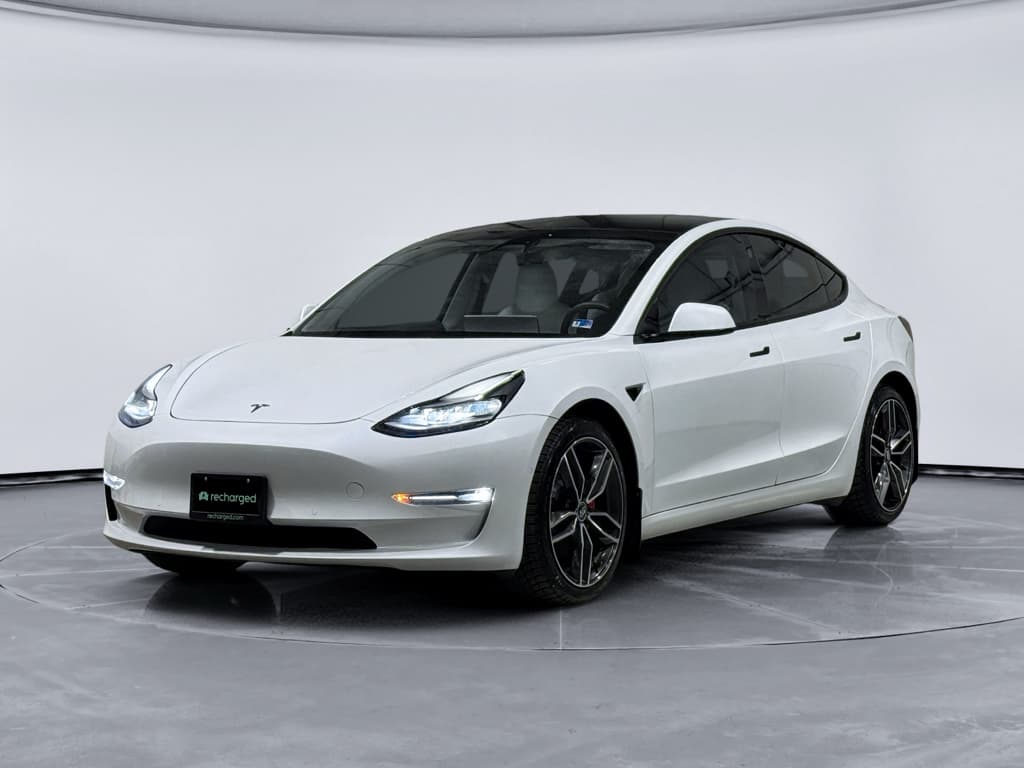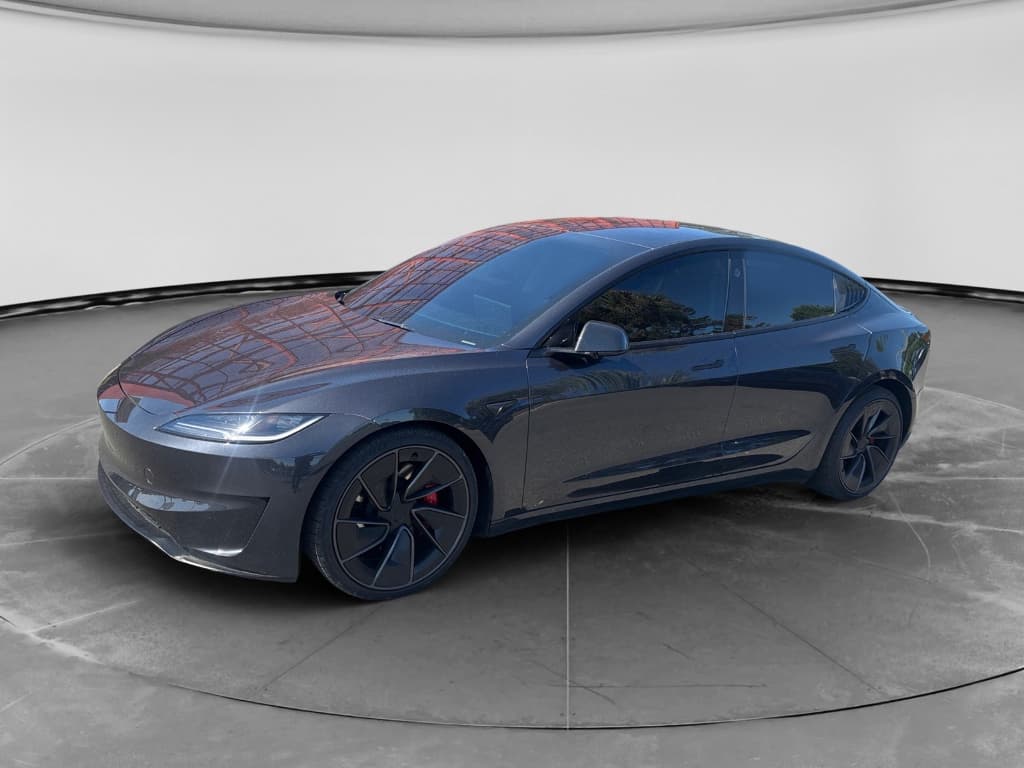
If you’re eyeing a Tesla Model 3, you’ve probably already checked range and performance. But if this will be your daily family hauler or road-trip partner, cargo space dimensions matter just as much. The Model 3 hides more space than its sleek sedan shape suggests, but it’s not a mini moving van, and it definitely doesn’t match a Model Y. Let’s walk through the trunk, frunk, and seat-folding layout so you know exactly what will (and won’t) fit.
Quick takeaway
Overview: Tesla Model 3 cargo space at a glance
Tesla Model 3 cargo figures (recent generations)
Those numbers put the Tesla Model 3 on par with a roomy midsize sedan. The frunk and deep underfloor well add flexibility you just don’t get in a conventional gas car, but the traditional sedan trunk opening means tall and boxy items are more of a puzzle than in a hatchback or SUV.
Official Tesla Model 3 cargo volume numbers
Tesla doesn’t bombard you with cargo specs on the consumer site, but recent owner’s manuals do give the key numbers for the Model 3’s cargo volume. For current and late pre-refresh cars, you can safely work with these ballpark figures:
Tesla Model 3 official cargo volume (recent years)
Factory-quoted volumes for the current Model 3 generation. Numbers can vary slightly by test method and region, but these are the figures you’ll see most often.
| Area | Volume (cubic feet) | Volume (liters) | Notes |
|---|---|---|---|
| Front trunk (frunk) | 3.1 | ≈88 | Good for cables, backpacks, or a few grocery bags. |
| Rear cargo behind 2nd row | 21.0 | ≈594 | Includes trunk and some underfloor area. |
| Total cargo with 5 passengers | 24.1 | ≈682 | Tesla’s “maximum total cargo volume with 5 passengers” figure. |
| Estimated max with seats folded | ≈40–44* | ≈1,130–1,250* | Not an official Tesla number; based on independent testing and comparisons. |
Use these volumes as a guide, real-world usable space also depends on the shape of your cargo.
Why the numbers don’t always match
Tesla Model 3 trunk space dimensions & shape
Numbers are helpful, but how the space is shaped matters more for day-to-day life. The Model 3 trunk is deep and deceptively long, but the opening is sedan-sized and the rear glass doesn’t lift like a hatchback. Here’s how that plays out when you’re loading it.
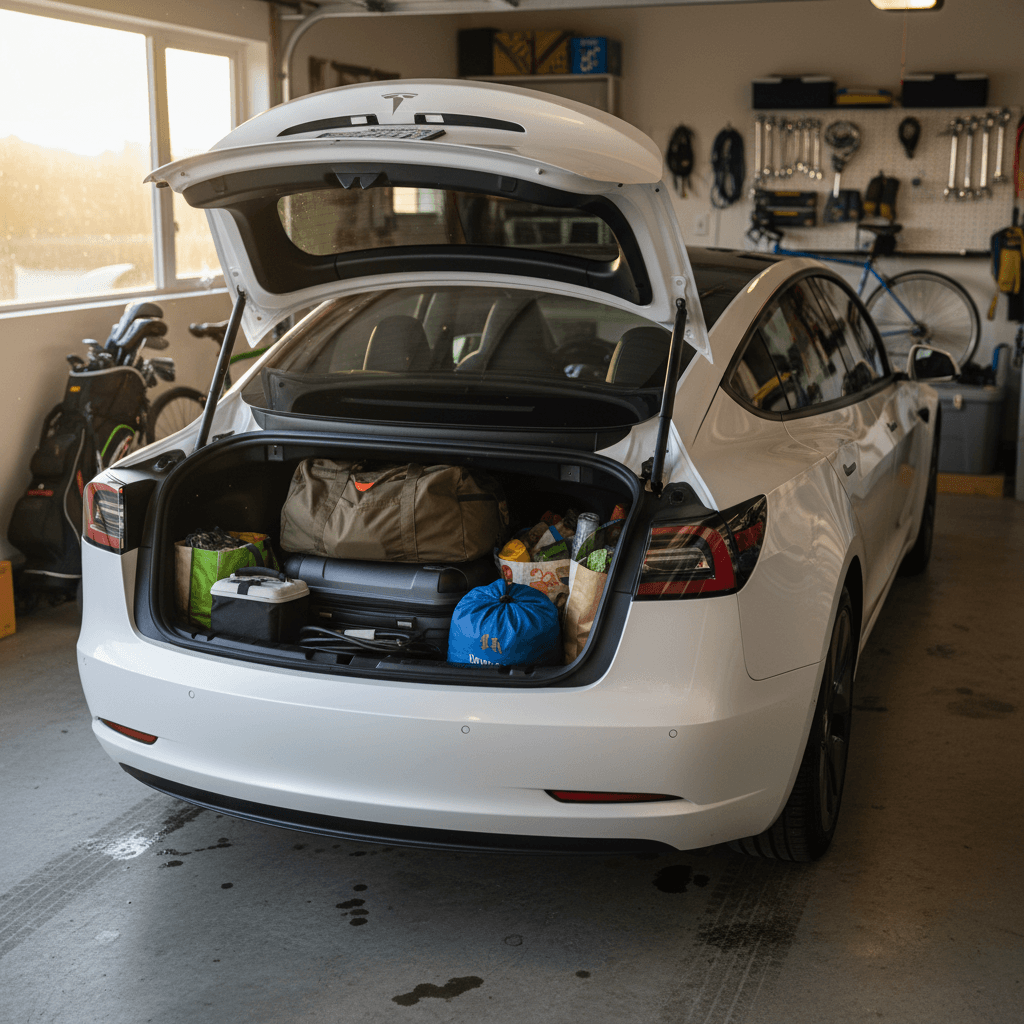
How the Model 3 trunk is laid out
Key dimensions and design details that affect what you can carry.
Trunk opening
Width: wide between the tail lights, but tapers slightly toward the latch area.
Height: limited by the fixed rear glass and trunk lid, so tall, boxy items can be tricky.
The opening is generous for luggage and duffels but not for huge boxes or tall furniture pieces.
Floor length & depth
Floor length (seats up): easily swallows large checked suitcases laid flat.
Depth: a deep well under the floor adds hidden storage for cables, shoes, or soft bags.
That underfloor bin is a big usability win over many gas sedans.
Seat-fold opening
When you fold the 60/40 rear seats, you gain a long, continuous load floor from the trunk up to the back of the front seats.
There is a mild step-up where the seats hinge, but it’s not severe, long items like skis or flat-pack boxes can slide through with some finesse.
Use soft bags, not hard boxes
Tesla Model 3 frunk space dimensions & best uses
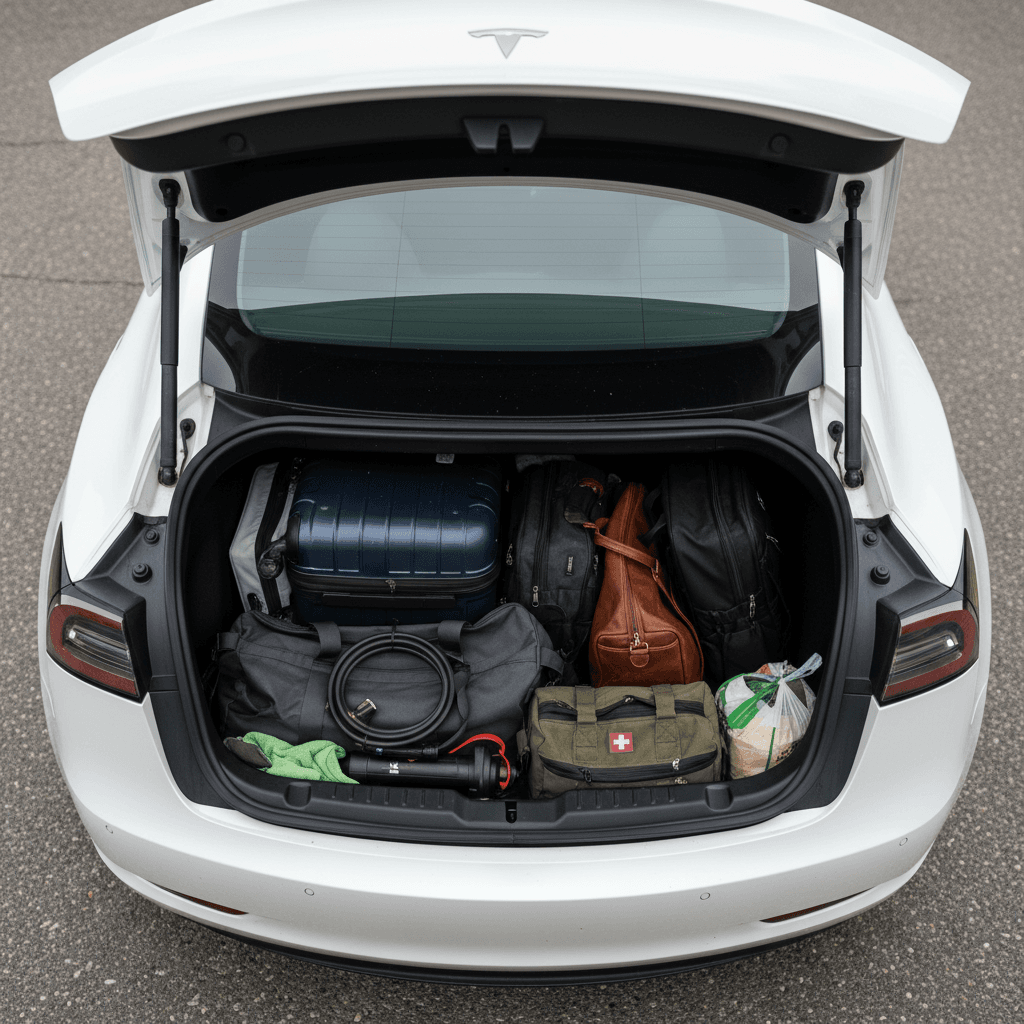
Open the hood and you’ll find one of the Model 3’s secret weapons: a surprisingly useful front trunk. At about 3.1 cubic feet, it’s not giant, but it’s shaped like a small, deep bin, easy to load and great for keeping messy or valuable items separate from the main trunk.
Frunk dimensions & shape
- Approx. width: similar to the distance between the headlights, slightly narrower at the bottom.
- Approx. depth: deep enough for a medium backpack or two grocery totes stacked.
- Side walls: tall, straight plastic sides keep items from rolling around.
The opening is wide and low, so loading is easy, no lifting over a bumper like in the rear trunk.
Best ways to use the frunk
- Charging gear: Store your portable EVSE, adapters, and gloves, cleanly separated from luggage.
- Emergency kit: Jumper pack, first-aid kit, flashlight, tow strap.
- “Smelly” items: Takeout food, sports shoes, or beach gear you don’t want perfuming the cabin.
Because the frunk is sealed from the cabin, it’s also a smart place for valuables when you park, just don’t forget where you put them.
Seats folded: long items, strollers & road-trip gear
The Model 3’s rear seats fold in a 60/40 split (with a center pass-through on some builds), which turns the car from sleek sedan into a decent mini-wagon. You won’t rival a crossover, but you can get creative.
What the Model 3 can realistically handle with seats folded
Skis and snowboards
Most owners can slide <strong>up to 2–3 pairs of skis</strong> diagonally with the longer section of the seat folded. A narrow roof box still makes life easier if you’re a winter-sports family.
Strollers & baby gear
Compact travel strollers fit easily in the trunk; full-size joggers often need a wheel removed or the back seat folded. Test-fit your stroller when you’re shopping a used Model 3.
Flat-pack furniture
Think <em>bookshelves and small desks</em>, not giant wardrobes. The limiting factor is the trunk opening height and the angle you can feed boxes through, not raw volume.
Bikes
A road bike can fit with wheels off and the rear seats folded, but it’s not a throw-it-in-and-go affair. For frequent bike trips, a hitch rack is a much better answer.
Dogs & crates
Medium dogs are fine in the trunk area with a low soft crate or barrier. Full-height hard crates are harder to angle through the trunk opening, measure carefully if that’s a must-have.
Mind the glass and seals
Tesla Model 3 vs Model Y cargo space comparison
If cargo space is your top priority, the big question is usually: Model 3 or Model Y? They share the same basic platform, but the Y’s hatchback body changes everything for practicality.
Cargo space: Tesla Model 3 vs Tesla Model Y
How the Tesla Model 3’s trunk and frunk compare to its SUV-shaped sibling, the Model Y.
| Measurement | Model 3 (recent models) | Model Y (5-seat, recent models) | What it means for you |
|---|---|---|---|
| Rear trunk / cargo behind 2nd row | ≈15–21 cu ft (depending on measurement method) | ≈30–36 cu ft | Model Y offers roughly double the usable rear cargo volume. |
| Total cargo, seats up | ≈24 cu ft (incl. frunk) | ≈34–36 cu ft | Again, Y is roomier, but Model 3 matches many midsize sedans. |
| Max cargo, seats folded | ≈40–44 cu ft (est.) | ≈70–76 cu ft | Y behaves like a compact SUV when you drop the seats. |
| Frunk volume | 3.1 cu ft | ≈4+ cu ft | Both have useful frunks; Y’s is a bit deeper. |
| Opening style | Sedan trunk lid | Full-height hatch | The Y’s hatch makes bulky items much easier to load. |
Model Y wins on pure volume and ease of loading, but the Model 3 still holds its own for most daily needs.
Who should pick which?
Real-world packing examples: what actually fits
Specs are one thing. Standing in your driveway on a Friday night wondering if all this stuff will fit is another. Here’s how Tesla Model 3 cargo space dimensions translate into trips and toys.
Typical scenarios for Tesla Model 3 cargo space
How far you can push a Model 3 before you really need a crossover.
Airport run for four
With the rear seats up, a Model 3 can typically handle:
- 2 large checked suitcases
- 2 carry-on roller bags
- Smaller backpacks or purses in the frunk
You’ll stack the larger suitcases upright at the back of the trunk and tuck smaller bags into the deep well.
Big grocery day
Using the trunk well and frunk, a Model 3 swallows a full family grocery run without drama.
Put heavier items and liquids in the trunk floor, and softer, lighter bags up top or in the frunk so they don’t crush produce.
Weekend road trip
For two adults, you can easily pack:
- 2 medium duffels
- Cooler in the trunk well
- Camping or hiking gear along one folded seatback
For a family of four, you’ll want to be more strategic, but a long weekend is very doable without a roof box.
If you pack a Model 3 like a puzzle, soft bags, heaviest items in the well, small stuff in the frunk, it behaves like a much bigger car than its sleek shape lets on.
Shopping used? Cargo-related checks for a Model 3
When you’re shopping for a used Tesla Model 3, especially from 2018–2023 builds, cargo area condition and accessories can quietly add or subtract value. This is also where a service like Recharged can save you a lot of guesswork.
Cargo-space checks before you buy a used Model 3
Inspect trunk seals & trim
Look closely at the rubber weatherstripping around the trunk and frunk, plus the plastic trim along the bumper lip. Tears, gaps, or heavy scuffing can hint at minor impacts or lots of heavy loading.
Lift the trunk floor
Pop up the trunk floor and examine the deep storage well. You’re looking for moisture, rust on exposed metal, stains, or cracked plastic that might suggest past leaks or hard use.
Test the seat-fold mechanism
Fold both sections of the rear seat. They should drop smoothly and lock firmly back into place. Sticky latches or misalignment can make everyday use a headache.
Check for included cargo accessories
Factory cargo covers, trunk organizers, and frunk mats are small things that make ownership easier. Replacing them later adds cost you might not have budgeted for.
Confirm powered trunk operation (if equipped)
On newer Model 3s with a powered trunk, run it through a full open–close cycle. Listen for grinding, watch for uneven movement, and verify that the height can be adjusted if you have a low garage.
Review battery and usage history
Cargo isn’t the only thing that matters. A <strong>Recharged Score Report</strong> can show you battery health, charging habits, and overall vehicle condition so you’re not surprised after delivery.
How Recharged can help
Tesla Model 3 cargo space FAQs
Frequently asked questions about Tesla Model 3 cargo space
Bottom line: Is Tesla Model 3 cargo space enough for you?
The Tesla Model 3 is a bit of a magician. On the outside it’s a low, sleek sedan; inside, the combination of a deep trunk, hidden underfloor storage, and a genuinely useful frunk gives you more real-world flexibility than many gas sedans in its class. What it doesn’t offer is the tall, square doorway and massive max volume of a hatchback or SUV, no surprise there.
If your life revolves around kids, sports gear, and bulk shopping, a Model Y or another EV SUV is the right tool for the job. But if you mostly juggle people, luggage, groceries, and the occasional home project, the Tesla Model 3 cargo space dimensions are likely to be “enough”, especially if you pack smart and use the frunk. And if you’re shopping used, Recharged can help you line up the right Model 3 with verified battery health, fair pricing, and the everyday practicality you actually need.