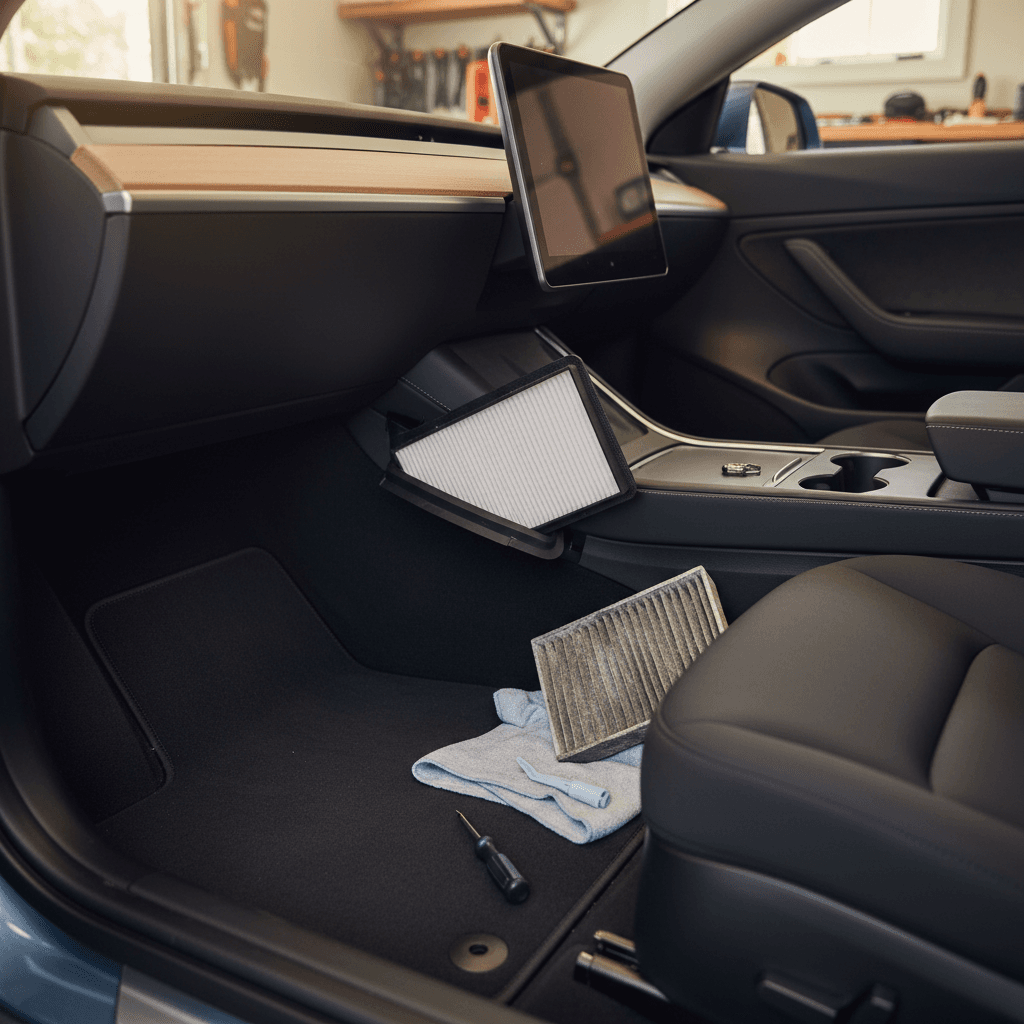
If your Tesla’s vents have started to smell musty, or your defogging performance isn’t what it used to be, it’s probably time for a Tesla HVAC filter replacement. The good news: with a free afternoon, the right parts, and a bit of patience, most owners can handle this DIY job at home and save a trip to the service center.
HVAC vs. cabin air filter
Why your Tesla HVAC filter matters
Electric vehicles skip oil changes and exhaust systems, but they still breathe. Your Tesla’s HVAC (cabin) filter traps dust, pollen, brake dust, road grime, and, if you have a carbon filter, odors and some pollutants before they reach your lungs.
- Cleaner air for you and your passengers, especially if anyone has allergies or asthma.
- Less fogging on the inside of the windshield because a clean, dry filter moves air more efficiently.
- Less strain on the HVAC blower motor, which doesn’t have to work as hard to push air through a clogged filter.
- Fewer funky smells from moisture and organic crud trapped in a dirty filter.
Don’t ignore that “Cabin air filter replacement required” message
When to replace Tesla HVAC filters (by model)
Tesla updates software and recommendations over time, but as a rule of thumb, think of your HVAC filters as 2-year wear items, and sooner if you drive in dusty or polluted areas. Here’s a simplified schedule you can use as a starting point.
Typical Tesla HVAC / cabin filter replacement intervals
Use this as a guideline; always confirm with the latest maintenance recommendations in your Tesla app or owner’s manual.
| Model | Generation / Notes | Typical interval | Filter type |
|---|---|---|---|
| Model 3 | All years | Every 2 years (12–25k miles) | Two cabin filters |
| Model Y | All years | Every 2 years (12–25k miles) | Two cabin filters |
| Model S | Older pre-HEPA cars | Around 2 years | Single cabin filter |
| Model S | With HEPA filter (Bioweapon Defense Mode) | Cabin: ~2 years; HEPA: 3–4 years | Cabin + large HEPA filter |
| Model X | Older pre-HEPA cars | Around 2 years | Single cabin filter |
| Model X | With HEPA filter (Bioweapon Defense Mode) | Cabin: ~2 years; HEPA: 3–4 years | Cabin + large HEPA filter |
If you live in a dusty climate, drive lots of highway miles, or often park under trees, aim for the shorter end of these ranges.
Let your nose be your guide
Tools and parts you’ll need for DIY
Before you pull the glove box apart, gather everything you’ll need. Tesla interiors are tight and held together with plastic clips; being prepared keeps you from forcing anything and breaking trim.
Basic tools and parts for Tesla HVAC filter DIY
Exact details vary slightly by model, but the core kit is similar.
Tools
- Trim removal tools (plastic pry tools to avoid scratching panels)
- Torx or Phillips screwdriver (varies by model / year)
- Small ratchet or nut driver if your car uses hex screws
- Flashlight or headlamp to see up behind the dash
- Shop vacuum with a crevice tool (optional but handy)
- Gloves and safety glasses if you’re sensitive to dust
Parts & extras
- Correct replacement cabin filters for your model (often sold as a kit for Model 3/Y)
- Optional: activated carbon filters if you want extra odor control
- Optional: coil or evaporator cleaner rated for automotive HVAC
- Clean rags or paper towels for wiping dust and debris
Budget roughly $25–$80 for filters depending on brand and whether you choose HEPA/activated carbon options.
Safety first: power and airbags
Model 3 and Model Y HVAC filter replacement DIY
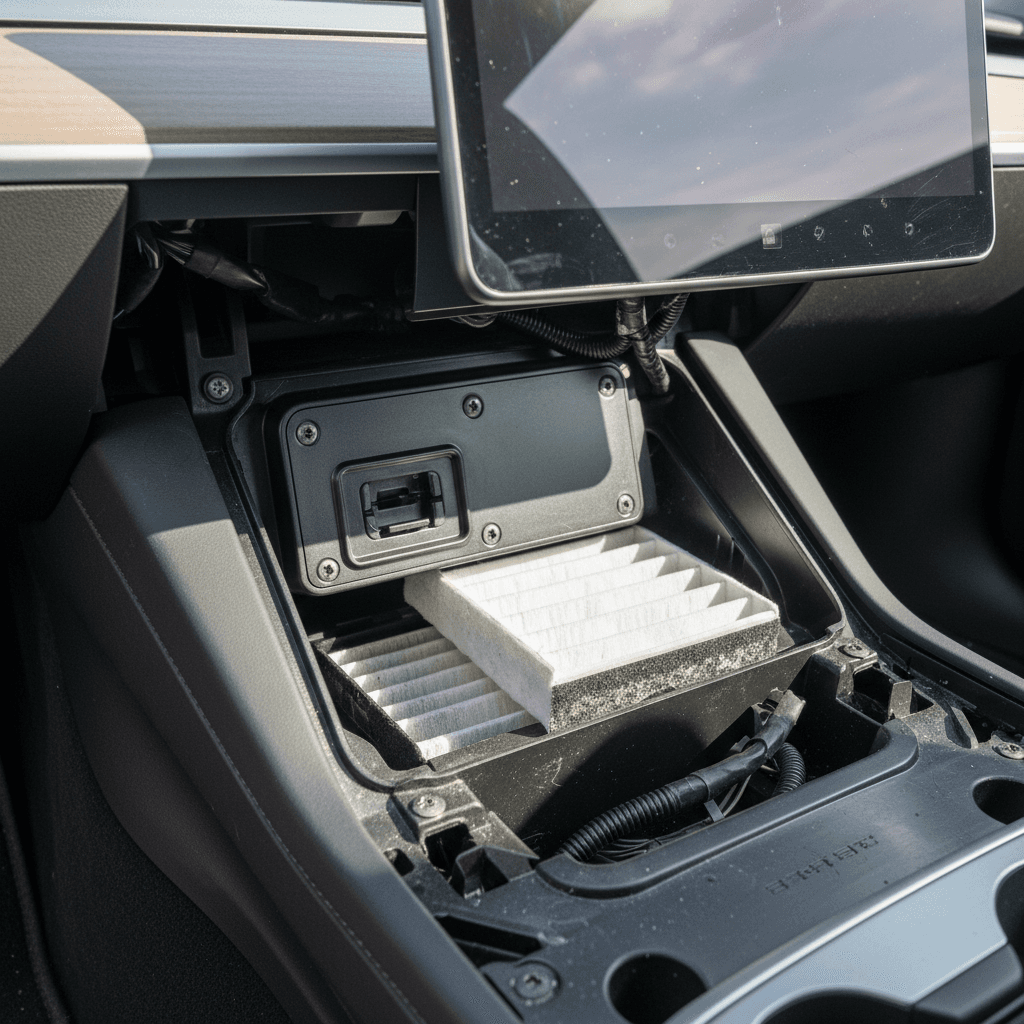
For most owners, Model 3 and Model Y are the main DIY targets. The process is similar between the two: you’ll pull some passenger-side trim panels, drop the glove box, and slide out two stacked cabin filters from a vertical housing.
DIY difficulty: Model 3 and Model Y
Step-by-step: Model 3 / Model Y HVAC filter replacement
- Prepare the car. Park on level ground, set the parking brake, and power the car down in the Service menu. Open the passenger door fully for room to work.
- Move the passenger seat back. Slide it rearward and recline slightly to give your shoulders space while you work in the footwell.
- Remove the passenger-side lower trim. Gently pull down the carpeted footwell panel below the glove box. It’s held with clips and sometimes a small fastener; unplug any courtesy light connectors carefully and set the panel aside.
- Remove the side console trim. On the right side of the center console (passenger side), use a plastic pry tool to release the narrow vertical trim panel. Work slowly from one end so you don’t snap the clips.
- Drop or loosen the glove box (if required). On some years you’ll remove a few screws along the glove box edges and gently let it hang down to reveal the filter access panel. Support it so you don’t stress the hinges or wiring.
- Locate the HVAC filter housing. Look for a tall, narrow cover with a small retaining tab or screw. It sits just to the right of the center console tunnel, behind the trim you removed.
- Remove the housing cover. Release the tab or remove the screw and swing or pull the cover off. Take note of how the original filters are oriented, arrows usually indicate airflow direction (typically downward).
- Slide out the top filter. The filters are stacked. Pull the small pull-tab on the upper filter and angle it out toward you, then downward.
- Slide out the lower filter. Once the top filter is out, you’ll see the lower one. Pull it up slightly, then out. Expect dust and debris; this is where a shop vac helps.
- Clean the housing (optional but recommended). Vacuum loose debris and, if you have an approved HVAC cleaner, lightly treat the evaporator area following the product instructions. Don’t soak anything, and avoid electrical connectors.
- Install the new lower filter. Insert the first new filter in the lower slot, matching the airflow arrow direction to the originals. Push it fully seated.
- Install the new upper filter. Insert the second filter on top of the first, again matching airflow arrows, and ensure the pull-tab is reachable for the next service.
- Reinstall the housing cover. Snap or screw the cover back on securely. A loose cover can cause rattles or air leaks.
- Reassemble the trim. Reattach the glove box (if removed), snap the side console trim back into place, and reinstall the lower footwell panel, reconnecting any lights you unplugged.
- Power up and test. Wake the car, turn on the HVAC, and cycle through fan speeds. Listen for new rattles, and make sure airflow and defrost performance feel normal.
Snap photos as you go
Model S and Model X HVAC filter replacement DIY
For Model S and Model X, the basic idea is the same, access the HVAC housing on the passenger side and slide out the cabin filters, but the details depend heavily on model year and whether your car has the big HEPA “Bioweapon Defense Mode” filter.
Older Model S / X without HEPA
- Usually a single cabin filter behind the glove box or under the passenger footwell.
- Access often involves removing the lower dash panel and a small access cover.
- DIY difficulty is similar to Model 3/Y but with fewer stacked filters.
Consult a model-year-specific guide or the owner’s manual so you’re removing the correct panels.
Model S / X with HEPA filter
- There’s still a standard cabin filter, plus a huge HEPA element in the front trunk area.
- Replacing the cabin filter is similar to other Teslas; replacing the HEPA filter is more involved, often requiring frunk trim removal.
- Many owners DIY the cabin filter but leave the HEPA element to a service center.
If the HEPA filter is due, consider the time and cost of specialty parts before diving in.
Airbags and wiring in S/X
Simple HVAC filter replacement checklist
Run through this checklist before you start
1. Confirm the right filters
Double-check that the replacement filters match your exact Tesla model and year. Cabin filters for Model 3/Y are different from those for S/X, and HEPA kits are different again.
2. Review a model-specific guide
Look up an illustrated or video guide for your exact car before tearing into trim. Even between early and late Model 3s, screw locations and clips can change.
3. Gather tools and lighting
Have your trim tools, screwdrivers, and a bright light at arm’s reach. Good lighting in the passenger footwell is half the battle.
4. Protect interior surfaces
Lay down a clean towel or pad on the door sill and floor to protect against scuffs while you crawl in and out.
5. Power down the car
Use the Service menu to power off the car and avoid accidentally cycling the HVAC while your hands are near the blower and connectors.
6. Take it slow on reassembly
If a panel doesn’t want to snap back in place easily, back up and check alignment. Most Tesla trim goes together with light, even pressure, not brute force.
Costs, time, and when to skip DIY
Doing your own Tesla HVAC filter replacement DIY can save real money and let you control the quality of filters you install. But it’s not for everyone, every time.
DIY vs. service center: what to expect
Rough, owner-oriented expectations; actual costs vary by region, service provider, and filter choice.
| Scenario | DIY cost (parts) | Typical service cost | Time estimate | Best for |
|---|---|---|---|---|
| Model 3/Y cabin filters only | $30–$70 | $120–$250+ | 60–90 min first time | Hands-on owners comfortable with trim work |
| Model S/X cabin filter only | $30–$80 | $150–$300+ | 60–120 min depending on year | Owners with some DIY experience |
| Model S/X HEPA filter + cabin | $200–$400+ | $400–$800+ | Half day if DIY | Owners who don’t mind a big project or bundle work with other service |
| Any model with limited access or mobility | N/A | Service only | N/A | Owners who prefer not to work on the car physically |
Consider your time, comfort level, and whether other work is already being done on the car when deciding DIY vs. service.
Stack it with other EV maintenance
HVAC filter tips to keep your Tesla fresh longer
Once you’ve done the hard work of wrestling with panels and swapping filters, a few habits can help your new filters last longer and keep cabin air as clean as the EV drivetrain.
- Use recirculate sparingly. Constant recirculation can trap humidity and odors in the cabin; mix in fresh air on longer drives.
- Run the fan briefly before shutting down. Letting the fan blow for a minute without heavy cooling can help dry out the evaporator, which reduces musty smells.
- Avoid smoking or strong fragrances in the car. Cabin filters help, but they can only do so much against persistent sources.
- Consider activated carbon filters. If you drive in traffic-heavy or urban areas, carbon filters can help reduce exhaust and industrial odors.
- Keep leaves and debris away from the cowl. If you park under trees, occasionally check the area at the base of the windshield and gently clear away buildup so it doesn’t get drawn into the HVAC system.
After heavy wildfire smoke or construction dust
How HVAC filter care affects used Tesla value
Buyers may not ask directly about the HVAC filter, but they notice what it affects: smell, fogging, and general feel the second they open the door. A clean, neutral-smelling cabin suggests the car has been cared for; a musty interior raises questions about leaks, mold, and maintenance history.
If you plan to sell your Tesla
- Replacing the HVAC filters before listing is an inexpensive way to improve first impressions.
- Document the replacement with receipts and a quick note in your maintenance log.
- A fresher-smelling cabin helps your car stand out among similar listings.
How Recharged looks at it
When a Tesla comes through Recharged, we look beyond battery health and paint. Our Recharged Score and inspection process considers day-to-day livability details, like HVAC performance and cabin odors, so buyers know they’re getting a used EV that feels good to live with, not just one that looks good on paper.
Tesla HVAC filter replacement FAQ
Frequently asked questions about Tesla HVAC filter DIY
Taking on a Tesla HVAC filter replacement DIY project is one of the best low-cost ways to make your EV feel newer, smell fresher, and keep its climate system working efficiently. Whether you tackle it yourself in the driveway or have a shop do the work, keeping those cabin filters on a regular schedule pays off every time you breathe in. And if you’re shopping for a used Tesla, or getting ready to sell yours, paying attention to details like this is exactly the kind of care a serious buyer, or a marketplace like Recharged, will notice.