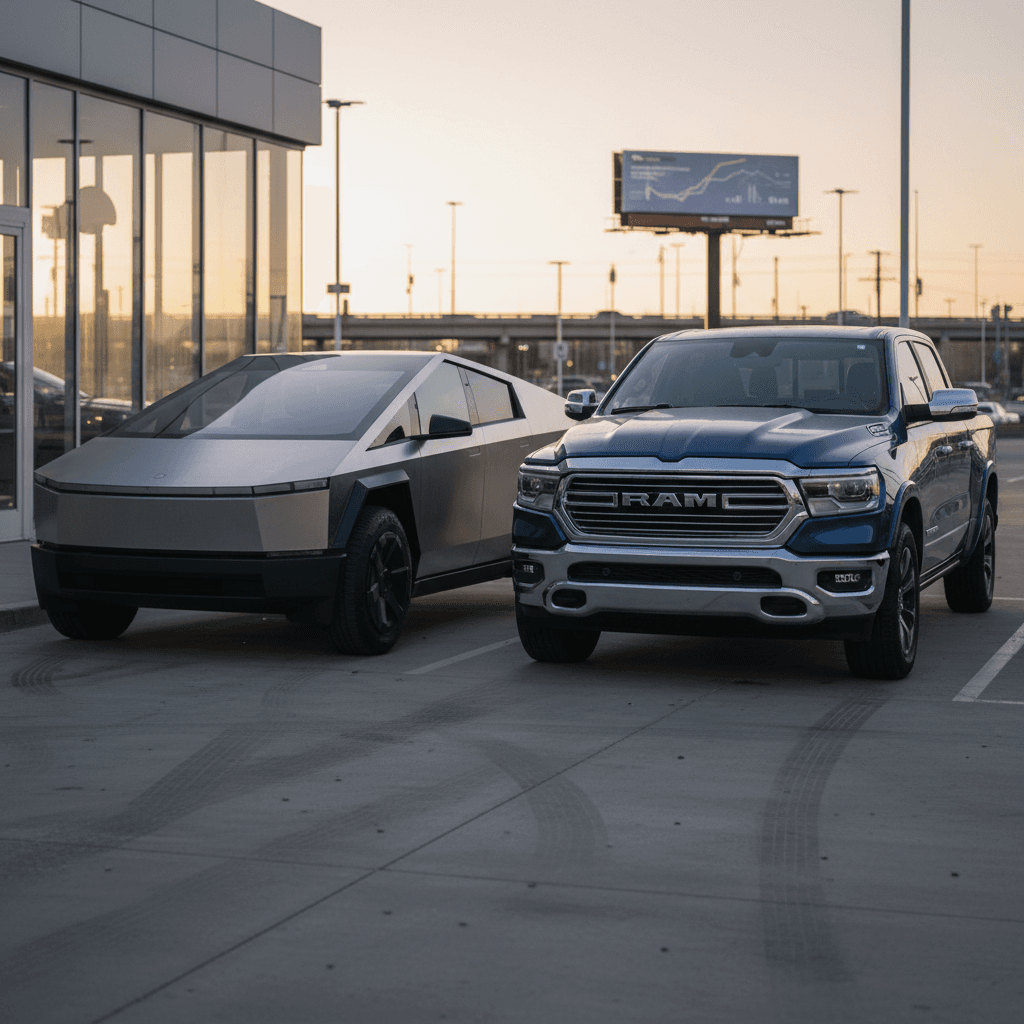
If you’re trying to decide between a Tesla Cybertruck and a Ram 1500 in 2026, sticker price is only the beginning. The real question is: over five years of truck ownership in the U.S., which costs you less once you add fuel, maintenance, insurance, and resale value?
Scope of this 2026 cost comparison
Why Cybertruck vs Ram 1500 cost really matters in 2026
Gas trucks like the Ram 1500 are known quantities: familiar to dealers, easy to fuel anywhere, and heavily discounted. The Tesla Cybertruck is the opposite, polarizing design, new tech, and a price that doesn’t scream “bargain.” Yet when you look beyond monthly payments, EV pickups can claw back a lot of ground in lower energy and maintenance costs.
In 2026, with federal EV tax credits gone and gasoline still volatile, truck buyers are rightly focused on total cost of ownership (TCO), not just MSRP. That’s where the Cybertruck vs Ram 1500 comparison gets interesting: the gas truck usually wins on purchase price, while the Cybertruck fights back with lower per‑mile running costs.
High-level 5‑year cost signals (typical U.S. driver)
Quick take: who spends less over 5 years?
Cybertruck vs Ram 1500: 5‑year cost comparison at a glance
Assuming ~15,000 miles/year, U.S. average energy prices, and mainstream trims
Tesla Cybertruck (AWD‑type trims)
Strengths:
- Much lower energy cost per mile when charged at home.
- Lower maintenance and no oil, transmission, or exhaust work.
- Strong tech and OTA updates can help resale desirability.
Weaknesses:
- Higher purchase price than a typical Ram 1500, especially if you don’t find discounts.
- Insurance can be higher in some markets.
- Towing or heavy loads erode energy‑cost advantage.
Ram 1500 (V6 / Hurricane I‑6)
Strengths:
- Lower upfront cost and lots of dealer discounting.
- Simple to fuel anywhere, no charging learning curve.
- More body styles, bed lengths, and trim variety.
Weaknesses:
- Much higher fuel bills, especially if you drive a lot or tow.
- Higher maintenance over time: oil, spark plugs, emissions system, etc.
- Gas trucks face tighter emissions rules and long‑term demand uncertainty.
Bottom line in one sentence
Purchase price: 2026 Cybertruck vs 2025–2026 Ram 1500
Exact 2026 pricing will move month to month, but by early 2026 the pattern is clear: a Cybertruck is fundamentally a premium‑priced truck, while a Ram 1500 still covers a wide range from value‑oriented Tradesman to six‑figure luxury builds.
Representative Cybertruck and Ram 1500 price ranges (early 2026 U.S.)
Approximate new‑vehicle pricing including destination, before dealer discounts or add‑ons. Always confirm current numbers on Tesla and Ram sites or with dealers.
| Model / trim | Typical 2026 status | Approx. price (USD) | Notes |
|---|---|---|---|
| Tesla Cybertruck base AWD‑type trim | New, factory order or inventory | $70,000–$75,000 | Pricing has been in flux, but dual‑motor all‑wheel‑drive Cybertrucks still land around the $70k mark new in 2026. |
| Tesla Cybertruck higher trims / Cyberbeast | New | $90,000–$100,000+ | Performance‑oriented trims add substantial cost with relatively modest practical utility gains for most owners. |
| Used Tesla Cybertruck (early builds) | 1–2 years old | $65,000–$85,000 | Depend heavily on mileage, configuration, and how the early‑adopter hype vs recall history shakes out locally. |
| Ram 1500 Tradesman / Big Horn / Lone Star (V6) | New 2025–2026 | $42,000–$55,000 | Entry and volume trims with 3.6‑L V6 and eTorque mild hybrid systems. |
| Ram 1500 Laramie / Rebel (Hurricane S.O.) | New 2025–2026 | $62,000–$70,000 | More power and equipment; pricing overlaps with lower Cybertruck trims. |
| Ram 1500 Limited / Longhorn / Tungsten | New 2025–2026 | $75,000–$95,000+ | Luxury and high‑output Hurricane engines push well into Cybertruck money. |
These are ballpark figures to frame the cost discussion, not formal quotes.
Don’t compare base to base blindly
Energy and fuel costs per mile
Operating cost is where the Cybertruck earns its keep. It’s a heavy, bluff‑fronted EV, so it’s not as efficient as a Model 3, but it’s still far cheaper to power than a big gasoline pickup, especially if you charge at home at typical U.S. electricity rates.
Real‑world efficiency assumptions (energy use)
- Cybertruck dual‑motor–type trims: Roughly 41–43 kWh/100 miles in mixed driving, making it Tesla’s least efficient vehicle but still far better than a gas truck on energy cost per mile.
- Ram 1500 V6 / Hurricane I‑6: Real‑world 17–20 mpg combined for common 4x4 crew‑cab configurations, depending on engine and driving style.
For towing, both trucks consume far more energy; assume a 30–50% hit to range or mpg when pulling serious weight.
Energy price assumptions (2026 U.S. averages)
- Electricity (home charging): ~$0.15 per kWh all‑in. Many owners can do better overnight; public DC fast charging is usually higher.
- Gasoline for Ram 1500: ~$3.50 per gallon nationwide average across 2025–2026 is a reasonable planning number; your local price may be higher.
If your home electricity is very expensive or you rely heavily on premium DC fast charging, the Cybertruck’s advantage shrinks but rarely disappears entirely.
Illustrative per‑mile energy cost: Cybertruck vs Ram 1500
Based on the assumptions above; your real‑world numbers will track your local prices and driving style.
| Truck / scenario | Energy use assumption | Energy price assumption | Approx. cost per mile |
|---|---|---|---|
| Cybertruck charged mostly at home | ~0.41 kWh/mile | $0.15/kWh | ≈ $0.06/mile |
| Cybertruck relying heavily on fast charging | ~0.41 kWh/mile | $0.30/kWh | ≈ $0.12/mile |
| Ram 1500 at 18 mpg | 1 gallon / 18 miles | $3.50/gal | ≈ $0.19/mile |
| Ram 1500 at 20 mpg (light‑footed driving) | 1 gallon / 20 miles | $3.50/gal | ≈ $0.18/mile |
Even for a relatively inefficient EV like the Cybertruck, electricity usually undercuts gasoline on a per‑mile basis.
Annual fuel/energy bill comparison at 15,000 miles/year

Maintenance and repairs: electric vs gas truck reality
Over the past several years, fleet and consumer data have converged on the same conclusion: EVs generally cost a lot less to maintain than comparable gas vehicles. There’s no engine oil, spark plugs, timing belts, or exhaust system, and regenerative braking reduces brake wear.
Typical 5‑year maintenance patterns
Exact numbers vary, but the shape of the curve is consistent
Tesla Cybertruck maintenance profile
- Cabin air filters, brake fluid checks, and inspections rather than scheduled engine service.
- Tires are the main recurring expense, big, heavy EV trucks chew through rubber.
- Brake pads can last a long time thanks to regenerative braking, especially in commuter duty.
Across EVs generally, maintenance and repair spend often runs about 40–50% lower than for comparable gas vehicles over typical ownership windows.
Ram 1500 maintenance profile
- Regular oil and filter changes (every 5,000–10,000 miles depending on usage).
- Transmission fluid, spark plugs, cooling system service, and emissions‑system components over time.
- More brake wear in stop‑and‑go driving, plus the same tire costs as any big truck.
Real‑world 5‑year maintenance and minor repair bills on a gas half‑ton commonly land in the mid‑four figures, even without major failures.
Rough 5‑year maintenance cost ballpark
Insurance, taxes, and fees
Insurance is a wild card. Early on, brand‑new EVs like the Cybertruck can be more expensive to insure because repair networks are still maturing and parts pricing is volatile. Ram 1500 insurance is more predictable, with lots of historical data for actuaries to work with.
- In many U.S. markets, expect Cybertruck insurance quotes to come in somewhat higher than a comparable‑value Ram 1500 at first, then normalize as repair data accumulates.
- Registration, property tax, and plate fees are generally driven by vehicle value. If your Cybertruck is worth more than an equivalent Ram 1500, expect slightly higher yearly taxes until depreciation evens things out.
- Some states and utilities still offer EV‑specific perks (like HOV lane access or discounted off‑peak EV rates) that don’t show up as line items in TCO calculators but still affect the day‑to‑day ownership experience.
Get real quotes before you choose
Depreciation and resale value
Depreciation is where a lot of online debates go off the rails. The truth is that both EVs and pickups have seen unusual market swings since 2020, and nobody has a crystal ball. That said, we can outline the forces nudging Cybertruck and Ram 1500 values over the next 5–10 years.
Cybertruck depreciation dynamics
- Early‑adopter premium on first‑wave trucks has already started to erode as supply catches up with demand.
- Battery health and range retention will be key to resale; buyers will want to see data rather than just mileage.
- Software‑heavy, OTA‑updated vehicles can stay current longer, but wild styling polarizes buyers and could hurt mainstream resale.
Used EVs in general often cost more up front than similar gas vehicles but may depreciate faster percentage‑wise if new‑EV pricing drops.
Ram 1500 depreciation dynamics
- Half‑ton pickups have traditionally held value well, especially volume trims with sensible options.
- As more fleets and consumers lean toward lower‑emission or electrified trucks, demand for thirsty gas‑only pickups could soften.
- Heavy incentives on new trucks (common in the segment) can compress used values, especially for high‑MSRP luxury trims.
If gas prices stay high or cities tighten emissions rules, the long‑term desirability of big gas trucks becomes less certain.
How to protect yourself on resale
5‑year total cost of ownership estimates
Now let’s put the pieces together. The table below compares a representative Cybertruck against two plausible Ram 1500 scenarios for a typical U.S. driver in 2026. These are simplified estimates meant to show directionally where the money goes, not to replace a personalized quote sheet.
Illustrative 5‑year cost of ownership (15,000 mi/year)
Approximate cumulative costs over 5 years, excluding financing interest. Purchase price assumes you drive off new in 2026 and sell after 5 years.
| Category (5 yrs) | Cybertruck dual‑motor–type trim | Ram 1500 mid‑trim (e.g., Big Horn / Laramie) | Ram 1500 high‑trim (e.g., Limited / Tungsten) |
|---|---|---|---|
| Starting price (drive‑off, incl. fees) | $72,000 | $60,000 | $80,000 |
| Estimated value after 5 yrs | $36,000–$40,000 | $24,000–$30,000 | $32,000–$40,000 |
| 5‑yr depreciation (cash lost) | ≈ $34,000 | ≈ $32,000–$36,000 | ≈ $40,000–$48,000 |
| Fuel / electricity (home‑biased charging) | ≈ $4,500 | ≈ $14,000 | ≈ $14,000 |
| Routine maintenance & minor repairs | ≈ $2,250 | ≈ $4,500 | ≈ $5,000 |
| Insurance, taxes, fees (highly variable) | ≈ Similar band for equal market value trucks | ≈ Similar band for equal market value trucks | ≈ Similar band for equal market value trucks |
| Approx. 5‑yr TCO (excl. insurance/taxes) | ≈ $40,750 | ≈ $50,500–$54,500 | ≈ $59,000–$67,000 |
Numbers rounded for clarity; real‑world results will vary.
How the math usually nets out
What changes if you buy used in 2026?
Most truck buyers don’t buy brand‑new every time. On the used market in 2026, you’re likely to see a few early‑build Cybertrucks alongside a huge number of used Ram 1500s spanning multiple generations.
Key used‑truck cost considerations in 2026
1. Battery health on a used Cybertruck
Battery condition directly affects range and value. Look for trucks with documented charging habits and battery health reporting. A neutral third‑party diagnostic, like the Recharged Score we use on every EV we sell, gives you real data instead of guesswork.
2. Powertrain history on a used Ram 1500
On a gas truck, long‑term costs hinge on how well the engine, transmission, and emissions systems have been maintained. Service records, oil‑change history, and any major repairs matter more than odometer alone.
3. Depreciation already “baked in”
A 2–3‑year‑old Cybertruck or Ram has already taken a big depreciation hit. Buying at this point can dramatically improve your personal TCO compared with being the first owner, especially if you don’t plan to keep the truck beyond another 5 years.
4. Warranty coverage and risk tolerance
For Cybertruck, factory powertrain and battery coverage can protect you from big‑ticket failures. For an older Ram 1500 out of warranty, it may be worth budgeting for possible engine or transmission work if you tow or haul heavily.
5. Financing terms on used vs new
Interest rates and loan terms on used vehicles can be slightly higher or shorter than on new. If you’re stretching your budget, the financing math can matter as much as fuel vs electricity.
Where used EVs often shine
Which truck makes financial sense for you?
Cybertruck vs Ram 1500: buyer profiles
Match your use case to the cost profile, not the marketing slogan
You’re a good Cybertruck candidate if…
- You drive 12,000–20,000 miles per year, mostly commuting or regional trips.
- You can install or already have home charging at reasonable electricity rates.
- You care about long‑term operating costs more than the lowest possible monthly payment right now.
- You’re comfortable with Tesla’s service model and more software‑centric ownership experience.
You’re a good Ram 1500 candidate if…
- You can buy a well‑priced used Ram or a heavily discounted new one.
- You drive relatively few miles each year, so fuel costs don’t dominate your budget.
- You tow or roam in areas with limited fast‑charging infrastructure.
- You prefer conventional dealers, independent shops, and a more traditional truck experience.
Avoid this common mistake
How Recharged can help you run the numbers
If you’re trying to make a rational choice between a used Cybertruck and a used Ram 1500, or cross‑shopping other EV and gas trucks, the missing piece is usually transparent, vehicle‑specific data rather than generic averages.
- Every EV we sell comes with a Recharged Score Report that verifies battery health and gives you an objective snapshot of remaining range and pack condition, critical inputs for long‑term cost.
- Our pricing tools benchmark each vehicle against current fair‑market data, so you see whether that used Cybertruck or gas truck is priced realistically for 2026 conditions.
- Recharged’s EV‑specialist advisors can walk you through your driving pattern, local energy prices, and financing options so you’re not guessing which truck will cost less to keep on the road.
- With nationwide delivery and flexible options like trade‑in, instant offer, or consignment, you can move into the right truck for your budget without spending Saturdays hopping between dealers.
When you strip away the hype, the 2026 Tesla Cybertruck vs Ram 1500 cost comparison comes down to miles, energy prices, and how long you keep your trucks. For high‑mileage owners with home charging, the Cybertruck’s lower running costs can more than offset its higher price. For low‑mileage drivers or anyone able to snag a well‑priced Ram 1500, the traditional gas truck can still pencil out. The key is to put your own numbers into the equation, and if you’re looking at used EVs, make sure you have real battery‑health data before you sign anything.