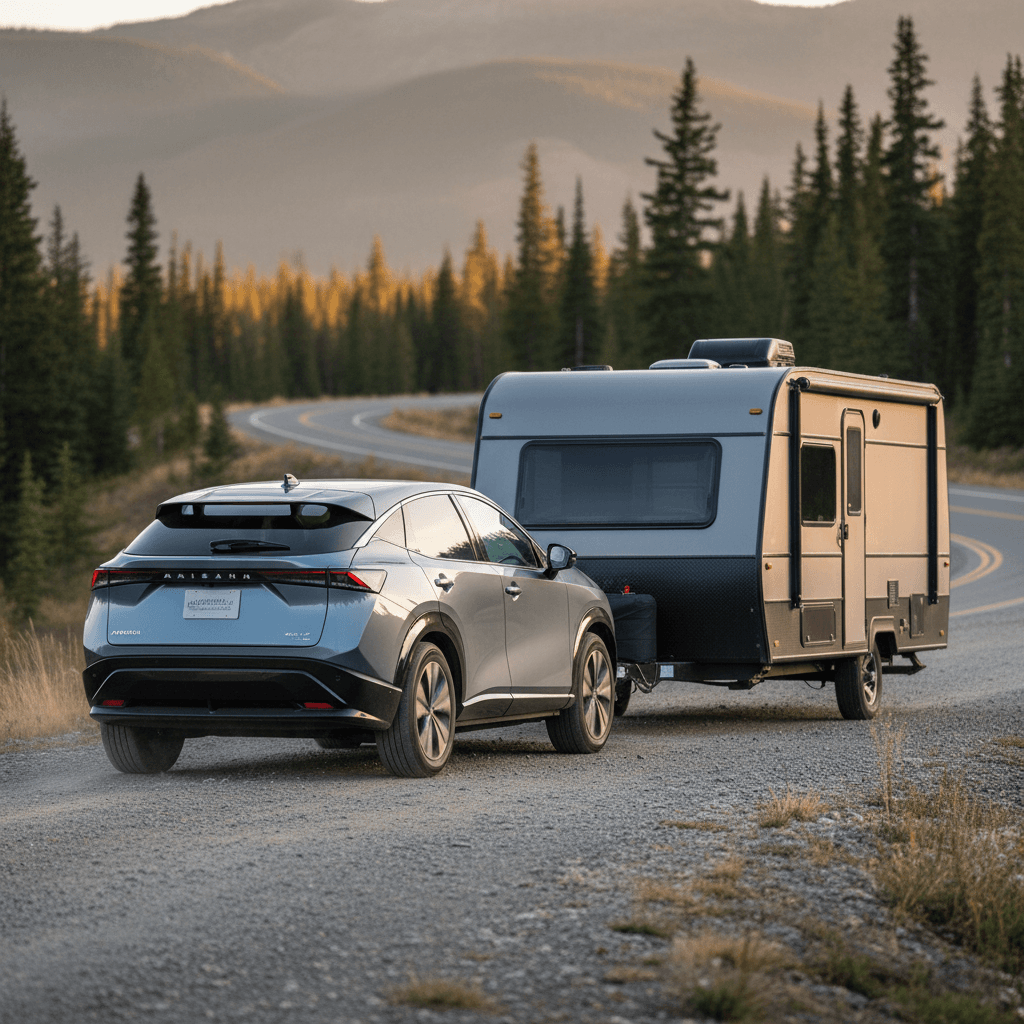
If you’re eyeing a Nissan Ariya and wondering, “Can this EV actually tow a trailer?” the short answer is yes, in the right configuration, with the right hitch, and the right expectations. This guide walks you through tow ratings, trailer types, range impact, and how to decide if a Nissan Ariya is the right tow vehicle for your plans.
Key takeaway
Quick answer: Can a Nissan Ariya tow a trailer?
Yes, but with limits
On properly equipped Ariya models with a rated tow package, Nissan typically allows towing up to about 1,500 lb (≈680 kg) in many markets. In Europe and Australia, some trims are rated higher on paper, but for U.S. buyers you should plan around that 1,500 lb ceiling.
Light-duty towing only
The Ariya is best used as a light-duty tow vehicle, think utility and cargo trailers, bike racks, and small, aerodynamic campers. If you’re dreaming about a 5,000 lb travel trailer, you’ll want a different tow rig.
Always check your specific car
Nissan Ariya tow ratings by model and market
Nissan’s own literature makes things a bit confusing because tow ratings differ by region and trim. Here’s how to think about it at a high level.
Typical Nissan Ariya tow ratings (high-level guide)
Approximate tow ratings seen in manufacturer materials and market guides. Always verify for your specific VIN and market.
| Market / Trim Type | Example Configuration | Typical Max Braked Trailer | Typical Use Case | ||||
|---|---|---|---|---|---|---|---|
| U.S. – AWD trims with tow package | e-4ORCE dual-motor, larger battery | ≈1,500 lb (680 kg) | Small camper, utility trailer, cargo trailer | ||||
| U.S. – some FWD trims | Single-motor FWD, 63 or 87 kWh | Often limited or not officially rated for towing | Bike racks, small cargo carriers (non-towing) | ||||
| Europe / Australia – FWD | Single-motor FWD | ≈750 kg (1,650 lb) | Light utility or small trailer | Europe / Australia – AWD | e-4ORCE dual-motor | ≈1,500 kg (3,300 lb) on paper | Heavier camping or cargo trailers within limit |
Use this as a directional guide only; local regulations and your Ariya’s paperwork are the final word.
Why numbers differ by country
In practical terms, if you’re in the U.S. you should treat 1,500 lb as an upper bound on a properly equipped Ariya, and shoot for a comfortable margin below that, often in the 1,000–1,200 lb trailer weight range once fully loaded with gear.
What kind of trailer can a Nissan Ariya safely tow?
Best trailer types for a Nissan Ariya
Think compact, light, and as aerodynamic as possible.
Bike racks & small carriers
Perfect match for any Ariya. A hitch-mounted bike rack or small cargo carrier stays well under weight limits and has a modest impact on range.
Utility & cargo trailers
Single-axle utility trailers for yard work, dump runs, or moving can work well if you stay well below 1,500 lb total and keep the load balanced.
Small campers & teardrops
Aerodynamic teardrop or micro-campers in the 1,000–1,200 lb loaded range are at the upper end of what an Ariya should comfortably handle.
- Avoid tall, boxy trailers that catch a lot of wind, they’ll hurt range dramatically even if they’re light.
- Stay away from dual-axle, full-size travel trailers or heavy toy haulers; they’re beyond what the Ariya is designed to tow.
- Make sure the trailer’s tongue weight (downforce on the hitch) is roughly 10% of the trailer’s total weight and within the hitch’s rating.
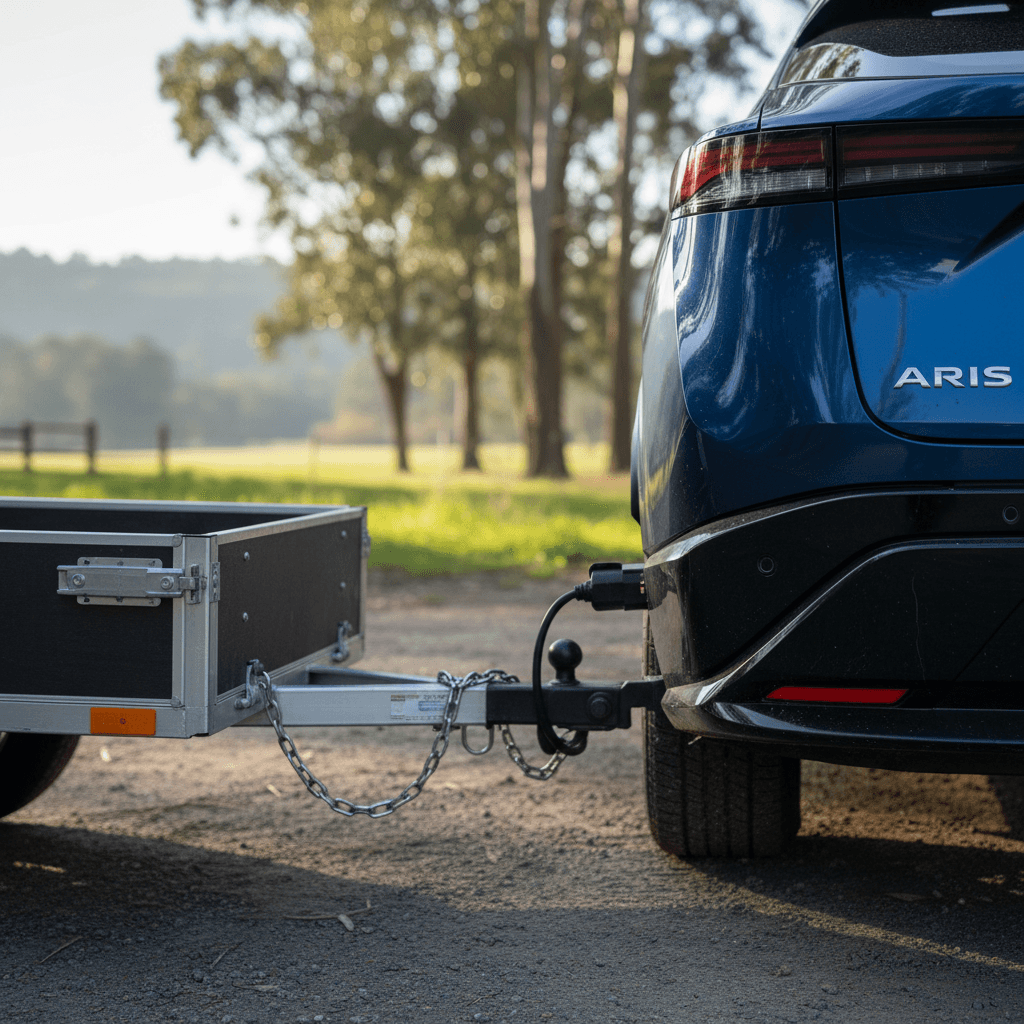
Aim for light and low
How towing affects Nissan Ariya range and charging
Hook any trailer to an EV and your real-world range will drop. With the Ariya, how much it drops depends mainly on trailer weight, shape, speed, terrain, and weather.
Typical range impact when towing with an Ariya
Plan your charging stops
Because your range shrinks, you’ll want to plan DC fast charging stops closer together. Instead of stretching between chargers at 10–15% remaining, think about arriving with 25–30% in hand when towing.
Use charging breaks smartly
With a trailer, you may need to unhitch or park creatively at some charging stations. Build extra time into your schedule, and look for sites with pull-through spaces or back-in options that won’t block other drivers.
Cold weather magnifies range loss
Equipment you need to tow with a Nissan Ariya
Before you tow anything with your Ariya, make sure your hardware is up to the job. Some accessories look similar but are not designed for real towing.
Essential towing gear for an Ariya
1. A properly rated hitch
Most Ariya owners will use a <strong>Class I or Class II receiver hitch</strong> that bolts to factory mounting points. Check that the hitch’s maximum trailer weight and tongue weight meet or exceed what you plan to tow, and never exceed Nissan’s tow rating for your specific car.
2. The right ball mount and ball
Match the ball size to your trailer coupler (commonly 1-7/8" or 2"). Use a ball mount that keeps the trailer approximately level when hitched, and confirm its weight rating as well.
3. Trailer wiring harness
You’ll need a <strong>4-pin wiring harness</strong> for basic trailers so your brake lights and turn signals work. Many factory and aftermarket hitch kits for the Ariya include a plug-in harness designed for the car’s electrical system.
4. Trailer with its own brakes (near the limit)
If you’re approaching the upper end of the Ariya’s tow rating, choose a trailer with <strong>electric or surge brakes</strong>. That takes strain off the EV’s friction brakes and improves safety in panic stops or long downhill stretches.
5. Tongue weight scale or method to check load
Improper tongue weight can cause sway. Aim for roughly <strong>10% of the trailer’s total weight</strong> on the hitch and make sure it’s within the limits of both your hitch and vehicle.
6. Quality tie-downs and wheel chocks
If you’re hauling gear, motorcycles, or lawn equipment, invest in proper ratchet straps and chocks. The smoother EV powertrain makes it easy to forget how much momentum your load still has.
Don’t use a “lifestyle” receiver for towing
Step-by-step: How to tow a trailer with your Ariya
Once your hardware is sorted, the actual towing process is straightforward, but it pays to be methodical, especially the first few times.
- Confirm your Ariya’s official tow rating and tongue weight limit in the owner’s manual and door-jamb label.
- Inspect the hitch, wiring, and trailer, check for loose bolts, damaged wiring, and properly inflated trailer tires.
- Load the trailer so about 10% of the total weight is on the tongue and the load is centered side-to-side.
- Back up slowly and lower the coupler onto the hitch ball; secure the latch and insert the safety pin or lock.
- Attach the safety chains in a crisscross pattern under the coupler and plug in the trailer wiring harness.
- Test tail lights, brake lights, and turn signals before you move the car.
- Start driving gently: use smooth throttle, leave extra following distance, and keep speeds modest (often 60–65 mph is a smart cap when towing with an EV).
- After the first 10–15 miles, stop and re-check hitch connections, chains, strap tension, and tire temperatures by hand. Repeat regularly on long trips.
Let the Ariya’s driver aids help you
Is the Nissan Ariya a good choice for towing?
Where the Ariya shines
- Great for everyday life + occasional towing, groceries and commuting during the week, dump runs or bike trips on weekends.
- Quiet, smooth power delivery makes towing feel stable and refined, especially at moderate speeds.
- Good traction on AWD (e-4ORCE) models when pulling a small camper or trailer on wet or unpaved surfaces.
Where it falls short
- Not a heavy hauler, 1,500 lb isn’t much if you’re used to pickup trucks or big SUVs.
- Range penalty is real on longer trips, especially with boxy or heavy trailers.
- Charging logistics with a trailer can be awkward at older stations that weren’t designed with pull-through lanes.
If your goal is the occasional camping weekend, a small boat, or yard-work duties, an Ariya can be a smart, efficient tow partner. If your lifestyle revolves around a large RV or heavy toys, you’ll probably be happier pairing the Ariya with a second, more tow-focused vehicle, or choosing a different primary tow rig.
Shopping used Ariya: What to check if you plan to tow
The Ariya is increasingly common on the used market, and towing is one of those use cases you’ll want to think about up front, not after you’ve signed paperwork.
Used Ariya towing checklist
Questions to ask and things to inspect before you buy.
1. Is this trim actually rated to tow?
Confirm whether the specific trim level and market version of the Ariya you’re considering has an official tow rating. Owner’s manuals, door-jamb labels, and original window stickers are good places to look.
2. Is there an existing hitch?
Inspect any installed hitch for rust, damage, or questionable installation. Ask whether it’s a tow-rated receiver or just a lifestyle/bike-rack accessory.
3. Battery health and towing history
Frequent towing at high loads and high speeds can add thermal stress. A battery health report gives peace of mind that the pack is still performing well.
4. Brakes and tires
Towing adds wear to brake pads, rotors, and tires. Check remaining life, look for uneven wear, and budget replacements if they’re near the end of their service window.
How Recharged can help
Ready to find your next EV?
Browse VehiclesFAQ: Nissan Ariya towing questions answered
Common Nissan Ariya towing questions
The bottom line: a Nissan Ariya can tow a trailer, but it’s happiest in the light-duty end of the spectrum, bikes, utility trailers, and compact campers that respect its 1,500 lb-ish ceiling and aerodynamic sweet spot. If you plan your loads, routes, and charging stops with those limits in mind, an Ariya can cover daily commuting and weekend adventures in one refined, all-electric package. And if you’re shopping used, working with an EV-focused retailer like Recharged makes it much easier to find an Ariya whose battery health, equipment, and price all line up with your towing plans.