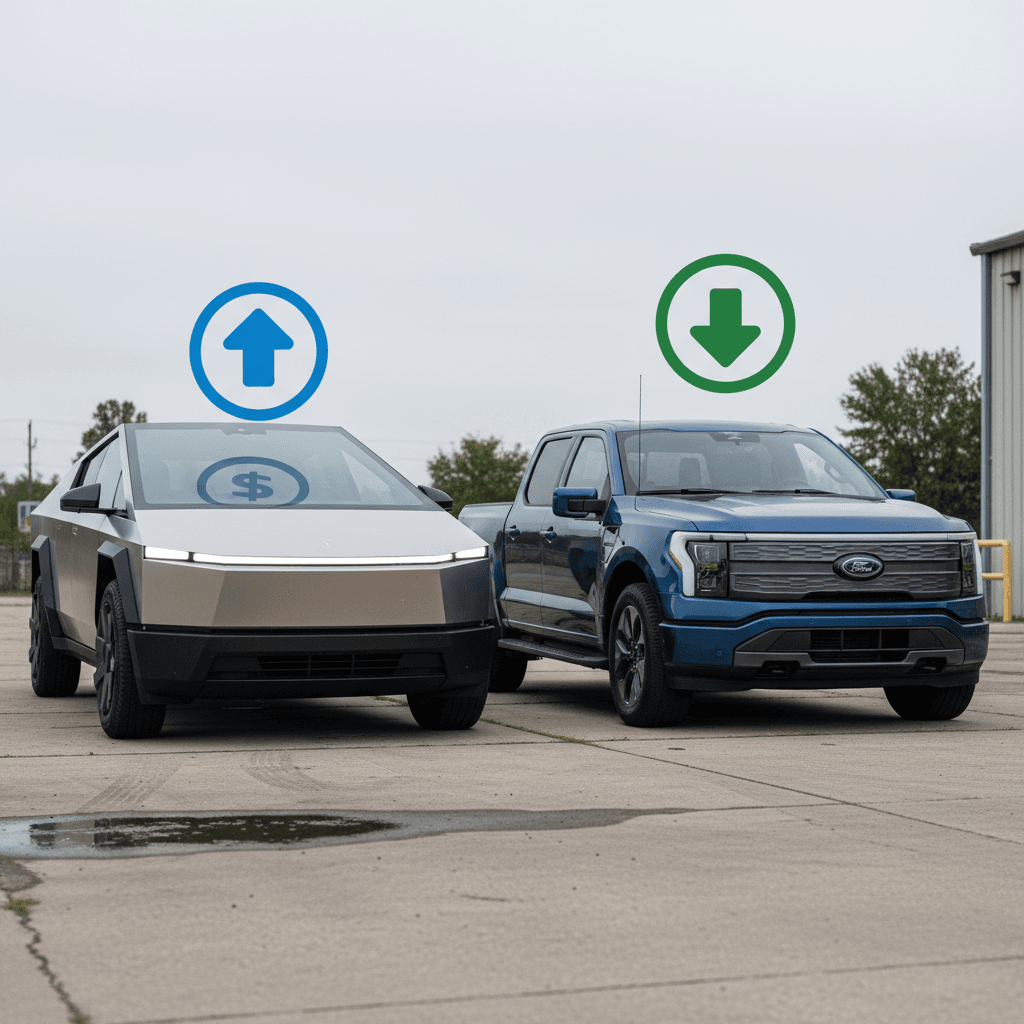
If you’re looking at trucks in 2026, you’re not just choosing between brands, you’re choosing between **powertrains and cost structures**. A *Tesla Cybertruck vs Ford F‑150 cost comparison in 2026* looks very different than it did even two years ago, especially now that Ford has discontinued the fully electric F‑150 Lightning in favor of gas and hybrid trucks. The question isn’t just “Which is cheaper to buy?” but “Which is cheaper to live with for the next 5–10 years?”
What this guide covers
Cybertruck vs F‑150 costs in 2026: what’s changed
Two big shifts define the **2026 truck landscape**: 1. **Cybertruck pricing has settled into premium territory.** After several revisions, all three Cybertruck trims now sit in what used to be "upper" F‑150 territory, with the Dual Motor AWD positioned as the volume model. 2. **Ford has killed the all‑electric F‑150 Lightning.** Ford announced in late 2025 that it would end Lightning production and pivot resources toward more efficient gasoline and hybrid trucks. That means your 2026 F‑150 choices on the new side are **gas and hybrid**, while the Lightning lives on only in the used market. So when you compare Cybertruck vs F‑150 in 2026, you’re really comparing a **new electric halo truck** to a **mature gas/hybrid workhorse**, with the **used F‑150 Lightning** as an important wild card for value shoppers.
High‑level cost signals for 2026 truck shoppers
Which Cybertruck and F‑150 versions are we actually comparing?
Both lineups are huge, and list prices move with incentives and dealer markups. To keep this practical, we’ll focus on **representative 2026 builds** that an everyday truck buyer might cross‑shop, then show how a used F‑150 Lightning fits in as a third path.
Baseline trucks for this 2026 cost comparison
These aren’t the only configurations, but they frame the economics clearly.
Tesla Cybertruck Dual Motor AWD
Role: Core Cybertruck trim most buyers target.
- Approx. mid‑$70k MSRP as of early 2026
- ~340–350 miles of rated range
- Best mix of performance and price vs Cyberbeast
Ford F‑150 XLT (Gas 4x4 Crew Cab)
Role: Mainstream full‑size truck buyer’s default.
- Low–mid $50k with common options
- 2.7L or 3.5L EcoBoost V6
- Buyers balance price, tow rating, comfort
Used Ford F‑150 Lightning Lariat
Role: Electric alternative now found only used.
- Original MSRPs often $70k–$90k
- Used prices in 2026 typically well below new Cybertruck
- Shows how **used EVs** can undercut new‑truck economics
Trims and prices move fast
Purchase price and incentives in 2026
Typical 2026 pricing snapshots (before tax, fees, and dealer markup)
Approximate new or like‑new pricing for representative Cybertruck and F‑150 configurations in early 2026. Numbers are rounded to keep the comparison readable.
| Truck & trim (2026) | Powertrain | Ballpark price | Notes |
|---|---|---|---|
| Tesla Cybertruck AWD | Electric | $70,000–$75,000 | Core Cybertruck configuration, before software add‑ons. |
| Cybertruck Cyberbeast | Electric | $90,000–$100,000 | High‑performance trim; can climb higher with options. |
| Ford F‑150 XL 4x4 Crew | Gas | ~$42,000–$48,000 | Entry work truck with 4x4 and basic equipment. |
| Ford F‑150 XLT 4x4 Crew | Gas | ~$52,000–$60,000 | Typical family/commuter build with popular packages. |
| Ford F‑150 Lariat/Platinum 4x4 | Gas/Hybrid | $65,000–$80,000+ | Luxury and tech‑heavy trims rival Cybertruck pricing. |
| Used F‑150 Lightning Lariat | Electric | Often $45,000–$65,000 | Depends heavily on mileage, battery condition, and incentives. |
Actual transaction prices will vary by region, incentives, and inventory.
On sticker price alone, a **mid‑spec Cybertruck** sits closer to a **well‑optioned F‑150 Lariat or Platinum** than an XLT. If you’re simply trying to get into a full‑size truck as cheaply as possible in 2026, a gas F‑150 still wins on day‑one outlay. Where things get complicated is incentives. Depending on how federal and state rules play out for final assembly location, battery content, and price caps, some Cybertruck buyers may qualify for **federal EV tax credits or state rebates**, while new gas F‑150s typically don’t. Used F‑150 Lightnings can also qualify for **used EV tax credits**, which can knock thousands off the effective purchase price and pull them into Camry‑money territory after incentives.
Don’t ignore dealer behavior
Energy costs: charging vs gas (and where Lightning fits)
Over 5–10 years, **energy costs** can either narrow or widen the gap between an expensive EV truck and a cheaper gas truck. The key variables are: - How much you drive - Whether you charge mostly at home or on the road - Local electricity and gasoline prices - How efficient your truck actually is in your use case (towing vs commuting, city vs highway)
Assumptions for this comparison
- Annual miles: 15,000 miles
- Ownership period: 5 years (75,000 miles)
- Home electricity cost: $0.15/kWh (U.S. residential average ballpark)
- Gas price: $3.50/gal long‑run average
- Mix: Mostly commuting, light towing a few times a year
Realistic efficiency estimates
- Cybertruck AWD: ~43 kWh/100 miles (0.43 kWh/mi) in mixed use
- F‑150 EcoBoost 4x4: ~18–20 mpg in real owners’ hands
- F‑150 Lightning: ~2.0–2.4 mi/kWh (0.42–0.5 kWh/mi) depending on weather and load
EV trucks are inherently less efficient than EV sedans and crossovers, but still convert energy more efficiently than gas trucks, especially in stop‑and‑go driving.
5‑year energy cost estimates (15,000 miles/year)
Approximate 5‑year energy spend under moderate U.S. prices and mixed use. Numbers rounded for clarity.
| Truck | Energy use | Unit cost assumption | 5‑year energy cost (~75k mi) | Notes |
|---|---|---|---|---|
| Cybertruck AWD | 0.43 kWh/mi | $0.15/kWh home | ≈ $4,800 | Many owners with off‑peak rates pay less; heavy Supercharger use pushes this higher. |
| F‑150 Lightning (used) | 0.45 kWh/mi | $0.15/kWh home | ≈ $5,100 | Similar ballpark to Cybertruck if mostly home charging. |
| F‑150 EcoBoost 4x4 | 19 mpg | $3.50/gal gas | ≈ $13,800 | More than double EV energy cost over 5 years. |
| F‑150 Hybrid 4x4 | 22 mpg | $3.50/gal gas | ≈ $11,900 | Hybrids narrow, but don’t erase, the EV advantage. |
Charging entirely at home keeps Cybertruck and Lightning costs low; heavy DC fast charging can erode savings.
Where EV trucks clearly win
Maintenance, repairs, and downtime
Maintenance is where EVs quietly claw back money in the background. Fewer moving parts, no oil, and no exhaust system means **fewer things to service and fewer failures**, but that doesn’t mean zero cost, especially for a first‑generation product like Cybertruck.
Typical maintenance patterns: Cybertruck vs gas F‑150
Not an exhaustive list, but enough to frame a 5‑year budget.
Tesla Cybertruck (and F‑150 Lightning)
- No oil changes, spark plugs, or transmission service
- Brake wear is often low thanks to regenerative braking
- Maintenance mostly tires, cabin filters, brake fluid checks, occasional alignment
- Software fixes many issues over‑the‑air, reducing service visits
- Big risk is out‑of‑warranty battery or body work, which can be expensive
Ford F‑150 gas/hybrid
- Regular oil and filter changes (2–3 per year for many owners)
- Transmission fluid, coolant, spark plugs, belts over 5–10 years
- More wearable mechanical components (exhaust, emissions, etc.)
- Vast service network; independent shops can keep costs in check
- Predictable maintenance, but more line items on the schedule
Budgeting rules of thumb
Insurance and other ownership costs
Insurance is the sleeper cost that can completely change a **Tesla Cybertruck vs Ford F‑150 cost comparison in 2026**. Early real‑world data suggests full‑coverage Cybertruck insurance averages **well over double the U.S. passenger‑vehicle average**, with many quotes landing in the **$4,000–$5,000+ per year** range for standard coverage. That’s driven by high repair costs, limited parts availability, and the truck’s novelty. By contrast, F‑150 insurance, while not cheap, is built on decades of actuarial experience and a broad repair ecosystem. Many owners pay **noticeably less** per year than Cybertruck drivers with comparable profiles, especially outside high‑cost states.
5‑year insurance and other ownership costs (ballpark)
Very rough, driver‑agnostic estimates using nationwide averages to illustrate relative differences, not quote you a specific rate.
| Cost item (5‑year view) | Cybertruck AWD | Ford F‑150 XLT (gas) | Used F‑150 Lightning |
|---|---|---|---|
| Insurance (full coverage) | $4,500/yr → ~$22,500 | $2,000/yr → ~$10,000 | $2,800/yr → ~$14,000 |
| Registration & fees | Similar class; varies by state | Similar class; varies by state | Similar class; varies by state |
| Home charging setup / Level 2 | $800–$1,500 (one‑time) | Optional (for hybrids) | $800–$1,500 (one‑time) |
| Public fast‑charging subscriptions | Optional; $0–$300/yr depending on use | N/A | Optional; $0–$300/yr |
Your credit, location, driving history, and coverage choices will dominate the actual numbers.
Don’t skip an insurance quote until the end
Resale value and depreciation by 2031
Depreciation is where a lot of online comparisons go off the rails, because nobody actually knows what a 2024–2026 Cybertruck will be worth in 2031. But we can lay out **plausible patterns** based on how similar vehicles have behaved.
- Historically, **F‑150s hold value well**, especially well‑equipped 4x4 crew cabs in popular trims and colors.
- First‑generation EVs often see **steeper early‑year depreciation** as range and charging tech improve on newer models.
- Tesla vehicles have sometimes rebounded in value after price cuts or software changes, but they’ve also seen sharp drops when new incentives or competition appear.
- The F‑150 Lightning’s early resale curve has been volatile, initial dealer markups followed by used prices falling faster than comparable gas F‑150s as incentives and higher interest rates hit demand.
How to think about resale risk
5‑year total cost scenarios
Let’s pull the big pieces together into simplified 5‑year scenarios. These aren’t precise forecasts, they’re **decision tools** that show where each truck tends to win or lose under common patterns. We’ll assume 15,000 miles per year, typical insurance for a clean‑record driver, and mostly home charging for EVs.
Illustrative 5‑year total cost of ownership (TCO)
Very rough, all‑in approximations for a typical U.S. buyer. Purchase prices assume you finance but focus on total vehicle cost, not interest structure.
| Item (5‑year span) | Cybertruck AWD (new) | Ford F‑150 XLT 4x4 (new, gas) | Used F‑150 Lightning Lariat (3‑yr old) |
|---|---|---|---|
| Purchase price incl. tax/fees | ≈ $75,000–$80,000 | ≈ $55,000–$60,000 | ≈ $50,000 (after used EV incentives in some cases) |
| Energy costs | ≈ $4,800 | ≈ $13,800 | ≈ $5,100 |
| Maintenance & repairs | ≈ $3,000–$4,000 | ≈ $5,000–$7,000 | ≈ $3,500–$4,500 |
| Insurance | ≈ $22,500 | ≈ $10,000 | ≈ $14,000 |
| Home charging install | ≈ $1,200 (one‑time) | $0 | ≈ $1,200 |
| Estimated 5‑yr TCO (before resale) | ≈ $106k–$112k | ≈ $83k–$91k | ≈ $74k–$80k |
| Resale value after 5 years (very rough) | Highly uncertain; could be strong or weak depending on demand | Historically strong for mainstream F‑150 | Likely lower than Cybertruck but may benefit from limited supply |
Use these as directional guides, not quotes. Local factors can swing each column by thousands of dollars.
Cybertruck’s hidden wildcard: depreciation + insurance
How used EVs change the Cybertruck vs F‑150 math
So far, we’ve mostly compared **new vs new**. But in 2026, a growing share of the action is happening in the **used EV truck market**, especially for models like the F‑150 Lightning that are no longer being built. This is exactly where a platform like Recharged comes in.
Why a used electric truck can beat both new Cybertruck and new F‑150 on cost
Especially when you have good data on battery health and fair pricing.
1. Front‑loaded depreciation
The steepest value drop is usually in the first 3 years. A used F‑150 Lightning or other EV truck lets you skip that hit while still enjoying modern range and tech.
2. Transparent battery health
Battery condition is the big variable with any used EV. Tools like the Recharged Score give you verified battery diagnostics, so you’re not guessing about the most expensive component in the vehicle.
3. Better alignment with real budgets
Not everyone can, or wants to, spend $70,000+ on a new truck. A well‑priced used electric truck can deliver EV running costs at a mid‑tier gas‑truck price point, especially once you factor in financing and trade‑in.
How Recharged fits into this decision
Ready to find your next EV?
Browse VehiclesHow to choose the right truck for your budget and use case
5 questions to answer before you pick Cybertruck or F‑150
1. How many miles do you actually drive per year?
If you’re closer to 8,000 miles per year than 18,000, the **fuel or charging savings won’t dominate your budget**. A cheaper gas F‑150 might make more sense than stretching for an expensive EV truck just for energy savings.
2. Where will you charge or fuel most of the time?
Home Level 2 charging is the difference between an EV truck that’s cheap and convenient to run and one that’s expensive and annoying. If you don’t control parking or can’t install charging, a Cybertruck is a tougher sell than a traditional F‑150, or a plug‑in hybrid.
3. How sensitive are you to insurance and repair surprises?
If a **sudden $1,500 bump in annual insurance** or a complex body repair would be a serious problem, you may want the predictability of a gas F‑150’s insurance and repair ecosystem. If you’re comfortable with more variability, Cybertruck’s energy and maintenance advantages may appeal.
4. Do you plan to keep the truck 3 years or 10?
Over a short horizon, **purchase price and insurance dominate**. Over a decade, **energy and maintenance** start to matter more. Long‑term keepers who rack up miles stand to benefit most from an EV truck, especially if bought used at a good price.
5. Are you open to a used EV truck instead of new?
If the idea of being an early adopter of a first‑gen Cybertruck makes you uneasy, a **used F‑150 Lightning, Rivian, or other EV truck** with verified battery health can be a pragmatic bridge: EV running costs without new‑truck price or volatility.
Use total cost, not monthly payment, to compare
FAQ: Tesla Cybertruck vs Ford F‑150 costs
Frequently asked questions
In 2026, the simple “EVs are cheaper than gas” story doesn’t hold up cleanly when you zoom in on **Tesla Cybertruck vs Ford F‑150 costs**. Cybertruck buyers trade lower energy and routine maintenance for higher purchase prices, steep insurance, and uncertain long‑term depreciation. F‑150 buyers enjoy familiar economics, strong resale, and predictable insurance, but accept higher fuel and maintenance bills, especially if they drive a lot. The emerging sweet spot for cost‑conscious shoppers is often **neither** a brand‑new Cybertruck **nor** a brand‑new gas F‑150, but a **well‑vetted used EV truck** whose first owner already absorbed the depreciation. If you want to explore that path with clear numbers, battery‑health data, and EV‑savvy guidance, a marketplace like Recharged is built exactly for this decision.