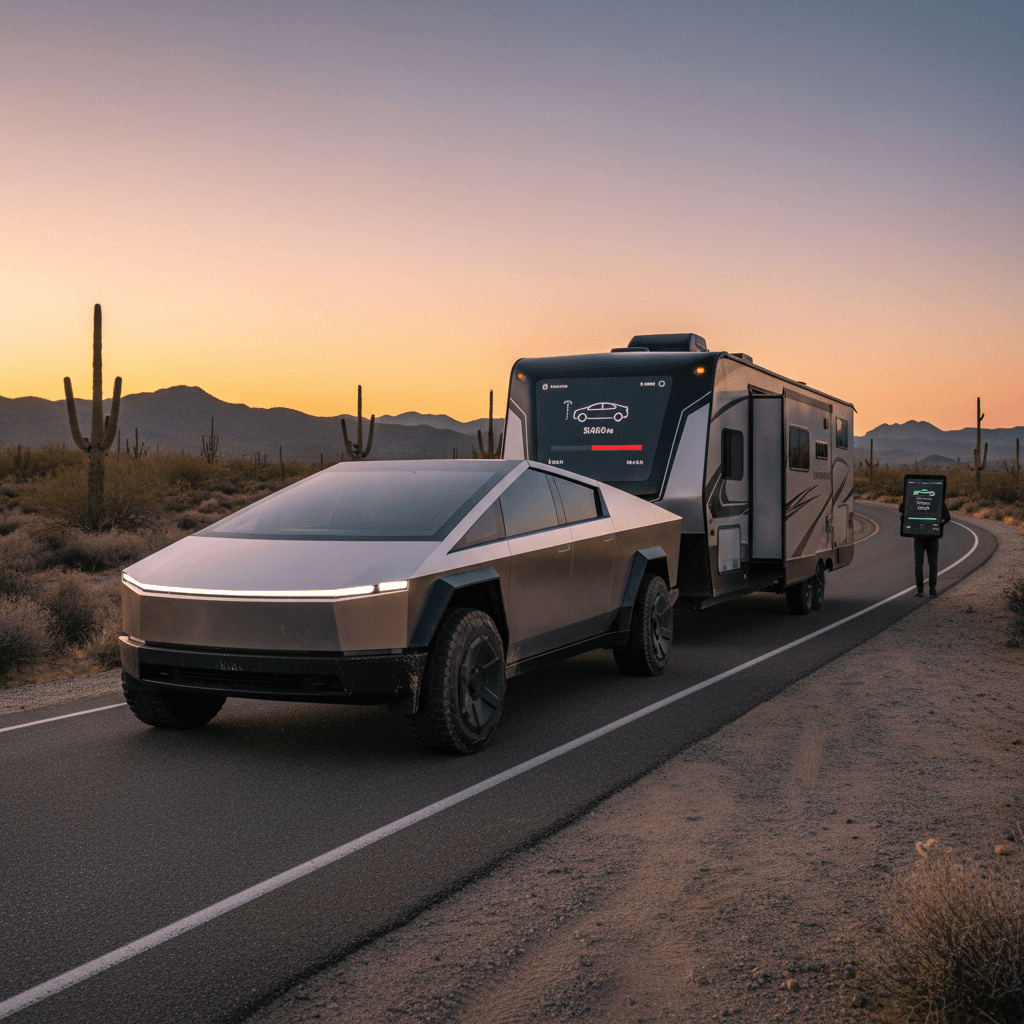
If you’re eyeing a Tesla Cybertruck as a work rig or tow vehicle, you’ve probably heard the headline number: **up to 11,000 pounds of towing capacity**. Impressive on paper, but what really matters is how much range you lose once there’s a trailer on the hitch. This guide breaks down Tesla Cybertruck towing capacity and range loss in plain language, using published specs and early real‑world testing so you can decide if it fits your jobs, toys, and trips.
TL;DR: What most owners see
Tesla Cybertruck towing overview: Specs vs reality
Tesla’s marketing for the Cybertruck focuses on three big promises: **up to 11,000 lb towing**, around **2,500 lb payload**, and **pickup‑like utility** with EV performance. Those numbers are real, but, as with every truck, gas or electric, they only tell part of the story. Once you hitch up a trailer, your practical maximum tow weight and your real‑world range both shrink, sometimes dramatically.
Key Cybertruck towing and range stats
If that sounds like a big hit, it is, but it’s also **not unique to the Cybertruck**. Every full‑size pickup, including gas and diesel, burns far more fuel when towing. The difference with an EV is that you feel the impact sooner, because your total energy “tank” is smaller than a 30‑gallon fuel tank and charging takes longer than a fuel stop.
Cybertruck tow ratings by trim and payload basics
As of early 2026, Tesla’s U.S. configurator focuses on **dual‑motor AWD** and **Cyberbeast** trims. Tow ratings have evolved a bit as Tesla tweaked configurations, but the core picture is straightforward:
Tesla Cybertruck tow and payload specs (current trims)
Approximate current U.S. ratings for main Cybertruck trims. Always confirm on the door jamb label and in the owner’s manual for your specific truck.
| Trim | Drivetrain | Max tow rating | Approx. payload rating | Notes |
|---|---|---|---|---|
| Dual‑Motor AWD | All‑wheel drive | 11,000 lb | ~2,500 lb | Core Cybertruck work truck spec; most common configuration |
| Cyberbeast | Tri‑motor AWD | 11,000 lb | ~2,500 lb | Higher performance; similar tow rating but more power on tap |
Tow ratings are maximums under ideal conditions with proper equipment and loading.
Tow rating isn’t the whole story
Before you fixate on the tow rating, get comfortable with two other specs Tesla publishes for the Cybertruck:
- Payload capacity: The total weight of passengers, cargo in the cab and bed, and tongue weight from the trailer pushing down on the hitch. Cybertruck’s payload is around 2,500 lb on current trims.
- Tongue weight limit: Roughly 10% of max tow rating, around 1,100 lb in Tesla’s documentation. That means an 8,000‑lb travel trailer could easily push 800–1,000 lb of tongue weight with gear and water on board.
Quick payload reality check
Why EVs (and Cybertruck) lose so much range when towing
Cybertruck’s battery pack is big, on the order of 120+ kWh, but physics doesn’t care whether your truck burns gasoline or electrons. When you tow, three main forces gang up on your range:
Three main culprits behind Cybertruck towing range loss
Understanding these will help you predict and manage range on tow days.
Aerodynamic drag
Rolling resistance & weight
Weather & climate
That’s why you can see wildly different range outcomes towing the **same weight**. A low, aero‑friendly car hauler at 55 mph might cost you 35–45% of your range, while a tall travel trailer at 75 mph in a headwind might cost 60–70% or more.
Real-world Cybertruck towing range: What tests show
Early independent tests and owner reports are starting to build a clear picture of how Cybertruck behaves under load. Numbers vary by route, temperature, and speed, but a few consistent patterns have emerged.
Snapshot of early Cybertruck towing tests
Approximate results from well‑documented public tests. These are directional, not guarantees.
| Scenario | Approx. trailer weight | Conditions | Observed range vs solo |
|---|---|---|---|
| Enclosed car hauler with EV onboard | ~6,000 lb | Mixed highway, moderate temps | Around 160 miles usable vs low‑ to mid‑200s solo (≈35–40% loss) |
| Max‑weight equipment/vehicle trailer near 11,000 lb | ~10,000–11,000 lb | Highway, Tow mode, conservative speeds | Range cut roughly in half or a bit more (≈50–60% loss) |
| Medium camper trailer weekend trip | ~4,000–5,000 lb | Hilly terrain, 60–70 mph | Often 50–65% loss, depending heavily on speed and wind |
Assumes dual‑motor or Cyberbeast trims on 20" wheels in Tow mode.
What this looks like in miles
Remember, **EPA ratings are done without trailers, at controlled speeds and temperatures**. Add a big sail behind the truck and drive into a headwind, and you’ll burn through energy much faster, just like you would in a gas truck, only now the energy “tank” refills more slowly.
How much range you lose by trailer type and weight
You won’t know your exact towing range until you’ve run your route a few times, but you can get comfortably close with some rules of thumb. Below is a practical grid of what many EV truck owners, including early Cybertruck drivers, are seeing with similar setups.
Typical Cybertruck range loss by trailer type
Assumes highway speeds (60–70 mph), mild weather, and a healthy battery.
Low, aero‑friendlier trailers
- Weight: 4,000–7,000 lb
- Typical range loss: ~35–50%
- Usable range: ~150–200 mi from a ~300‑mi rated truck
Tall travel trailers & toy haulers
- Weight: 4,500–8,000 lb
- Typical range loss: ~50–65%
- Usable range: ~110–160 mi
Boats and specialty loads
- Weight: 3,500–9,000 lb
- Typical range loss: ~45–65%
- Usable range: highly variable with aero and hills
Don’t plan down to the last mile
Speed hurts more than weight
With EV towing, drivers are often surprised that slowing down 5–10 mph can have a bigger impact on range than dropping a few hundred pounds. Air drag goes up roughly with the square of speed, so going from 65 to 75 mph can easily push you out of your comfort zone, especially with a tall trailer.
Shape matters as much as mass
A 5,000‑lb car on a low hauler may be easier on your battery than a 4,000‑lb toy hauler with a flat front wall. When in doubt, assume a **tall, blunt trailer acts like a heavier one** from the battery’s point of view.
How to plan trips with a Cybertruck when you tow
Once you accept that towing will slash your range, the name of the game becomes **trip planning and charging strategy**. Here’s how to make Cybertruck towing work for road trips, track days, and light commercial use.
Practical trip‑planning steps for Cybertruck towing
1. Start with a conservative range estimate
If your unloaded highway range is ~250 miles, plan your first towing leg around **110–130 miles** with a mid‑size trailer. Adjust based on what you see on the energy graph and your state of charge on arrival.
2. Use Tesla navigation in Tow mode
Enable Tow mode and set your route to favor Superchargers right off the highway. Cybertruck’s trip planner will factor in elevation and temps, but you still want manual margin for wind and weather.
3. Prioritize chargers with trailer access
Look for Supercharger layouts that allow you to **pull through with a trailer** or easily drop it in a safe corner. On some sites you’ll need to briefly unhook to avoid blocking stalls, build that time into your plan.
4. Charge more often, not to 100%
EVs charge fastest from low to mid state of charge. Stopping every 90–130 miles to charge from, say, 15–65% is often faster overall than trying to push one long leg and trickle‑charge to 95%.
5. Watch elevation gain on map apps
Big climbs can crush efficiency, especially when towing near the upper end of Cybertruck’s rating. Plan extra buffer for mountain passes and consider slower speeds on long grades.
6. Have a no‑ego backup plan
Especially on a first long tow, pick a fallback charger 30–40 miles earlier than you think you need. If consumption spikes due to wind or weather, you’ll be glad you had a backup stop ready.
Good use cases for Cybertruck towing
Range Extender, charging strategy, and turnaround time
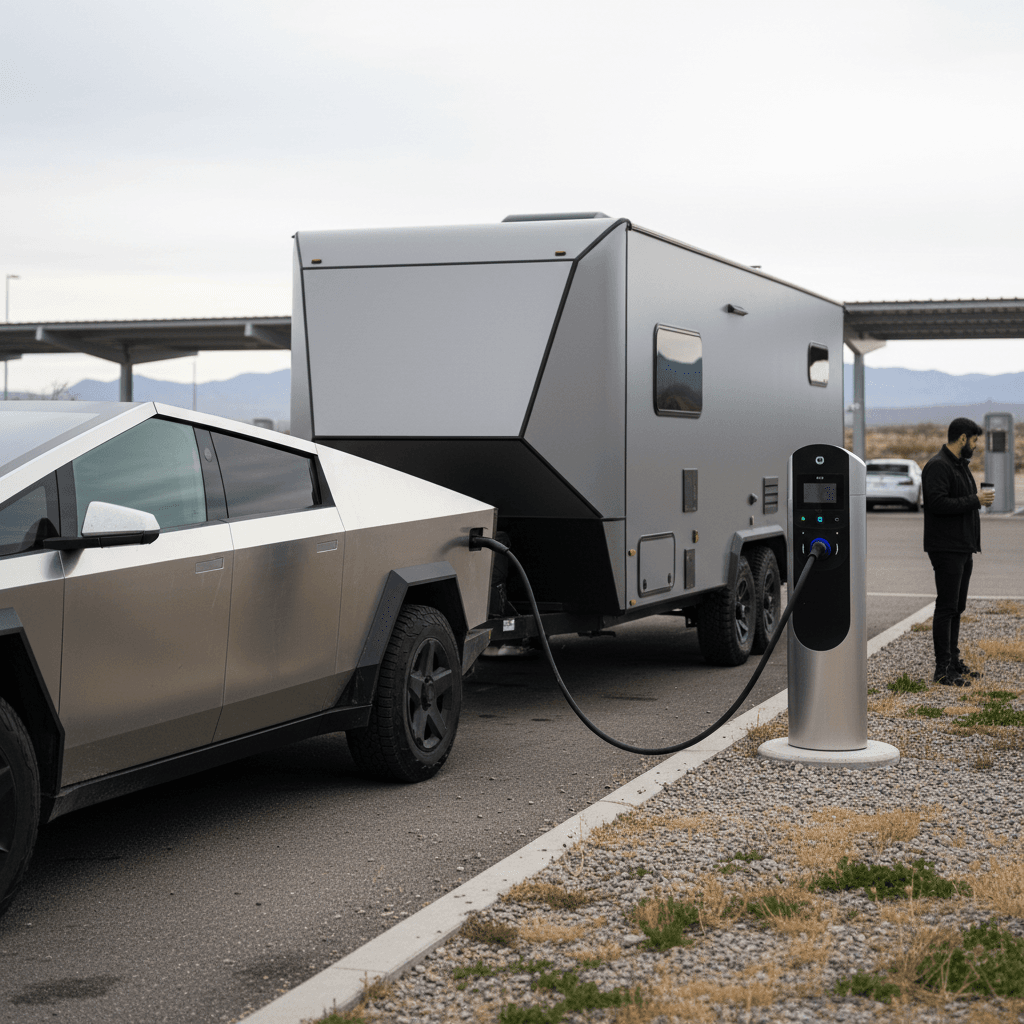
Tesla has floated a **Range Extender pack** for Cybertruck, an auxiliary battery module that sits in the bed and adds roughly 120–130 miles of extra rated range. It’s aimed squarely at towing and long‑distance travel, though it eats into bed space and payload. Availability and pricing have shifted over time, so think of it as an optional tool rather than the core towing solution.
Managing towing downtime: what matters most
Three levers you can pull besides just “bigger battery.”
Charge where you stop anyway
Target fast SOC windows
Know your home base options
Home charging pays off for work trucks
Towing safety, tongue weight, and setup tips
Range matters, but so does **stability and safety**. Cybertruck’s steer‑by‑wire, rear‑steer, and adaptive air suspension help, but they don’t change the fundamentals of trailer dynamics. A few setup mistakes will cost you range and can turn a stable rig into a white‑knuckle drive.
- Set the hitch height correctly. A trailer that’s nose‑high or nose‑low increases sway and drag. Use Cybertruck’s adjustable suspension and the right drop hitch to keep the trailer level.
- Mind tongue weight. Too little tongue weight invites sway; too much overloads the rear axle and suspension. Aim for **10–15% of total trailer weight** on the hitch, staying under Cybertruck’s tongue‑weight rating.
- Use trailer brakes and brake controller correctly. Heavy trailers should have functional electric brakes correctly dialed in. Without them, stopping distances grow and energy usage spikes.
- Secure cargo to avoid shifting loads. A load that moves under braking or in crosswinds can change tongue weight on the fly and hurt stability and efficiency.
- Practice before the big trip. Take a shorter shakedown run, note your Wh/mi consumption, and adjust your expectations and route based on hard data from your truck.
Respect the limits printed on your truck
Is the Cybertruck right for your towing needs?
Where Cybertruck shines as a tow rig
- Weekend warriors: Boats, side‑by‑sides, small to mid‑size campers within ~150 miles each way.
- Enthusiasts: Track cars or toys on a low hauler for events within a state or two, especially with good Supercharger coverage.
- Light commercial use: Landscapers, trades, and small equipment hauling with routes that bring the truck back to the same depot nightly.
Where a Cybertruck may struggle
- Very long, remote routes: Towing through rural areas with sparse DC fast charging, especially in winter.
- Max‑weight commercial towing: Regularly running near 11,000 lb in hilly terrain where uptime is critical and fuel stops need to be 10 minutes, not 30.
- Oversized RV lifestyles: Full‑timers pulling tall, heavy fifth‑wheel‑class loads for 300+ mile daily legs.
If you’re primarily towing within a few hours of home and you value **quiet, instant torque and low running costs**, the Cybertruck can make a compelling tow platform, especially once you learn your real‑world consumption and build routes around fast chargers. If your towing life looks more like long‑haul commercial trucking, an EV pickup today will require bigger compromises.
Thinking about a used EV truck instead?
FAQ: Tesla Cybertruck towing capacity and range loss
Frequently asked questions about Cybertruck towing
Tesla’s Cybertruck delivers serious headline numbers for towing, but the deciding factor for most buyers isn’t whether it can pull 11,000 pounds, it’s whether the **real‑world range loss while towing** fits their routes, schedules, and expectations. If you mostly move boats, campers, or equipment within a couple of hours of home, and you’re willing to plan around Superchargers, the Cybertruck can be a highly capable, low‑maintenance tow rig. If your work or lifestyle depends on 300‑plus‑mile towing days with minimal downtime, today’s EV pickups, including Tesla’s, still demand meaningful compromises. Knowing your numbers up front is the difference between a truck that works for you and one that doesn’t, especially in the used market where battery health and range matter most.