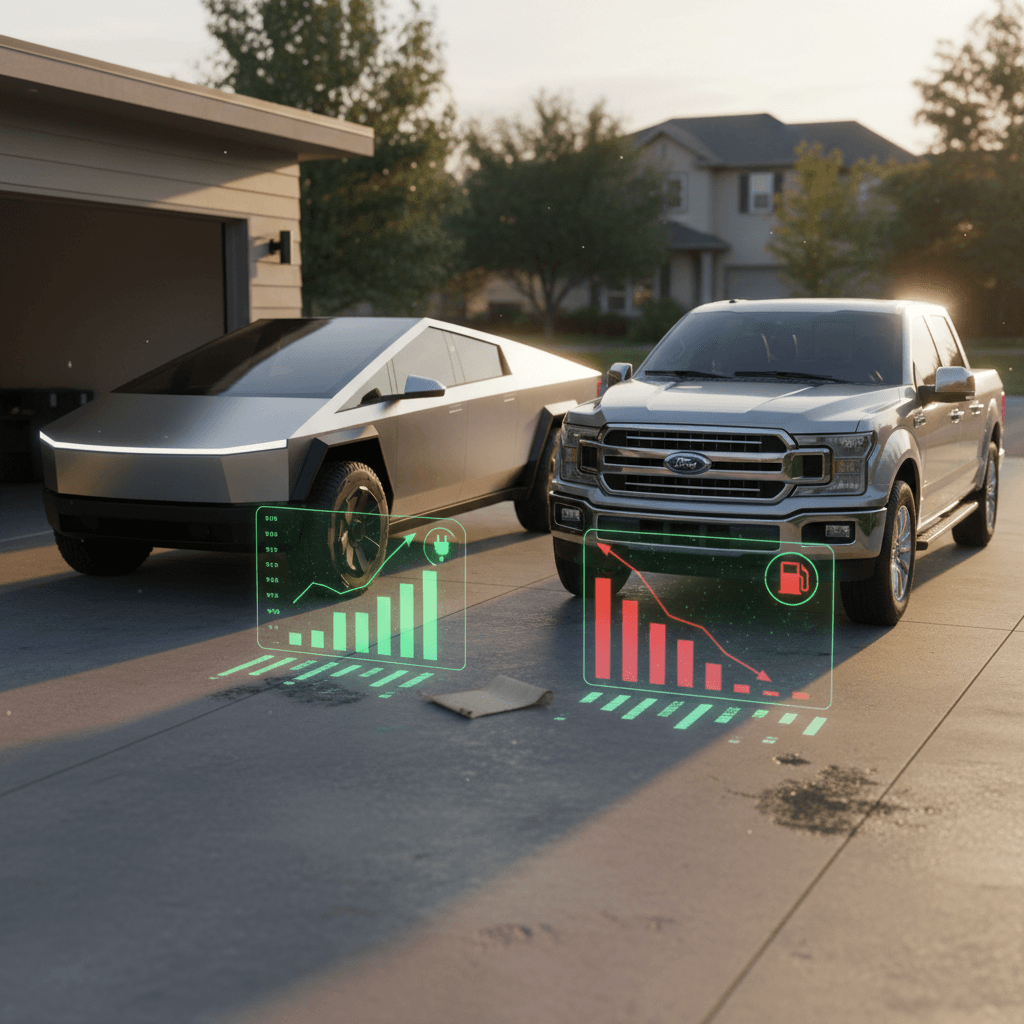
If you’re cross‑shopping a Tesla Cybertruck against a traditional gas pickup, the big question isn’t just sticker price. It’s the total cost of ownership: purchase, fuel or electricity, maintenance, insurance and what you’ll get back when you sell. This guide walks through a realistic 5‑year, 60,000‑mile comparison so you can see how a Cybertruck’s total cost stacks up against a comparable gas truck.
What this article covers
Why Cybertruck vs Gas Truck Total Cost Matters
Full‑size trucks are expensive to buy and thirsty to run. With the Cybertruck, Tesla is promising lower energy and maintenance costs but with a higher initial price and insurance. Over five years, those trade‑offs can add up to tens of thousands of dollars either way. Understanding where the money goes helps you pick the truck that fits your budget and how you actually use it, whether that’s daily commuting, job‑site hauling, or long‑distance towing.
Headline Numbers: Cybertruck vs Gas Truck (5 Years)
Estimates, not exact quotes
Key Assumptions Behind the Cost Comparison
To compare a Tesla Cybertruck and a gas truck fairly, you have to make some assumptions. Here’s the framework we’ll use so you can adjust for your own situation.
- Time horizon: 5 years of ownership.
- Mileage: 60,000 miles total (12,000 per year).
- Truck choice (EV): Tesla Cybertruck AWD with roughly 340 miles of EPA range and a large battery pack (~120+ kWh).
- Truck choice (gas): A comparably priced, well‑equipped 4x4 crew cab half‑ton such as a Ford F‑150, Chevy Silverado 1500 or Ram 1500 with a V6/V8 gasoline engine.
- Real‑world fuel economy (gas): 17 mpg combined. Many nicely optioned 4x4s end up in the mid‑teens in actual mixed driving.
- Real‑world efficiency (Cybertruck): around 43 kWh/100 miles (0.43 kWh/mile) in mixed driving without heavy towing.
- Average U.S. residential electricity rate: about $0.18 per kWh in 2025–2026; we’ll use $0.18 to keep the math simple.
- Average U.S. regular gasoline price over the next few years: we’ll model two cases – a conservative $3.50/gal and a higher $4.00/gal scenario.
- Charging mix: 80% home Level 2, 20% DC fast charging (Supercharging) at roughly double the per‑kWh cost of home charging.
Customize these numbers for you
Purchase Price, Financing and Incentives
Sticker price: Cybertruck vs gas truck
Exact pricing will vary with options and market conditions, but for a realistic comparison:
- Cybertruck AWD: commonly transacting in the high $70,000s to low $80,000s when new.
- Gas 4x4 full‑size pickup with similar equipment (crew cab, 4WD, premium package): often ends up in the $65,000–$75,000 range out the door.
So the Cybertruck usually starts with a $5,000–$10,000 higher purchase price than a comparable gas truck.
Financing and incentives
- Financing: If you’re financing 90% of the purchase over 72 months at today’s interest rates, that extra $5,000–$10,000 for the Cybertruck means a higher monthly payment, often $80–$160 more per month compared with the gas truck.
- Tax credits: Eligibility for federal and state EV incentives on a new Cybertruck depends on current IRS rules, your income, and where you live. Many shoppers find that the big federal credit either doesn’t apply or is partially reduced, so it’s risky to assume a full $7,500 benefit without checking.
- Gas trucks: Typically no EV‑style purchase incentives, though occasional rebates and dealer discounts can trim the price.
In short, expect the Cybertruck’s front‑end cost to be higher unless you qualify for strong EV incentives or negotiate an aggressive discount on the gas truck.
Electricity vs Gasoline: What You’ll Spend to Drive
This is where EV trucks like the Cybertruck can claw back a lot of that higher sticker price. Let’s walk through the math step by step with our 60,000‑mile, 5‑year scenario.
Energy Cost Comparison: Cybertruck vs Gas Pickup (60,000 Miles)
Using 43 kWh/100 mi for Cybertruck and 17 mpg for a gas truck. Electricity at $0.18/kWh (home) and gasoline at $3.50 and $4.00 per gallon.
| Scenario | Assumptions | Total Energy Used | Energy Cost per Unit | 5‑Year Energy Cost |
|---|---|---|---|---|
| Cybertruck – mostly home charging | 60,000 mi · 0.43 kWh/mi · 80% home, 20% fast charge | 25,800 kWh | Blended ≈$0.21/kWh (home + fast) | ≈$5,400 |
| Gas truck – $3.50/gal | 60,000 mi · 17 mpg | ≈3,530 gallons | $3.50/gal | ≈$12,350 |
| Gas truck – $4.00/gal | 60,000 mi · 17 mpg | ≈3,530 gallons | $4.00/gal | ≈$14,100 |
Actual numbers will vary by your local electricity and gas prices, but the pattern is consistent: Cybertruck energy is much cheaper per mile when you charge mostly at home.
Fuel savings snapshot
Fast charging isn’t free
Maintenance, Repairs and Tires
One of the big advantages of any EV is lower routine maintenance. The Cybertruck drops complex parts you’ll find in a gas truck, like engine oil systems, multi‑speed transmissions and exhaust components, but adds high‑voltage hardware and large, expensive tires.
Where Cybertruck Saves You Money on Maintenance
And where costs are similar to a gas pickup
No oil or engine service
Simple brakes, fewer wear parts
Tires: expensive either way
Real‑world 5‑year maintenance and repair costs for full‑size gas pickups routinely land in the $4,000–$5,000 range for owners who keep up with service. For a Cybertruck, you’re more likely in the $2,000–$3,000 range over the same period, assuming no major collision or out‑of‑warranty surprises.
Collision and body repairs
Insurance, Registration and Taxes
Insurance premiums
Early data suggests that insuring a new Cybertruck in North America typically costs more per year than insuring a traditional pickup of similar value. Reasons include:
- High replacement cost and cutting‑edge tech.
- Limited claims history for actuaries to work from.
- Specialized bodywork and parts.
If an equivalent gas truck runs, say, $1,700 per year to insure in your zip code, the Cybertruck might go $2,000–$2,200 per year with the same driver and coverage. Over five years, that’s often an extra $1,500–$2,500.
Registration and taxes
Registration fees and taxes are highly state‑specific. A few trends:
- Some states charge extra annual fees for EVs to replace gas tax revenue, which slightly erodes your energy‑cost advantage.
- Other states offer EV registration discounts or HOV perks that add non‑cash value.
- Because the Cybertruck’s purchase price is higher, any ad valorem (value‑based) taxes can also be a bit higher early on.
In most states, these differences are meaningful but small compared with fuel, insurance and depreciation. They rarely make or break the decision by themselves.
Depreciation and Resale Value
Depreciation, the value you lose over time, is the single biggest cost of owning almost any new vehicle, gas or electric. That’s especially true for high‑priced trucks.
- Historically, popular full‑size gas pickups (F‑150, Silverado, Ram 1500) hold value extremely well, often retaining 50–60% of their MSRP after 5 years in normal market conditions.
- Early estimates for the Tesla Cybertruck suggest strong resale as well, especially if demand stays high and production remains constrained.
- Because the Cybertruck starts out more expensive, a similar percentage drop can still mean more dollars of depreciation, but there’s also upside if the truck becomes highly sought‑after in the used market.
- Battery health plays a major role in used EV pricing. A Cybertruck with documented, healthy battery capacity can command a premium over one with unknown history.
How Recharged can help on resale
5‑Year Total Cost: Cybertruck vs Gas Truck Side by Side
Now let’s put it all together. These are simplified but realistic 5‑year ownership estimates for a new Cybertruck AWD vs a similarly capable gas 4x4 pickup at 60,000 miles. Numbers are rounded to keep the comparison clear.
Approximate 5‑Year Total Cost of Ownership (60,000 Miles)
Illustrative 5‑year comparison for a new Tesla Cybertruck AWD vs a comparable gas crew‑cab 4x4 pickup.
| Cost Component | Cybertruck AWD | Gas Pickup (4x4 Crew Cab) | Notes |
|---|---|---|---|
| Purchase price & depreciation | ≈$55,000–$60,000 lost value | ≈$48,000–$55,000 lost value | Cybertruck starts higher; both lose roughly half of MSRP in 5 years. |
| Energy / fuel (60,000 mi) | ≈$5,400 | ≈$12,350–$14,100 | Cybertruck saves ~$7,000–$9,000 in energy at typical U.S. prices. |
| Maintenance & repairs | ≈$2,500 | ≈$4,500 | Fewer routine services for Cybertruck; similar tire costs. |
| Insurance (5 years) | ≈$10,000–$11,000 | ≈$8,500–$9,000 | Cybertruck typically costs more to insure today. |
| Other fees (EV surcharges, etc.) | ≈$1,000 | ≈$500 | Highly state‑dependent; modest impact overall. |
| Estimated 5‑year total | ≈$88,000–$92,000 | ≈$93,000–$98,000 | In this scenario, the Cybertruck edges out the gas truck on 5‑year total cost. |
Totals include depreciation, financing impact baked into the purchase line, fuel/energy, insurance and maintenance. Taxes/fees are excluded or assumed similar.
Who wins on cost?
When a Cybertruck Will Likely Save You Money
Scenarios Where Cybertruck Is a Financial Win
Beyond the cool factor
You drive a lot every year
You can charge cheaply at home
You have high gas prices locally
You plan to keep it 7–10 years
When a Gas Truck Might Still Make Sense
Despite the Cybertruck’s advantages, there are plenty of buyers for whom a traditional gas pickup is still the better financial and practical fit, at least for now.
- Low annual mileage: If you’re only driving 6,000–8,000 miles a year, fuel costs represent a smaller slice of total ownership. In that case, paying more up front for an EV may take a long time to pay off.
- No home charging: Apartment living with no reliable overnight charging, or depending almost entirely on public DC fast charging, erodes the Cybertruck’s cost advantage and can even make it more expensive on a per‑mile basis.
- Very cheap local gas or high electricity rates: In regions with inexpensive gas but high cents‑per‑kWh, the math can favor gasoline power.
- Upfront budget constraints: If your priority is lowering the monthly payment more than lowering long‑term operating cost, a discounted gas pickup may fit your budget better today, even if it costs more over 5–10 years.
Don’t ignore resale and usage
How Buying Used (Including a Used Cybertruck) Changes the Math
Buying used often lowers your total cost dramatically because you avoid the steepest years of depreciation. That’s true for both gas trucks and EVs, but there are a few extra variables to consider with a used Cybertruck or any electric pickup.
Used Cybertruck vs used gas pickup
- Lower upfront price: A 3‑year‑old truck (EV or gas) could be 20–40% less than new, which immediately cuts your financing and depreciation hit.
- Fuel savings remain: A used Cybertruck still enjoys the same energy‑cost advantage over gas, as long as its battery remains healthy.
- Battery health matters: Unlike a gas truck, where miles and maintenance history tell most of the story, an EV’s usable battery capacity has a big impact on value and your daily experience.
Why a verified battery report is critical
When you consider a used Cybertruck, you want more than just a test drive and a Carfax. You want to know how much battery capacity the truck has retained and how it’s been charged and used.
Every EV sold on Recharged comes with a Recharged Score battery health report and fair‑market pricing baked in. That can give you confidence that you’re not inheriting a poorly treated pack, and it can save you thousands compared with guessing in a private‑party sale.

Quick Checklist: Cybertruck vs Gas Truck Decision
7 Questions to Answer Before You Decide
1. How many miles will you drive each year?
If you’re routinely over <strong>12,000–15,000 miles per year</strong>, the Cybertruck’s lower per‑mile energy cost becomes a major advantage. Lower mileage makes the decision tilt more toward purchase price and incentives.
2. Can you charge at home most nights?
A dedicated Level 2 charger at home, especially with off‑peak electric rates, is almost a requirement to make the most of a Cybertruck. If you can’t plug in regularly where you live or work, run the numbers very carefully.
3. What are your local electricity and gas prices?
Check a recent bill for your <strong>cents per kWh</strong> and note typical gas prices in your area. Re‑run the simple cost-per‑mile math using those numbers; small differences add up over tens of thousands of miles.
4. How long do you plan to keep the truck?
The longer your ownership horizon, the more years the Cybertruck’s <strong>fuel and maintenance savings</strong> can outweigh its higher sticker and insurance costs. Short‑term leases narrow those advantages.
5. How often will you tow or haul heavy loads?
Both gas and EV trucks use more energy under load. With a Cybertruck, heavy towing can significantly reduce range and push you toward more frequent fast‑charging, which is more expensive. Consider your real towing mix, not your once‑a‑year boat trip.
6. Is upfront monthly payment or long‑term cost more important?
If you simply need <strong>the lowest possible monthly payment</strong>, an aggressively discounted gas truck may win, even if it costs more over 5–10 years. If total cost and predictability matter more, the Cybertruck’s stable "fuel" pricing is a big plus.
7. Are you open to buying used?
A <strong>used Cybertruck or other used EV truck</strong> can offer a sweet spot: much lower purchase price plus ongoing fuel savings. That’s where platforms like <strong>Recharged</strong>, with verified battery health and nationwide delivery, can give you a clear edge.
FAQ: Cybertruck vs Gas Truck Costs
Frequently Asked Questions
Bottom Line: Is a Cybertruck Worth It vs a Gas Truck?
When you look beyond the wild styling and headlines, the Tesla Cybertruck is, at heart, a work truck with a very different cost profile than a traditional gas pickup. Up front, it’s usually more expensive to buy and insure, but it pays you back in the form of cheaper energy and lower maintenance. Over a 5‑year, 60,000‑mile window with mostly home charging, the Cybertruck can edge out a comparable gas truck on total cost, and if you drive more miles or pay high local gas prices, its advantage only grows.
On the other hand, if you drive relatively few miles, lack home charging, or live where electricity is pricey and gas is cheap, the numbers can tilt back toward gasoline. That’s why it’s so important to run the math based on your real life, not national averages.
If you’re leaning toward an electric truck but want to avoid first‑owner depreciation, consider a used EV truck, Cybertruck or otherwise, with verified battery health. That’s exactly the problem Recharged was built to solve, with Recharged Score battery diagnostics, fair market pricing, EV‑savvy support and nationwide delivery. Whether you go Cybertruck or gas, an honest look at total cost will help you end up in the truck that fits both your lifestyle and your long‑term budget.